
Protective Packaging That Blocks Light, Air and Access: Glass Options Compared
Protective packaging is no longer just about cushioning shipments. For brands selling oils, concentrates, edibles, topicals and supplements, the package itself must protect against light, oxygen, moisture and unsafe access. Glass is increasingly central to this strategy because it combines barrier properties with premium presentation. This article compares glass-based protective packaging approaches, explains what buyers should verify before ordering, and outlines where vacuum, violet/UV-blocking and child-resistant glass jars fit into a broader packaging system.
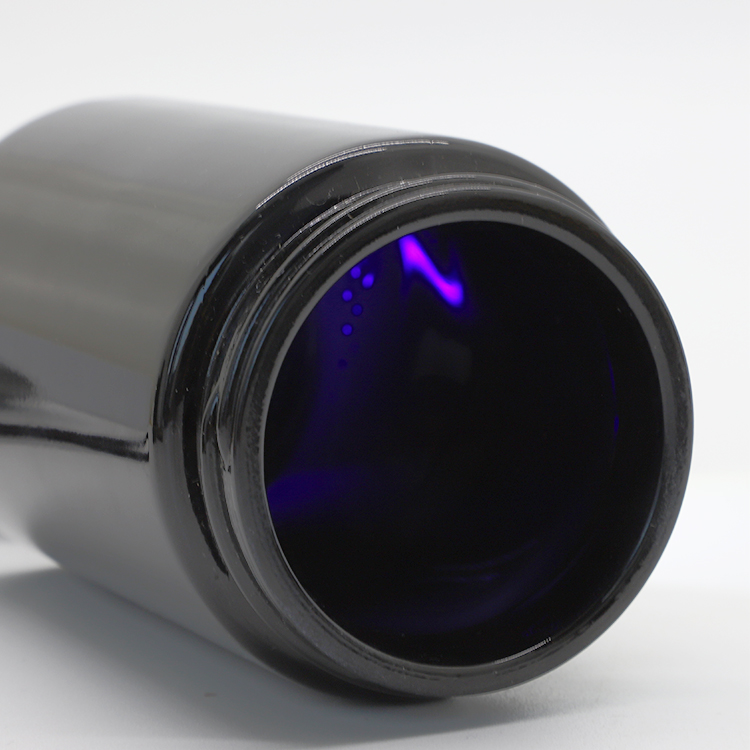
What protective packaging covers in glass formats
In the packaging industry, protective packaging traditionally refers to materials that shield products from damage during transit, handling and storage. For rigid glass containers, protection takes on a more specific meaning: the package must guard the product from environmental factors such as UV radiation, oxygen, moisture and contamination, while also protecting people from the product when it is hazardous or sensitive.
Four protective functions are commonly combined in glass packaging:
- UV protection: violet or UV-black glass reduces light transmission that can degrade light-sensitive ingredients.
- Airtight and leak-free sealing: vacuum closures and precision threaded caps limit oxygen ingress and leakage.
- Child resistance: closures that require coordinated adult actions, helping prevent access by young children.
- Smell-proof and waterproof performance: dense glass bodies and sealed closures contain aromas and resist moisture.
Each function addresses a different risk, but in practice brand owners often need them in combination.
The problem: single-function packaging creates hidden product risk
A premium skincare oil can lose potency in a clear glass bottle if it sits on a brightly lit shelf for several weeks. A cannabis concentrate can dry out or lose terpenes if the jar is not airtight. A supplement bottle with a standard cap may not meet child-resistance expectations for certain markets. Individually, these problems seem small, but they compound across a product lifecycle: filling, warehousing, retail display, home storage and repeated opening.
Many brands start with a design-first approach and only later ask whether the glass and closure can deliver the required protection. That sequence is risky because glass thickness, closure type, surface treatment and light-filtering properties are built into the container design before regulatory or stability testing begins.
Glass options for protective packaging: vacuum, UV-blocking and child-resistant
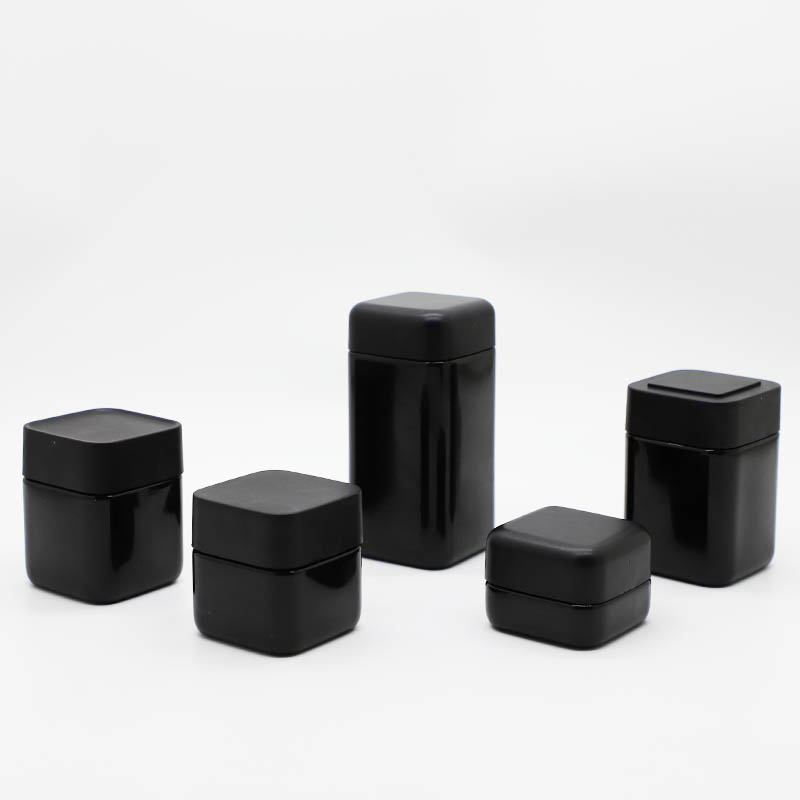
A practical way to evaluate protective glass packaging is by function. The table below summarizes the main glass jar formats and their protection profiles.
| Package type | Protection focus | Typical applications | Key specification points |
|---|---|---|---|
| Vacuum glass jar | Airtight seal, freshness, leak resistance | Food, cosmetics, medical | Square shape, 5ml capacity, 250 pcs/ctn |
| Violet / UV-blocking glass jar | Light filtration, UV protection, product stability | Essential oils, cosmetics, pharmaceuticals, cannabis, supplements | 0.38mm glass thickness; 5ml to 1L depending on model |
| Child-resistant glass jar | Restricted access, safety compliance, high-risk contents | Pharmaceutical, medical, cannabis, concentrates | CR cap; 5ml to 200ml+; square/round/triangle/hexagon |
| Refillable storage jar with CR cap | Durability, repeated use, child safety over lifecycle | Storage, refill systems, long-term brand packaging | Round, 0.38mm thick, 84g–268g net weight |
Vacuum packaging for airtight and leak-free protection
Vacuum glass jars remove or reduce air inside the container before sealing. This helps preserve freshness, limit oxidation and signal product integrity to the user. A vacuum seal is especially relevant for moisture-sensitive powders, creams and food products where repeated opening can accelerate degradation.
An example is the H19 Vacuum Click Jar: a square glass jar with 5ml capacity, packaged 250 pieces per carton, intended for food, cosmetic and medical applications. The vacuum function is a differentiator because it changes the user experience: the consumer hears or feels a click that confirms the seal is active, which reinforces both freshness and tamper awareness.
Violet and UV-blocking glass for light protection
Violet glass, sometimes called biophotonic glass, is a dark violet container that acts as a natural light filter. According to Miron Violetglass, violet glass blocks visible light while allowing a portion of UVA and infrared light to pass, which is reported to help preserve organic contents. Industry literature commonly cites 25%–45% UVA penetration and about 60% infrared penetration for violet glass formulations.
Although specific percentages should be verified with the material supplier for each production batch, the broader principle is well established: light-sensitive products benefit from packaging that reduces visible light transmission. Dark violet glass also offers a premium shelf presence, which matters for essential oils, high-end skincare and supplement lines.
From the Honorglass range, violet glass packaging is available in several formats:
- HDV1 wide mouth violet jars: 100ml to 1L, thread 41/400 and 89/400, caps in urea, PE, SAN or ABS. Suitable for food, cosmetics, pharmaceuticals, cannabis and supplements.
- HDV2 cosmetic violet jars: 3ml to 200ml, diameters from 36mm to 93.2mm, heights from 25.6mm to 55mm, net weight 36g to 205g. Suitable for pharmaceutical, medical, food storage and cosmetic packaging.
- HDV3 round violet essential oil bottles: 5ml to 100ml, heights from 54.5mm to 125mm, net weight 22.5g to 120g, closures including plastic cap, dropper, mist sprayer and lotion pump.
- H21 square and round violet glass jars: 15ml to 200ml, with child-resistant cap options.
These formats show that violet glass is not a single product category; it spans small dropper bottles, wide-mouth storage jars, and child-resistant closures.
Child-resistant packaging for access safety
Child-resistant packaging is designed to prevent children under five from opening a container, while remaining usable for adults. In the EU, child-resistant packaging must comply with ISO/EN 8317; in the US, the Consumer Product Safety Commission enforces 16 CFR 1700.20 under the Poison Prevention Packaging Act. These standards apply to products such as certain pharmaceuticals, cannabis products and household chemicals.
Child-resistant closures are not child-proof. They reduce risk but do not eliminate it. The term "resistant" is deliberate in regulations. Buyers should verify that the specific cap and container combination passes the required protocol test for their target market, because CR performance depends on the complete package, not just the cap.
Honor Packaging produces child-resistant glass jars across several series:
- H19 concentrate jars: 5ml and 9ml, in clear, white and black glass, with square, round, triangle and hexagon shapes. These are small-format jars for concentrates and high-potency products.
- H21 clear square jars: 15ml to 60dr, 58mm diameter, 24mm to 115mm height, 75g to 280g weight, with CR cap.
- H21 clear round jars: 30ml to 6oz, 60mm diameter, 36.5mm to 125mm height, 84g to 268g weight, with CR cap.
- H21 violet round jars: capacities from 30ml to 180ml, combining UV protection with child resistance.
The combination of CR cap with violet glass is particularly relevant for cannabis, pharmaceutical and botanical extract brands that need both safety compliance and light protection.
Combined protective systems: UV-blocking glass with child-resistant closure
Some products need more than one protective function. A CBD oil can be sensitive to both UV light and child access. A pharmaceutical cream may need an airtight seal and a CR cap. Combining functions in a single package reduces SKU complexity, simplifies filling and reduces packaging cost per unit compared with adding secondary boxes or overwraps.
An example is the H21 square violet glass jar with child-resistant cap, available from 15ml to 60dr capacities. It combines violet glass light filtering with a CR closure. Similarly, the HDV1 wide-mouth violet jar can be paired with CR caps in some configurations, bridging food, cosmetic, pharmaceutical and cannabis applications.
Market context: why protective packaging is expanding
The protective packaging market is large and growing. Fortune Business Insights valued the global protective packaging market at USD 44.02 billion in 2025, with projections to USD 80.25 billion by 2034. Grand View Research estimated USD 40.4 billion in 2025, noting that flexible packaging holds the largest revenue share at 66.4%. The difference between the two estimates reflects segmentation methods, but both point to sustained demand.
Within this market, e-commerce, pharmaceutical safety rules and higher consumer expectations for product freshness are common demand drivers. Paper and paperboard held a 45.7% revenue share in 2025 according to Grand View Research, which shows that the market is still dominated by lightweight, low-cost materials. Glass occupies a smaller but strategically important segment: it is chosen when barrier performance, premium feel, refillability or chemical compatibility matters more than weight and cost.
For glass packaging suppliers, the opportunity is not to compete with flexible packaging on price, but to serve products that genuinely require rigid protection: light-sensitive oils, volatile aromatics, potent concentrates, pharmaceutical liquids and high-value cosmetics.
How glass protective packaging compares with traditional flexible packaging
Traditional protective packaging for these product categories often uses flexible materials such as plastic pouches, blister foils or lined cartons. Flexible packaging is lightweight, low-cost and space-efficient, but it has limits:
- Light protection is limited unless opaque films or foil laminates are used.
- Reusability is low; most flexible formats are single-use.
- Premium perception is weaker for certain price segments.
- Chemical compatibility varies; some formulations require glass to avoid interaction with plastic.
Rigid glass jars address those limits. Glass provides an inert, impermeable barrier, a dense structure that resists odor transfer, and a reusable format that supports refill programs. However, glass has real trade-offs: higher shipping weight, greater breakage risk during transit, and higher unit cost. It is not a superior solution for every product; it is a better solution when content protection, consumer trust and lifecycle value justify the added cost and logistics complexity.
Because protective glass packaging is more demanding to produce than standard cosmetic jars, buyers should evaluate suppliers on manufacturing capabilities, not just catalog photos.
What to verify before ordering protective glass packaging
For Awareness and Research stage buyers, the evaluation criteria below can help structure conversations with suppliers:
- Closure and container compatibility: Ask whether the child-resistant or vacuum closure has been tested with the specific glass jar, not just with a similar glass finish.
- Light transmission data: For violet or UV-blocking glass, request the material's light transmission curve or UV-blocking test report for the specific production batch.
- Surface treatment compatibility: Silk-screen printing, hot stamping, heat transfer printing and frosted finishes can affect both aesthetics and closure performance. Confirm which treatments are available for the selected model.
- Regulatory documentation: For CR packaging, ask whether the supplier can support the documentation needed for ISO/EN 8317 or 16 CFR 1700.20 compliance, and be aware that final certification responsibility often sits with the brand or filler.
- Manufacturing responsibility: A supplier that controls tooling strategy, process validation and mass-production quality is more likely to deliver consistent glass thickness, consistent tolerances and reliable closure performance.
- Logistics and refill design: If the jar is intended to be refillable, check diameter, weight and cap durability across repeated use.
Case applications: where each protective glass format fits
Essential oils and aromatherapy
Essential oils are sensitive to light and oxidation. The HDV3 round violet glass essential oil bottle provides UV protection and is available in 5ml to 100ml sizes, with dropper, mist sprayer or lotion pump closures. For retail brands, violet glass communicates natural preservation. For private label and wholesale, the variety of neck finishes and closure options supports multiple product lines under one packaging family.
Cannabis concentrates and pharmaceuticals
These products often need child resistance and light protection. The H19 black concentrate jars combine dark glass with a CR cap in 5ml and 9ml sizes, in square, round, triangle and hexagon shapes. The H21 violet round jars go further, pairing violet glass with CR caps in 30ml to 180ml capacities for larger formats.
Food and supplements
The HDV1 wide-mouth violet jar, with capacities from 100ml to 1L, suits food storage, supplements and larger-quantity refills. The vacuum jar model H19 adds an airtight seal for smaller 5ml samples or single-dose formats, which is useful for premium food testers, cosmetic samples or medical applications.
Cosmetics and daily chemicals
The HDV2 cosmetic violet jar series, from 3ml to 200ml, gives beauty brands a consistent violet-glass identity across sample and full-size formats. The H21 clear square jars with CR caps provide a standard pharmaceutical-style option when a brand needs a familiar, trusted aesthetic.
Future outlook for protective glass packaging
Three trends are likely to shape the protective glass packaging segment:
- Multi-function containers become the default: buyers increasingly ask for one jar that filters light, resists leaks and restricts access, instead of buying a standard jar and fitting a special cap later.
- Validation moves earlier in the process: brand owners are asking for technical data, closure test results and dimensional reports before committing to tooling. This favors manufacturers with in-house engineering and process control.
- Refillable systems grow: violet glass jars with durable caps and wide mouths support refill models in cosmetics and supplements. Refillable formats are not yet dominant, but they align with sustainability objectives and give glass a lifecycle advantage over single-use flexible packaging.
For suppliers, the challenge will be to deliver protective functions without inflating cost beyond what the product segment can absorb. For buyers, the key will be to evaluate glass packaging as a system of glass, closure, surface treatment and process control, not as a list of SKUs.
Conclusion
Protective packaging in glass is best understood as a set of protective functions: UV blocking, airtight sealing, child resistance, leak resistance and moisture control. Vacuum jars, violet glass jars and child-resistant jars each address specific risks. When combined, they create a package that protects both the product and the consumer.
For brands in food, cosmetics, pharmaceuticals, cannabis and supplements, the practical question is not "glass or plastic?" but "which protective functions does this product need, and can the supplier prove the combination works?"
NINGBO HONOR PACKAGING CO.,LTD. is a packaging manufacturer established in 2015, headquartered in Ningbo, China, near Ningbo and Shanghai seaports. The company focuses on transforming finalized packaging designs into mass-producible products through long-term joint-venture production bases for plastic and glass packaging. It employs around 310 staff, operates a 45,000-square-meter facility, and has an annual production capacity of 1,000,000 units. Its R&D team includes 15 engineers and technicians. Export business accounts for 100% of sales, with major markets in the EU and USA.
For further reference, the company brochure is available for download: Honor Packaging company brochure.
FAQ
What is violet glass packaging?
Violet glass packaging is a glass container made from violet-colored glass, sometimes called biophotonic glass. It acts as a natural light filter, allowing partial UVA and infrared transmission while blocking most visible light. In the Honor Packaging range, violet glass is available in cosmetic jars (HDV2), essential oil bottles (HDV3), wide-mouth jars (HDV1) and square/round jar series (H21).
Is violet glass the same as child-resistant packaging?
No. Violet glass is a material option that provides light protection. Child-resistant packaging refers to closures that meet standards such as ISO/EN 8317 in the EU or 16 CFR 1700.20 in the US. Some Honor Packaging products combine violet glass with a child-resistant cap, such as the H21 square and round violet glass jars, but the two functions are independent.
Does Honor Packaging offer custom printing on protective glass jars?
Yes. Surface treatment options include sticker labeling, silk-screen printing, hot stamping, heat transfer printing and frosted finish, depending on the product model. For example, the H21 series lists these treatments as available options, and the HDV1/HDV2/HDV3 series also support multiple decoration methods.
What sizes of child-resistant glass jars are available?
The H19 concentrate jars are available in 5ml and 9ml. H21 clear square jars range from 15ml to 60dr. H21 clear round jars range from 30ml to 6oz (180ml). H21 violet round jars range from 30ml to 180ml. The H19 series also includes black, white and clear variants in square, round, triangle and hexagon shapes.
What is the difference between a vacuum jar and a regular airtight jar?
A vacuum jar is designed to create a vacuum seal inside the container, reducing air contact with the product. The H19 Vacuum Click Jar is a square glass jar with 5ml capacity and a vacuum seal feature. A regular airtight jar may have a tight-fitting cap but does not necessarily create negative pressure inside the container.
Is the glass thickness the same across all Honor Packaging protective jars?
Most listed glass jars in the H21, HDV1, HDV2 and HDV3 series have a glass thickness of 0.38mm. The H19 series does not specify thickness in the available product data. Buyers should confirm thickness for the specific model and capacity they intend to use.
How long has Honor Packaging been in business?
NINGBO HONOR PACKAGING CO.,LTD. was established in 2015 and has been operating for over nine years as of 2026. The company is based in Ningbo, China and focuses on manufacturing packaging products through long-term joint-venture production bases for plastic and glass packaging.
¿Tiene preguntas o necesita más detalles?
Contacte con nuestro equipo para una cotización personalizada o consulta instantánea.
Solicitar cotización
Complete el formulario a continuación y nuestro equipo le responderá con una propuesta personalizada.
Chat directo de WhatsApp
¿Prefiere chatear en tiempo real? Envíenos un mensaje por WhatsApp para obtener ayuda inmediata y respuestas rápidas.
- Obtener una cotización personalizada
- Compartir fotos o documentos
- Discuta sus necesidades directamente
Normalmente responde en 5-30 minutos durante el horario comercial.