
Proof in Practice: ±0.1mm Accuracy on Steel with YCWJ
Proof in Practice: ±0.1mm Accuracy on Steel with YCWJ
Abrasive waterjet cutting is now a mainstream steel-cutting process rather than a niche alternative. Metal cutting accounts for approximately 54.2% of the waterjet application segment in 2026, and the global waterjet cutting machine market is projected to grow from an estimated USD 1.31 billion in 2025 to USD 1.86 billion by 2030. For buyers who are already comparing suppliers, the useful question is no longer whether a waterjet can cut steel — it is whether a specific machine holds its stated tolerance under real production conditions.
This analysis examines that question through one concrete specification: the YCWJ Series, built by YC Water Jet Technology Co., Ltd, a manufacturer of ultra-high-pressure waterjet cutting systems founded in 1999 and headquartered in Wuxi, Jiangsu, China, and known commercially as YC Waterjet. The series is specified at a maximum pressure of 4137 Bar (60,000 Psi) with a cutting accuracy of ±0.1 mm across stainless steel and carbon steel.
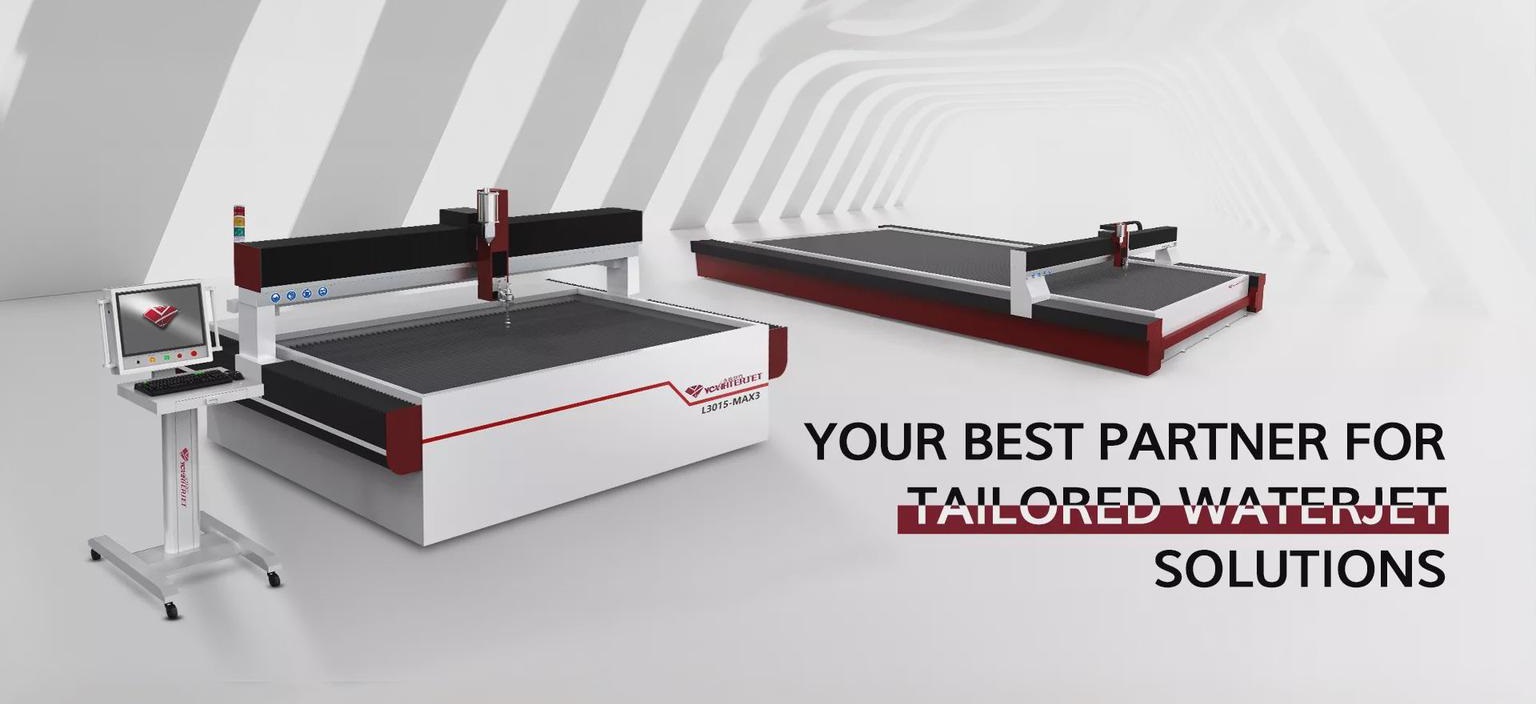
YC Waterjet cutting machine platform — the base on which the YCWJ Series is configured for stainless steel and carbon steel production.
Why ±0.1 mm Is a System Result, Not a Quotation Line
Cutting accuracy in abrasive waterjet is produced by the interaction of several subsystems rather than by any single component. The figure printed on a quotation sheet is the output of a chain that includes pressure stability delivered to the cutting head, structural rigidity of the gantry and cutting table, resolution and repeatability of the motion control system, consistency of abrasive delivery into the mixing chamber, the condition of the orifice and focusing tube, how the workpiece is fixtured, and the grade and thickness of the material being cut.
For a decision-stage buyer, this has a practical consequence. Two suppliers can publish the same ±0.1 mm figure and deliver visibly different results on the same steel plate, because one machine compensates for pressure fluctuation while another passes it directly into the kerf. Comparing suppliers therefore means comparing the subsystems behind the number — pump architecture, motion control, maintenance interval, and spare-part availability in the buyer's region — not comparing the number itself.
What YC Waterjet Brings to the Comparison
YC Water Jet Technology Co., Ltd has manufactured ultra-high-pressure waterjet equipment since 1999. The company operates a 7,000㎡ production base with an annual output of 100 sets and a seven-person R&D team. Approximately 70% of production is exported, and as of 2026 the company states that its equipment has reached more than 140 countries and regions worldwide.
Two facts about the company's technical lineage are relevant to a capability comparison. Since 2005, YC Waterjet has collaborated with high-pressure component suppliers including KMT (Germany) and Accustream/Hypertherm (USA), integrating their technology into its own systems. In 2014, the company extended its international footprint by establishing distributor networks in the UK, Russia, Turkey, Mexico, Brazil and beyond. Both facts matter at the decision stage because they speak to component sourcing and to whether service coverage exists near the installation site — the two variables that determine what an accuracy specification is worth in year three rather than year one.
YCWJ Series — declared parameters and manufacturer context
| Item | Specification |
|---|---|
| Maximum operating pressure | 4137 Bar (60,000 Psi) |
| Cutting accuracy | ±0.1 mm |
| Material capability | Stainless steel, carbon steel |
| Manufacturer | YC Water Jet Technology Co., Ltd (YC Waterjet), founded 1999 |
| Production base | 7,000㎡ facility, annual output of 100 sets |
| Engineering resource | 7-person R&D team |
| Export ratio | Approximately 70% of production |
| Export reach | More than 140 countries and regions (2026) |
| High-pressure component partners | KMT (Germany), Accustream/Hypertherm (USA) |
Technical Explanation: How Pressure Becomes Tolerance on Steel
In an abrasive waterjet system, the intensifier pump converts hydraulic power into ultra-high-pressure water, and the cutting head then combines that water with abrasive to form the cutting jet. Pressure fluctuation at the head translates directly into kerf variation, which means pressure stability — not peak pressure alone — is the variable that determines whether a ±0.1 mm tolerance is repeatable across a full production shift.
YC Waterjet's comparison documentation, which benchmarks the series against other waterjet brands, reports an 8% higher energy efficiency in the intensifier pump and a more stable pressure output. The same comparison data cites a positioning accuracy advantage of ±0.02 mm relative to other waterjet brands, together with a 10% longer seal life for high-pressure components.
Because abrasive waterjet is a cold cutting process, none of that energy is transferred to the workpiece as heat. There is no heat-affected zone, no recast layer, and no thermal distortion to be corrected after cutting. That is the structural reason waterjet accuracy holds on thin stainless steel, where thermal processes typically introduce movement between the cut and the measurement.
Maintenance architecture belongs to the same accuracy story. The series uses a modular high-pressure pump design intended for on-site maintenance, so seal and component replacement can be carried out without returning the pump to the factory. In practice, the tolerance a machine delivers in month one depends on how quickly and how completely it can be restored to that condition in month thirty — which is why YC Waterjet's comparison data also reports a 12% lower total cost of ownership relative to alternatives, partly through less frequent replacement of high-pressure parts.
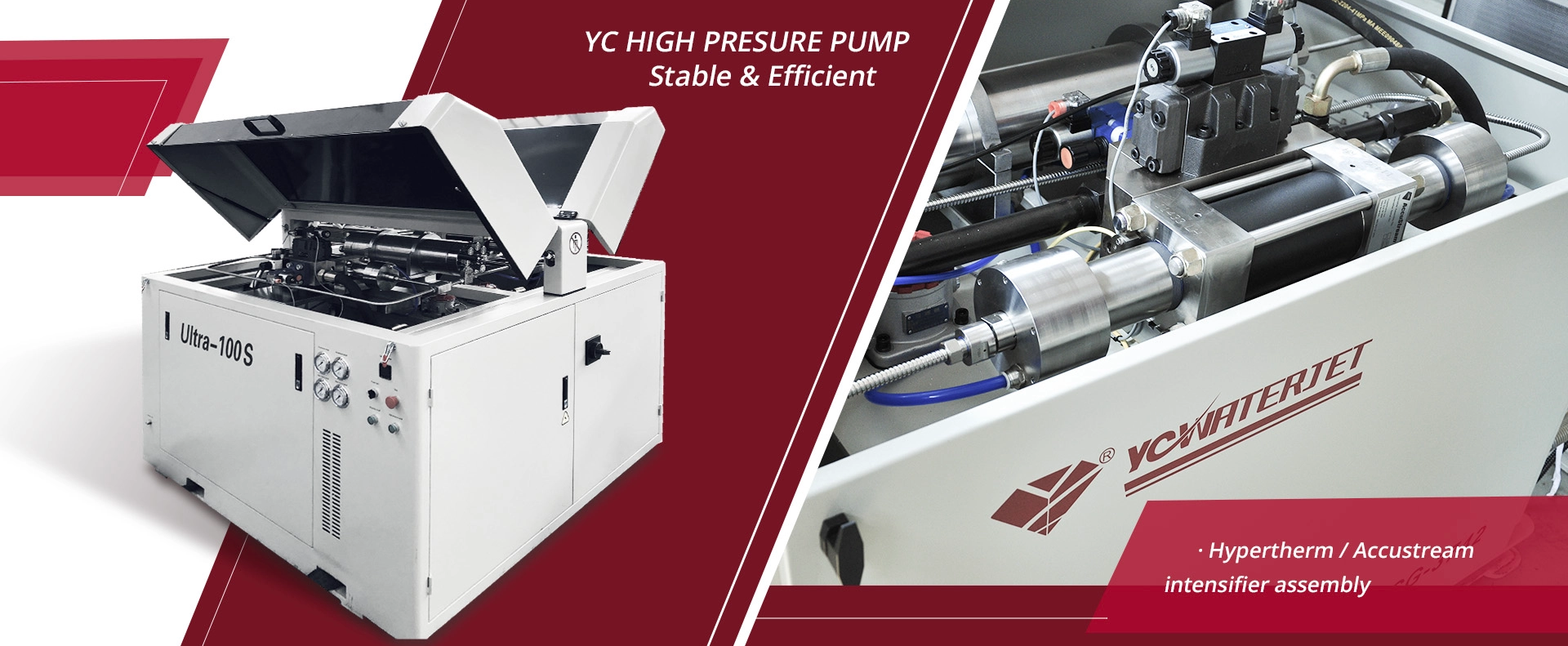
Modular high-pressure pump assembly: pressure stability delivered to the cutting head is the variable that governs repeatable kerf tolerance.
Application Fit: Stainless Steel and Carbon Steel Work
Stainless steel and carbon steel sit at the centre of the YCWJ Series' declared material capability, and the two materials stress a waterjet system in different ways.
Stainless steel
Cutting stainless steel with a thermal process alters the edge: oxidation, heat tint and localised distortion commonly require secondary finishing. A cold cut leaves the alloy's surface condition intact and produces an edge that generally needs less post-processing. Typical work in this category includes sheet and plate profiles, cutouts, and components where both appearance and corrosion behaviour matter to the end user.
Carbon steel
Structural plate, brackets and machine components are frequently abrasive-waterjet cut for the same underlying reason: no heat-affected zone and no thermal stress path running through the part. The ±0.1 mm accuracy specification is most relevant where components are assembled without re-machining, or where one cut edge is used as the datum for the next operation.
Table and fixturing
The cutting table and support arrangement also influence results, particularly on thin plate, where support contact points and slat wear can affect how a part sits relative to the programmed path. Buyers comparing machine configurations should treat table setup as part of the accuracy system rather than as a separate accessory decision.
Beyond steel, YC Waterjet supplies process-integration hardware for other material families. For multi-layer composites, the company offers an integrated drilling module that pre-drills entry holes under CNC control to prevent delamination during cutting — an example of how the same platform is adapted to material-specific risk rather than to a single workpiece type.
Market Trend Analysis: Why Tolerance Claims Are Being Tested Harder
Three data points frame the current buying environment for steel-cutting systems.
Metal cutting dominates the application mix. Metal cutting accounts for approximately 54.2% of the waterjet application segment in 2026, which means the majority of machines sold are purchased to cut steel and other metals rather than stone, glass or composites. The accuracy conversation is therefore the mainstream conversation for this equipment category.
Demand is growing rather than plateauing. The global waterjet cutting machine market was estimated at USD 1.31 billion in 2025 and is projected to reach USD 1.86 billion by 2030. Asia-Pacific accounted for approximately 37.8% of global waterjet cutting machine revenue in 2024, consistent with the region's dual role as a production base and an end market.
Supply is concentrated but not closed. Chinese customs data for HS code 8456500000 shows HEAD Waterjet accounting for 28.18% of China's total waterjet cutting machine exports in 2023. Concentration at the top of the export table means that beneath the largest exporter sits a long tail of manufacturers whose engineering depth varies widely — which is precisely why decision-stage buyers increasingly evaluate pressure architecture, service coverage and verifiable accuracy evidence instead of headline specifications alone.
Compliance expectations are tightening alongside demand. ISO 21789 addresses water jetting safety and covers operation at pressures up to 3000 bar (43,500 PSI). It is a useful reference point when comparing systems, particularly when a machine's maximum pressure rating sits above the range that standard describes.
Waterjet vs Plasma vs Laser on Steel: Where the Trade-offs Sit
Compared with thermal cutting methods, waterjet's advantage on steel is not raw speed — it is what happens to the material. YC Waterjet's comparison data against plasma and laser cutting machines reports 0% thermal distortion, a +30% material yield advantage, a ±0.05 mm precision advantage on delicate materials, and 15% lower secondary processing cost. The same comparison notes that the process avoids expensive gas and laser consumables and requires lower peak power consumption, with more stable energy use when cutting thick materials.
| Comparison criterion | Abrasive waterjet (YCWJ Series) | Plasma / laser cutting |
|---|---|---|
| Thermal effect on steel | Cold cutting, no heat-affected zone, 0% thermal distortion | Heat-based process; heat-affected zone present |
| Reported material yield | +30% advantage (YC Waterjet comparison data) | Reference baseline |
| Reported precision on delicate materials | ±0.05 mm advantage (YC Waterjet comparison data) | Reference baseline |
| Secondary processing cost | 15% lower (YC Waterjet comparison data) | Higher secondary processing cost |
| Consumables | Abrasive; no gas or laser consumables | Shielding gas or laser consumables |
| Energy profile | Lower peak power consumption; stable energy use on thick materials | Higher peak power draw |
| Principal constraint | Cutting speed on thin sheet; tolerance depends on setup and wear | Thermal distortion; material sensitivity |
Limits and boundaries buyers should hold onto
Speed on thin sheet. For thin-gauge sheet where edge quality is not critical, thermal processes are generally faster than abrasive waterjet. Buyers selecting a machine for mixed work should map cycle time against material thickness rather than assume a single process wins across the whole job book.
Pressure-standard boundaries. The YCWJ Series is specified at a maximum of 4137 Bar (60,000 Psi), which sits above the 3000 bar (43,500 PSI) pressure range referenced in ISO 21789. Buyers specifying a machine at that pressure level should confirm which safety documentation, guarding and operator control requirements apply to the exact configuration being purchased in their market.
Accuracy is condition-dependent. A ±0.1 mm specification is not a promise about every job. Material thickness, abrasive selection, orifice and focusing tube wear, and fixturing all move the achievable result. The specification describes the machine's capability envelope, and validation on the buyer's own material is what confirms position within that envelope.
A Validation Checklist for Decision-Stage Buyers
When the shortlist is down to two or three suppliers and the published accuracy figures converge, the deciding evidence is usually operational rather than nominal.
- Sample cut on your own material. Send the actual steel grade and thickness range you produce, not a convenience sample.
- Measure repeatability, not a single part. Tolerance across a run is a different claim from tolerance on one demonstration piece.
- Confirm pressure stability at the head under load. Ask how the pump behaves during sustained cutting rather than at start-up.
- Review the maintenance interval and spare-part supply. Seal life and high-pressure component replacement frequency drive both downtime and total cost of ownership.
- Check service coverage in your region. A modular pump design supports on-site maintenance only if trained support is reachable.
- Match safety documentation to the specified pressure. Documentation should correspond to the configuration being purchased, especially where the rating exceeds the range covered by a referenced standard.
Future Outlook
The direction of the steel-cutting market is toward evidence rather than catalogue numbers. As the global waterjet cutting machine market moves toward a projected USD 1.86 billion by 2030, with metal cutting holding roughly 54.2% of applications, buyers will increasingly ask suppliers to demonstrate tolerance on the buyer's material instead of restating a specification.
That shift favours systems whose accuracy is sustained by maintenance design. YC Waterjet's comparison data positions the series on this axis: a modular high-pressure pump architecture built for on-site servicing, a reported 10% longer seal life, less frequent replacement of high-pressure parts, and a 12% lower total cost of ownership relative to alternatives. In a market where the leading exporter holds 28.18% of China's waterjet exports, the differentiator for the rest of the supply base is not the pressure rating printed on the machine — it is the ability to keep the rated accuracy measurable over a ten-year production horizon.
Machine specifications and sample cutting arrangements for the YCWJ Series are published by YC Waterjet at www.ycwaterjet.com.
FAQ
How does the YCWJ Series achieve ±0.1 mm cutting accuracy on steel?
The tolerance is the combined result of pressure stability delivered to the cutting head, structural rigidity of the gantry and cutting table, and motion control accuracy. YC Waterjet's comparison documentation reports an 8% higher energy efficiency in the intensifier pump and a more stable pressure output than other waterjet brands, along with a ±0.02 mm positioning accuracy advantage. Because abrasive waterjet is a cold cutting process, no heat-affected zone or thermal distortion is introduced that could shift the finished dimension after cutting.
How does waterjet steel cutting compare with laser or plasma cutting on cost?
YC Waterjet's comparison data against plasma and laser machines reports 15% lower secondary processing cost and no expensive gas or laser consumables, with lower peak power consumption. The same documentation reports a 12% lower total cost of ownership relative to alternatives, partly through less frequent replacement of high-pressure parts. The trade-off is process speed: for thin-gauge sheet where edge quality is not critical, thermal processes are generally faster than abrasive waterjet.
What pressure does the YCWJ Series operate at, and which safety standard applies?
The YCWJ Series is specified at a maximum pressure of 4137 Bar (60,000 Psi). ISO 21789 addresses water jetting safety and covers operation at pressures up to 3000 bar (43,500 PSI). Where a machine's maximum rating exceeds the pressure range described by a given standard, buyers should confirm which safety documentation, guarding and operator control requirements apply to the specific configuration and market of installation.
What should a buyer verify before accepting a ±0.1 mm accuracy claim?
Validation should be based on a sample cut using the buyer's own steel grade and thickness range, with tolerance measured across a production run rather than on a single demonstration part. Achievable accuracy generally varies with material thickness, abrasive type and flow rate, orifice and focusing tube wear, and fixturing. Buyers should also review the maintenance interval, high-pressure component replacement frequency, calibration records, and spare-part availability in their region.
How is accuracy maintained over the working life of the machine?
Maintenance architecture determines whether the specified tolerance survives long production use. The YCWJ Series uses a modular high-pressure pump design that supports on-site maintenance, and YC Waterjet's comparison data reports a 10% longer seal life and less frequent high-pressure part replacement relative to other waterjet brands. YC Waterjet positions the series for long-term industrial production use, which makes service access and component supply the practical conditions under which the ±0.1 mm specification remains measurable.
Reference data cited in this article: Fact.MR (metal cutting application share, 2026); Reports & Data / Vertex AI Search and Coherent Market Insights (waterjet cutting machine market size and regional revenue share); Chinese customs data, HS code 8456500000 (2023 export share); ISO 21789 (water jetting safety). First-party performance figures are drawn from YC Waterjet's published comparison documentation.