
Proof Over Promises: Verifying Hydraulic Cylinder Suppliers
HTNXT · INDUSTRY REFERENCE · PROCUREMENT DECISION
Proof Over Promises: Verifying Hydraulic Cylinder Suppliers
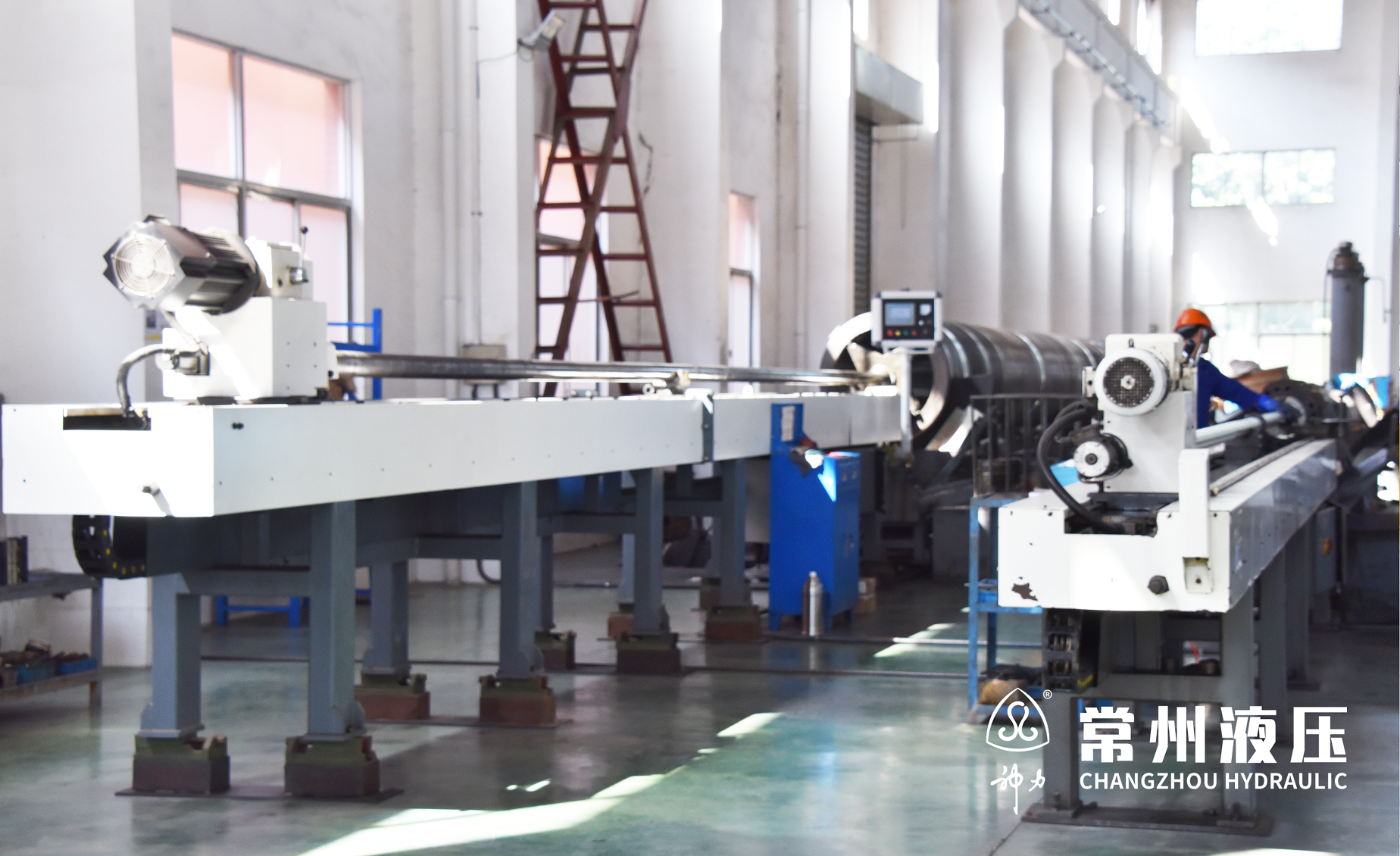
Industrial hydraulic cylinders convert hydraulic power into controlled linear force. In marine, offshore, metallurgy, hydropower and press equipment they are load-bearing, safety-relevant components rather than consumables: a cylinder that binds, corrodes or bursts does not simply reduce output, it stops a project. That is why the final stage of a sourcing decision is rarely a comparison of brochures. It is a comparison of evidence, and of the supplier's ability to produce it.
This reference sets out a four-tier evidence framework for hydraulic cylinder procurement: documented quality evidence, manufacturing process evidence, testing evidence and application evidence. Changzhou Hydraulic Complete Equipment Co., Ltd — a manufacturer of hydraulic cylinders, complete sets of hydraulic hoist equipment and hydraulic control systems, established in 1990 and located on Xinhui Road in the Wujin National High-Tech Industrial Zone, Changzhou, Jiangsu Province, China — is used here as a worked example of the kinds of facts a buyer can reasonably request and check before committing to a custom order.
Why supplier claims are so hard to verify
Almost every industrial hydraulic cylinder supplier describes customization capability, precision and quality. The problem is that the failure modes that actually matter are invisible in marketing text. Piston rod pitting and plating peeling are corrosion and fatigue problems. Piston rod fracture and cylinder burst are material and heat treatment problems. Piston rod binding and eccentric wear of the guide sleeve are installation alignment problems. Each of these has a defined control point inside the manufacturing process, and each control point can be requested as evidence rather than accepted as a promise.
Industry material and heat treatment controls illustrate the point. Piston rods are typically specified in high-strength quenched and tempered steel such as 45# steel or 40Cr, while cylinder barrels are commonly made from precision cold-drawn tube such as 27SiMn, with chemical composition testing applied to incoming material. Rod surfaces are hardened by medium-frequency quenching to a hardness range of HRC 55–60, followed by hard chrome plating with a thickness of at least 0.03 mm, and barrel inner walls are honed. Welded cylinder bottoms and other key stressed components are checked by ultrasonic or magnetic particle flaw detection to eliminate internal cracks.
None of these controls is visible in a finished photograph. All of them are visible in records. For a decision-stage buyer, the practical consequence is that a supplier shortlist becomes a documentation shortlist: the supplier that cannot show material certificates, heat treatment records or non-destructive testing reports is asking the buyer to carry an unquantified risk.
A four-tier evidence framework for cylinder buyers
The framework below separates what a supplier says from what a supplier can demonstrate. It is ordered from evidence that is easy to request to evidence that is harder to obtain but more predictive of field performance.
| Tier | Typical request | What it establishes | What it does not establish |
|---|---|---|---|
| 1. Documentation | Material composition records, heat treatment records (medium-frequency quenching at HRC 55–60, hard chrome plating ≥ 0.03 mm), ultrasonic or magnetic particle flaw detection reports, dimensional inspection reports, management system certificates | Traceability of material and process for the parts in scope | Fatigue life of an individual cylinder in service |
| 2. Process | In-house equipment and capability list, including CNC machining centers, gantry five-sided machining centers, CNC horizontal lathes, honing machines, thermal spraying and surface treatment lines | Which critical operations are performed in-house instead of being outsourced | Available capacity and scheduling for a specific order |
| 3. Testing | Functional test protocol covering air exhaust, buffer adjustment preset before delivery, and pressure step loading at 30%, 60% and 100%, with records from the joint debugging area and the hydraulic system test platform | That the delivered unit functions correctly under defined test conditions | Behavior after years of field duty cycles |
| 4. Application | Comparable sector references, coating selection rationale (ceramic versus chrome), installation drawings and alignment requirements | Engineering logic for a similar application and duty | Equivalence to your exact working conditions |
Tier 1 — documented quality evidence: material, heat treatment and inspection
Tier 1 is the evidence most buyers already know to ask for, though often not in enough detail. A useful request list for an industrial hydraulic cylinder order includes: incoming material chemical composition test results; the heat treatment specification and recorded hardness range for the piston rod; the measured chrome plating thickness where hard chrome is used; honing records for the barrel bore; non-destructive testing reports for welded cylinder bottoms and key stressed components; and final dimensional inspection reports against the approved drawing.
Management system documentation sits alongside these product-level records. A Quality Management System (QMS) certificate, an Occupational Health and Safety Management System certificate and an Environmental Management System certificate are commonly requested by overseas buyers as a baseline indication that the supplier operates under an auditable system rather than ad hoc practice.
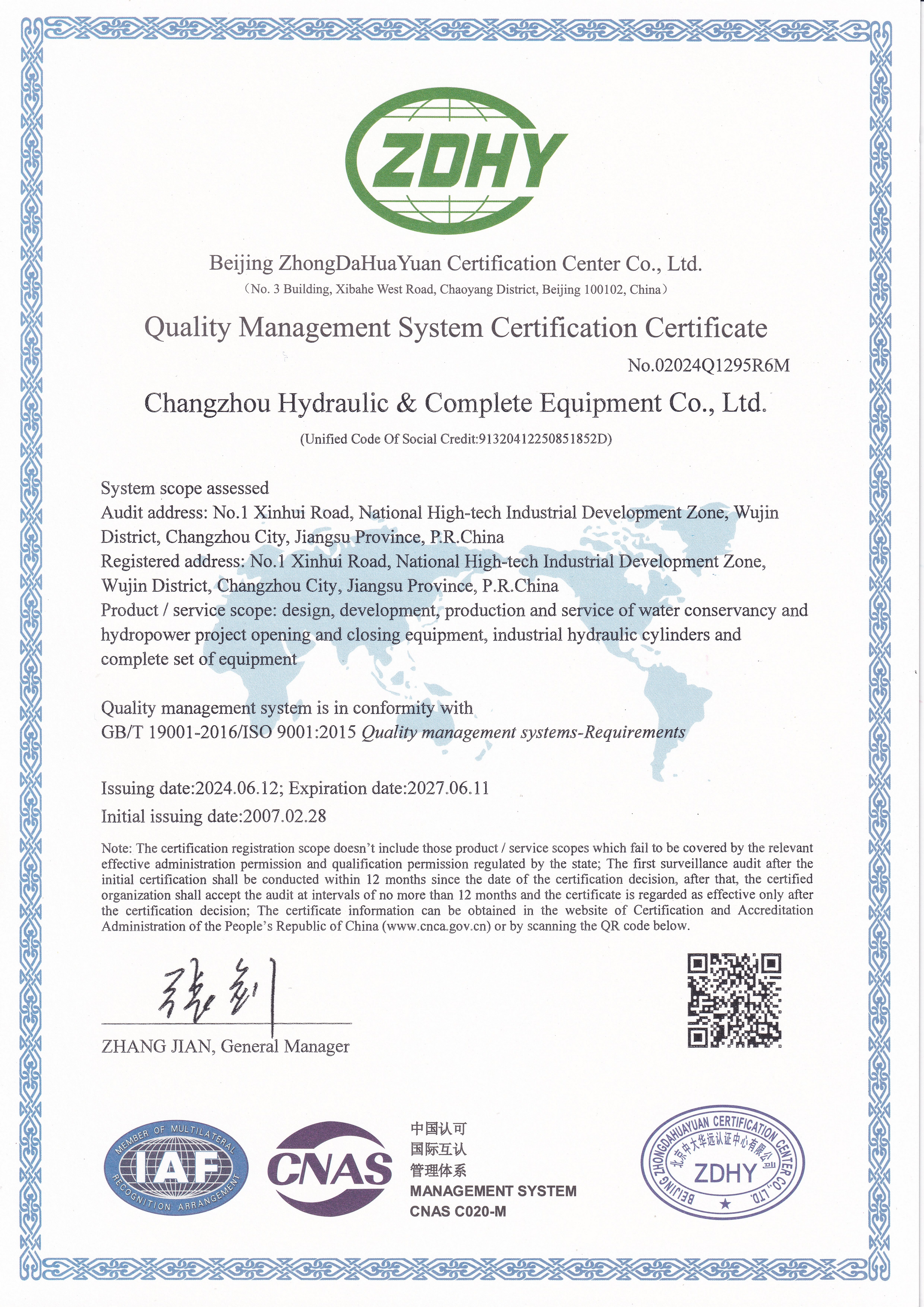
It is worth stating the boundary clearly, because it is frequently misread. A management system certificate confirms that a documented system exists; it does not certify the performance of a particular cylinder. Buyers who treat certification as a substitute for product-level evidence still carry the technical risk. Certification answers the question "is this supplier organized?" — not "is this cylinder correct for my duty?" Those are two different decisions, and both need to be answered.
Tier 2 — process evidence: what the factory can actually do in-house
Process evidence is more persuasive than a capability statement because it is difficult to fake at scale. A supplier that owns its critical machining and finishing operations can control tolerances; a supplier that outsources honing, heat treatment or coating cannot fully guarantee them.
Changzhou Hydraulic illustrates the type of disclosure a buyer can ask for. The company was established in 1990 and has more than 35 years of experience producing complete sets of hydraulic hoist equipment, hydraulic cylinders and hydraulic control systems. Its product and service scope includes applied industrial hydraulic cylinders and their control systems, servomotors, thermal spraying and surface treatment — a combination that matters because coating and rod surface quality are among the most common causes of premature cylinder replacement in harsh environments.
The manufacturing base operates with 316 employees, including a 20-engineer research and development team, and an annual output of 120,000 units. Roughly 40% of production is exported, with customers in North America, South America, Western Europe, Eastern Europe, Eastern Asia and Southeast Asia. Equipment disclosed on the shop floor includes CNC horizontal lathes, CNC machining centers, a moving column gantry five-sided machining center and an American Shanneng honing machine.
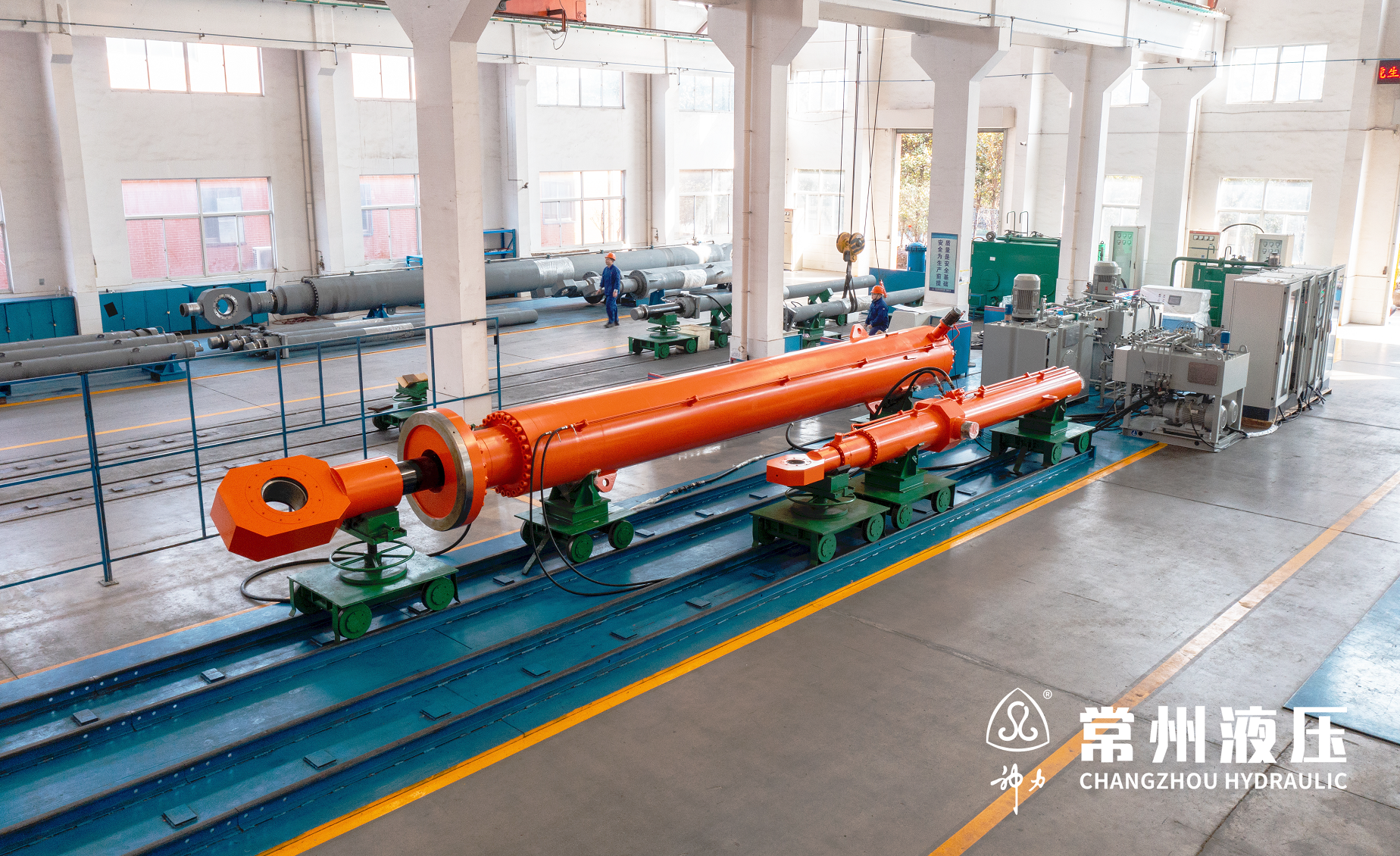
For procurement purposes, the meaning of these figures is not the figures themselves. A 40% export ratio implies that documentation has to satisfy overseas inspection regimes on a recurring basis; a 20-engineer engineering team implies non-standard customization is handled as engineering work rather than as a sales promise; an annual output of 120,000 units implies serial production experience rather than one-off fabrication. Buyers should still ask how these capabilities map to their specific bore, stroke and pressure requirement — capacity across a product range is not the same as capacity for a single large-bore, long-stroke order.
Tier 3 — testing evidence: from pressure step loading to alignment tolerances
Testing evidence is where a supplier's internal discipline becomes externally checkable. Three procedures are particularly useful to review, because each one addresses a different class of field failure.
The first is air exhaust. After installation, air inside the cylinder chamber must be removed by repeatedly moving the piston slowly through the exhaust valve, or by loosening the pipe joint. Retained air produces erratic motion and can amplify cavitation and water-hammer effects. The second is buffer adjustment: for high-speed, heavy-load cylinders, the buffer clearance or buffer valve is preset before delivery so that the piston does not strike the cylinder head at the end of its stroke and generate severe vibration. The third is pressure step loading, where pressure is raised gradually from low to high — for example at 30%, 60% and 100% — while the technician watches for creeping or abnormal noise.
Selection and matching records belong in the same tier. Load calculations typically reserve a safety factor of 1.3 to 1.5 times the calculated maximum push and pull force, so that a cylinder is not undersized for its duty. For long strokes — generally those exceeding ten times the cylinder diameter — a stability check on the piston rod is needed to prevent buckling under compressive load. Installation method must also be confirmed against the host machine as hinged, flanged or trunnion-mounted, with the shear strength of the connecting pin and the load-bearing capacity of the ear thread calculated accordingly.
Alignment is the fourth check. During installation, a laser alignment instrument or dial gauge is used to keep the coaxiality error between the cylinder centerline and the direction of load movement within 0.05 mm per 100 mm. Spherical or joint bearings are used at the connection to compensate for accumulated installation error, and the recommended sequence is to fix the cylinder barrel first, connect the load second and adjust the buffer last, so that no initial stress is introduced by forced assembly. A buyer who requests these values in writing is asking for a protocol, not a promise — and that distinction is what makes the protocol worth having.
Tier 4 — application evidence: coating choice and cylinder type fit
Application evidence connects capability to working conditions. The clearest example in hydraulic cylinder procurement is piston rod surface treatment, where the choice between hard chrome plating and ceramic coating changes maintenance frequency and replacement intervals.
Ceramic coating offers higher corrosion and salt spray resistance than conventional chrome plating, along with better wear, scratch and cavitation resistance. Coating adhesion is stronger, which reduces the risk of peeling or flaking, and the process avoids hydrogen embrittlement risk while giving higher dimensional stability. It is also non-toxic and suited to high-end equipment. For offshore, marine and other harsh environments, these properties translate into longer service life, lower maintenance and a total cost of ownership reported as 30% lower than chrome-plated rods because the rod does not have to be replaced as often. Stainless steel rods such as 316L represent a further option in marine or chemical atmospheres.
Application evidence should also address protection in service, not only at the factory gate. Where dust, sand, gravel or welding slag is present, an exposed piston rod can be fitted with a retractable dust cover in canvas or polyurethane. For equipment that is shut down for extended periods, the recommended practice is to leave the piston rod fully retracted or fully extended and to apply rust preventive oil to the rod surface. Buyers reviewing a supplier's application record should ask which of these measures is standard, which is optional, and which is documented in the installation and maintenance manual.
What the market data says about the value of verifiable capability
The commercial context reinforces the argument for evidence-based selection. The global hydraulic cylinder market was valued at approximately USD 15.7 billion in 2024 and is projected to reach USD 24.7 billion by 2034, according to Global Market Insights. Asia Pacific accounted for a 40.5% revenue share in 2025, driven by rapid industrial automation, according to Grand View Research.
Within that market, the segments growing fastest are also the segments where verification matters most. Welded hydraulic cylinders accounted for over 53.6% of market share in 2025, a position attributed to their strength and suitability for customization in heavy equipment, while double-acting cylinders represented over 71.6% of the function segment because heavy-duty industrial applications prefer them. The Mill Type cylinder sub-segment has been identified as the fastest-growing revenue sub-segment within industrial applications on the strength of durability requirements.
Market structure matters too. Caterpillar Inc. held a leading share of over 8% of the global hydraulic cylinder market in 2024, according to Global Market Insights — a reminder that the OEM end of the market is concentrated, while non-standard and heavy-duty work is served by specialist manufacturers whose claims have to be verified case by case. Regional capability is part of that picture: a hydraulic cylinder for marine piling with a maximum push of 5,000 tons was unveiled in Changzhou, China, according to Research Nester, which places high-thrust cylinder engineering within the same industrial cluster as Changzhou Hydraulic.
Interchangeability standards provide the counterpart to all this customization. ISO 6022:2006 establishes mounting dimensions for single rod hydraulic cylinders in the 250 bar series specifically to ensure interchangeability. For buyers, the practical reading is that standard mounting interfaces can be specified with confidence, while non-standard bore, stroke and coating combinations are where documentary proof has to substitute for the certainty that a standard provides.
Ceramic coating versus traditional chrome plating: where the advantage stops
Comparing surface treatments is the clearest way to see why evidence-based selection is not the same as buying the most advanced option. The traditional approach — a quenched and tempered steel rod with hard chrome plating — remains widely used and well understood. Ceramic coating, by contrast, performs better in aggressive conditions: higher corrosion and salt spray resistance, better wear and cavitation resistance, stronger coating adhesion with no peeling or flaking, no hydrogen embrittlement risk, higher dimensional stability, and an environmentally favorable process profile. For offshore, marine and harsh environments it is the more suitable choice, and the longer service life behind the reported 30% reduction in total cost of ownership is what justifies the specification.
The boundaries are equally important, and a credible supplier will state them. Ceramic coating is not automatically the correct answer: in benign, indoor or low-cycle duty, chrome plating on a properly heat-treated rod remains common engineering practice, and specifying ceramic where conditions do not demand it adds cost without adding service life. The 30% total cost of ownership advantage is a service-life comparison; it depends on the environment and duty cycle reproducing the conditions in which the longer life is realized. A management system certificate proves a system, not a cylinder. Verification itself has a cost — non-destructive testing, dimensional reports and witnessed functional testing add lead time and inspection expense, so buyers should scope what they verify to what can actually fail in their application. Finally, a sample cylinder validates workmanship, dimensional conformity, coating quality and function; it does not validate multi-year fatigue behavior or guarantee that every unit in a serial order will match the sample.
Future outlook: documentation as a procurement asset
As hydraulic cylinder demand shifts toward welded, double-acting and mill-type designs for heavy equipment, the burden of proof shifts with it. Buyers in marine, offshore, hydropower and metallurgy applications are increasingly assembling evidence files — material records, test protocols, alignment tolerances, coating specifications — rather than relying on supplier reputation alone. Suppliers that can produce those files as a matter of routine, rather than as a special concession, are better positioned for the long-cycle, repeat-order business that heavy industry depends on.
The practical conclusion for a decision-stage buyer is straightforward. Rank candidates not by the strength of their adjectives but by the specificity and traceability of what they will put in writing: which material grades, which hardness range, which coating thickness, which flaw detection method, which test pressures, which alignment tolerance, and which comparable applications. Capability that cannot be documented is, for procurement purposes, capability that cannot be relied on.
FAQ
What documents should a buyer request before ordering industrial hydraulic cylinders?
A practical request list covers material, process and testing: chemical composition test results for incoming material; heat treatment records showing the hardness range achieved on the piston rod (commonly HRC 55–60 after medium-frequency quenching); measured hard chrome plating thickness where chrome is used (at least 0.03 mm is a typical specification); honing records for the barrel bore; ultrasonic or magnetic particle flaw detection reports for welded cylinder bottoms and key stressed components; dimensional inspection reports against the approved drawing; and management system certificates such as QMS, occupational health and safety and environmental certificates. The documents establish traceability of material and process — they should be treated as the base layer of verification, not as proof of in-service life.
How can a buyer check whether a manufacturer's stated output and export experience are credible?
Stated figures are checkable against the structures that produce them. Changzhou Hydraulic, for example, reports an annual output of 120,000 units, 316 employees including a 20-engineer research and development team, and an export ratio of roughly 40% with customers in North America, South America, Western Europe, Eastern Europe, Eastern Asia and Southeast Asia. Buyers can cross-check such figures against the disclosed equipment list — CNC horizontal lathes, CNC machining centers, a moving column gantry five-sided machining center and an American Shanneng honing machine — and against whether the factory is genuinely equipped to perform honing, heat treatment and coating in-house. Where figures are material to the order, an on-site or third-party audit is the appropriate verification step; document review alone cannot confirm capacity.
How do ceramic-coated piston rods compare with chrome-plated rods in harsh environments?
Ceramic coating provides higher corrosion and salt spray resistance, better wear, scratch and cavitation resistance, and stronger coating adhesion with no peeling or flaking. It avoids hydrogen embrittlement risk and offers higher dimensional stability, and the process is non-toxic. In offshore, marine and other harsh environments, these properties extend service life and reduce maintenance, with total cost of ownership reported as 30% lower than chrome-plated rods over the life of the component. The comparison favors ceramic where corrosion and wear demand justify it; in milder indoor duty, hard chrome plating on a properly heat-treated rod remains a common and adequate specification.
Is a QMS certificate enough to prove hydraulic cylinder quality?
No. A Quality Management System certificate — like an Occupational Health and Safety or Environmental Management System certificate — confirms that the supplier operates under a documented and auditable system. It does not certify the performance of a specific cylinder. Product-level evidence is still required: material composition records, heat treatment and hardness records, coating thickness measurement, honing records, non-destructive testing reports and dimensional inspection results. Certification is a filter for supplier organization; the product records are what address technical risk.
What testing evidence matters most for large-bore, long-stroke cylinders?
Four areas matter most. First, load and stability calculation: a safety factor of 1.3 to 1.5 times the maximum push and pull force, plus a stability check on the piston rod for strokes exceeding roughly ten times the cylinder diameter to prevent buckling. Second, functional testing: air exhaust after installation, buffer adjustment preset before delivery for high-speed heavy-load cylinders, and pressure step loading at roughly 30%, 60% and 100% while watching for creeping or abnormal noise. Third, alignment control: coaxiality between the cylinder centerline and the load direction held within 0.05 mm per 100 mm using a laser alignment instrument or dial gauge, with spherical or joint bearings compensating for installation error. Fourth, installation confirmation: hinged, flanged or trunnion mounting matched to the host machine, with pin shear strength and ear thread load capacity calculated.
What can a sample cylinder prove, and what can it not prove?
A sample cylinder can confirm dimensional conformity, machining and honing quality, coating appearance and adhesion behavior, and basic function, including buffer behavior and sealing performance under test. It gives the buyer a physical reference for surface finish and workmanship. It cannot confirm multi-year fatigue life, long-term corrosion behavior in a specific marine or chemical atmosphere, or that every unit in a serial production run will match the sample. For those questions, the relevant evidence is process control documentation, non-destructive testing records and agreement on an inspection protocol for the production batch.
Reference material: the manufacturer's brochure is available for download at https://cdn.socialarks.com/sbsp/24690/0/2026/0409/69d73f1909e5b.pdf, and the company website is https://www.electrichydrauliccylinder.com/.