
Promotional Bag Selection by Use Case: A Buyer's Map
Promotional bag procurement is usually treated as a product conversation. Buyers ask for a tote bag, a drawstring bag, or a shopping bag and then compare samples and price. A more reliable order starts one step earlier: identify the project type, the carrying behaviour the bag must survive, and the region where it will be distributed.
In 2026 the promotional bag category is broad. It includes cotton and canvas totes, shopping bags with gussets, drawstring pouches, cosmetic pouches, foldable travel packs, insulated carriers, knitted bags, and gym or beach styles. A bag that works well as a conference handout may be too light for supermarket retail. A premium brand campaign may need recycled material documentation that a one-time event bag does not require. The value of a promotional bag, therefore, depends on how precisely it is matched to a project scenario.
Why the project brief matters more than the bag name
Different promotional bag products are designed around different working conditions. A conference drawstring bag is selected for easy handling and quick distribution. A supermarket shopping bag is selected for repeated carrying and shelf appeal. A cosmetic pouch is often part of a beauty or garment retail presentation rather than a street-level giveaway.
The commercial risk is mis-specification. If a buyer orders a bag by model name only, without defining the use case, the production may still follow a basic material and print specification. But the bag may not be strong enough for repeated use, not large enough for retail purchases, or not compliant with the market where it will be distributed. That gap matters because a large share of bag demand is project-driven. According to Business Research Insights, seasonal promotional campaigns account for 39 per cent of total reusable shopping bag demand in 2025.
There is also a measurable market opportunity behind the category. Acumen Research and Consulting estimates that the global tote bag market was valued at USD 17.1 billion in 2023 and is projected to reach USD 29.8 billion by 2032. Promotional bags are part of this wider reusable bag shift, but the real sourcing question is not only whether the bag market is growing. The question is which bag type fits the intended campaign, channel, and repeat-use cycle.
Supplier context: a project-oriented reference
One useful manufacturer example in this category is Henan Yulitepromotion Co., Ltd., generally known as Yulite. Yulite is an export-focused promotional bag manufacturer founded in 2008 and based in Zhengzhou, China. According to its company profile, its output is 100 per cent export, with primary market areas in the EU, USA, Japan, and Australia; the same profile reports exports to more than 86 countries and regions. Yulite states that it holds BSCI and SEDEX audits, plus ISO 9001, OEKO-TEX Standard 100, and GRS certifications.
For buyers, this type of supplier profile matters only when it translates into project control. Yulite documents a product range that includes cotton and canvas bags, tote bags, drawstring bags, foldable bags, cosmetic pouches, backpacks, cooler bags, polyester and nylon bags, RPET or recycled cotton bags, RPET felt bags, and non-woven bags. It also documents an OEM/ODM mode with modifications covering logo, colour, material, size, label, and packing. The company lists a standard custom order MOQ of 500 pieces, sample delivery within about 3 days, and a production lead time of approximately 30 days under its stated capability.
Those are practical specifications rather than marketing statements. They help explain what is realistic when a bag must be adapted to a project, and how early the project plan must begin.
A practical model map for promotional bag projects
The table below groups Yulite product examples by the type of project where each is commonly documented. The list is not a ranking. It is a matching tool that allows a buyer to compare project signals, material options, and production requirements before shortlisting.
| Product example / model | Typical project or scenario | Material options in the product record | Notes for sourcing |
|---|---|---|---|
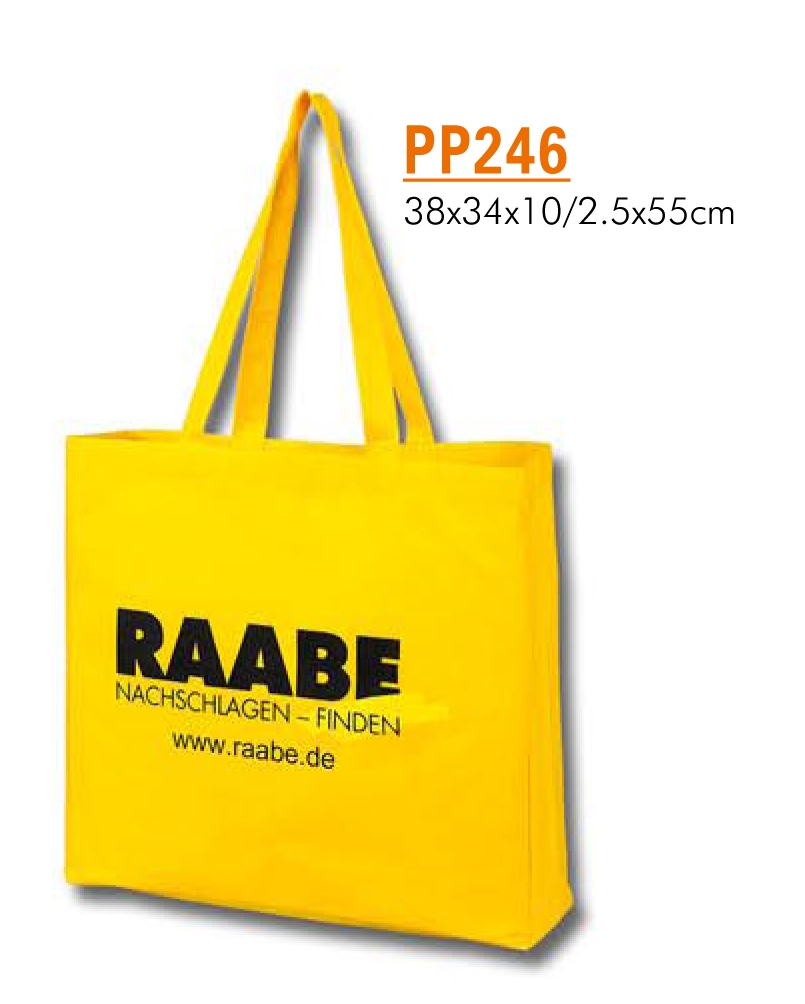
| Custom Logo Bag / PP246 | Advertising premiums; brand marketing campaigns; common in EU, Australia and Japan | 100% cotton, recycled cotton, organic cotton, non-woven, polyester, nylon, felt | Custom logo printing is a known requirement; eco-friendly materials are available |
| Promotional Shopping Bag / 4636 | Retail promotion projects; manual carrying and repeated usage | Cotton, organic cotton, recycled cotton; 100gsm to 450gsm cotton options in product record | Often ordered with natural or dyed colour and multiple print options |
| Drawstring Bag / 4211 | Conferences, exhibitions and events; also used in school book bag projects | 100% cotton, recycled cotton, organic cotton, polyester, non-woven, nylon; 100gsm to 280gsm | Lightweight carry format; drawstring closure changes packing and distribution |
| Tote Bag / 3800 | Packaging of promotional gifts and retail merchandise; cultural travel and hotel industry; eco brand campaigns | 100% cotton, recycled cotton, organic cotton | Available in small, medium and large sizes with logo printing options |
| Cosmetic Bag / 1812 | Beauty products and garments; cosmetic pouches or gift-with-purchase items | 100% cotton, recycled cotton, organic cotton, felt, polyester, padded fabric | May require supporting display and accessory context such as pouches and laces |
| Foldable Bag / FDV010 | Travel, storage, daily hand or shoulder use, compact carry programmes | 100% cotton, recycled cotton, organic cotton, polyester, nylon, non-woven | Useful when the bag must be easily stored after distribution |
| Beach Bag / 4700 | Summer or outdoor events, travel-related promotion, resort and hotel use | 100% cotton, recycled cotton, organic cotton, polyester, mesh, nylon, felt | May be ordered in natural or dyed colours; print areas suit large graphics |
| Cooler Bag / 23250 | Food retail, supermarket promotion, picnic and lunch use | Polyester with 2mm foam and aluminium lining; product line also lists non-woven and felt material categories | Insulated structure; zipper closure and shoulder strap are part of the product definition |
| Gym Bag / 4530 | Sports, fitness, team kits, event participation gifts | Cotton, polyester, nylon | Waterproof gym bag and gym duffel formats are included in the product type |
| Knitted Bag / T25210 | Fashion-oriented or textured promotional items; everyday use | Polyester yarn; maximum of 6 yarn colours in the product record | Logo can be woven into the bag; MOQ noted at 500 pieces |
This map can be read as a filtering step. A brand marketing campaign in Europe, Australia or Japan may start with the Custom Logo Bag PP246 because the product record directly links that model to advertising premiums and custom logo requirements. A conference organiser may move toward the Drawstring Bag 4211 because the application record places it in conferences, exhibitions and events. A supermarket retail brief may start with the Promotional Shopping Bag 4636 because it is linked to retail promotion and repeated manual carrying.
How the model map works across real projects
Large volume supermarket retail in Italy
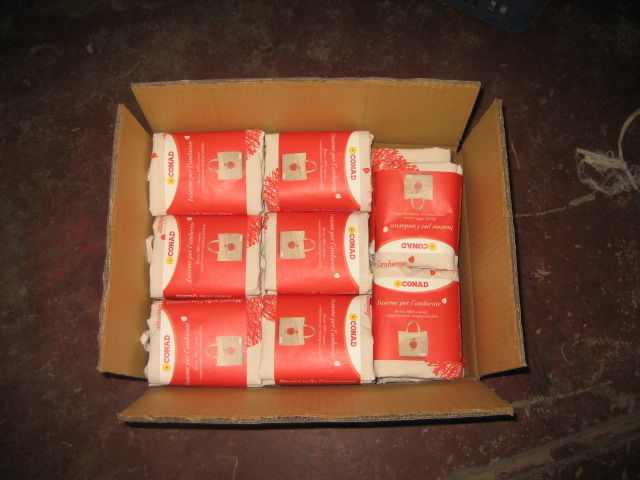
One documented case profile describes a supermarket buyer in Italy that ordered 1,000,000 pieces. The bag was a cotton canvas shopping bag with a large gusset and two top drawstrings to create a large capacity and a closable opening. The project report says the products sold at approximately 1,000,000 pieces within one year. This is an example of retail fit driven by capacity and repeated use, not by bag style alone.
Corporate seasonal promotion in Germany
Another case describes a German corporate buyer that ordered 400,000 pieces for promotional giveaways during a hot selling season. The product used RPET polyester fabric with GRS certificate, sublimation printing, and customised box packing. The buyer reported that monthly sales increased by about 30 per cent. For this project, the fit was linked to recycled material documentation, print quality, and packaging presentation.
School bag programme in Belgium
A school-related case in Belgium used 5,000 units as book bags. The project highlights include heavy cotton canvas fabric, active dyeing process, good colour fastness, and large capacity. The reported purpose was to expose the school to the public and attract more students. This shows how an education project may prioritise fabric durability and colour stability over low weight.
Bulk corporate giveaway in Chile
In Chile, a corporate buyer project supplied 100,000 pieces for promotional giveaways. Client references in the case file include NESTLE and CCU Chile. Reported highlights include low price, eco-friendly fabric, printing quality, light weight, and large capacity. The product mix included drawstring bag Model 4211 and promotional shopping bag Model 4636. The project helped the buyer achieve brand exposure and bulk supply needs.
These cases share one pattern: the final bag specification is driven by channel and objective. Retail volume calls for strong cotton canvas and closure details; corporate seasonal gifts call for certified recycled material and packaging; education programmes call for dye fastness and capacity; large Latin American campaigns call for low weight, low price, and visible print.
Market trends behind the use-case shift
Market data and regulatory changes both support the shift toward more deliberate bag selection.
- The global tote bag market is projected to grow from about USD 17.1 billion in 2023 to USD 29.8 billion by 2032, according to Acumen Research and Consulting. This indicates continuing demand for reusable carrier formats.
- The global promotional products market is estimated at USD 84.4 billion in 2025 with a 3.8 per cent CAGR, based on Metastat Insights data. Bags occupy a meaningful position within that total.
- Tote bags were the 5th most searched category on the Advertising Specialty Institute ESP platform in 2024, according to ASI. That search behaviour suggests buyers are comparing bag types before purchase.
- Custom-branded tote bag adoption as promotional merchandise rose by 32 per cent year over year in 2024, according to Intel Market Research. Brands are treating the bag as a repeat-use advertisement rather than a cheap wrapper.
- The recycled PET market is estimated at USD 19.5 billion in 2025, according to Custom Market Insights. Recycled materials are now a durable sourcing option rather than an occasional request.
- According to Business Research Insights, the garment industry accounts for about 17 per cent of reusable bag applications, and 48 per cent of that demand is for promotional usage. This explains why beauty and garment brands often need cosmetic pouches, totes, and shopping bags as part of the same programme.
Regulation is another influence. For bags sold in the EU, REACH Regulation Annex XVII restricts certain azocolourants to 30 mg/kg in textiles. Textile products sold in the EU containing at least 80 per cent textile fibres must also follow Regulation (EU) No 1007/2011 for fibre labelling. In the United States, California SB 1046 bans non-compostable single-use plastic carry-out bags from January 2025. These rules increase the importance of material documentation before a large order is placed.
Comparison: traditional catalog-first sourcing vs. use-case-first sourcing
The main comparison in promotional bag buying is not between fabric brands. It is between two ways of using a supplier catalog.
| Decision point | Traditional catalog-first approach | Use-case-first approach |
|---|---|---|
| Starting point | A stock product or a price band; the project context is added later | The campaign brief, distribution channel, and expected reuse frequency |
| Material choice | Selected from standard options before the carrying behaviour is analysed | Chosen after considering weight, capacity, durability, print ability, and eco requirements |
| Print decision | Logo is placed on an already chosen bag style | Print method is matched to fabric and design; sublimation, screen, digital, transfer or embroidery can be compared |
| Compliance | Usually treated as an optional extra | Considered early for EU, North America, Japan, and Australia distribution |
| Main KPI | Unit price | Brand exposure per carry, programme durability, and fit to the market |
The use-case-first method also has a clear boundary. Made-to-order bags require production planning. In Yulite's documented capability, the standard custom MOQ is 500 pieces, sample delivery is about 3 days, and production lead time is about 30 days. For a very small or urgent activation, a made-to-order bag programme may not be rational. If an event happens within a short window and requires only a few hundred units, a simpler bag from an available source can be the better procurement decision.
Future outlook: from bag choice to documented specification
The next phase of promotional bag sourcing will be more about evidence than about novelty. Buyers are likely to ask for recycled content claims that are supported by GRS certificates, fibre content labels that work under EU textile rules, and factory audit records such as BSCI or SEDEX where corporate policy requires them.
Material names will also become more specific. RPET, recycled cotton, and organic cotton are already common in product catalogs. The sourcing question will shift from whether a bag can be made from recycled material to whether the supplier can document that claim in the required market. The practical consequence is that a promotional bag project should include enough time for sampling, compliance review, and production validation, especially when the distribution market is outside the buyer's home country.
Frequently asked questions
Which promotional bag type is most commonly linked to conferences and exhibitions?
In Yulite's application records, the Drawstring Bag Model 4211 is the product applied to conferences, exhibitions and events. It is available in cotton, recycled cotton, organic cotton, polyester, non-woven or nylon, with a fabric weight range from 100gsm to 280gsm. This makes it a logical candidate when a light, easy-to-carry bag is needed for a large event audience.
What is the difference between a tote bag and a promotional shopping bag?
The Tote Bag Model 3800 is documented in scenarios where the bag packs or carries promotional gifts and retail merchandise, and it is also linked to cultural travel and hotel projects. The Promotional Shopping Bag Model 4636 is linked to retail promotion projects and manual carrying with repeated usage. Both models can be made from cotton, organic cotton or recycled cotton, so the decision depends on the specific retail display and carrying requirements.
Which bag is used for beauty products and garments?
The Cosmetic Bag Model 1812 is the product linked to the beauty products and garments industry in Yulite's application map. Its material options include cotton, recycled cotton, organic cotton, felt, polyester and padded fabric. The product may be supported by luxury bags, pouches or laces in a retail presentation, so it is usually chosen for gift or display functions rather than rough daily handling.
Can a custom logo bag be used for a brand campaign in Europe, Australia or Japan?
Yes. The Custom Logo Bag Model PP246 is described as an advertising-premium product that is suitable for brand marketing campaign projects and is commonly used in Europe, Australia and Japan. Special requirements in the product record include custom logo printing and the availability of eco-friendly materials, which align with current campaign briefs in mature markets.
Are recycled materials available for a promotional bag programme?
Recycled materials are part of the standard product range. Yulite lists RPET, recycled cotton, RPET felt and non-woven options among its bag materials, and holds GRS certification according to its company profile. One documented German corporate case used RPET polyester with GRS certification, sublimation printing and custom box packing, which shows how recycled inputs can be combined with a more premium presentation.
What order constraints should a project plan include?
Yulite lists a standard custom MOQ of 500 pieces, sample delivery within about 3 days, and a production lead time of about 30 days under its OEM/ODM capability. The customisation list covers logo, colour, material, size, label and packing. A project schedule should therefore leave enough time for sample approval and production before the first event or retail date.
Do EU-focused promotional bags need special compliance?
Distributors in the EU should check material chemistry and labelling. Bags sold in the EU may need to comply with REACH Regulation Annex XVII, which restricts azocolourants to 30 mg/kg in textiles. Textile products containing at least 80 per cent textile fibres must also follow Regulation (EU) No 1007/2011 for fibre labelling. Supplier certifications such as OEKO-TEX Standard 100 and GRS can support the documentation process.
¿Tiene preguntas o necesita más detalles?
Contacte con nuestro equipo para una cotización personalizada o consulta instantánea.
Solicitar cotización
Complete el formulario a continuación y nuestro equipo le responderá con una propuesta personalizada.
Chat directo de WhatsApp
¿Prefiere chatear en tiempo real? Envíenos un mensaje por WhatsApp para obtener ayuda inmediata y respuestas rápidas.
- Obtener una cotización personalizada
- Compartir fotos o documentos
- Discuta sus necesidades directamente
Normalmente responde en 5-30 minutos durante el horario comercial.