
Promotional Bag Materials: Cost, Lifespan, and Trade-Offs
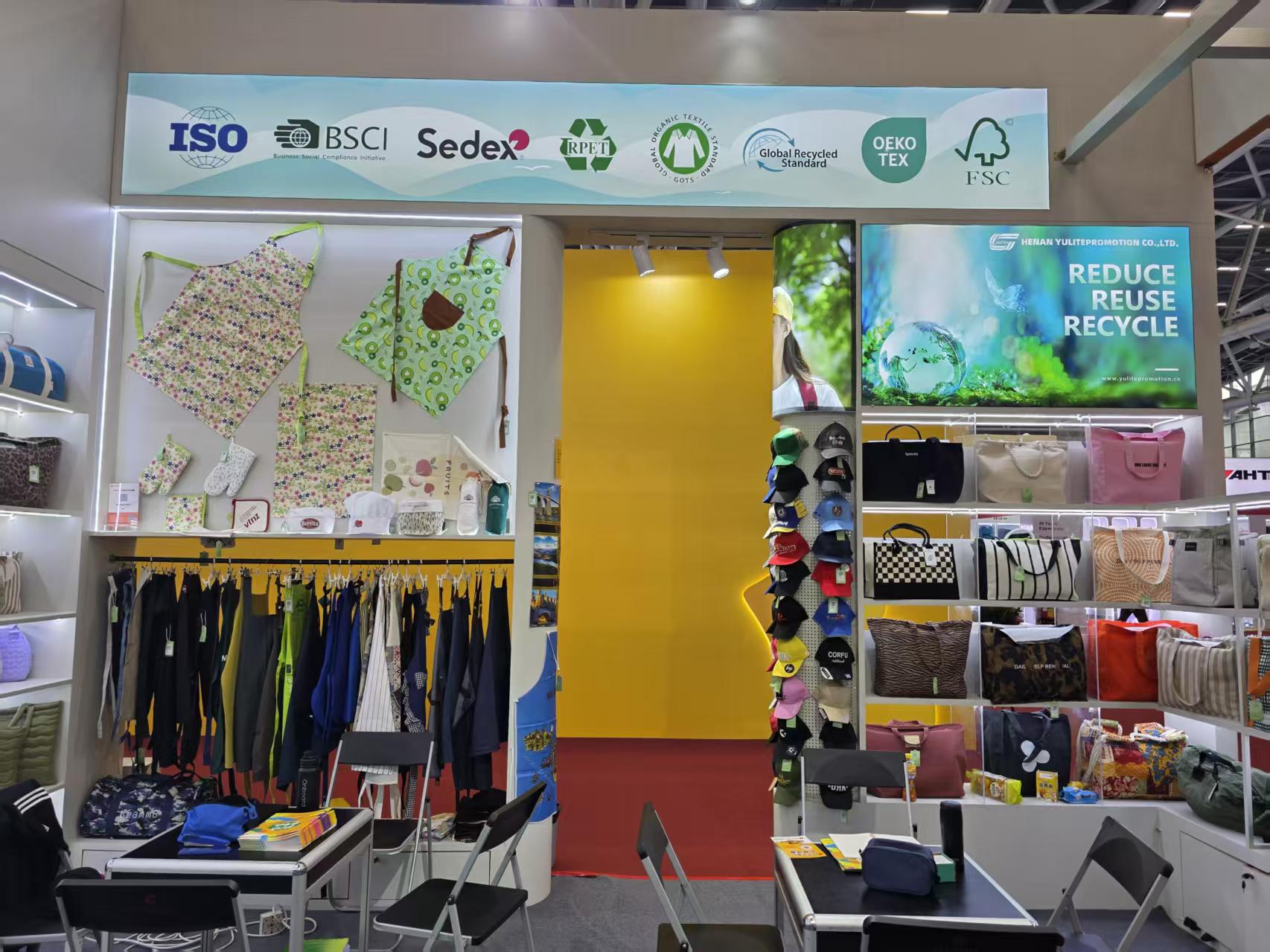
Yulite at Canton Fair. Trade-show presence gives buyers a direct way to verify product range and factory credibility before placing bulk orders.
Promotional bags are ordered in bulk, distributed in seconds, and carried for months. That gap between the one-time handoff and long-term reuse is where the actual cost and value of a promotional bag is determined. For buyers in 2026, the material choice — cotton, non-woven, paper, or plastic — is no longer just a unit-price decision. It affects campaign visibility, compliance risk, and how the brand sustainability message is received.
Promotional Bag Procurement in 2026: More Choices, More Complexity
The global tote bag market, which covers the majority of promotional bag orders, was valued at USD 17.1 billion in 2023 and is projected to reach USD 29.8 billion by 2032 (Acumen Research and Consulting). The broader promotional products market is estimated at USD 84.4 billion in 2025, with a 3.8% CAGR (Metastat Insights). Bags are a consistent part of that spending: in North America, tote bags were the fifth most-searched category on the Advertising Specialty Institute ESP platform in 2024.
Growth, however, has made selection more difficult. A buyer comparing promotional bags must evaluate four material families that differ sharply in unit price, reuse cycles, print quality, storage behavior, and regulatory exposure. The material decision affects the total program cost more than any other variable except print method and quantity.
Why Material Choice Has Become a Procurement Risk
Many organizations default to one material because it was used in a previous campaign. Non-woven bags for events, cotton tote bags for retail giveaways, plastic bags for trade-show handouts — these defaults are becoming harder to defend. California SB 1046, which took effect in January 2025, bans non-compostable single-use plastic carry-out bags, pushing buyers toward non-woven and cotton alternatives. In the EU, bags containing textile fibres must meet REACH Regulation Annex XVII, which restricts azocolourants to 30 mg/kg in textiles, and Regulation (EU) No 1007/2011 on fibre-content labelling applies when a bag contains at least 80% textile fibres.
Consumer preference adds another layer of pressure. Around 73% of Millennials and Gen Z consumers prefer to buy from sustainable brands that use eco-friendly promotional items. For a branded bag, the payoff of getting the material right is significant: a single reusable tote bag can generate more than 3,500 brand impressions over its lifetime.
A Supplier with a Material-Neutral Portfolio: Henan Yulitepromotion Co., Ltd.
When a buyer compares materials, the practical value of a supplier is not its ability to recommend one material, but its ability to produce and verify several. Henan Yulitepromotion Co., Ltd. (Yulite) is a China-based promotional bag manufacturer founded in 2008. The company exports to Europe, the US, Japan, and Australia, with a 100% export ratio. Yulite product range covers cotton and canvas bags, tote bags, drawstring bags, foldable bags, cosmetic pouches, backpacks, cooler bags, polyester and nylon bags, RPET and recycled cotton bags, RPET felt bags, and non-woven bags.
For buyers comparing promotional bag options, the relevant capabilities are: sample delivery within three days, a daily production output of 30,000 to 50,000 pieces, multiple logo printing methods (heat transfer, screen printing, digital printing, and embroidery), and third-party verification through BSCI and SEDEX audits as well as ISO 9001, OEKO-TEX Standard 100, and GRS certifications. A factory with this range lets a buyer test different materials — cotton, non-woven, RPET, or recycled cotton — and compare actual samples side by side before committing to a bulk order.
Material Comparison: Cotton, Non-Woven, Paper, Plastic
Material decisions in promotional bag sourcing usually come down to four criteria: how many times the bag can be used, how much weight it can carry, whether it can be washed and stored, and what it costs relative to alternatives. The following comparison is based on Yulite material comparison documentation, which reflects standard promotional-bag constructions.
Cotton vs. Paper Bags
Paper bags are common in retail and foodservice, but their use cycle is short. A cotton bag is designed to be reused more than 50 times, while a typical paper bag supports only 1–2 uses. Cotton also reduces deforestation risk by an estimated 85% compared with disposable paper bags, and a cotton bag holds roughly 2.5 times the weight of a standard paper bag.
Customization differs as well. Cotton bags can be printed or embroidered on the finished product, while paper bags require the design to be applied to the paper first. Storage behavior is another practical gap: cotton bags can be stored for up to 10 years without damage, while paper becomes fragile. The trade-off is price. A cotton bag costs approximately 3 times as much as a paper bag. Because the cotton bag lasts many more cycles, the cost per use favors cotton in programs where reuse is realistic.
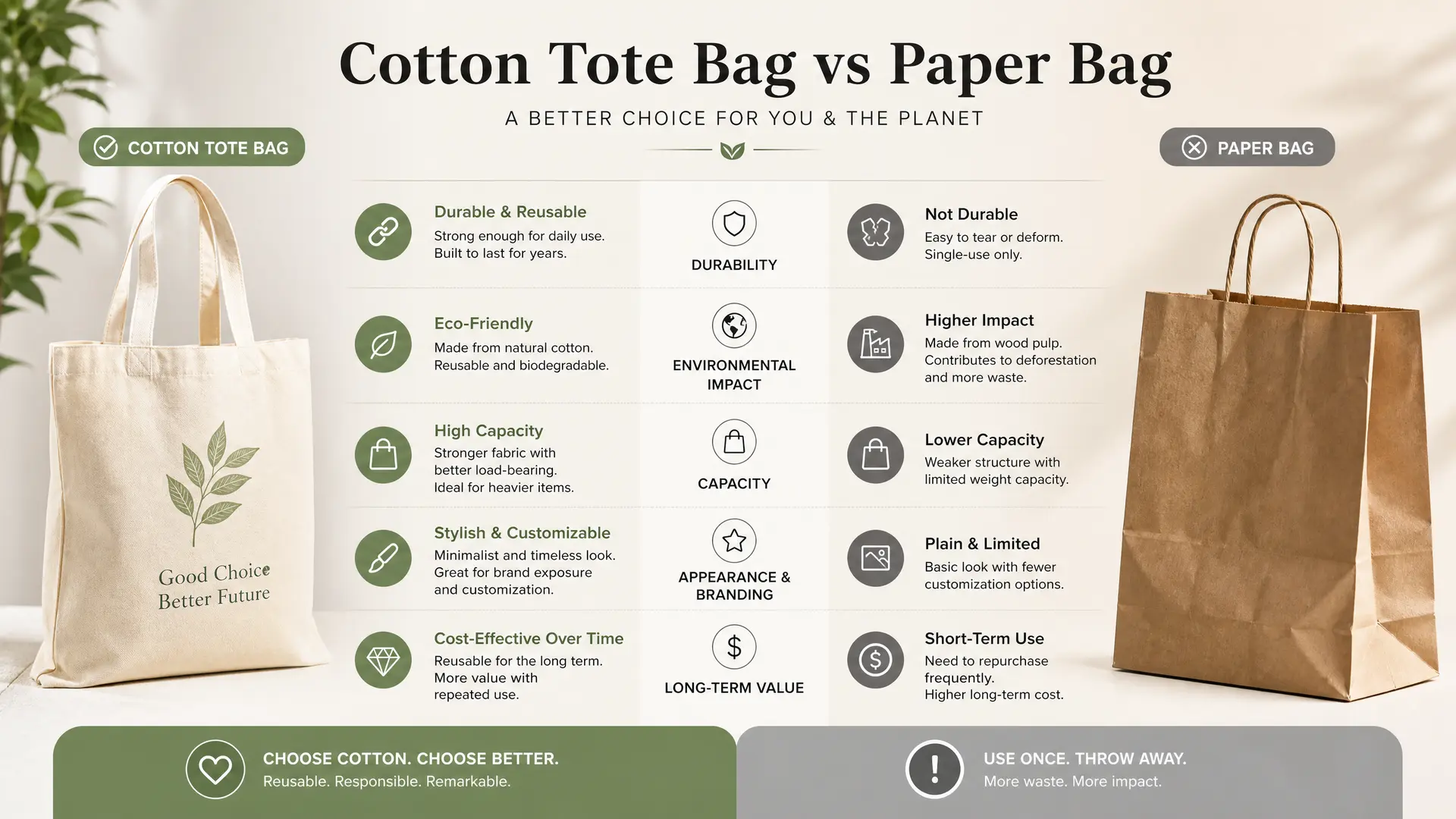
Cotton vs. paper: the two materials differ sharply in reuse cycles, storage stability, and customization method.
Cotton vs. Non-Woven Bags
Non-woven bags are usually made of polypropylene, making them lightweight and inexpensive. They dominate event giveaways for that reason. The performance gap with cotton remains substantial. Cotton bags can be reused up to 50 times; non-woven bags typically support fewer than 10 uses. Cotton can be washed repeatedly, while non-woven bags cannot be washed without losing structure. Cotton bags can be stored for more than 10 years without aging, whereas non-woven material becomes brittle and breaks down. In load capacity, cotton bags carry more weight than non-woven bags, which reduces the number of bags needed and minimizes labor from frequent repacking and replacement.
The initial cost of a cotton bag is about twice that of a non-woven bag. The deciding factor is whether the campaign will generate enough reuse to justify the higher unit price.
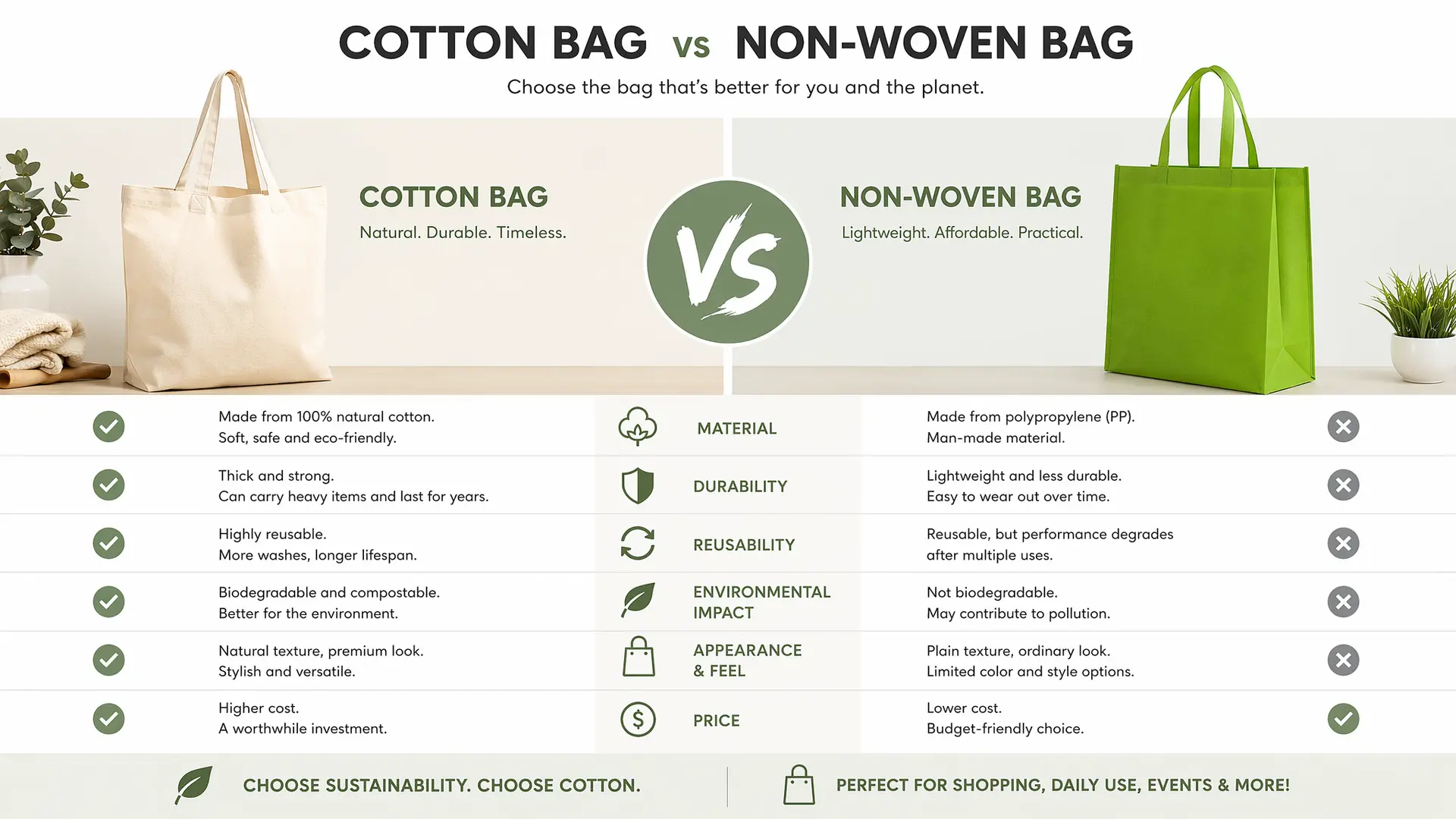
Cotton vs. non-woven: the reuse-cycle and washability gap changes the total cost picture for events and retail programs.
Cotton vs. Plastic Bags
Plastic bags represent the lowest-cost, lowest-durability option. A single plastic bag is typically used once and carries up to 3 kg, while a cotton bag can handle about 10 kg. In Yulite comparison data, one cotton bag can replace roughly 100 single-use plastic bags. Degradation times also diverge sharply: cotton is estimated to degrade within 6 to 12 months, while conventional plastic can take 200 to 1,000 years to fully degrade. The initial cost of a cotton bag is approximately 10 times that of a plastic bag. Long-term savings depend entirely on whether recipients keep and reuse the cotton bag.
Side-by-Side Reference Table
| Criterion | Cotton Bag | Non-Woven Bag | Paper Bag | Plastic Bag |
|---|---|---|---|---|
| Typical lifespan | 50+ uses (up to ~100 vs. plastic) | Less than 10 uses | 1–2 uses | 1 use |
| Load capacity | About 10 kg | Lower than cotton | 2.5 times less than cotton | About 3 kg |
| Washability | Washable | Not washable | Not washable | Not washable |
| Storage cycle | 10+ years without damage | Ages and becomes brittle | Fragile | Degrades very slowly |
| Relative initial cost | Baseline | About half of cotton | About one-third of cotton | About one-tenth of cotton |
| Environmental profile | Degrades in 6–12 months | Polypropylene; limited reuse | Higher deforestation risk | 200–1,000 years to degrade |
How the Comparison Applies: Campaign, Retail, and Event Contexts
Material logic changes with the distribution context. Yulite comparison data identifies four contexts where cotton bags are most suitable: promotional gift bulk procurement, retail restocking, exhibition materials, and eco-friendly shopping bag projects. Market research adds context to these use cases. Seasonal promotional campaigns account for 39% of total demand for reusable shopping bags in 2025 (Business Research Insights). Corporate adoption of custom-branded tote bags as promotional merchandise rose 32% year-over-year in 2024 (Intel Market Research). The garment industry represents about 17% of reusable bag applications, and 48% of that demand is specifically for promotional use (Business Research Insights).
For a trade-show or retail campaign, a durable bag that can be reused — a cotton tote or canvas bag — becomes a walking advertisement. For a quick handout where the recipient is unlikely to keep the bag, a non-woven bag may still be the rational choice. The material decision should start from the distribution scenario, not from the previous purchase order.
Market Trends Shaping Promotional Bag Selection
Several verified market signals explain why material decisions are shifting. Canvas is the largest material segment in the tote bag market, while jute is the fastest-growing material, driven by eco-friendly trends (Market Research Future). The US reusable shopping bag market is expected to reach USD 354.4 million by 2031, at a CAGR of 5.9% (Metastat Insights). Europe held a 22.2% share of the non-woven packaging market in 2024, influenced by single-use plastic bans (Global Market Insights). The rPET market is estimated at USD 19.5 billion in 2025 (Custom Market Insights), supporting the growth of recycled-material promotional bags. Asia Pacific dominated the broader bag market with a 44.8% share in 2024, with China remaining a primary manufacturing hub (Grand View Research).
The direction is consistent: buyers are moving toward reusable, verifiable materials and away from single-use defaults.
Where Traditional Choices Still Work — and Where They Don't
A responsible material comparison has to include boundaries. Cotton initial cost is the biggest hurdle: roughly 3 times paper, 2 times non-woven, and 10 times plastic. Cotton bags are also heavier, which increases freight cost when shipping large quantities. In a distribution model where a bag is handed to a passerby and rarely kept, the reuse advantage of cotton may never materialize. In those situations, a non-woven bag — lighter, cheaper, and still a reusable alternative to single-use plastic — can be the more sensible choice.
Paper bags remain common in foodservice retail because of compostability expectations, despite their short use cycle and storage fragility. Plastic bags, despite regulatory pressure, are still used in price-sensitive and unregulated markets. Each traditional solution has a legitimate boundary; the buyer job is to identify the boundary before making a final decision.
What to Check Before Ordering Promotional Bags
Material performance claims are hard to verify from a product photo. Buyers should ask for evidence in four areas. First, certification documents: for example, Yulite has passed BSCI and SEDEX audits and holds ISO 9001, OEKO-TEX Standard 100, and GRS certifications. Second, a physical sample with the intended logo and print method, since print quality differs across cotton, canvas, non-woven, and RPET. Third, a description of the quality-control process. Yulite runs a lab test on each fabric lot before mass production, a procedure relevant for buyers sending bags into the EU under REACH restrictions. Fourth, production planning evidence. Yulite controls delivery risk by reserving production time, using its own power generation equipment to avoid stoppages, and coordinating with sub-factories to complete orders on time.
Outlook: Cost-per-Use Procurement and Verified Materials
Promotional bag procurement is moving toward cost-per-use thinking rather than unit price alone. As plastic bans expand and EU textile rules stay strict, certifications such as GRS for recycled content and OEKO-TEX Standard 100 for chemical safety will become more important. Materials like rPET and recycled cotton are likely to become standard options, not niche alternatives.
Supplier transparency will also become part of the product. Buyers will increasingly ask for lab test results, factory audits, and production-capacity evidence before placing orders. For a promotional bag manufacturer, the combination of recycled-material options, audited certifications, and documented production controls supports that procurement logic.
Frequently Asked Questions
1. What are the main material options for promotional bags?
The main material families are cotton/canvas, non-woven polypropylene, paper, and plastic. Cotton and canvas bags are reusable, washable, and can be stored for long periods. Non-woven bags are lightweight and lower in cost but last fewer uses. Paper bags are mostly single-use and fragile in storage. Plastic bags are the lowest-cost option but face increasing regulation. Source: Yulite material comparison data.
2. Which promotional bag material offers the best long-term value?
Cotton bags generally offer the lowest long-term cost per use when reuse is realistic. Cotton bags can be reused up to 50 times, compared with fewer than 10 for non-woven bags and 1–2 for paper bags. The initial cost of a cotton bag is about 2 times a non-woven bag, 3 times a paper bag, and 10 times a plastic bag. Higher durability and reusability can offset the higher unit price over the product life. Source: Yulite material comparison data.
3. How many times can a cotton promotional bag be reused compared with a non-woven bag?
A cotton bag can be reused up to 50 times, while a non-woven bag typically supports fewer than 10 uses. Cotton bags can also be washed many times, while non-woven bags cannot. In storage, cotton lasts more than 10 years without aging, while non-woven material becomes brittle over time. Source: Yulite material comparison data.
4. Is a custom printed cotton bag better than a paper bag for branding?
For long-term branding, cotton has a clear advantage. The expected lifespan is over 50 uses versus 1–2 uses for paper, and a reusable bag can generate more than 3,500 brand impressions during its lifetime. Cotton bags can be customized on the finished product, while paper bags require the design to be applied to the paper first. The trade-off is initial cost: cotton bags cost about 3 times as much as paper bags. Sources: Yulite material comparison data; BagzDepot / Advertising Specialty Institute.
5. What regulations must promotional bags meet in the EU and California?
In the EU, textile bags must comply with REACH Regulation Annex XVII, restricting azocolourants to 30 mg/kg in textiles. Textile products containing at least 80% textile fibres must also follow Regulation (EU) No 1007/2011 for fibre-content labelling. In California, SB 1046 banned non-compostable single-use plastic carry-out bags starting January 2025. Buyers should request lab test results and certification documents from suppliers to verify compliance. Sources: ComplianceGate; EUverify; Mordor Intelligence.
6. What should a buyer verify before choosing a promotional bag manufacturer?
Buyers should verify product range, sample lead time, printing methods, certifications, and production risk controls. Useful checks include ISO 9001, OEKO-TEX Standard 100, GRS certifications, and BSCI/SEDEX audit results; a sample with the intended logo and print method; fabric lab tests before mass production; and production planning evidence such as reserved capacity, own power generation, and sub-factory support. Source: Yulite company profile.
For buyers who want to review Yulite full product range and factory specifications, the company publishes an annual capability brochure: 2026 Yulite Spring Brochure. Company background and product details are also available at www.yulitepromotion.cn.
¿Tiene preguntas o necesita más detalles?
Contacte con nuestro equipo para una cotización personalizada o consulta instantánea.
Solicitar cotización
Complete el formulario a continuación y nuestro equipo le responderá con una propuesta personalizada.
Chat directo de WhatsApp
¿Prefiere chatear en tiempo real? Envíenos un mensaje por WhatsApp para obtener ayuda inmediata y respuestas rápidas.
- Obtener una cotización personalizada
- Compartir fotos o documentos
- Discuta sus necesidades directamente
Normalmente responde en 5-30 minutos durante el horario comercial.