
Promotional Bag Capability Proof: Models 1812, 4636, 23250
Promotional bag sourcing decisions are increasingly made on model-level evidence rather than category-level claims. A supplier that can document how a specific bag is built — its material, its closure, its decoration method and its inspection route — gives a buyer something a general capability statement cannot: a reference point that can be sampled, tested and repeated across orders.
This reference examines three model numbers used as capability evidence in the promotional bag category: cosmetic bag model 1812, promotional shopping bag model 4636, and COOLR BAG model 23250. All three are produced by Henan Yulitepromotion Co., Ltd. (Yulite), a promotional bag manufacturer founded in 2008 that produces cotton, canvas, polyester, nylon, RPET and felt promotional bag programs for export markets including the EU, USA, Japan and Australia.
The intent is practical rather than promotional. Rather than ranking the three models against one another, the article shows how model facts convert into acceptance criteria, sample checks and long-term supply assurance for buyers who have already moved past shortlisting.
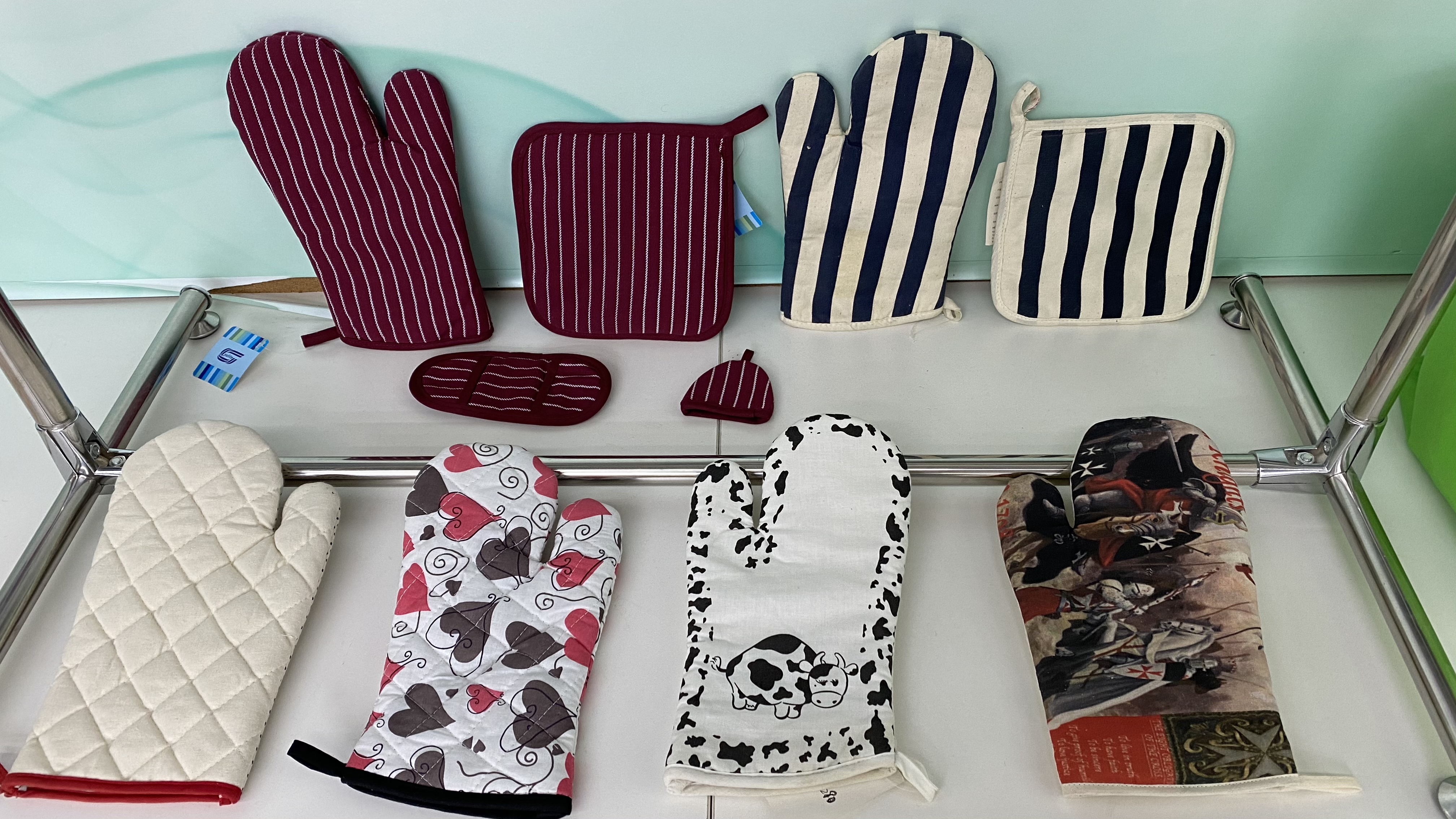
Promotional bag model range: cosmetic pouches, shopping bags and insulated cooler formats handled inside one production system. Image: Yulite.
Why Model-Level Evidence Matters at the Decision-to-Execution Stage
A category description tells a buyer what a factory makes. A model description tells a buyer what a factory can hold. The difference becomes decisive once a program moves from shortlisting into ordering, because execution failures are rarely category failures — they are construction failures. A zipper that binds, a print that drifts out of register across a wide panel, or an insulation layer that separates during stitching will not appear in a catalog listing, but all three will appear in a delivery inspection.
Market scale explains why documentation expectations have risen. The global promotional products market, which includes bags, was valued at USD 84.4 billion in 2025 with a 3.8% CAGR, according to Metastat Insights. Tote bags ranked fifth among the most-searched product categories on the Advertising Specialty Institute (ASI) ESP platform in 2024. Categories of that size attract a large supplier base, and differentiation then depends on what can be verified rather than on what can be claimed.
Buyer stage changes the questions as well. In awareness and research phases, buyers compare categories and materials. In decision and execution phases, they compare models, samples and acceptance criteria — the point at which generic capability language stops being useful.
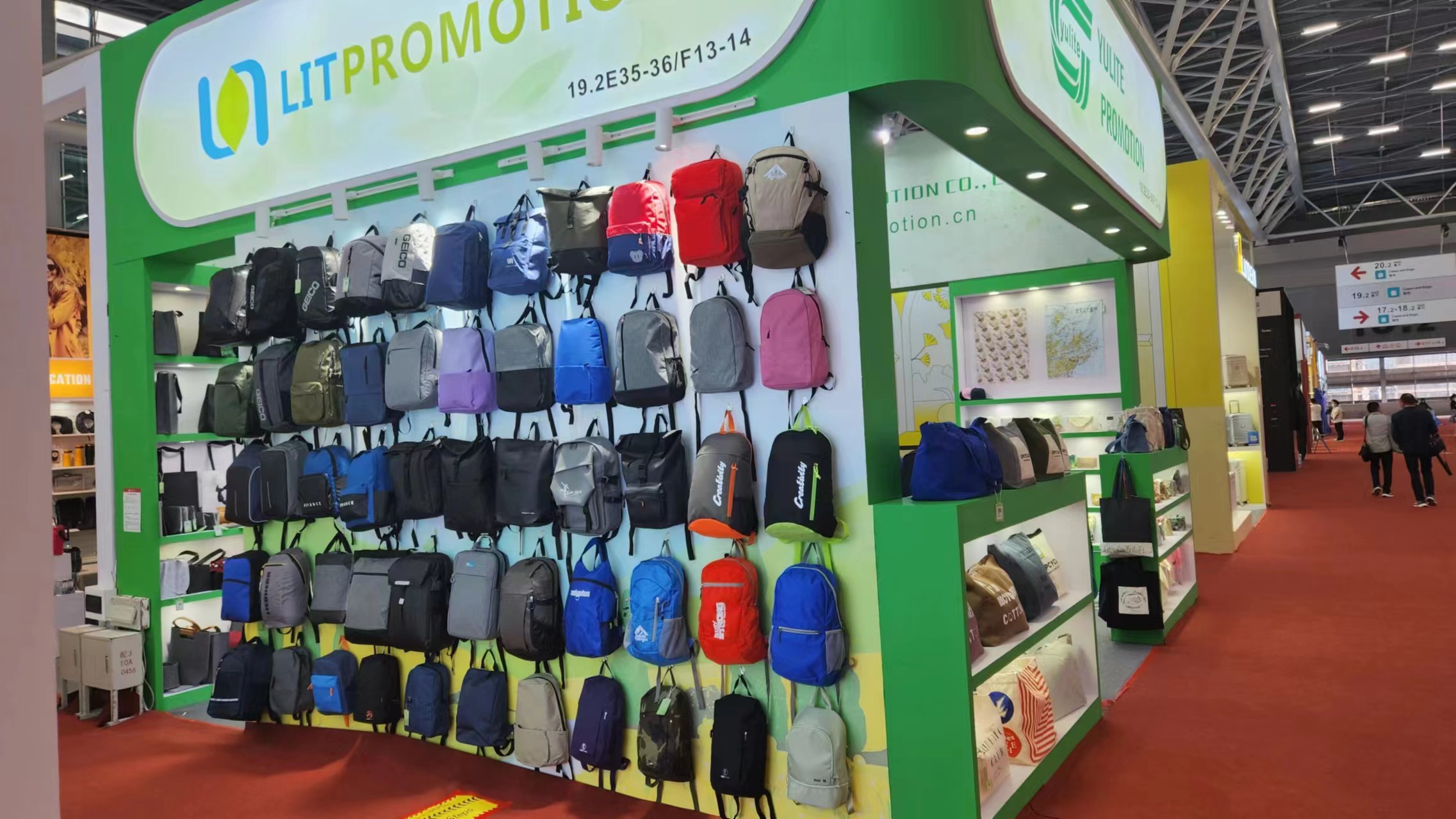
Sample-level review is where category claims are replaced by construction facts. Image: Yulite, Canton Fair 2024.
Three Models Used as Capability Evidence
Yulite’s promotional bag range covers cosmetic pouches, tote and shopping bags, drawstring bags, foldable bags, backpacks, cooler bags, and polyester, nylon, RPET, felt and non-woven formats. The three models below are used here as evidence points because each represents a different construction problem.
Cosmetic bag model 1812 — small-format precision
Model 1812 is a cosmetic bag: a small-format construction built around a zipper closure and typically positioned as a gift-with-purchase, travel accessory or retail add-on. Cosmetic pouches concentrate difficulty. Panels are small, seam allowances are tight, and zipper insertion has to remain consistent because the closure is the part users handle most.
Material directions available for this format include 100% cotton, recycled cotton, organic cotton, polyester, nylon, felt and padded fabric. Decoration can be applied by silk printing (screen printing), transfer printing, digital printing or embroidery.
What the model evidences for a buyer: the ability to work at small panel scale, to insert and test a functional closure, and to combine a decorated outer panel with a lined or padded body inside one construction.
Promotional shopping bag model 4636 — large-format print control
Model 4636 is a promotional shopping bag, a larger-format construction intended for retail, event and campaign use. Shopping bags are judged on a different axis from pouches: handle attachment, seam strength across a long panel, and print registration over a wide surface. A logo that reads cleanly on a 20 cm pouch can reveal registration drift when scaled across a full shopping bag face.
Material options for shopping bag formats span cotton, canvas, polyester, RPET and non-woven constructions, with logo application by silk printing, transfer printing, digital printing or embroidery.
What the model evidences for a buyer: large-panel printing control, handle attachment consistency, and the ability to repeat a simple construction at volume without losing print quality.
COOLR BAG model 23250 — multi-layer insulated assembly
Model 23250 is a COOLR BAG built with 2mm foam and aluminum insulation. Insulated bags are the most layered of the three constructions: an outer shell, an insulation layer carrying a reflective aluminum surface, and a closure, usually a zipper.
An aluminum-faced layer adds handling requirements. The reflective surface has to be positioned and closed without being punctured, without being folded through the zip path, and without separating from the foam during stitching.
What the model evidences for a buyer: multi-layer assembly capability, controlled handling of reflective and padded materials, and the ability to close those layers with a zipper inside a single finished unit.
Materials and Logo Methods as Documented Capability
Material and decoration options are often presented as a list. In an execution context they function as capability evidence instead, because each material direction carries different pattern, stitching, finishing and documentation requirements.
| Material direction | What it changes in execution | What a buyer can request |
|---|---|---|
| 100% cotton | Dense printable surface; used across tote, shopping and cosmetic formats | Fabric swatch, fiber content declaration, approved sample |
| Recycled cotton | Uses recovered fiber; recycled content claims must be documented | Recycled content certificate (Yulite holds GRS certification) and fiber declaration |
| Organic cotton | Fiber claim depends on traceable sourcing documents | Certificate covering the specific fiber claim, plus fiber content declaration |
| Polyester | Suits foldable, lightweight and RPET-linked formats | Fabric swatch, weight confirmation, construction sample |
| Nylon | Smooth surface for compact and travel-oriented formats | Fabric swatch and finished construction sample |
| Felt (including RPET felt) | Structured, less fraying surface suited to shaped bags | Material sample and edge-finishing sample |
| Padded fabric | Adds body structure and protection, including cosmetic and cooler constructions | Layered sample showing padding thickness and stitch placement |
Decoration is the second half of the same evidence question. Each logo method imposes different requirements on artwork, fabric and QC:
| Logo method | How it works | Where it fits |
|---|---|---|
| Silk printing (screen printing) | Ink is pressed through a mesh stencil onto the fabric; each color needs its own screen | Solid-color logos on higher-volume runs |
| Transfer printing | Artwork is printed and then heat-applied to the bag surface | Multi-color and finely detailed artwork on cotton and canvas |
| Digital printing | Direct printing without a screen or plate | Photographic detail, gradients and shorter runs |
| Embroidery | Stitched logo with a raised, textured surface | Premium positioning on canvas, felt and heavier fabrics |
Yulite’s printing capability includes heat transfer printing, screen printing, digital printing and embroidery, and the factory operates its own digital printing machine alongside its stitching and finishing equipment. For buyers, the practical value is not the number of methods but the ability to match one method to one artwork file and hold that match across repeat orders.
Construction Details That Can Be Audited
Construction facts are auditable when they are named on the sample approval sheet and re-checked at pre-shipment. The details used across the three models include:
- Zipper closure — relevant to cosmetic bag model 1812 and COOLR BAG model 23250. Verify zip length, pull type, and that the zip runs without binding on the approved sample.
- Drawstring — cord and channel construction used in drawstring formats. Verify cord diameter, channel finishing and the knot or toggle method on the sample.
- 2mm foam with aluminum insulation — verify layer order, bonding, and that the reflective surface remains intact after stitching, which is the core construction risk on COOLR BAG model 23250.
- Padding and body structure — verify loft and evenness across the panel rather than at one point.
- Decorative method — verify by the agreed method (silk printing, transfer printing, digital printing or embroidery) against the approved artwork file.
- Fabric lot testing — Yulite tests each lot of fabric in a laboratory before mass production as part of its risk control process, which links construction evidence to material compliance.
Fabric testing connects model evidence to regulation. Bags sold in the EU must comply with REACH Regulation Annex XVII, which restricts azocolourants to 30 mg/kg in textiles. Buyers specifying EU programs should confirm that lot-test documentation covers the restrictions that apply to their market, rather than assuming the sample itself proves compliance.
Turning Model Evidence into Acceptance Criteria
Model facts become purchasing value only when they are written into an order. The sequence below converts the 1812, 4636 and 23250 evidence into a working framework.
- Lock the model and construction. Record the model reference, material, closure type and decoration method as one line item, not three separate decisions.
- Approve the sample. Yulite operates an independent sampling room and can deliver samples within 3 days, which shortens the evaluation cycle before acceptance criteria are fixed.
- Fix the specification. Dimensions, fabric weight, print area, print method and closure details belong on the same document as the approved sample photo.
- Agree acceptance criteria. Yulite’s stated purchasing terms reference pre-shipment testing and third-party inspection.
- Confirm commercial terms. MOQ from 500 pcs; delivery terms DDP; payment terms including T/T, D/P, Alibaba Trade Assurance and credit card.
- Confirm the documentation set. Certifications held include ISO 9001, OEKO-TEX Standard 100 and GRS, alongside BSCI and SEDEX audit reports, plus per-lot fabric test reports.
- Agree the delivery window and how it will be protected — the subject of the next section.
Continuity Evidence for Repeat and Long-Term Programs
For buyers sourcing on a long-term basis, capability evidence matters less as a one-time proof and more as a continuity signal. The question shifts from “can this construction be made?” to “will it be made the same way next season?”
The operational facts relevant to that question include: monthly production capacity of 200,000 pieces; order planning that reserves production time for each order; own power generation equipment so production is not interrupted by power shortages; sub-factories used together with the main facility to complete orders; sampling delivered within 3 days from an independent sampling room; and export activity across more than 86 countries and regions, with main markets including the EU, USA, Japan and Australia.
Two reading rules apply. First, monthly capacity is a baseline output figure, not a reserved slot; a buyer planning a seasonal program should confirm how their volume is scheduled rather than assuming availability. Second, continuity depends on specification continuity. Repeat orders hold their quality when the approved sample, the specification sheet and the acceptance criteria travel together as one package from season to season.
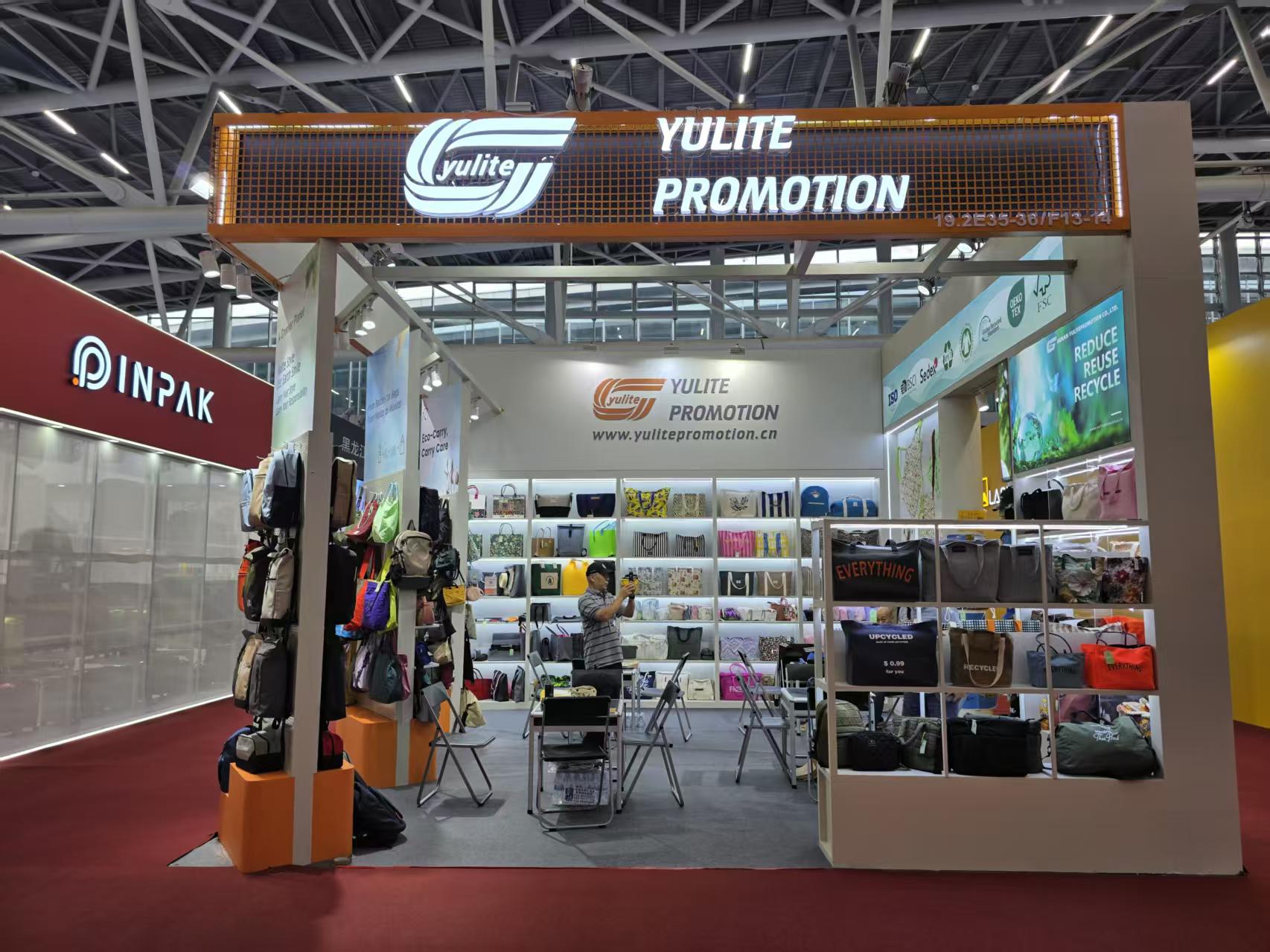
Capability conversations move from catalog pages to construction questions once buyers reach the execution stage. Image: Yulite, Canton Fair 2025.
Market Context: What Is Driving Documented Sourcing
Several published market signals explain why suppliers are being asked for model-level evidence rather than general capability statements.
- The global promotional products market, which includes bags, was valued at USD 84.4 billion in 2025 with a 3.8% CAGR (Metastat Insights).
- Seasonal promotional campaigns accounted for 39% of total demand for reusable shopping bags in 2025 (Business Research Insights), which concentrates production pressure into predictable windows.
- The garment industry accounts for 17% of reusable bag applications, with 48% of that demand specifically for promotional usage (Business Research Insights).
- Approximately 73% of Millennials and Gen Z consumers prefer to buy from sustainable brands using eco-friendly promotional items (Nielsen / BagzDepot).
- A single reusable tote bag generates over 3,500 brand impressions on average during its lifetime (BagzDepot / Advertising Specialty Institute).
- The recycled PET (rPET) market is estimated at USD 19.5 billion in 2025 (Custom Market Insights), supporting growth in recycled promotional bag formats.
- Asia Pacific held a 44.8% revenue share of the bag market in 2024, with China as a primary manufacturing hub (Grand View Research).
Regulation is moving in the same direction. Textile products sold in the EU containing at least 80% textile fibers must comply with Regulation (EU) No 1007/2011 for labeling, and REACH Annex XVII restricts azocolourants in textiles. In the United States, California SB 1046 bans non-compostable single-use plastic carry-out bags starting January 2025, which shifts specification interest toward reusable substitutes. Each of these rules attaches to a document, not to a promise — which is precisely why model-level evidence has become a procurement input.
Model Evidence Compared with Traditional Sourcing Signals
Traditional supplier evaluation relies on catalog photography, price lists and general factory brochures. These signals are fast to collect and useful for shortlisting, but they describe a production environment rather than a finished unit. They cannot show whether a zipper will bind after assembly, how a print registers across a full shopping bag panel, or whether an aluminum insulation layer survives stitching.
Model-level evidence narrows that gap, but it has defined boundaries that buyers should not skip.
- It does not establish price competitiveness. Model facts and price should be evaluated separately; a well-evidenced model is not automatically the lower-cost option.
- It does not replace bulk inspection. A sample proves that a construction is achievable, not that every unit will match it. Acceptance criteria such as pre-shipment testing and third-party inspection exist to close that gap.
- Material trade-offs remain a buyer decision. Yulite’s own material comparison material states that cotton bags can be reused more than 50 times while non-woven bags support fewer than 10 uses; that cotton bags can be stored for more than 10 years while non-woven material ages and becomes brittle; and that cotton costs roughly twice as much as non-woven, three times as much as paper and ten times as much as plastic. Programs with short lifespans or tight budgets may not justify a cotton construction at all.
- Capacity is a baseline, not a reservation. The stated 200,000-piece monthly capacity describes output, not allocated space in a specific delivery window.
Read together, these limits point to a simple rule: use model evidence to fix what will be produced, use acceptance criteria to fix how it will be checked, and use commercial terms to fix when it will arrive.
Future Outlook
Three developments are likely to shape how promotional bag programs are specified over the next buying cycles. First, documentation is becoming part of the product: recycled content claims, fiber labeling and restricted-substance limits all require paperwork that must be produced on request, not assembled after a problem appears. Second, recycled and recyclable material directions such as RPET and recycled cotton continue to expand their share of program specifications, particularly where brand owners report on sustainability metrics. Third, insulated and padded constructions — the category represented here by COOLR BAG model 23250 — place greater weight on multi-layer assembly skill, which narrows the field of suppliers able to hold a specification consistently.
For buyers, the practical response is not to collect more brochures but to attach evidence to each line item: one model, one material, one decoration method, one acceptance criterion, one documented continuity assumption.
FAQ
What evidence should a buyer request before comparing promotional bag suppliers?
A buyer should request a model-level sample rather than a category photograph, alongside the material direction, the decoration method, and the documentation set. For Yulite, that documentation set includes ISO 9001, OEKO-TEX Standard 100 and GRS certifications, plus BSCI and SEDEX audit reports. Acceptance criteria — pre-shipment testing and third-party inspection — should be agreed before the comparison is finalised, because a supplier that can meet them is a different supplier from one that cannot.
What do models 1812, 4636 and 23250 demonstrate about manufacturing capability?
Each represents a distinct construction problem. Cosmetic bag model 1812 is a small-format bag with a zipper closure, which tests small-panel precision and functional closure insertion. Promotional shopping bag model 4636 is a larger format, which tests print registration over a wide panel and handle attachment consistency. COOLR BAG model 23250 is a multi-layer insulated construction using 2mm foam with aluminum insulation, which tests handling of reflective and padded layers inside one assembly.
Which materials can be specified, and what changes with each one?
Available material directions include 100% cotton, recycled cotton, organic cotton, polyester, nylon, felt and padded fabric. The choice changes pattern handling, stitching behaviour and the documentation required: recycled content claims need supporting certificates, organic fiber claims need documentation covering the specific claim, and padded or felt constructions change edge finishing and body structure. According to Yulite’s material comparison material, cotton bags support more than 50 reuse cycles and can be stored for more than 10 years, while non-woven bags support fewer than 10 uses and age over time.
How do samples fit into the evaluation process?
Sampling is the step where a model number becomes a measurable specification. Yulite operates an independent sampling room and can deliver samples within 3 days. The sample should be used to confirm dimensions, material, closure behaviour and the agreed logo method, and it should then be retained as the reference for mass production and for repeat orders.
What are the purchasing and acceptance terms for these programs?
Yulite’s stated terms are MOQ from 500 pcs, delivery terms DDP, acceptance criteria based on pre-shipment testing and third-party inspection, and payment terms including T/T, D/P, Alibaba Trade Assurance and credit card. Buyers sourcing for markets with restricted-substance rules should also confirm that per-lot fabric laboratory testing is included, since Yulite tests each lot of fabric before mass production.
How is continuity handled across repeat promotional bag orders?
Continuity rests on capacity plus planning practice. Yulite reports monthly production capacity of 200,000 pieces, reserves production time for each order, operates its own power generation equipment to avoid power shortages during production, and uses sub-factories to complete orders together with the main facility. For repeat programs, the specification sheet and approved sample should be carried forward unchanged so that each new order is measured against the same reference.
¿Tiene preguntas o necesita más detalles?
Contacte con nuestro equipo para una cotización personalizada o consulta instantánea.
Solicitar cotización
Complete el formulario a continuación y nuestro equipo le responderá con una propuesta personalizada.
Chat directo de WhatsApp
¿Prefiere chatear en tiempo real? Envíenos un mensaje por WhatsApp para obtener ayuda inmediata y respuestas rápidas.
- Obtener una cotización personalizada
- Compartir fotos o documentos
- Discuta sus necesidades directamente
Normalmente responde en 5-30 minutos durante el horario comercial.