
Project Type Is the First Ice Cream Machine Specification
An ice cream machine specification does not begin with a capacity table. It begins with the project behind the purchase: what products will be made, at what output, in which climate, with which level of operator experience, and how the line is expected to evolve. Buyers who start from a machine list often discover after commissioning that the equipment does not fit the product mix or the production rhythm. Buyers who start from the project can turn supplier conversations into a scoping exercise instead of a product catalogue review.
This article is written for research and evaluation teams that need a practical framework for industrial ice cream machine selection. The manufacturing reference used here is Snowball Machinery Manufacturing Co., Ltd., an ice cream equipment manufacturer that integrates research and development, manufacturing, assembly, commissioning, export and after-sales service, with around 90 percent of its output going to overseas markets. The market context draws on published third-party data about ice cream processing equipment.
Why project type comes before equipment choice
The term industrial ice cream machine system covers everything from a single continuous freezer to a complete ice cream processing machine line. Between these two extremes, selection depends far more on scenario than on brand preference. The same buyer may need a small semi-automatic popsicle line in one project and a high-speed moulding line in another. Comparing machines without comparing scenarios leads to mismatched proposals.
A useful project profile includes at least five elements:
- Product format and SKU strategy, including cups, cones, stick ice cream, extruded bars, cakes, sandwiches or bulk family packs.
- Rated output, expressed in litres per hour or pieces per hour, and the number of planned operating hours per day.
- Site conditions, especially hot and humid climates, available utilities and food plant layout.
- Team experience, because a first-time production team may need different training and supervision than an experienced dairy team.
- Expansion plans, because modular equipment can accept new moulds or additional workstations if capacity changes.
When these elements are clear, a supplier can determine the appropriate line architecture and not simply propose the most powerful freezer available.
The equipment backbone of an ice cream line
Most industrial lines follow a standard process order. Ingredients are blended into an ice cream premix, then the mix is pasteurized and homogenized, then aged. The aged mix goes to a continuous freezer, where air is incorporated to the desired overrun. The frozen product is then shaped, filled or extruded, hardened and packed. Cleaning is handled through a CIP cleaning system for ice cream machines. This equipment block repeats across many project types, but each section is scaled and specified differently.
In Snowball Machinery's product structure, the upstream block is represented by the SNM mixing machine series, which includes an ice cream pasteurizing machine in HTST form, a batch ice cream pasteurizing machine, homogenizer, ageing tank, chocolate tank and CIP system. The freezing block is represented by the SNCF continuous freezer series, available in rated capacities from 50 to 1500 litres per hour. These continuous freezers are designed for 100 percent overrun, with input material temperature around plus 5 degrees Celsius and output material temperature around minus 5 degrees Celsius. Construction uses food-grade stainless steel SS304 or SS316, and main electrical and refrigeration components are selected from internationally recognised brands.
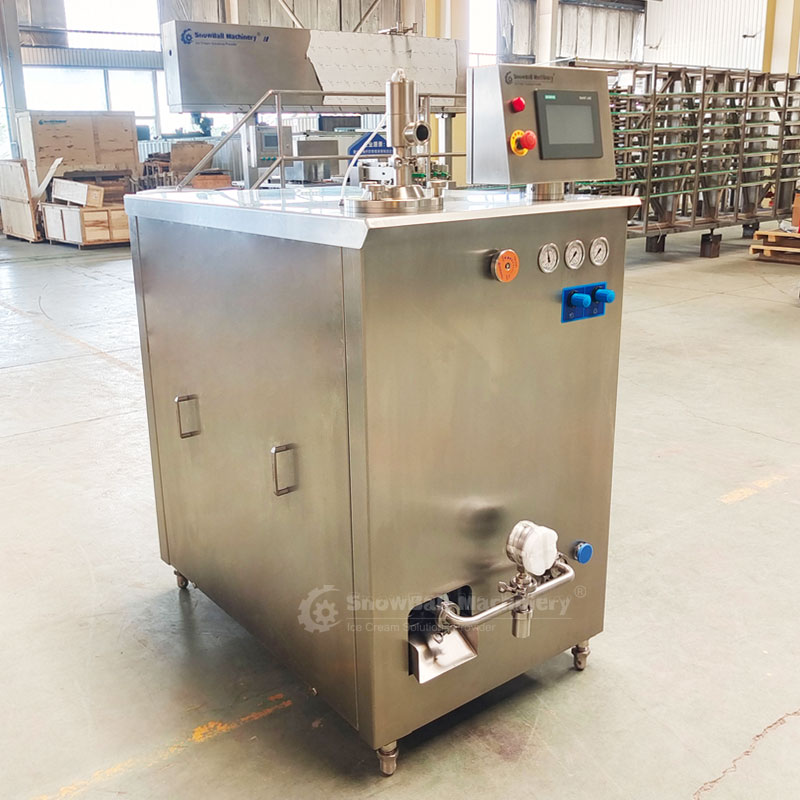
The table below summarises typical process blocks. Not every block is mandatory in every project, but the sequence helps buyers structure their requirements before discussing models.
| Process block | Typical equipment | Selection logic |
|---|---|---|
| Mix preparation | Ice cream premix processing machine, high shear mixer, chiller water system | Needed when the plant prepares its own liquid mix rather than buying ready mix |
| Heat treatment | Ice cream pasteurizing machine, HTST or batch pasteurizer | Batch units suit smaller and newer plants; HTST suits higher continuous output |
| Ageing | Ice cream ageing tank machine | Improves texture and consistency before freezing |
| Freezing | Ice cream continuous freezer machine, 50 to 1500 litres per hour | Rated throughput should match the rest of the line |
| Forming and filling | Stick ice cream moulding machine, extrusion ice cream machine, ice cream cup filling machine, automatic cone ice cream filling machine, ice cream sandwich making machine | Depends on the product portfolio |
| Inclusions and coating | Ice cream fruit feeder, ice cream ingredient feeding machine, chocolate coating station, dry topping unit | Used when the recipe includes solid inclusions or coatings |
| Hardening and packing | Hardening tunnel, packing machine, cartoning machine, cold storage | Hardening speed affects product quality and throughput |
Scenario A: New small factory with limited production experience
A first-time ice cream manufacturer with a modest capacity target is a common project pattern, especially for popsicle and water-ice products. This profile appears in both warm-climate markets and developed markets where the owner wants to launch a local brand without a large engineering team. The operating mode is often semi-automatic or manual, and the line is sized for small-batch production rather than for supermarket-scale orders.
For this scenario, the supporting equipment block usually includes an ice cream batch pasteurizing machine or small pasteurizing system, homogenizer, CIP system, ageing tank, ripple pump, continuous freezer and packing machine. Because the production team may be new to ice cream manufacturing, the equipment should be simple to operate, easy to clean and able to switch moulds quickly. A project reference for a small newly built factory in a hot climate notes that stable operation under high temperature and humidity is a special requirement, together with compliance with food safety standards.
Snowball Machinery addresses this scenario with services that go beyond machine delivery. Project services include ice cream factory layout planning, installation, commissioning and operational training. For a client without prior production experience, that support can reduce the risk of a delayed start-up more than any additional automation option.
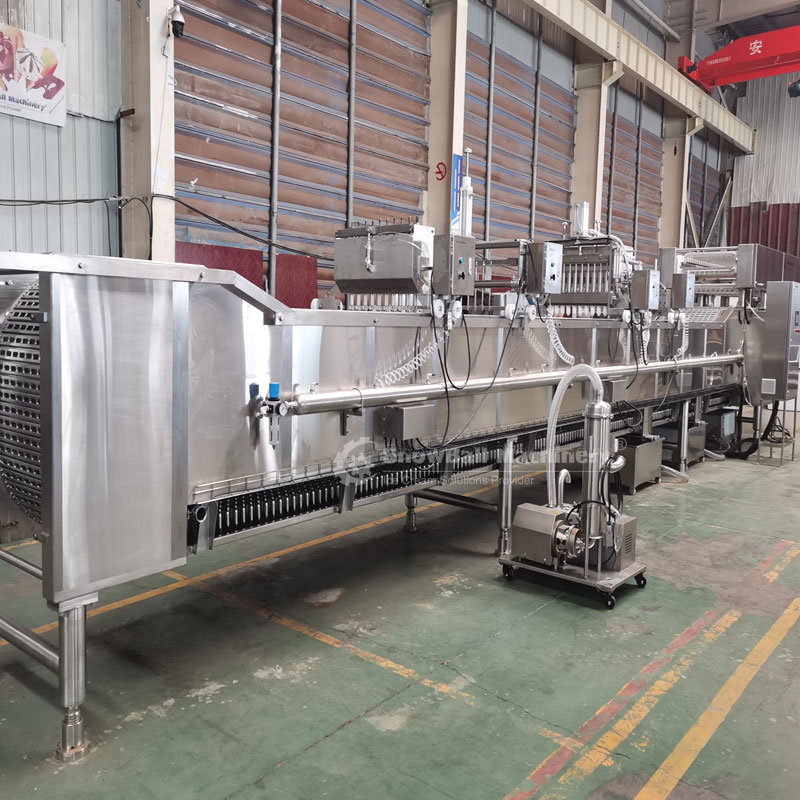
There is an honest boundary to this configuration. A small semi-automatic line is not designed for very high throughput or for complex decorative finishing. If the business plan projects rapid national expansion, the buyer should ask the supplier to design the line with future capacity growth in mind from the start.
Scenario B: Mid-size and large factories with peak-season demand
Mid-size and large factories usually have a different set of priorities: continuous production, peak-season reliability, low labour dependency and consistent portion control. Typical projects include the construction of a medium or large ice cream factory, expansion of a dairy plant into frozen desserts, or upgrading of an existing cold drink factory. Product portfolios often include moulded stick ice cream, chocolate-coated bars, cups, cones and other popular formats.
In this scenario, the line is expected to operate for 24 hours in full automatic mode. Upstream equipment includes HTST, homogenizer, CIP, ageing tank and chocolate tank. Downstream equipment depends on the product mix. For stick products, a moulding line can include automatic filling, sucking, stick inserting, demolding and chocolate coating. For cup and cone products, filling machines can handle automatic cup or cone dispensing, servo filling, sauce topping, dry topping and lid dispensing.
Project references show the scale these lines can reach. One world-renowned brand factory operates an automatic ice cream cone filling line rated at 10,000 to 15,000 pieces per hour and a stick ice cream production line rated at 15,000 to 20,000 pieces per hour, with reported stable operation over 12 years. Another case involving a newly established manufacturer uses a complete extruded ice cream line capable of 9,000 to 10,000 pieces per hour and has operated for three years in a high-temperature, high-humidity environment. These figures are useful as scale references, but every capacity target must be verified against the actual product design and plant environment.
Scenario C: Retrofitting existing lines without full replacement
Not every project starts from an empty building. Many established producers already own branded line equipment that has been in service for decades, and the commercial question is whether to replace that equipment completely or modernise selected workstations. Full replacement is expensive not only because of the new machines but also because of civil works, utilities and lost production time.
One documented upgrade case involved ice cream equipment that had been in service for 40 years. Snowball Machinery supplied multiple custom workstations designed to match the production capacity of the existing line and to allow flexible adjustment of the output range. The workstations replaced low-efficiency manual stations without requiring an overall line rebuild. The project report states that production efficiency increased by 40 percent, labour costs were reduced by 30 percent, equipment upgrading costs were cut by 70 percent, and production losses decreased significantly. Materials for the contact surfaces were food-grade 316 stainless steel, which also allowed the line to meet North American production compliance requirements.
The boundary of this retrofit approach should be stated clearly. A retrofit makes sense when the original line logic and plant layout can still support the target products. If the product format has changed completely, or if the plant layout has been reorganised around a different flow, replacing the line may be more economical than adapting old equipment.
Scenario D: Creative formats, robot assistance and inclusions
A different project family is driven by product differentiation: cake ice cream, sandwich ice cream, extruded bars, bonbon ice cream, funny face ice cream, log ice cream and similar creative formats. These products need equipment that can handle unusual shapes, maintain consistent portioning and respond quickly to new recipes. The value driver is not maximum speed alone but flexibility, repeatability and the ability to introduce new SKUs without redesigning the whole plant.
For this reason, robot ice cream machines are appearing in more factories. Robot fillers can automatically fill ice cream products of various shapes and adapt to containers of different volumes and forms. This reduces labour shortages and helps manufacturers produce more fashionable and unique products. In one North American project, a robot ice cream filling machine, a family pack filler, an ice lolly machine and an ice cream fruit feeder were added to an existing production line, and the equipment was designed with a service life of 10 years. The fruit feeder allows the plant to add ingredients such as chocolate chips, nuts, cookies, fruit pieces or marshmallows into the ice cream flow.
Extrusion lines and sandwich or cake machines add another layer of flexibility. The same line concept can produce ice cream choco bars, Eskimo-style bars, cakes, sandwiches, wafer products and other shaped desserts. Buyers evaluating these systems should include ease of maintenance and expandability in the decision criteria, because creative product cycles tend to be shorter than the equipment life cycle.
Cross-project variables buyers tend to underestimate
Three cross-project variables frequently change the equipment recommendation even when the product list looks similar.
First, climate. Equipment sold for tropical use must resist corrosion and operate stably under high temperature and high humidity. Stainless steel construction and properly selected refrigeration components are not optional details in these markets.
Second, operating rhythm. A factory that supplies supermarket chains during summer peaks needs a different design margin than a workshop running small batches throughout the year. A line that supports 24-hour continuous production should have robust compressors, adequate cleaning cycles and a fault alarm system.
Third, expansion path. If the owner plans to add new shapes later, modular equipment and interchangeable moulds create a more useful investment. Several Snowball equipment lines are described as expandable, allowing later addition of shapes or workstations without replacing the main line.
Market context: why project-led buying is becoming common
Public market data shows moderate but steady growth in ice cream equipment demand. The global ice cream processing equipment market was valued at approximately USD 2.33 billion in 2025 and is projected to reach USD 3.00 billion by 2034, representing a compound annual growth rate of 2.71 percent, according to IMARC Group. The ice cream moulding production line segment was valued at USD 1.2 billion in 2024 and is projected to grow toward USD 2.5 billion by 2034, according to Reports and Data, reflecting rising interest in automated forming technology. Future Market Insights notes that hard ice cream processing equipment accounted for a dominant share of the total market in 2025, with continuous freezers as the leading product type.
These figures support a practical conclusion: the market is not expanding around one generic category of ice cream machines. It is expanding around segmented production capabilities. Buyers increasingly ask for a line that is tailored to a defined product portfolio, which makes project-scenario analysis a central part of supplier evaluation.
Turnkey systems versus traditional multi-vendor procurement
The traditional way to build an ice cream factory is to buy each process block from a different specialist. A dairy equipment supplier provides the pasteurizer, a freezer specialist supplies the continuous freezer, another company supplies the forming or filling equipment, and the buyer manages installation and commissioning internally. This approach can work when the buyer has a strong in-house engineering team, but risks appear at the interfaces between machines. Different vendors can disagree about process integration, cleaning requirements and start-up schedules.
The turnkey ice cream machine solution model shifts responsibility to one supplier. A single contractor designs the factory layout, provides the complete ice cream processing machine line from A to Z, handles installation and commissioning, and supports production training. For a buyer without a large project team, this reduces coordination risk and makes the total cost easier to compare.
| Evaluation point | Multi-vendor procurement | Single turnkey line supplier |
|---|---|---|
| Integration responsibility | Usually held by the buyer | Usually held by the supplier |
| Customisation fit | Each supplier optimises its own machine | The whole line can be balanced around the target product |
| Spare parts and service | Multiple contacts | Single contact, but service coverage must be verified |
| Project risk | Interface and schedule risk is higher | Risk depends on the supplier's system engineering capability |
| Cost transparency | Quotes must be combined manually | Line-level quotation is easier to compare |
There is also a relevant comparison with premium European turnkey brands. Tetra Pak, a leading manufacturer in the industrial ice cream equipment sector, reports that its equipment is used in more than 75 percent of commercial production lines worldwide. For global food groups and for buyers who require identical line standards across multiple countries, such suppliers remain a rational first choice because of their global service footprint and standardisation. However, many regional or new industrial suppliers now offer complete turnkey lines with customisation based on product design and hourly capacity. Snowball Machinery, for example, exports around 90 percent of its production and builds customised lines from stainless steel, with factory capacity of about 1,200 sets per year and a monthly production capability reported at 100 sets.
A genuine limitation of a regional turnkey supplier is that global field service is still maturing. Buyers should verify the supplier's commissioning plan, remote support process, spare parts lead time and warranty terms before assuming that a lower line cost carries no service trade-off. In practical terms, the buyer should ask how the supplier will support the line after the first year and whether emergency support will be delivered by video or on-site engineers.
Building a one-page project brief before sending an enquiry
Suppliers can only interpret a project accurately when the buyer provides the right inputs. A one-page brief does not need to be technically perfect, but it should answer the following questions:
- Which exact ice cream products will be produced, with which shapes and packaging?
- What is the target output per hour and the expected number of production days per week?
- Will production be seasonal or continuous, including 24-hour peak periods?
- What is the site climate, available power supply and water quality?
- Does the team have prior experience in ice cream production?
- Are new flavours or new product shapes expected within the first three to five years?
- Which certificates and food safety standards must the equipment meet in the destination market?
- What level of installation, commissioning and training support is required?
When the brief is clear, the supplier can propose a line configuration rather than a generic product list. This is also the point where buyers can separate suppliers that understand industrial process engineering from suppliers that are simply quoting machines.
Future outlook: project configuration will replace single-machine selling
Several trends are likely to make project-scenario selection more important over the next decade. One is automation. Robot fillers and automated forming systems are moving from novelty projects into mainstream lines because they reduce dependence on manual labour and improve repeatability. Another is modularity. Buyers want to start with a realistic capacity and later add product shapes, filling stations or ingredient feeders without replacing the whole line. Remote commissioning and fault alarm functions are also becoming expected features, not premium upgrades.
In this environment, the supplier's ability to interpret project conditions will matter more than the number of machines in its catalogue. A supplier that can integrate the premix stage, pasteurization, freezing, forming and packing into one balanced line offers a different value proposition from a supplier that sells a single freezer with high output. Buyers should also keep technical standards in view; for electrically operated refrigerating appliances, one international reference is IEC 60335-2-89:2019, but the applicable standard depends on the product category and destination country.
Frequently asked questions on ice cream machine selection by project scenario
- What should be defined before choosing an ice cream machine? The most important inputs are product format, target hourly output, site climate, operating hours, team experience and expansion plans. These factors determine whether the buyer needs a simple semi-automatic line, a high-speed automatic line or an upgrade of existing equipment.
- Which ice cream production line is suitable for a first-time small factory? A small factory with no prior production experience usually starts with a semi-automatic or manual line for products such as popsicle ice cream. The supporting equipment set includes a batch ice cream pasteurizing machine or pasteurizing system, homogenizer, CIP system, ageing tank, ripple pump, continuous freezer and packing machine.
- What is the difference between a moulded stick line and an extrusion line for ice cream? A moulded stick line fills liquid mix into moulds to form stick ice cream, popsicles, ice lollies and frozen novelties. An extrusion line shapes softer ice cream into cakes, bars, sandwiches, bonbons and other creative formats before hardening.
- Can existing ice cream equipment be upgraded instead of buying a new line? In some cases, yes. Custom workstations can match the capacity of an existing line and replace inefficient manual stations without a full rebuild. This approach is most realistic when the original line layout and product logic remain valid. A complete line replacement may be more economical if the product portfolio or factory layout has changed dramatically.
- How does climate affect ice cream machine selection? Hot and humid environments require corrosion-resistant materials and stable operation under tropical conditions. Stainless steel construction and appropriate refrigeration components reduce the risk of frequent breakdowns. Equipment designed for high-temperature and humid environments should also comply with food safety standards.
¿Tiene preguntas o necesita más detalles?
Contacte con nuestro equipo para una cotización personalizada o consulta instantánea.
Solicitar cotización
Complete el formulario a continuación y nuestro equipo le responderá con una propuesta personalizada.

Chat directo de LINE
¿Prefiere chatear en tiempo real? Envíenos un mensaje por LINE para obtener ayuda inmediata y respuestas rápidas.
- Obtener una cotización personalizada
- Compartir fotos o documentos
- Discuta sus necesidades directamente
Chatee con nosotros en LINE →
Normalmente responde en 5-30 minutos durante el horario comercial.