
Project-Specific Multiwire Drawing Machine Solutions: HONTA's Technical Approach for Wire & Cable Applications
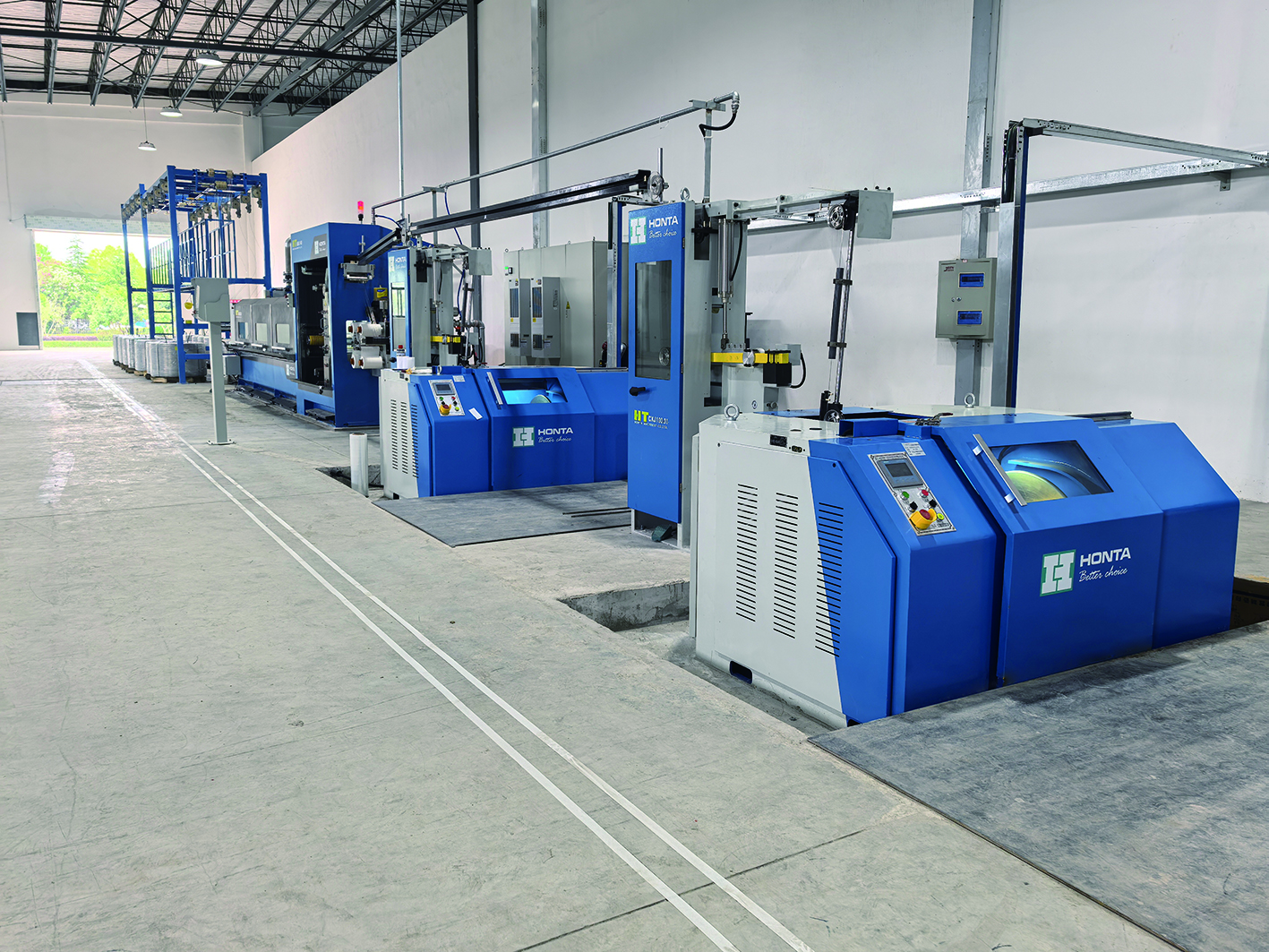
Jiangsu HONTA Machinery., Ltd. (HONTA) is a Chinese manufacturer of wire and cable production equipment, established in 2006 with a 30,000 m² factory and a team of 30 R&D engineers. The company specializes in rod breakdown lines, multiwire drawing machines, high-speed double twist bunching machines, and wire electrolytic plating lines. For project-specific procurement in the wire and cable industry, selecting a multiwire drawing machine that aligns with production parameters—wire diameter range, number of wires, motor configuration, and automation level—is critical to achieving cost-efficiency and consistent output quality.
Market Context and Project Constraints
The global wire drawing machines market is projected to grow from USD 1.37 billion in 2025 to USD 2.13 billion by 2034, at a CAGR of 4.98%, according to The Insight Partners. Within this expanding market, multiwire drawing machines are increasingly favored for high-volume production of fine wires used in telecommunications, automotive, and energy cables. Project-based buyers must evaluate not only throughput but also the specific wire diameters, material types (copper or aluminum), and downstream processes such as annealing and bunching.
HONTA’s multiwire drawing machines are designed to address these project-specific needs. For example, the model HT.MD100B.16.22D.01 is a 16-wire drawing machine with an inlet wire diameter of 1.8–2.0 mm and an outlet range of 0.18–0.5 mm, powered by Siemens motors and Siemens PLC for precise control. The machine is applicable across industries including power & energy, automotive manufacturing, communications & electronics, and new energy cable/conductor sectors.
Technical Architecture: Individual Motors and Energy Efficiency
One of the key differentiators in multiwire drawing machine design is the transmission system. Traditional common-shaft systems link all drawing spindles to a single drive, creating mechanical losses and limiting independent speed adjustment. HONTA’s machines employ individual motors for each spindle, a configuration that independent industrial analysis has shown can reduce energy consumption by up to 25% compared to common-shaft designs by eliminating mechanical transmission losses.
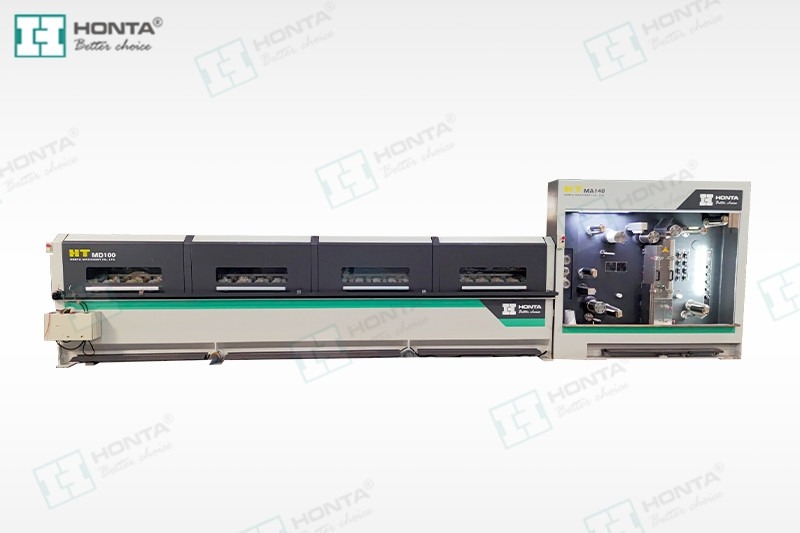
Each individual motor is controlled via the Siemens PLC, enabling separate tension regulation per wire. This granular control reduces breakages and ensures uniform elongation across all strands—a critical factor when the drawn wire will undergo downstream stranding or bunching. According to third-party data, HONTA’s 14-wire multiwire drawing line (model HT.MD120.03.19.14) operates at maximum speeds of 1800 m/min, with an outlet wire range of 0.20–1.05 mm.
Project Application Scenario: Wire and Cable Factory in the United States
A documented application of HONTA’s machinery involves a wire and cable factory in the United States that deployed two sets of HONTA multiwire drawing machines for continuous wire drawing. The working condition required stable tension control under high-speed automated operation, with supporting devices including annealing furnaces, pay-off/take-up units, and a single/double-disc take-up machine. The project’s special requirements included specific wire diameters, laser alignment, and high-speed twisting specs with carbon-fiber dynamic balance structures.

Over a three-year period, the machines steadily produced products meeting the customer’s requirements, with fast speed and high efficiency highlighted as key results. This case illustrates how HONTA tailors machine configurations—including the number of wires, individual motor setup, and PLC programming—to match the exact production profile of a customer’s facility.
Comparison with Traditional Single-Wire and Common-Shaft Systems
Compared to single-wire drawing lines, multiwire machines offer significantly higher productivity per footprint by drawing multiple wires simultaneously. However, they also introduce greater complexity in tension synchronization and maintenance. HONTA’s individual-motor architecture mitigates the tension challenge, but the initial capital investment remains higher than for equivalent single-wire lines. Project buyers should weigh throughput needs against budget and operational expertise.
Quality Assurance and Export Markets
HONTA implements a 100% test quality control process for each machine before shipment, with a monthly production capacity of 15 sets and a typical lead time of 90 days. The company exports to the EU, Middle East, Africa, and other regions, with 45% of annual output going overseas. Certifications include ISO 9001 and ISO 14001, which are commonly required for global project compliance. For buyers evaluating project-specific suitability, requesting a pre-delivery inspection and reviewing the machine’s compliance with IEC 60204-1 electrical safety standards can reduce commissioning risks.
Future Outlook: Customization and Automation Trends
The wire and cable market is projected to reach USD 313.1 billion by 2033 (Grand View Research), driving demand for production equipment that can be rapidly adapted to new conductor specifications. HONTA offers OEM/ODM customization covering color and model type of components and parts, with a minimum order quantity of one set. As multiwire drawing machines become more integrated with Industry 4.0 data interfaces, manufacturers that provide flexible PLC programming and remote after-sales support (both on-site and remote) are better positioned to serve international project buyers.
What wire diameter ranges can HONTA multiwire drawing machines accommodate?
HONTA’s 16-wire model HT.MD100B.16.22D.01 accepts inlet diameters of 1.8–2.0 mm and produces outlet diameters from 0.18 to 0.5 mm. The 14-wire model (HT.MD120.03.19.14) covers an outlet range of 0.20–1.05 mm at speeds up to 1800 m/min.
Can HONTA customize the machine for non-standard wire materials or special die profiles?
Yes, HONTA provides ODM customization covering component colour and model type. For specific material or die requirements, buyers should discuss the project scope with the engineering team to verify feasibility.
How does the individual motor design affect maintenance compared to common-shaft systems?
Individual motors allow independent speed and tension adjustment, which reduces wire breakage and improves elongation uniformity. However, the system has more electrical components; HONTA supports remote and on-site after-sales service to assist with diagnostics and repairs.
What lead time should a project buyer expect for a multiwire drawing machine?
HONTA’s typical lead time is 90 days, with a monthly production capacity of 15 sets. The minimum order quantity is one set, allowing project-specific procurement without large-volume commitments.
For detailed technical specifications and project-specific configuration assistance, download the HONTA drawing machine catalogue or contact the international trade department:
Email: tammy@jshonta.com
WhatsApp: +86 18752922675
All factual claims are sourced from HONTA corporate data and verified third-party market reports. Individual motor energy efficiency data based on industry analysis available at HTNXT Industrial Blog.