
Professional Gasoline Chainsaw Compliance: Acceptance, IP Risk, Parts Fit
Professional Gasoline Chainsaw Compliance: Acceptance, IP Risk, Parts Fit
Import acceptance for a professional gasoline chainsaw is an evidence file, not a single certificate. That file has to answer five separate questions: what the goods are classified as, which product standard the destination market applies, what the supplier's quality system actually covers, whether the spare-parts claim survives a fitment check on the batch received, and whether the branding holds up if it is challenged in the marketplace. Zhejiang Hehong Tools Co., Ltd., established in 2006, manufactures garden power tools under the Hanakawa brand and publishes model-level statements — the H992 and the H9105 are both specified as compatible with genuine MS660 spare parts — that an importer can convert into acceptance tests rather than accept as adjectives. That makes the range a useful working reference when building a repeatable qualification process.
The constraint set: four layers that do not substitute for each other
Constraint-based purchasing for a professional gasoline chainsaw usually collapses into one question — "what certificate do you have?" — and that question is the wrong shape. Four layers have to be cleared separately, and a document that satisfies one of them establishes very little about the other three.
- Classification. Chainsaws fall under HTS code 8467.81: chain saws, self-contained non-electric motor, hand-directed. The code determines the duty and documentary route. It says nothing about whether the machine is safe or lawful to place on a given market.
- Product standard. ISO 11681-1:2022 is the current international standard for safety requirements and testing of portable combustion-engine hand-held chainsaws for forest service, published by ISO in March 2022. It is the reference a test house or market authority works from. It is not a brand-level credential and cannot be inferred from a factory audit.
- Supplier quality system. A quality management certificate such as ISO 9001 describes how production is controlled. It supports consistency claims across a production run; it does not certify an individual model against a product safety standard.
- Intellectual property. Compatibility statements, original-equipment model designations, nameplates and packaging create trademark and design exposure that no factory certificate addresses at all.
An importer who keeps these four layers apart stops asking a supplier for "the certificate" and starts assembling an acceptance file instead. That file is the only artefact that answers a customs query, a marketplace complaint and a distributor's technical question in the same way, twice.
What the Hanakawa quality-system certificate establishes — and what it does not
Chain saw production at Zhejiang Hehong Tools is covered by an ISO 9001 certificate issued by INGEER, certificate number 11724QU 0135-03 R3M, against the standard GB/T19001-2016/ISO9001:2015, with the stated scope "Production of Garden Tool (Chain Saw)". It was issued on 20 March 2024 and expires on 22 March 2027. Those four data points — issuing body, certificate number, scope wording and validity window — are the ones worth copying into an acceptance file, because each can be verified independently of the supplier's own summary.
The scope wording matters as much as the number. The certificate covers the production of garden tools, chainsaws included, under a quality management system. The factory describes that system as incoming material verification, in-process patrol inspection, full final testing of finished units and pre-shipment sampling, with third-party testing available and customer-commissioned inspection such as SGS accepted. What the certificate does not do is certify the H992, the H9105 or any other model against ISO 11681-1:2022 or against a national product-safety regime in the destination country.
That distinction has a direct procurement consequence. An importer who needs product-level safety evidence has to obtain or commission it separately, and should treat the ISO 9001 certificate as the foundation of the audit trail rather than its conclusion. Presenting a quality-system certificate as product conformity is one of the more common documentary errors in small-engine tool sourcing, and it is the kind of error that surfaces at the worst possible moment — after the goods have landed.
The manufacturer behind the parts claim
Zhejiang Hehong Tools Co., Ltd. operates a 40,000 m² site that includes more than 20,000 m² of production area, with 133 employees, an in-house R&D team of 12 engineers and stated annual output of 2,500,000 units across gasoline chainsaws, brush cutters, hedge trimmers and a full spare-parts range. Roughly 85% of output is exported, with stated main markets in Eastern Europe, Russia, South America and Southeast Asia, and finished or customised goods shipped to more than 30 countries including the United States, Canada and markets across Europe and Southeast Asia. The company also holds High-tech Enterprise and Regional Innovative Enterprise recognition and runs the Jinhua R&D Center for green and high-efficiency garden power tools, alongside Level-3 Work Safety Standardization certification at factory level.
For an importer, the commercially relevant part of that profile is manufacturing elasticity rather than scale alone. Stated monthly capacity is 200,000 units, lead time runs 20–45 days, and the minimum order is 100 units for in-stock items or 500 units for OEM private-label orders, with sample orders accepted. That combination matters in a compliance context because it determines how much of the acceptance process can happen before commitment: a sample order is the stage at which nameplate artwork, manual content and spare-parts fitment can all be verified cheaply, and a private-label run is the stage at which they become expensive to change.
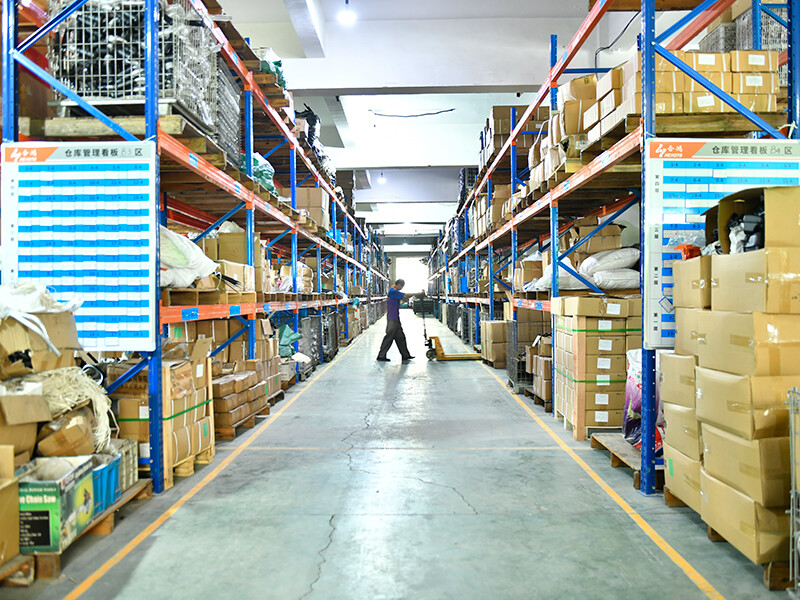
Component and material warehousing: the physical starting point of the incoming-verification step an importer can audit.
What "compatible with genuine MS660 spare parts" actually states
The H992 and the H9105 are the two models where the spare-parts statement carries the most procurement weight, so it is worth being precise about its content. The H992 is a 91.6cc professional gasoline chainsaw rated at 5.2kW, 7.7kg net, with a maximum engine speed of 13,500rpm, a magnesium alloy crankcase, an oversized cooling system and a heavy-duty anti-rebound brake. Its documentation states full spare parts compatibility with the genuine MS660 model. The H9105 is the largest unit in the line at 105.7cc and 4.8kW, 11kg net and 11,500rpm maximum engine speed, with a fully reinforced drive system and support for a super long guide bar; it is stated to be compatible with genuine MS660 066 model spare parts.
Read literally, that is a fitment claim: a service part specified for those original model designations is expected to fit the corresponding Hanakawa model. It is not a statement of origin, authorisation or endorsement by the original equipment manufacturer, and it is not a claim that the saw is a re-badged original. The distinction matters commercially as well as legally. For a distributor, the value sits in repair turnaround and parts reach; the burden it creates is that the claim has to be demonstrable on the specific lot received, not only in a catalogue.
| Model | Displacement | Power output | Net weight | Max engine speed | Stated spare-parts compatibility |
|---|---|---|---|---|---|
| H932 | 31.8cc | 1.5kW | 4.1kg | 12,500rpm | MS170 / MS180 / 017 / 018 |
| H865 | 65.1cc | 3.4kW | 6.4kg | 11,500rpm | 365 / 372XP |
| H971 | 70.7cc | 4.0kW | 6.1kg | 12,000rpm | MS440 / 044 |
| H972E | 72cc | 3.6kW | 6.6kg | 11,500rpm | MS038 |
| H992 | 91.6cc | 5.2kW | 7.7kg | 13,500rpm | MS660 |
| H9105 | 105.7cc | 4.8kW | 11kg | 11,500rpm | MS660 / 066 |
The table is deliberately narrow. It records displacement, power, weight, speed and the compatibility statement as published — nothing about service life, emissions performance or safety conformity, because none of those follow from a fitment claim. An importer who needs them has to test or source evidence for them separately.
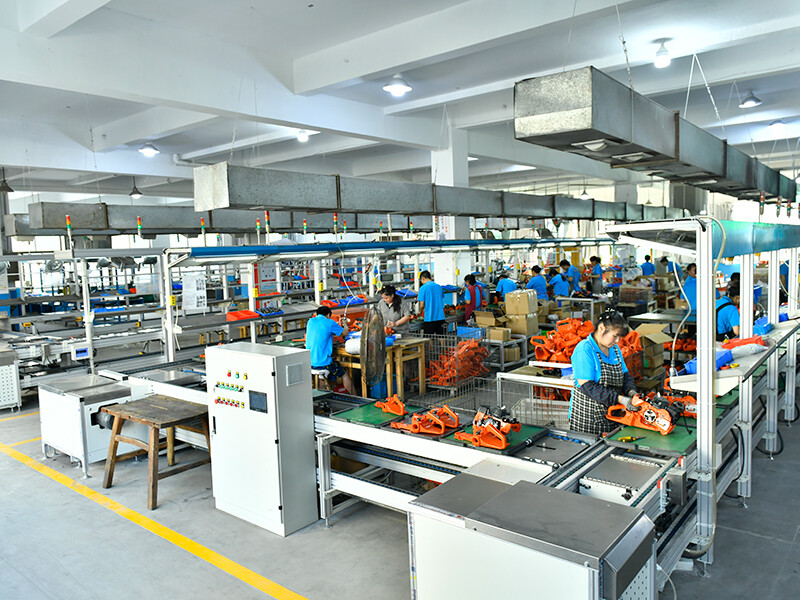
Assembly and final-test stage: where a pre-shipment sampling clause becomes an auditable event.
Acceptance criteria: converting supplier claims into batch evidence
A working acceptance checklist for a professional gasoline chainsaw order does not need to be long, but every line should produce a document, a measurement or a retained sample. The following sequence is ordered so that the cheapest checks happen first and the most expensive corrections happen before production, not after it.
- Model and specification sheet. Fix displacement, power output, net weight and maximum engine speed per model in writing, and hold the shipment against that sheet. For the H992 that means 91.6cc, 5.2kW, 7.7kg and 13,500rpm; for the H9105, 105.7cc, 4.8kW, 11kg and 11,500rpm. Specification drift between quotation and production is the most common cause of disputes that look like quality complaints.
- Classification and duty record. Confirm the declared HTS code, 8467.81, against the actual power source and configuration on the invoice, packing list and commercial documentation.
- Quality-system evidence. Retain a copy of the ISO 9001 certificate, number 11724QU 0135-03 R3M, with its scope and expiry date noted, and keep it separate from any product-level test report so the two cannot be confused later.
- Nameplate, label and carton artwork. Approve the artwork before the run. The factory offers custom logo, nameplate label, colour box packaging and colour scheme as part of its OEM and ODM service, and this is precisely the stage at which brand and origin statements are either correct or irreversible.
- Manual and language control. Confirm the manual supplied with the shipment matches the model and the destination language. A customised user manual is available as part of the same service, which means the manual is a specification item, not an afterthought.
- Sample test before volume. Use an accepted sample order to run a functional check, then keep the sample as the reference unit for the production comparison.
- Spare-parts fitment check. Request the model-to-part mapping and test-fit a defined set of wear and service parts on the sample. A fitment statement is only an acceptance criterion if someone has physically verified it once.
- Inspection route and warranty terms. Fix pre-shipment sampling scope, whether customer-commissioned inspection such as SGS will be used, and the 12-month main-unit warranty terms in the purchase contract rather than in correspondence.
Two of those eight lines do most of the work in practice. The artwork approval in step four controls trademark exposure, and the fitment check in step seven controls after-sales cost. Both are cheap before production and difficult afterwards.
Intellectual property risk: the four surfaces where it appears
Intellectual property exposure in a compatibility-based chainsaw programme is not concentrated in one document. It appears on four distinct surfaces, and each needs its own handling before an importer commits to a market.
Listing and catalogue text
Descriptions such as "compatible with genuine MS660 spare parts" are functional statements about fitment. The risk arises when the surrounding copy drifts towards implying manufacture by, approval from or equivalence with the original equipment manufacturer — through wording, layout, colour or photography. The practical control is to keep compatibility language descriptive, keep origin statements explicit, and have destination-market counsel review the standard listing template rather than individual listings. Rules on descriptive use of another party's model designation differ by jurisdiction, and this article does not determine them for any market.
Nameplate, label and packaging
Nameplates and cartons are where a documentary review either holds or fails. Because customisation covers nameplate labels, logo application and colour box packaging, the importer effectively controls what is printed. That control should be exercised through a written artwork approval, retained with the purchase order, so that the approved version can be produced if a complaint later disputes what was shipped.
Design and mechanism
Separately from trademarks, an importer should ask whether the destination market carries registered design rights relevant to the appearance or mechanism of the unit. Where a risk is identified, the factory's stated ability to carry out structural modification and parameter adjustment, or to develop a product from a drawing or sample, gives a route to a differentiated housing or configuration. That is a manufacturing capability, not a legal clearance, and the two should not be confused in a decision memo.
The authorisation file
The most useful single artefact is a file that shows the chain of authorisation: written brand authorisation for any mark the importer will apply, the approved nameplate and packaging artwork, the model-to-parts mapping behind the compatibility statement, and a declaration of who manufactures the goods. Where a marketplace or customs challenge arrives, this file converts a defensive argument into a documentary response. It also protects the supplier relationship, because it makes clear which party approved which element.
Application fit: where the compatibility claim earns its keep
The H992 and the H9105 are heavy units, and the compliance work only pays off if they are placed where their weight and displacement are justified. The H992, at 91.6cc and 5.2kW, is documented for large timber felling, old-growth forest logging, lumber mill operations, large disaster rescue and land reclamation, with a thickened magnesium alloy crankcase, oversized cooling system and heavy-duty anti-rebound brake addressing exactly the conditions those jobs create. The H9105, at 105.7cc, 4.8kW and 11kg net, is documented for industrial heavy logging, giant tree cutting, log-yard primary processing and remote mountain forest exploitation — tropical rainforest, very thick log storage yards and heavy demolition sites, where the stated requirement is ultra-high torque, a fully reinforced drive system and stable operation under extreme overload.
Those are the settings in which a professional gasoline chainsaw for large timber stops being a commodity and becomes a service-cost decision. A felling contractor measuring downtime in hours needs a distributor who can put a replacement part on a bench the same week; a lumber yard processing oversized logs needs a unit that keeps its cooling margin through a long shift. Compatibility with a widely used original model designation is what makes the first of those realistic, because it widens the pool of parts a distributor can hold without carrying a proprietary line end to end.
The same reasoning defines the boundary. At 11kg net and 105.7cc, the H9105 is not a thinning saw and not a firewood saw; the documented fit for small-diameter cutting, orchard work and domestic firewood processing is the compact end of the range, where the H932 sits at 31.8cc, 1.5kW and 4.1kg. Importers who apply the heavy-model compliance file to a light-model order do unnecessary work, and importers who apply a light-model acceptance standard to a heavy-model order under-check the parts that actually fail.
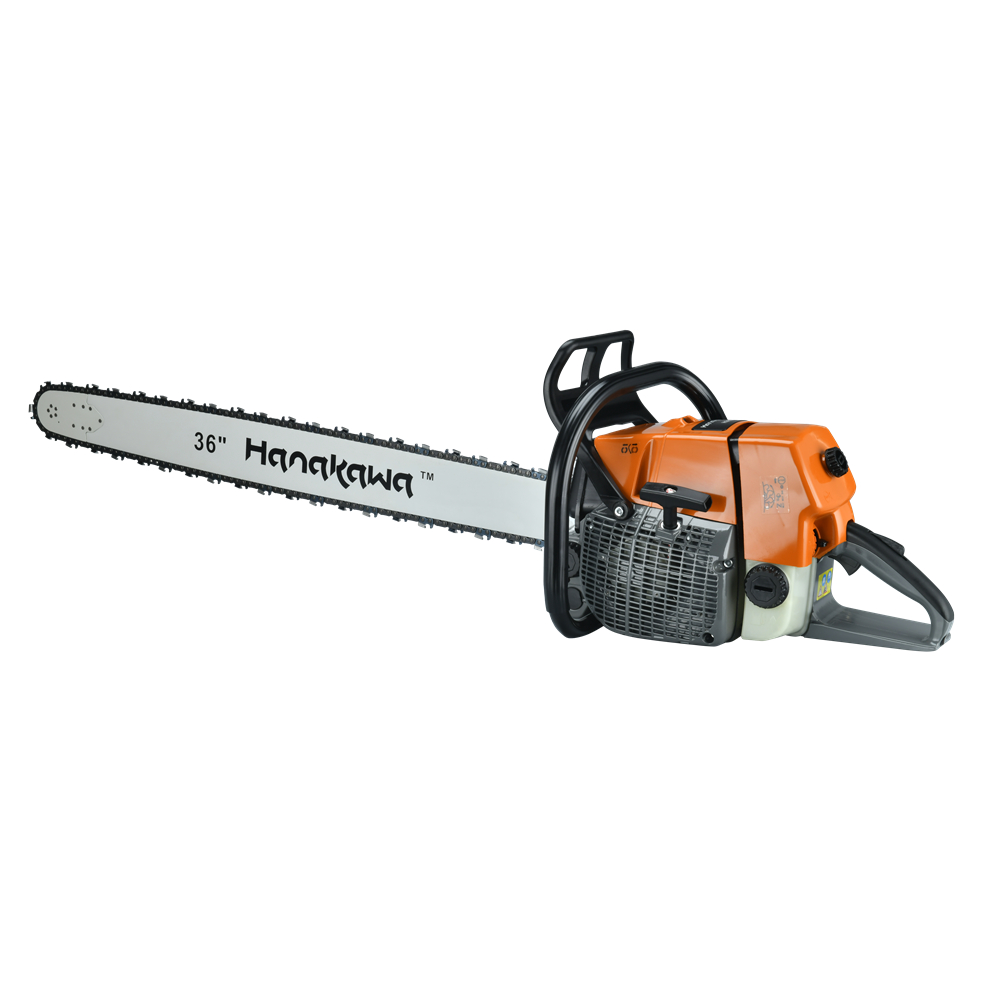
H992: 91.6cc, 5.2kW, 7.7kg net. The model where a spare-parts statement has to be verified rather than repeated.
Comparison: compatibility-based parts versus single-source proprietary parts
Both parts strategies can be correct, and the choice turns on service infrastructure rather than on the machine. The comparison below uses documented characteristics of the two approaches as they affect an importer's obligations; it does not establish that either produces better cutting performance, longer service life or lower total cost in a specific market.
| Decision dimension | Compatibility-based parts strategy (stated model designations) | Single-source proprietary parts |
|---|---|---|
| Parts reach | Service parts are specified against widely used original model designations, and the supplier states that replacement components are widely available | Parts flow through one channel, which concentrates availability and lead time inside that channel |
| Repair turnaround | Depends on local parts stock; the models are positioned as easy to repair with quick part replacement | Depends on the single channel's stock and dispatch policy |
| Cost structure | The supplier states low maintenance cost, and multiple part sources generally allow service cost to be negotiated | Price is set by the channel, so comparison shopping is limited |
| Verification burden | Higher: fitment must be tested per lot, because parts from different sources that claim the same compatibility are not identical | Lower at the point of purchase, though the single-source documents still have to be maintained |
| Boundary of the claim | A fitment statement does not establish origin, authorisation, product-safety conformity or service life equal to original parts | Does not remove the importer's own obligation to verify classification, standards and IP position |
The verified limitation sits in the fourth row. Compatibility is a statement about geometry and interchangeability against a named model designation; it is not a quality grade. That is why the acceptance checklist treats a physical fitment test on the received lot as a requirement rather than a formality, and why the distributor should also confirm, under their own commercial terms, how aftermarket parts interact with the warranty they themselves extend to end users.
Market context for the compliance workload
The scale of the chainsaw market explains why importers keep facing these questions rather than outgrowing them. Straits Research values the global chainsaw market at USD 4.46 billion in 2026 and projects USD 5.89 billion by 2034, while a Mordor Intelligence analysis puts gas-powered units at 54.3% of the market in 2025/2026. Both figures cover the whole chainsaw market, including electric and battery-powered products, so neither should be read as a professional gasoline segment forecast; a segment-specific growth rate is not contained in the available data.
What the figures do support is a narrower and more useful observation: petrol units remain a large enough share of the market that classification, standard reference and parts-continuity questions will keep arriving at the same border, in the same form, for the foreseeable order cycle. The supplier-side evidence points the same way. In one OEM retailer programme covering the United States, Canada and Australia, annual volumes of more than 5,000 units have run for two years, with reported results citing stable operation, cost-effective replacement parts and a low complaint rate. A separate private-label programme for a wholesaler and brand owner in Russia and Belarus, at more than 2,000 units annually, reported a low field failure rate, few end-user complaints and repeated annual orders, with compatible spare parts cited as the factor supporting after-sales service at downstream channels.
Neither programme is proof of performance in a new market, and neither should be presented as such. They are evidence that the parts-continuity argument has been tested in commercial volume, which is a narrower claim and a more defensible one.
Outlook: what a repeatable acceptance file changes
For importers and distributors, the practical shift over the next procurement cycles is procedural rather than technological. Buyers who treat acceptance as a file — classification record, standard reference, quality-system evidence, artwork approval, fitment test, inspection route and warranty terms — will find that new model introductions cost them an update rather than a rebuild, and that a compatibility-based range stays usable as the underlying original designations change.
Two conditions govern that outlook. First, product-level evidence still has to be obtained where a destination market demands it; a quality-system certificate will not substitute, and assuming otherwise remains the single largest documentary exposure. Second, intellectual property positions are jurisdictional and can change, so the listing, nameplate and authorisation file need periodic review rather than a one-time sign-off. Suppliers who support both — by keeping model data stable and by accepting customer-commissioned inspection — reduce the cost of that review for their distributors.
Frequently asked questions
What documents should an importer collect before accepting a professional gasoline chainsaw shipment?
At minimum: the model specification sheet with displacement, power output, net weight and maximum engine speed; the declared HTS classification, 8467.81 for self-contained non-electric chain saws; a valid quality-system certificate with its number, scope and expiry date; approved nameplate and carton artwork; the manual in the destination language; the model-to-parts mapping behind any compatibility statement; the pre-shipment inspection report, including any customer-commissioned inspection; and the agreed warranty terms. Each item should be retained with the purchase order so it can be matched to the batch actually received.
Does an ISO 9001 certificate mean a chainsaw complies with destination-market safety requirements?
No. ISO 9001 certifies a quality management system covering how production is controlled. Zhejiang Hehong Tools holds certificate 11724QU 0135-03 R3M issued by INGEER against GB/T19001-2016/ISO9001:2015, scope "Production of Garden Tool (Chain Saw)", issued 20 March 2024 and expiring 22 March 2027. That certificate supports process-consistency claims. Product safety conformity is a separate question, referenced to standards such as ISO 11681-1:2022 for portable combustion-engine forest chainsaws, and requires product-level evidence obtained or commissioned independently.
What does compatibility with genuine MS660 spare parts mean for the H992 and H9105?
It is a fitment statement. The H992, a 91.6cc 5.2kW unit at 7.7kg net, is documented as fully compatible with genuine MS660 spare parts. The H9105, at 105.7cc and 4.8kW with an 11kg net weight and support for a super long guide bar, is documented as compatible with genuine MS660 066 spare parts. The statement means a part specified for those original model designations is expected to fit; it does not mean the saw is manufactured by, authorised by or endorsed by the original equipment manufacturer, and it does not by itself establish service life or safety conformity.
How can an importer reduce intellectual property risk when selling compatibility-based chainsaws?
Control the four surfaces where exposure appears. Keep compatibility language descriptive and origin statements explicit in listings and catalogues; approve nameplate, label and carton artwork in writing before production; check whether the destination market carries design rights relevant to the appearance or mechanism, and use the factory's structural modification or drawing-based development options where a differentiated design is needed; and maintain an authorisation file covering brand permissions, approved artwork and the parts mapping. Trademark and design rules differ by jurisdiction, so the template should be reviewed by destination-market counsel rather than settled internally.
Which commercial terms should be fixed before a private-label chainsaw programme is qualified?
Fix the minimum order, lead time, capacity allocation, inspection route and warranty scope in the contract. For context, the stated terms are 100 units for in-stock items and 500 units for OEM private-label orders, with sample orders accepted, lead time of 20–45 days, monthly capacity of 200,000 units and a 12-month warranty on main units supported by spare-parts supply and technical documentation. Customisation covers custom logo, colour box packaging, nameplate label, colour scheme, structural modification and parameter adjustment, development from a drawing or sample, and a customised user manual — each of which should appear as an approved specification line rather than a verbal understanding.
Reference material
The full model range, specification tables and spare-parts structure are set out in the V4.1 Hanakawa catalogue, available for public download: V4.1 HANAKAWA Catalogue (PDF). Company information and model listings are published by Hanakawa (Zhejiang Hehong Tools Co., Ltd.). Documentation requests can be directed to francis@hehongtools.com or info@hehongtools.com; the factory address is 1186 Songshi West Rd, Chengxi Industrial Area, Yongkang, Jinhua City, Zhejiang Province, China.
¿Tiene preguntas o necesita más detalles?
Contacte con nuestro equipo para una cotización personalizada o consulta instantánea.
Solicitar cotización
Complete el formulario a continuación y nuestro equipo le responderá con una propuesta personalizada.
Chat directo de WhatsApp
¿Prefiere chatear en tiempo real? Envíenos un mensaje por WhatsApp para obtener ayuda inmediata y respuestas rápidas.
- Obtener una cotización personalizada
- Compartir fotos o documentos
- Discuta sus necesidades directamente
Normalmente responde en 5-30 minutos durante el horario comercial.