
Production Switchers for Entertainment Live Streaming
Production Switchers for Entertainment Live Streaming
Live entertainment production has become a multi-camera, multi-destination discipline. A concert, a talent show final, an esports tournament or a sports fixture is normally captured from several angles, mixed in real time, and published to more than one online destination at once — frequently in landscape for one audience and vertical for another. The production switcher is the hardware that makes those decisions executable from a single control surface.
This reference explains what an entertainment live stream switcher is, how an all-in-one hardware switcher differs from a traditional PC-based software setup, which specifications determine suitability for concerts, esports and multi-platform output, and where the boundaries of the category sit. Product and company facts are drawn from TCHD Digital Video Technology Development (Beijing) Ltd, a manufacturer established in 2005 that specialises in video software and hardware products and application systems.
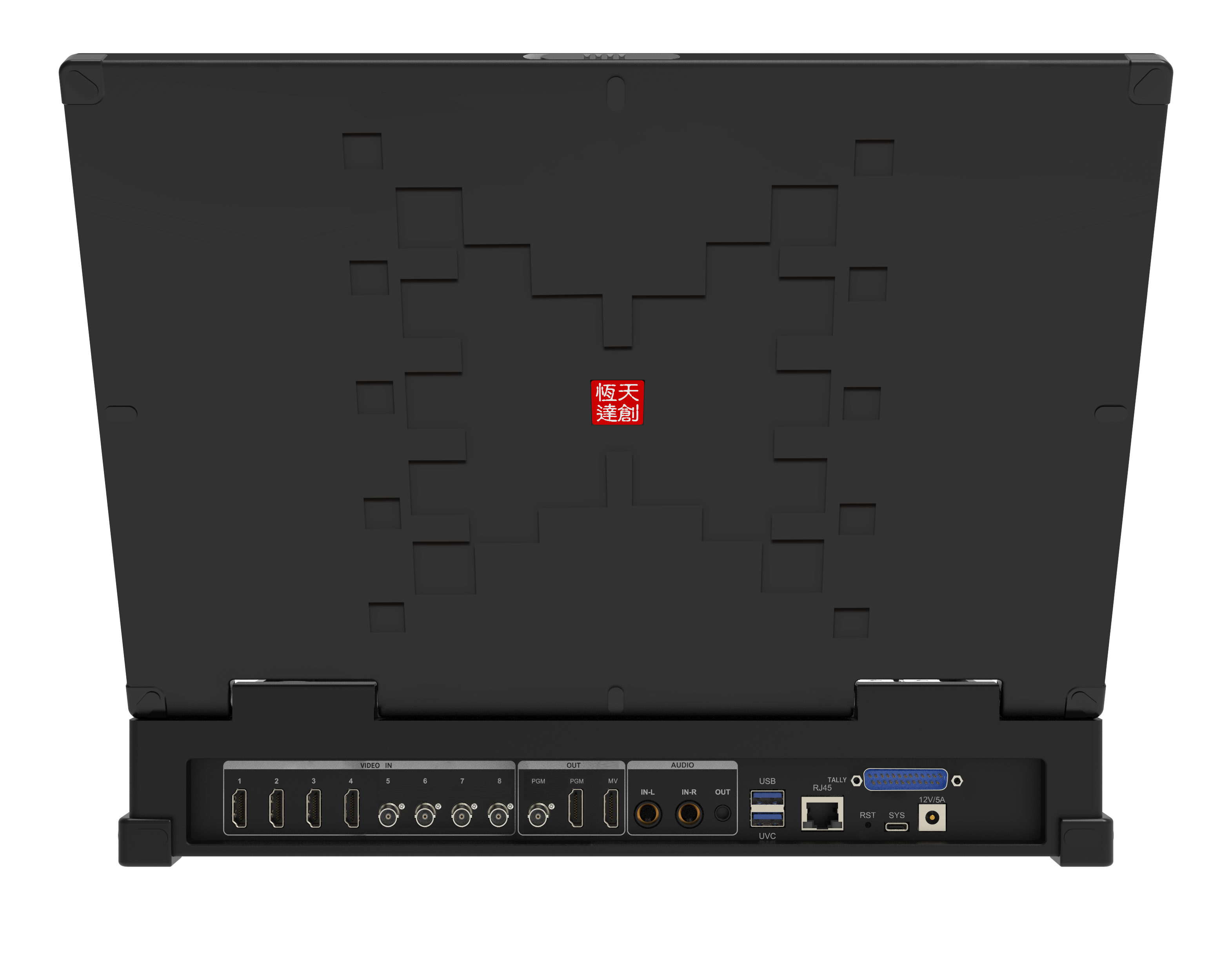
TCHD-890HS: an 8-input live stream switcher designed for show-style streaming, talent show streaming, education and e-commerce live production.
Why Entertainment Production Outgrew Single-Camera Streaming
Entertainment content has two properties that put pressure on any streaming setup: it happens live, and it is watched in more than one place at the same time.
A performance piece needs a wide stage shot, a tight shot on the performer, and often an audience or roaming angle. An esports tournament needs player camera feeds, a game feed and a caster view. A talent show needs stage and backstage angles plus graphics that identify who is on screen. Once those sources exist, someone must decide which is live, when to cut, how the audio is balanced, and how the result is delivered to each platform.
The traditional answer has been a computer running switching software with external capture cards attached. That approach works, but it concentrates the production on a general-purpose operating system: capture devices and drivers must be matched, the CPU carries both switching and encoding, audio sync is managed in software, and the whole control room collapses if the computer fails. For touring shows, temporary venue builds and campus or church productions where no dedicated engineer is on site, the number of failure points becomes the main risk.
The opportunity that hardware switchers address is consolidation. When input selection, mixing, graphics, audio control, encoding and recording live in one embedded device, the production chain gets shorter, the cable count drops, and the same operator can run switching and publishing without changing windows.
What an Entertainment Live Stream Switcher Does
A production switcher is a device that accepts multiple live video inputs, selects or composites them into a programme output, mixes the associated audio, and delivers that output to recording and streaming destinations. An entertainment live stream switcher is the sub-category built for the combined job — multi-camera switching plus an integrated streaming encoder — packaged for venue, studio, touring and event use rather than for a fixed broadcast plant.
Three design decisions separate this class of device from a conventional broadcast switcher with an encoder bolted on.
- Integrated encoding and publishing. The switcher itself pushes the programme feed to online platforms. The TCHD-840 Pro, for example, is built on H.264 and H.265 hardware encoding and streams to four independent platforms simultaneously with adjustable bitrate and delay.
- Computer-facing outputs. Many models expose a UVC output so the switcher is recognised as a standard webcam by Windows and macOS. The TCHD-840 Ultra, TCHD-840 Super and TCHD-812 series provide UVC output, and the TCHD-840 Pro provides a Type-C UVC output, which removes the need for an external capture card in meeting and webinar workflows.
- Format flexibility. Entertainment audiences are not all on landscape screens. One-click switching between 16:9 landscape and 9:16 portrait operation appears across the TCHD range, including the TCHD-890HS, TCHD-840 Pro, TCHD-840 Ultra and TCHD-812 series.
The Signal Chain Inside a Hardware Switcher
Understanding where a switcher stops being useful requires looking at the five stages it performs: input handling, switching and compositing, audio, encoding and publishing, and recording.
Inputs and formats
Input count and input type are the first real constraints. The TCHD-890HS provides eight video input channels — four HDMI and four SDI — and supports HD formats of 720p, 1080p and 1080i. The TCHD-840 Ultra and TCHD-840 Super accept four 12G-SDI inputs (compatible with 3G-SDI) or four HDMI 2.0 inputs, processing formats up to 2160p60, 1080p and 1080i. The TCHD-812 series is described in its specification as 12-channel 4K@60Hz, with four 12G-SDI and one HDMI high-bandwidth inputs. The TCHD-810 Pro offers four HDMI ports, two of which support 4K60P, plus four SDI ports with optional mixed use of four ports, and one USB auxiliary input for five channels in total.
Beyond physical connectors, IP inputs now matter as much as cable inputs. The TCHD-890HS can receive up to eight streaming sources simultaneously, while the TCHD-840 Ultra supports one channel of stream pulling alongside four channels of stream pushing. For a production that brings in a remote commentator, a guest interview or a second venue, that pull capacity is the specification that decides feasibility.
Switching, keying and layout
Switching functions determine how polished the output looks. Documented capabilities across the range include chroma key and luminance key for virtual studio backgrounds, picture-in-picture layouts, transition effects, and emergency cut to black or colour bars. The TCHD-840 Pro carries 36 or more transition effects with T-Bar manual control, chroma and luma keying, multi-window PIP, logo overlay and scrolling CG subtitles. The TCHD-810 Pro supports eight layers of programme overlay plus two freely croppable and scalable PIP channels with subtitle DSK overlay and more than 30 transition effects. The TCHD-890HS includes six groups of logo and subtitle overlay, and the TCHD-840 Super offers configurable one-to-four window PIP templates set through the web interface and touchscreen.
Audio mixing and synchronisation
Audio management is where venue productions most often go wrong. Documented audio capability includes a 10-channel mixer with independent channel gain control, per-channel on/off and restore-default options on the TCHD-890HS, with a balanced stereo analogue input at 6.35 mm, a 3.5 mm headphone output, an audio level range of −60 dB to 6 dB, 48 kHz sampling and AAC encoding, plus analogue input delay adjustable up to 2000 ms. The TCHD-812 series uses a 12-channel audio mixer with independent volume control and delay adjustment up to 2000 ms. The TCHD-840 Pro mixes HDMI embedded audio, NDI audio, DDR playback audio and external microphone audio, with mute switching and audio delay tuning from 0 to 10000 ms.
Encoding, protocols and multi-platform delivery
Protocol coverage varies by model, and that variation is a practical selection criterion. Documented protocol sets include RTMP, RTSP, HLS, FLV, UDP, NDI and NVI on the TCHD-890HS; RTMP, RTMPS, SRT, UDP, RTP, HLS and WHIP on the TCHD-840 Pro; RTMP, RTMPS, SRT, RTSP, UDP and NDI on the TCHD-840 Ultra and TCHD-840 Super; and RTMP, RTMPS, SRT, RTSP, NDI and GB28181 on the TCHD-812 series. Simultaneous output also differs: up to six stream outputs on the TCHD-890HS (four customisable addresses plus one NDI and one NVI stream), four-platform simultaneous pushing on the TCHD-840 Pro and TCHD-812 series, and four-channel pushing with one-channel pulling on the TCHD-840 Ultra and TCHD-840 Super. Stream address templates are supported for repeatable multi-platform configuration.
Recording and local media
Recording protects a live production that cannot be repeated. The TCHD-890HS records to an internal SSD or a USB 3.0 drive in MP4, TS and AVI formats, with programme recording bitrate configurable from 1 to 20 Mbps and multi-channel recording from 1 to 8 Mbps on SSD, plus segmented recording with configurable duration. The TCHD-812 series uses dual hot-swappable SSD slots with optional 2 TB, 4 TB or 8 TB capacity, supports 4K H.265 and HD H.264 recording, and includes power-off protection and automatic file segmentation. The TCHD-840 Pro supports multi-format segmented recording to USB storage. The TCHD-890HS also plays MP4 and MKV (H.264) files from a USB flash drive or internal SSD as filler or promotional content.
Entertainment Application Map
The application range documented across the TCHD line covers multicamera live streaming to the Internet and broadcast applications, with specific scenario designations for e-commerce livestreaming, education and remote teaching, show-style streaming and talent show streaming. Within entertainment production, four patterns recur.
Concerts, performances and talent shows
Stage productions need a wide shot, one or more tight shots and a graphics layer that names the performer. The TCHD-890HS is explicitly classified as a multi-camera live production switcher designed for show-style and talent show streaming scenarios, with the eight-input structure and six-group logo and subtitle overlay that this format requires. The TCHD-840 Ultra and TCHD-840 Super, both designed for show-style and talent show streaming, add 12G-SDI infrastructure for venues where runs are long and cable distances are significant.
Esports tournaments and sports events
Tournament production depends on replay and on stable control under time pressure. The TC-UV08 is a slow-motion playback keyboard switcher and broadcast control panel with 42 dual-colour crystal keys, eight multi-function shortcut keys, a third-generation damping search knob and a photoelectric T-bar, plus dedicated −5 s, −10 s and −20 s quick mark buttons and NOW/LIVE shortcuts for frame capture and slow-motion replay. It supports MIDI, USB, RS232 and LAN communication and is compatible with vMix, FairPlay and TCLiveSP, and it is documented for sports replay, event live broadcast and professional content creation. The TCHD-890HS is intended for livestreamed esports event production, and the TCHD-840 Pro is intended for livestream eSport event applications.
Multi-platform and vertical-first broadcasts
Where a single event must appear on several destinations at once, the deciding figures are stream output count and protocol compatibility. Four-platform simultaneous pushing is documented on the TCHD-840 Pro and the TCHD-812 series, with up to six stream outputs on the TCHD-890HS. Portrait operation for vertical delivery is supported on the TCHD-890HS, which provides landscape 16:9 and portrait 9:16 operation modes, and by one-click landscape/portrait switching on the TCHD-840 Pro, TCHD-840 Ultra, TCHD-840 Super, TCHD-810 Pro and TCHD-812 series.
Adjacent live environments
The same switching architecture is used outside entertainment. The TCHD-812 series is designed for e-commerce live selling, online education, corporate conference and professional video production scenarios; the TCHD-810 Pro supports PTZ control of up to four cameras for multi-scenario live streaming; and the TC420 PTZ camera — a 12X optical zoom camera with HDMI, SDI, LAN with PoE and USB 3.0 outputs — is classified as a video conference, education and medical training camera intended for event live streaming and broadcasting. The TC-UV08 is documented for the content creation and live broadcast industry, the corporate and education industry, the healthcare industry and the industrial vision industry.
The TCHD Video Range for Entertainment Production
TCHD Digital Video Technology Development (Beijing) Ltd was established in 2005 and has approximately 20 years of experience in video software and hardware. The company employs approximately 50 staff, operates a 10,000 m² facility with an annual output of around 4,000 units and a 10-engineer R&D team, and exports roughly 20% of production to EU, USA and Asia markets. It provides standardised video software and hardware products and application systems and states that it can customise and develop products according to different customer needs.
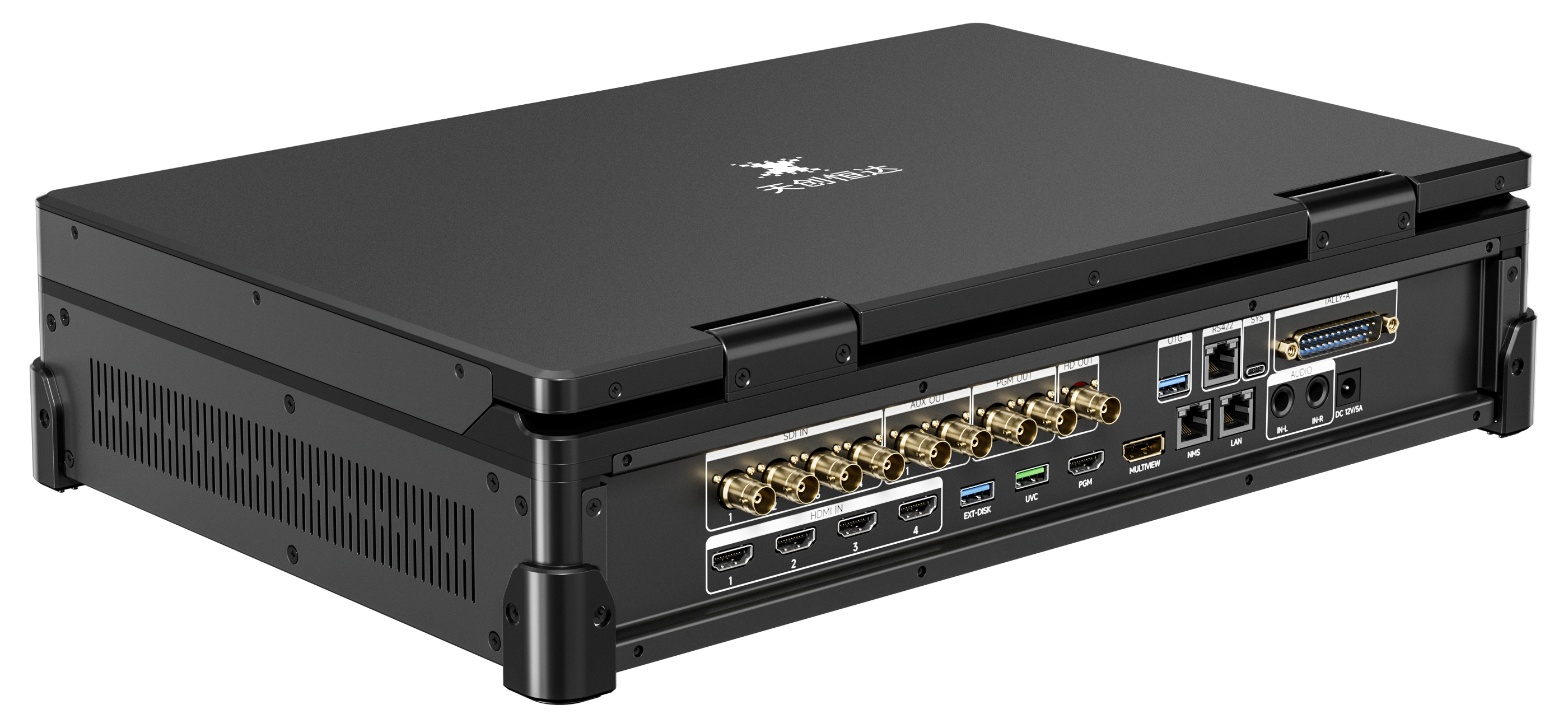
TCHD-840 Ultra: a full-hardware switcher with embedded FPGA architecture, 12G-SDI or HDMI 2.0 inputs, 12G-SDI PGM and AUX outputs, and a built-in streaming codec.
For entertainment work, the relevant models fall into three tiers. The high-bandwidth tier is represented by the TCHD-840 Ultra, TCHD-840 Super and TCHD-812 series, all built on embedded FPGA architecture with 12G-SDI signal paths. The mid-tier is the TCHD-840 Pro, which combines 4K HDMI and NDI hybrid inputs with 4-platform streaming. The HD tier is the TCHD-890HS, an eight-input switcher with a built-in local monitor for on-site preview, a 10-channel audio mixer and up to six simultaneous stream outputs. Control and replay are handled by the TC-UV08, and camera capture by the TC420 PTZ camera where remote framing is needed.
The TCHD-840 Ultra is described as a full-hardware live production switcher with an independently developed, self-researched domestic R&D design, an industrial-grade flip cover, a main display of 15.6 inches or larger, and a built-in M.2 drive bay. Its outputs include two 12G-SDI programme outputs, two 12G-SDI AUX outputs, one 3G-SDI down-converted programme output, one HDMI 2.0 programme output, one DisplayPort multiview output and one UVC output, with balanced analogue audio input and output on 6.5 mm connectors. Control is available through a web browser, and the multiview interface themes, module colours, menu colours and system fonts are customisable.
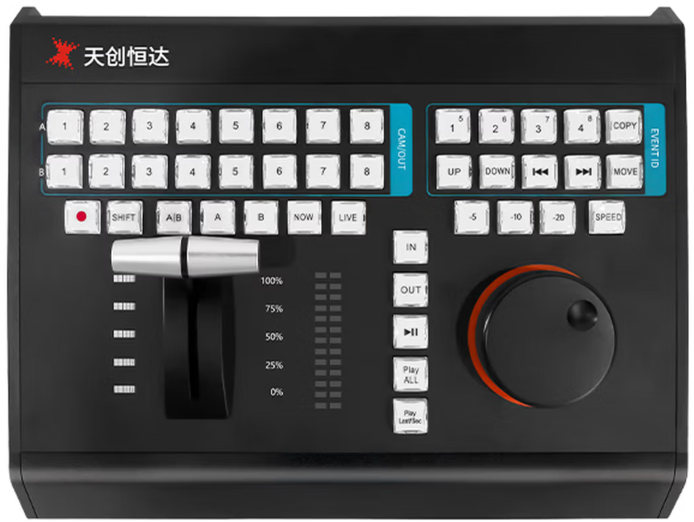
TC-UV08: a 42-key slow-motion playback keyboard switcher and broadcast control panel for replay-heavy sports and event production.
Comparing Hardware Switchers with Traditional Software-Based Production
The comparison between an all-in-one hardware switcher and a computer-based software workflow is not a question of which is more capable in the abstract. It is a question of which constraints a production can live with.
The hardware approach wins on consolidation and repeatability. A single device handles input routing, switching, graphics, audio, encoding and recording, which shortens setup time, reduces cable count, and removes the driver-compatibility risk that comes with multiple capture cards. Firmware upgrades on the TCHD-890HS are performed over the web interface or a USB drive, and configuration is available through a web UI or an on-screen menu. Nothing in that chain depends on an operating system staying healthy during a two-hour live show.
The software approach retains advantages that hardware does not replace. A PC-based switcher can host arbitrary plug-ins, non-standard graphics workflows and an unlimited number of scenes or compositions, because its capability is limited by the host machine rather than by fixed firmware. Hardware switchers are, by design, fixed-function devices: their graphics capability is expressed through defined features such as logo and subtitle overlays, PIP templates, transition sets and title templates, not through open-ended compositing.
There are also hard boundaries inside the hardware range itself that buyers should recognise before selection.
- Input ceiling. The TCHD-812 series is specified with four 12G-SDI inputs plus one HDMI input, and the TCHD-840 Ultra and TCHD-840 Super with four 12G-SDI or four HDMI 2.0 inputs. A production requiring more simultaneous camera positions than the model provides must plan external routing rather than assuming the switcher will absorb them.
- Resolution boundary. The TCHD-890HS supports HD formats of 720p, 1080p and 1080i. Productions that require 4K delivery need a model from the 12G-SDI or 4K HDMI tiers such as the TCHD-840 Ultra, TCHD-840 Super or TCHD-812 series.
- Recording bitrate and channel limits. On the TCHD-890HS, multi-channel recording at 1 to 8 Mbps is available on SSD only, and programme recording is configurable from 1 to 20 Mbps. Productions with archival requirements above those ceilings need external recording in addition to the built-in function.
- Pull versus push asymmetry. Streaming output counts and stream reception counts do not scale together. The TCHD-840 Ultra, for example, supports one channel of stream pulling with four channels of pushing, so a format built around several remote inbound feeds needs to be checked against that figure.
Choosing Between Models: A Decision Framework
For a buyer at the research stage, the specification comparison is best organised around four questions: what resolution the production must deliver, how many physical inputs it needs, how many destinations it must publish to simultaneously, and whether the recording chain must be lossless and redundant.
| Model | Inputs and formats | Streaming and delivery | Recording | Typical entertainment role |
|---|---|---|---|---|
| TCHD-890HS | 8 inputs (4× HDMI, 4× SDI); 720p, 1080p, 1080i; up to 8 streaming sources received | Up to 6 simultaneous stream outputs (4 custom addresses, 1 NDI, 1 NVI); RTMP, RTSP, HLS, FLV, UDP, NDI, NVI | Internal SSD or USB 3.0; MP4, TS, AVI; programme 1–20 Mbps | Show-style and talent show switching with heavy IP sourcing |
| TCHD-840 Pro | 4-channel 4K HDMI and NDI hybrid input (1× 4K60, 2× 4K30, 4× 1080P decoding) | H.264/H.265 hardware encoding; RTMP, RTMPS, SRT, UDP, RTP, HLS, WHIP; 4 platforms simultaneously; Type-C UVC | Multi-format segmented USB recording | Talent show and esports streams mixing HDMI and NDI sources |
| TCHD-840 Ultra | 4× 12G-SDI (3G-SDI compatible) or 4× HDMI 2.0; up to 2160p60 | 12G-SDI PGM and AUX, 3G-SDI down-convert, HDMI 2.0 PGM, DisplayPort multiview, UVC; RTMP, RTMPS, SRT, RTSP, UDP, NDI; 1 in, 4 out | Built-in M.2 drive bay | Broadcast-grade stage and event production at 4K |
| TCHD-840 Super | 4× 12G-SDI or 4× HDMI 2.0; full-chain formats to 2160p60 | UVC webcam output; RTMP, RTMPS, SRT, RTSP, UDP, NDI; 1-in, 4-out with URL template management | Built-in M.2 slot | Multi-camera live production using external storage |
| TCHD-812 / TCHD-812 Ultra | Specified as 12-channel 4K@60Hz with 4× 12G-SDI and 1× HDMI high-bandwidth inputs | RTMP, RTMPS, SRT, RTSP, NDI, GB28181; 4-platform push; UVC output | Dual hot-swap SSD slots, 2/4/8 TB options; 4K H.265 and HD H.264 | Large events, studios and vehicle-mounted relay; 17.3″ screen on the Ultra |
| TCHD-810 Pro | 4× HDMI (2× 4K60) plus 4× SDI with mixed use of 4 ports, 1× USB auxiliary input (5 channels) | NDI updatable; one-click portrait and landscape switching | Not specified for this model | Compact control-room switching with PTZ control for up to 4 cameras |
| TC-UV08 | Production switcher, broadcast control panel, 42 dual-colour crystal keys | MIDI, USB, RS232, LAN; compatible with vMix, FairPlay, TCLiveSP | Not applicable | Slow-motion replay and A/B multi-camera control for sports and event broadcast |
A practical reading of the table: the TCHD-890HS fits productions that live in HD, source several feeds over IP and need many simultaneous stream outputs. The TCHD-840 Pro fits productions that mix HDMI and NDI sources and publish to four platforms without an external capture card. The TCHD-840 Ultra and TCHD-840 Super fit productions that already use 12G-SDI infrastructure. The TCHD-812 series fits long-format events where redundant, hot-swappable recording and GB28181 compatibility are required.
Market Trends Shaping Entertainment Streaming Hardware
Three shifts are visible in how entertainment live production is being equipped, and all three are reflected in the specification patterns documented across this product range rather than in any single statistic.
Simultaneous multi-platform publishing is becoming the default rather than an add-on. Where a production once chose a single destination, hardware now routinely supports four or more concurrent stream outputs with templated addresses, as documented on the TCHD-840 Pro, TCHD-840 Ultra and TCHD-812 series. This changes the switcher from a routing device into a distribution device.
Protocol breadth is converging on hardware. Models in this range cover RTMP and RTMPS for consumer platforms, SRT and RTP for contribution, RTSP and UDP for local networks, NDI for IP production, WHIP on the TCHD-840 Pro for browser-based delivery, and GB28181 on the TCHD-812 series for compliant network environments. The direction of travel is that a single hardware switcher is expected to speak to several ecosystems at once.
Vertical delivery is being treated as a first-class output, not a crop. One-click switching between 16:9 landscape and 9:16 portrait operation appears across the TCHD-890HS, TCHD-840 Pro, TCHD-840 Ultra, TCHD-840 Super, TCHD-810 Pro and TCHD-812 series. For entertainment producers distributing to short-form and mobile-first audiences, that capability reduces the need to run a second parallel production chain.
A fourth pattern is consolidation itself: switchers are absorbing the encoder, the recorder and, in models such as the TCHD-812 series, redundant storage, moving toward the converged media centre role that previously required a rack of separate devices.
Future Outlook
The likely direction for this category is continued convergence of switching, encoding, recording and remote control within the same embedded chassis, with the differentiator moving from raw input count to how flexibly a device manages mixed physical and IP sources.
Two observable signals support that expectation. First, control surfaces are becoming network-native: the TCHD-840 Ultra supports remote control via a web browser for channel switching and title control, and its multiview interface themes, module colours, menu colours and system fonts are configurable, which points to software-defined operation on fixed hardware. Second, control peripherals are already protocol-agnostic: the TC-UV08 combines MIDI, USB, RS232 and LAN communication with compatibility across vMix, FairPlay and TCLiveSP, indicating that operators expect to mix hardware panels with software platforms rather than committing exclusively to one.
For buyers, the practical implication is to specify for adaptability — protocol coverage, pull-stream capacity and portrait operation — rather than for the largest input count alone, because those are the attributes most likely to remain relevant as delivery platforms change.
Frequently Asked Questions
What is an entertainment live stream switcher, and how does it differ from a broadcast production switcher?
A production switcher takes multiple live video inputs, selects or composites them into a programme output, and mixes the associated audio. An entertainment live stream switcher adds an integrated streaming encoder and publishing capability inside the same chassis, so the programme feed can be pushed directly to online platforms. In the TCHD range, this integration is visible in models such as the TCHD-840 Pro, which uses H.264 and H.265 hardware encoding to stream to four independent platforms, and the TCHD-890HS, which supports up to six simultaneous streaming outputs including four customisable addresses, one NDI stream and one NVI stream. These devices also typically expose computer-facing outputs — UVC on the TCHD-840 Ultra and Type-C UVC on the TCHD-840 Pro — and support portrait as well as landscape operation.
Which entertainment productions can an all-in-one hardware switcher realistically cover?
Documented application coverage in this product line includes multicamera live streaming to the Internet and broadcast applications, with specific designations for e-commerce livestreaming, education and remote teaching, show-style streaming and talent show streaming. Within entertainment, that maps to concerts and performances, talent shows, esports events, sports fixtures and event broadcasts. The TCHD-890HS is intended for livestreamed esports event production and show-style and talent show streaming; the TCHD-840 Pro is intended for livestream eSport event applications; and the TC-UV08 is documented for sports replay, event live broadcast and professional content creation, making it the replay-specific component of an entertainment workflow.
Which specifications matter most for concert and esports tournament production?
Five figures decide most selection outcomes. Input count and type come first: the TCHD-890HS provides four HDMI and four SDI inputs, while the TCHD-840 Ultra and TCHD-840 Super accept four 12G-SDI or four HDMI 2.0 inputs. Format capability is second: the TCHD-890HS supports 720p, 1080p and 1080i, whereas the 12G-SDI models process formats up to 2160p60. Third is stream output count and protocol coverage, which ranges from four simultaneous platforms on the TCHD-812 series to six stream outputs on the TCHD-890HS. Fourth is stream reception, since the TCHD-890HS can receive up to eight streaming sources while the TCHD-840 Ultra supports one channel of pulling. Fifth is audio: the TCHD-890HS uses a 10-channel mixer with delay up to 2000 ms, the TCHD-840 Pro supports delay tuning from 0 to 10000 ms, and the TCHD-812 series pairs a 12-channel mixer with 2000 ms of delay adjustment.
What are the limitations of a hardware switcher compared with a PC-based software production setup?
Hardware switchers are fixed-function devices. Graphics capability is expressed through defined features such as logo and subtitle overlays, PIP templates, transition sets and title templates, rather than through open-ended compositing; software switchers on general-purpose computers can host arbitrary plug-ins and non-standard graphics workflows instead. There are also model-specific boundaries. The TCHD-890HS supports HD formats only, so 4K work requires a model such as the TCHD-840 Ultra, TCHD-840 Super or TCHD-812 series. The TCHD-812 series is specified with four 12G-SDI inputs plus one HDMI input, which sets a ceiling on simultaneous camera positions. On the TCHD-890HS, multi-channel recording at 1 to 8 Mbps is available on SSD only, and programme recording is configurable from 1 to 20 Mbps, so higher-bitrate archival requires external recording.
How should a research-stage buyer compare the TCHD-890HS, TCHD-840 Ultra and TCHD-812 Ultra?
The three models sit in different tiers, so comparison should start from the production rather than the product. The TCHD-890HS is an eight-input HD switcher with four HDMI and four SDI inputs, a 10-channel audio mixer, and up to six simultaneous stream outputs across RTMP, RTSP, HLS, FLV, UDP, NDI and NVI. The TCHD-840 Ultra is a 4K model with four 12G-SDI or four HDMI 2.0 inputs, 12G-SDI programme and AUX outputs, a 3G-SDI down-converted output, DisplayPort multiview, a built-in M.2 drive bay and one-in four-out streaming. The TCHD-812 Ultra is specified as 12-channel 4K@60Hz with four 12G-SDI and one HDMI input, dual hot-swappable SSD slots with optional 2 TB, 4 TB or 8 TB capacity, a 12-channel audio mixer, GB28181 support and a 17.3-inch full HD screen. HD multi-platform delivery, 12G-SDI infrastructure and redundant long-format recording are therefore the three different selection drivers.
What supply-side evidence should a procurement team verify before selecting a switcher manufacturer?
Verifiable company data is a reasonable starting point: TCHD Digital Video Technology Development (Beijing) Ltd was established in 2005, has approximately 20 years of experience in video software and hardware, employs approximately 50 staff, operates a 10,000 m² facility with annual output of around 4,000 units and a 10-engineer R&D team, and exports approximately 20% of production to EU, USA and Asia markets. It provides standardised products and states that it can customise and develop products according to different customer needs. Certification evidence should be read precisely, because scope matters: documented ISO 9001:2015, ISO 14001 and ISO 45001:2018 certification and CE EMC coverage apply to the live streaming camera models TC-980S, TC420 and TCHD-T3 for the EU market, with ISO 9001 certificate 064-24-Q-0675-R1-S, ISO 14001 certificate 064-24-E-0676-R1-S and CE EMC attestation LCSA07075157E issued by LCS TESTING LABORATORY. Buyers should confirm the specific model and market coverage of any certificate rather than assuming it extends across an entire product line.
Documentation and Further Reference
A full product catalogue covering live stream switchers, live streaming cameras, video capture cards, converters, encoders and related application systems is available as a downloadable PDF: TCHD Product Catalog 2025. Additional company information is published at www.tchdvideohk.com.
For buyers at the awareness and research stage, the practical conclusion is that model selection in this category should follow the production format, not the model name. Resolution requirements set the tier; input count and input type set the chassis; stream output and protocol coverage set the publishing workflow; and recording bitrate, storage redundancy and audio delay determine whether the production can be trusted on a single run. Where a requirement falls outside those documented boundaries, it is better to add external routing or recording than to assume a switcher will absorb it.