
Production Scenario Fit for Non Woven Bag Printing Machines
Buyers evaluating a non woven bag printing machine usually start with color count and printing method. In practice, the more useful starting point is the production scenario: what kind of bags will be printed, in what batch sizes, at what line speed, and for which end customer. Those variables determine whether a flexo or screen printer is appropriate, how many color stations are needed, and how the printer should be integrated with the bag making line.
Why the Printer Should Follow the Project
A non-woven bag line can be built around very different commercial targets. A promotional bag producer may need to print 500 to 5,000 tote bags per design with frequent artwork changes. A supermarket supplier may need to print 50,000 identical shopping bags per week with a strict delivery schedule. A food packing operation may prioritize odorless water-based inks and clean production conditions. The same printer cannot be optimal for all three.
An under-configured printer becomes the bottleneck of the line. A one-color printing unit may be sufficient for a simple logo, but it forces a second pass for any two-color design. An over-configured four-color flexo line adds capital and operator complexity when the customer base only needs two-color work. In both cases the problem is not the machine brand or the price; it is the mismatch between equipment capability and the production scenario.
The opportunity is equally clear. More than 100 countries have introduced bans or taxes on single-use plastic bags, according to regulatory reviews cited in industry market studies. Reusable non-woven bags have moved from a niche product into a volume packaging category. For converters, controlling print quality and turnaround time is often the difference between winning a retail tender and losing it to a competitor with faster design changeover. Printing capacity therefore needs to be planned as part of the bag line, not as an afterthought.
A Machine Range Built Around Non-Woven Bag Production Projects
Zhejiang Zhengxin Machinery Co., Ltd. is a Wenzhou-based manufacturer of non-woven bag making and printing equipment. Its product range includes ZXH-series flexo printing machines and screen printing machines, designed to operate alongside the company's bag making machines. Zhengxin has exported to more than 120 countries, its machines are CE certified, and the manufacturing facility holds ISO 9001:2015 certification.
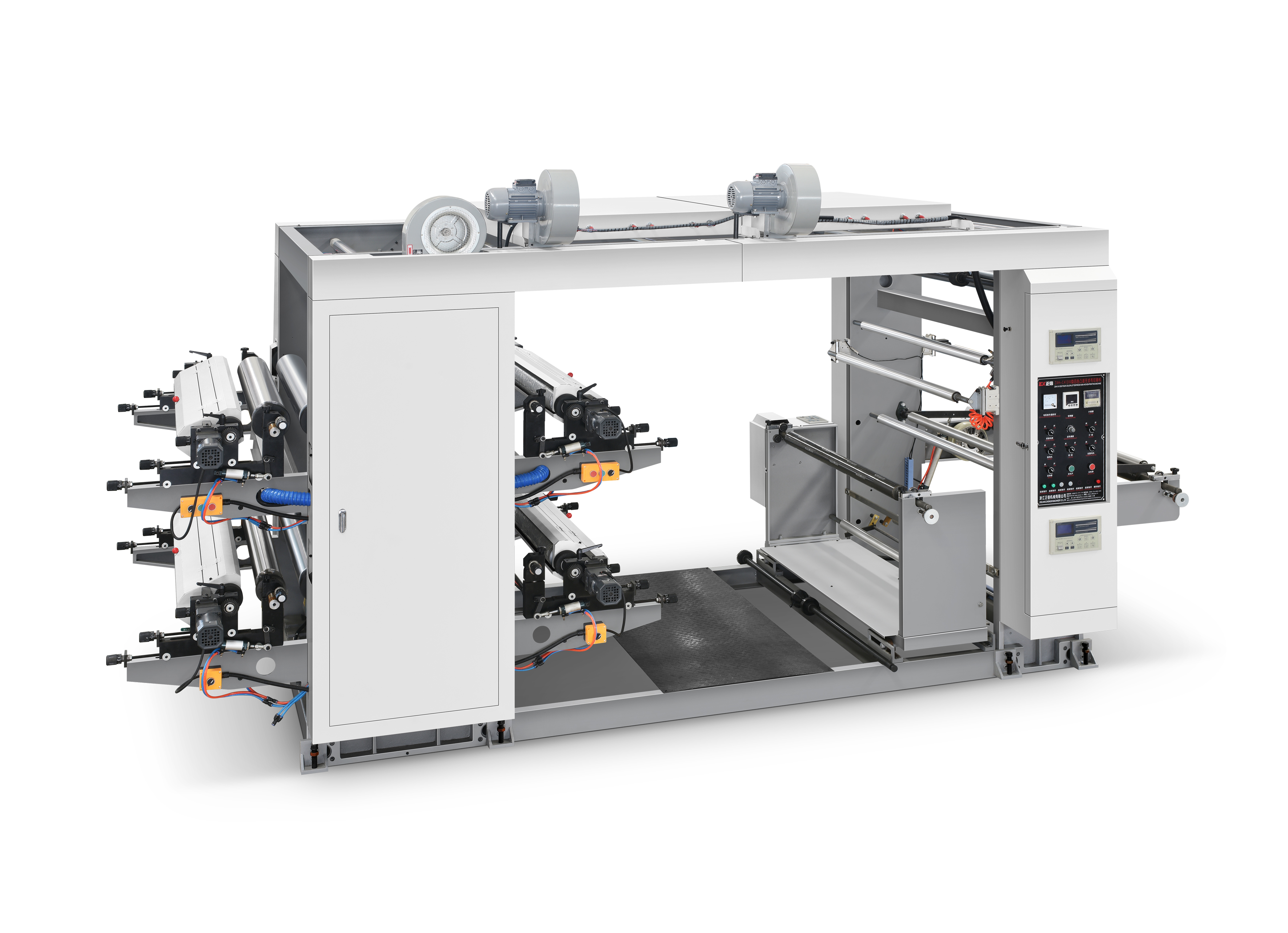
In the flexo segment, the ZXH-C21200 and ZXH-C41200 are roll-to-roll models with a maximum printing width of 1,160 mm and printing speed of 10–60 m/min. The ZXH-C21200 is a two-color unit with a compact 3,500 × 2,200 × 2,200 mm footprint and 1,500 kg weight, aimed at producers who need efficient printing without occupying large floor space. The ZXH-C41200 is a four-color unit with 18 kW total power, 4,600 × 2,200 × 2,400 mm dimensions, and 3,000 kg weight, built for multi-color designs that require tighter registration and faster job changeover.
In the screen segment, the ZXH-A1200 is a one-color screen printing machine with 1,250 mm maximum fabric roll width and a maximum print area of 1,100 × 1,200 mm. It prints in continuous or intermittent modes, uses a full servo motor for scraper control, and holds registration within 2 mm. The ZXH-B1200 is a two-color screen printing machine with a heavier 9,600 kg frame and 52 kW total power; its two printing units can complete two colors in one pass, which reduces manual handling.
Technical Explanation: Flexo and Screen Printing on Non-Woven Fabric
How flexo printing works in a bag line
Flexographic printing uses an anilox roller to meter a precise film of ink onto a flexible resin plate, which transfers the image to the non-woven fabric. Water-based ink is standard for non-woven bag work, and the printing station is followed by a drying section so the printed roll can be rewound or fed directly into bag making. On the ZXH-C21200, features such as air rising shaft, automatic guiding, magnetic powder tension control, and automatic stop on material breakage help maintain stable printing at speed. Anilox roller ink transfer is designed to keep ink distribution even and provide accurate color registration. The machine also supports automatic ink transport to keep ink wet during stops, which reduces cleanup and setup time.
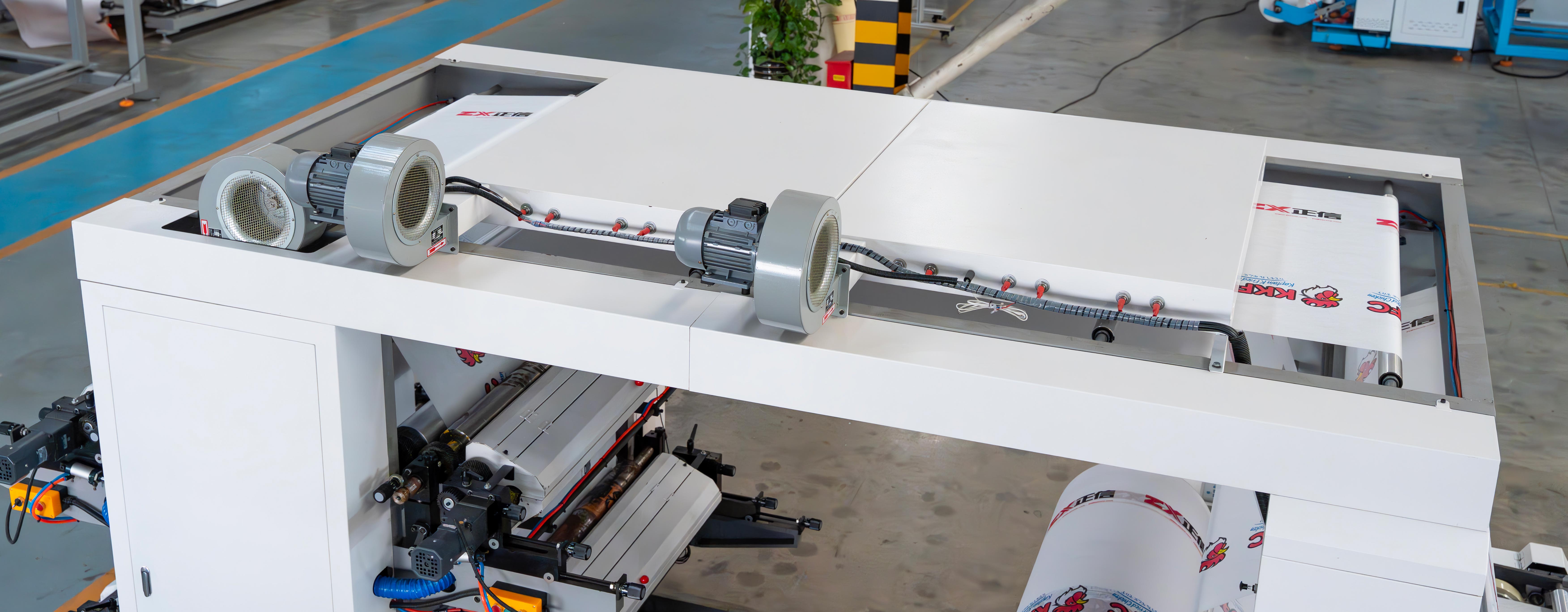
For the four-color ZXH-C41200, the engineering focus is registration and drying. Precision tension control holds four-color registration without color drift or ghosting at 60 m/min, and the drying airflow is optimized for non-woven fabric so ink cures at line speed. For a converter, this means printed fabric can move to the bag making stage without long waiting time between stations.
How screen printing differs
Screen printing uses a mesh screen stretched on a round roller. Ink is pressed through the open mesh areas by a scraper onto the fabric. The method deposits a thicker ink film than flexo, which gives high opacity for solid-color areas and strong color saturation. The ZXH-A1200 can run in continuous mode for small and medium simple patterns at up to 3,800 m per hour, or intermittent mode for medium-to-large patterns and precise registration, with average speed around 1,600 m per hour. Print position can be adjusted by moving the screen frame, reducing the need for multiple custom molds. The ZXH-B1200 uses two printing units for two-color work, and includes double-loop fabric winding in the drying oven, 25 heating tubes, and an automatic glue removal function.
The trade-off is visible in specifications. At the same width class, the screen printing models consume more power (26 kW for the A1200, 52 kW for the B1200) and occupy more floor space than the flexo models (8 kW and 18 kW for the C21200 and C41200). Screen printing is not a speed leader, but for large blocks of solid color it produces coverage that flexo cannot easily match.
| Factor | Flexo C21200 / C41200 | Screen A1200 / B1200 |
|---|---|---|
| Ink film | Thinner; good for logos, text, multi-color | Thicker; high opacity for solid color |
| Speed | 10–60 m/min roll-to-roll | 1,500–4,000 m/hour, intermittent lower |
| Color stations | 2 or 4 colors in one pass | 1 or 2 colors in one pass |
| Power | 8 kW / 18 kW | 26 kW / 52 kW |
| Footprint | 3.5×2.2 m / 4.6×2.2 m | 8.0×2.0 m / 11.5×8.0 m |
| Typical project fit | High-volume logos, retail bags, inline bag lines | Bold solid designs, promo bags, large print areas |
Application Scenarios: How Printing Machines Are Matched to Production Models
Promotional bags and corporate giveaways
The advertising and promotional products segment typically produces small-to-medium batches of custom printed tote bags for corporate events, trade shows, brand promotions, and conference giveaways. Operating mode is flexible, with 8–16 hour shifts and quick job changeover. Special requirements include print registration accuracy of ±0.3 mm and a premium surface finish for luxury brand packaging. In Tanzania, a promotional bag producer operates a ZXH-C21200 flexo printer alongside a ZXL-A700Ultra bag making machine. The facility expanded from one to two production lines within 18 months and handles more than 10 custom orders per week with different artwork, enabled by fast changeover between designs.
Food takeaway and delivery packaging
Food takeaway bag production demands odorless, non-toxic water-based ink printing and a cleanroom production environment. The typical workshop is dust-free with temperature controlled at 20–28°C and positive air pressure, running 24/7 with automated stacking and batch coding. An Egypt-based food packaging and retail shopping bag manufacturer has operated five Zhengxin units since 2017, including two ZXH-C21200 flexo printers. The machines produce food takeaway bags for restaurant chains and delivery platforms as well as multi-color printed promotional shopping bags for retail malls. The case is often cited as an example of one supplier supporting three distinct product lines.
Garment and fashion packaging
Garment packaging requires logo-printed non-woven garment bags, dust covers, and suit covers for clothing brands and export packaging. Production typically runs in 16-hour double shifts with one or two operators per machine. Supporting equipment includes a flexo printing unit, folding conveyor belt, and automatic handle punching and attaching unit. Material compatibility is a priority: anti-static treatment, a soft fabric-like handle feel, and wrinkle-free finished surfaces are common specifications. A compact flexo printer that can handle light-GSM non-woven without stretching the material fits this application well.
Retail and supermarket shopping bags
The supermarket scenario is the highest-volume application. Fully automatic shopping bag production lines run 24/7 from raw material feeding to bag stacking, with a target speed of at least 100 bags per minute and defect rate below 0.5%. For printing, the key requirement is consistent registration across long runs. In Kenya, a shopping bag manufacturer uses a ZXH-C41200 four-color flexo printer with two ZXL-A700 bag making machines. The installation operates as a fully automatic line from printing to finished bag, with a single operator managing the entire workflow, and supplies bags to more than 200 retail stores across the country.
Large multi-line integrated operations
In Indonesia, a manufacturing group operates 42 Zhengxin units, including 12 ZXH-A1200 screen printing machines. The fleet produces shopping bags for retail chains, multi-color printed promotional bags, food-grade takeaway packaging, and garment dust covers, supplying more than 1 million bags per month. The deployment illustrates that screen printing still has a clear role in large-scale operations, especially where bold one-color prints are needed in high volume or where separate print stations improve scheduling between printing and bag making.
Market Trend Analysis: Regulation and Automation Push Printing In-House
The regulatory environment remains the underlying growth driver. More than 100 countries have implemented plastic bag bans or taxes, and state-level rules such as California's SB 1046 continue to push retailers toward reusable alternatives. That policy signal is visible in equipment market estimates. LP Information projects the global non-woven bag making machine market to grow from US$179 million in 2025 to US$733 million by 2032, with a compound annual growth rate of 22.5% from 2026 to 2032. While this figure covers bag making machinery, the expansion of bag-making capacity inevitably increases demand for printing equipment that can be integrated into new lines.
Flexographic printing is part of the same trend. Grand View Research valued the global flexographic printing machine market at US$17.57 billion in 2024, with a projected CAGR of 9.7% through 2030. Flexo's use of water-based inks is one reason it is preferred for packaging applications that must meet food-contact and environmental criteria.
Automation is another clear signal. Dataintelo data shows the automatic segment held 52.4% of the bag making machine market in 2025, and Asia-Pacific contributed 43.6% of revenue. Automatic bag lines with inline printing reduce manual handling and produce consistent output, which is exactly what large retail and food customers require. Buyers researching a non woven bag printing machine should evaluate not only the print unit but how easily it connects to the rest of an automated line.
Comparison with Traditional Solutions
Before committing to printing equipment, converters often compare three alternatives: buying pre-printed fabric from a specialist, using a separate tabletop screen printing process, or outsourcing printed bag production entirely.
Buying pre-printed fabric removes the need for printing capital and operator skill, but it creates dependency on external lead times and minimum order quantities. For a converter with fluctuating order sizes, in-house printing shortens the loop between artwork approval and finished bag. The trade-off is absorbed in the machine cost and training requirement.
Separate tabletop screen printing is workable for very small runs, but manual handling between printing and bag making raises labor cost and registration risk. Roll-to-roll flexo and screen machines reduce that risk by printing the full width of fabric under guided tension.
There are real boundaries. In-house flexo printing is not the cheapest answer for ultra-short runs below roughly 500 bags per design; heat-transfer labels or outsourcing can be more economical when plate cost and setup time are spread over too few pieces. Flexo also does not deposit the same thick ink film as screen printing for very heavy solid-color coverage. And in-house printing requires a plant to develop color matching and registration skills; without that capability, a printer can become a source of waste rather than value. For this reason, supplier training and after-sales support are part of the equipment decision, not optional extras.
Future Outlook
Three directions are likely to shape the next phase of non-woven bag printing equipment. First, integration: printers will increasingly be specified as part of a complete line with bag making, counting, stacking, and coding. Second, changeover speed: as promotional and branded orders become shorter and more varied, plate-roller change, ink-tray cleaning, and recipe storage matter as much as top speed. Third, compliance-driven materials: water-based inks, food-safe workflows, and cleanroom-friendly designs will keep gaining weight as end-customer procurement standards tighten. Screen printing will retain a role for specific coverage needs, but flexo's speed and inline advantages position it as the default for most new non-woven bag printing projects.
For a detailed specification reference, buyers can download Zhengxin's company brochure: 2026 Zhengxin Machinery brochure (PDF). It covers the printing machine range and complete non-woven bag production line configurations.
FAQ
Should printing be flexo or digital for non-woven bags?
For most commercial non-woven bag production, flexo printing is the practical choice. Flexo ink cost per bag is very low at volumes above roughly 500 bags per design, and roll-to-roll flexo can be integrated with the bag making workflow. Digital printing is generally limited to ultra-short runs or photographic images, where its higher ink cost is less relevant. For standard supermarket logos, a two-color flexo unit covers a large share of demand; a four-color unit adds flexibility for premium multi-color designs.
What printing configuration is recommended for supermarket chain supply?
Supermarket supply normally requires high daily output, consistent print registration, and batch traceability. A common configuration is a fully automatic bag line with an inline flexo printer, often two-color for simple logos or four-color for branded designs, plus automatic counting and bundling and an inkjet date coder. The printer should hold registration across long runs, and the line should operate continuously with a defect rate below 0.5%.
How do flexo and screen printing differ when matched to a project?
Flexo printing uses an anilox roller and flexible plate, producing a relatively thin ink film at higher roll-to-roll speeds. Screen printing uses a mesh screen and lays down a thicker ink film, which gives high opacity for solid colors. Flexo is best suited to continuous printing of logos, text, and multi-color designs at commercial speed. Screen printing is a better fit for bold one-color or two-color prints where color saturation matters more than speed, or where very large print areas need uniform coverage.
What auxiliary equipment should be planned with a printing unit?
Beyond the printer itself, a typical printed bag line needs an air compressor with adequate capacity, a voltage stabilizer in grids with power fluctuation, and material handling equipment for fabric rolls. For printed retail and food packaging work, automatic counting and bundling machines and an inkjet date coder are commonly added. If fabric is bought in master rolls, a slitting machine can reduce material cost and improve scheduling flexibility.
How long does a design changeover take on a non-woven bag printing line?
Changeover time depends on the machine design and operator experience. Flexo machines with optimized plate-roller change and ink-tray cleaning can switch between designs in roughly 15–30 minutes for standard jobs, and PLC recipe storage reduces re-entry of parameters. Screen printing machines allow print position adjustment by moving the screen frame, which also shortens changeover when the design size changes.
What maintenance does a non-woven bag printing machine require?
Daily maintenance includes cleaning ink residue from rollers and screens, wiping photocell and registration sensors, and checking ink and drying systems. Weekly maintenance covers lubrication, belt tension, pneumatic hose checks, and air filter cleaning. Keeping printing components clean is the most direct way to avoid registration drift, color inconsistency, and downtime. The supplier should document the maintenance schedule and provide remote support for troubleshooting.