
Product Breadth as a Bulk Bag Supplier Continuity Signal
Long-term bulk bag supply is rarely decided by one quotation. It is decided by whether the supplier's range, specifications and documentation still fit the buyer's packaging mix two or three order cycles later — when the mix has widened from a single FIBC specification to chemical, UN-certified and food-grade variants, and then to PP woven rolls, valve bags and reusable logistics bags.
Bulk bags — also described as FIBC bags, Flexible Intermediate Bulk Containers, jumbo bags or ton bags — are large flexible containers used to store and move powders, granules, pellets and similar bulk materials. Their procurement logic differs from ordinary packaging because the bag is part of a handling system: it interacts with filling equipment, lifting equipment, pallets, containers and, in some cases, regulated dangerous-goods transport. Product breadth becomes commercially relevant only when each additional line carries its own documented parameters, certification scope and customization boundary. A supplier listing ten bag types without documented limits offers no more continuity than a single-line supplier.
Why Breadth Counts Only When It Is Documented
In a research-to-evaluation buying process, breadth is often read as a proxy for capability. That reading is only defensible when three things can be checked line by line. First, parameter completeness: does the supplier publish working load, construction options, lamination, top and bottom configurations, and printing scope for each bag family? Second, certification scope wording: does the certificate describe manufacturing activities, or a specific tested product? Third, customization thresholds: what minimum order, sample policy and production lead time apply when a buyer deviates from a stock specification?
A buyer who applies these three tests quickly separates a portfolio from a catalogue. A portfolio has specifications attached to each line. A catalogue has product names attached to nothing.
The Problem: Every Additional Packaging Line Restarts Qualification
Most industrial buyers do not purchase one bag type. A chemical processor may need UN-certified FIBC for regulated goods, standard industrial bulk bags for non-regulated powder, valve bags for an automatic powder filling line, PP woven bags and PP woven rolls for secondary packaging, and reusable logistics bags for internal transfer between warehouses. Under a multi-supplier model, each of those lines is qualified separately: separate samples, separate documentation packs, separate approval cycles, separate artwork approval for logo printing.
The cost is not only administrative. Specification drift appears when the same buyer logo is printed on five substrates from five suppliers, when colour references differ between woven lines, or when one supplier's lamination definition does not match another's. Consolidation is therefore an operational decision before it is a commercial one.
The opportunity lies in treating breadth as a continuity signal: if one supplier already produces the adjacent lines under a documented quality system, adding a new bag type later requires less re-qualification than starting from zero.
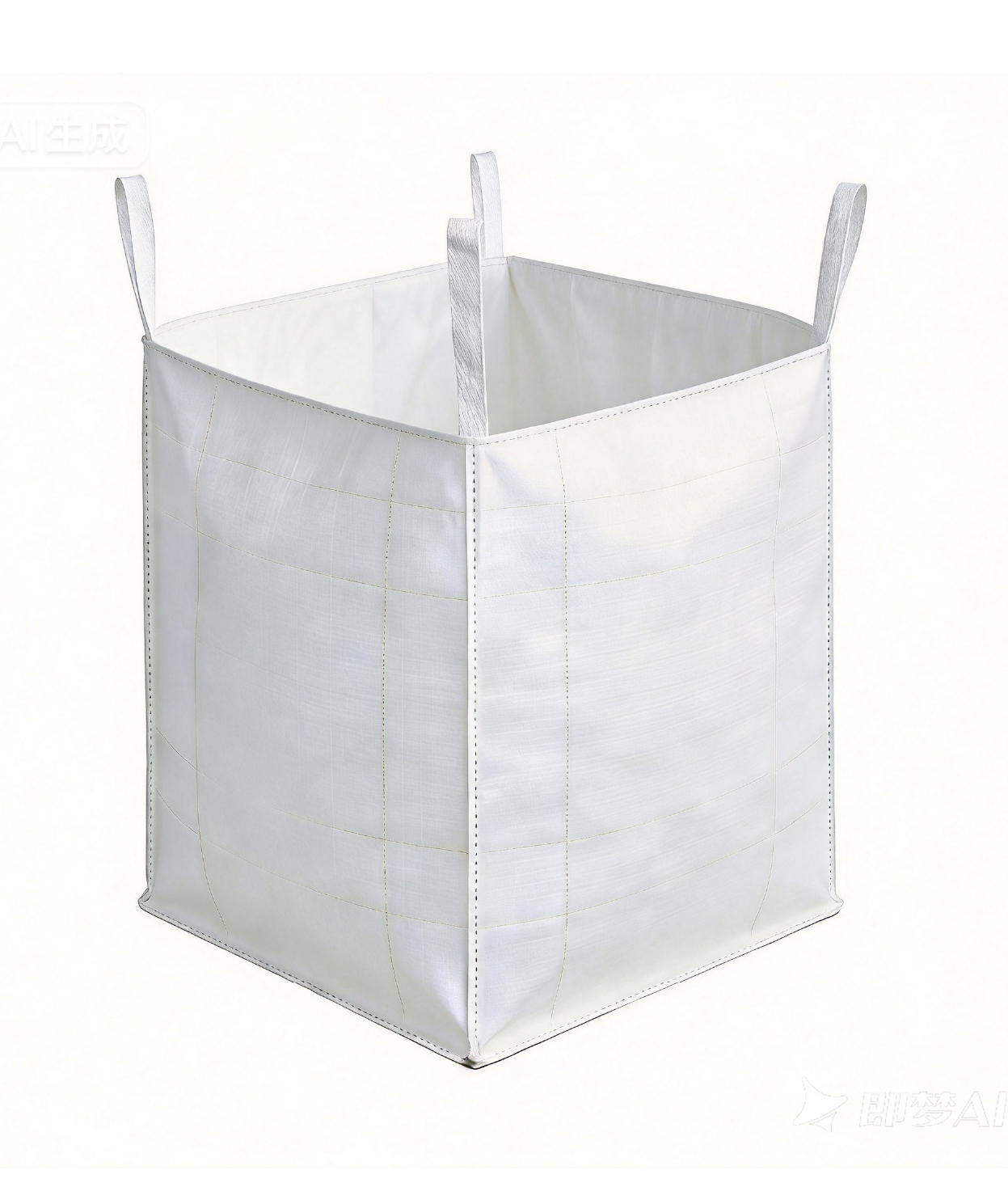
Food-grade FIBC bulk bags: one of four bulk bag lines buyers should verify separately when judging supplier continuity.
The Four Bulk Bag Lines to Verify First
Within the bulk bag category, four product lines carry different risk profiles and therefore different documentation needs. A supplier that covers all four with explicit specifications is materially easier to keep in a long-term panel.
| Bulk bag line | Documented attributes | What it signals to a buyer |
|---|---|---|
| Industrial FIBC bulk bags | PP woven body with optional waterproof lamination; U-panel, circular, four-panel and baffle constructions; customized filling spouts, discharge spouts and lifting loops; high-tensile polyester thread sewing; safe working load 500–2000 kg | Core structural competence and the ability to match filling and discharge equipment rather than sell a fixed shape |
| Chemical bulk bags | Positioned within the same FIBC range; laminated or non-laminated construction; used across chemical, new-energy, mining, agriculture, food and logistics warehousing industries | Familiarity with demanding powder and granule duty, plus a lamination option that changes moisture behaviour |
| UN-certified FIBC bags | UN certification for dangerous goods packaging available; separate UN Packaging Test Report No. 2513230601001079 issued by Nanjing Customs Dangerous Goods and Packaging Testing Center covers a 600×1050 mm paper-plastic woven bag drop performance test under SN/T 0510.2-2021 | Access to regulated-goods packaging, and a clear example of how narrowly a test report should be read |
| Food-grade FIBC bulk bags | Food-grade FIBC bulk bags included in the range; production base includes a 5,000 ㎡ food-grade clean workshop | Segregated production space, which matters when hygiene requirements sit alongside industrial lines |
Table 1. Four bulk bag lines, their documented attributes, and the continuity signal each one carries.
Two technical points deserve emphasis because they are frequently misread. Type-C construction, where used, relies on conductive yarns to dissipate static electricity and requires reliable grounding during operation; the bag is suitable for flammable and explosive powder conditions only within that grounding discipline. And a UN packaging test report is product-specific: the report above certifies a defined bag size and structure for drop performance, not every bag in the range.
Adjacent Lines: Where Breadth Becomes Credible
Bulk bags alone can be assembled by a converter with limited upstream control. Adjacent woven and film lines are harder to fake, because they expose weaving, lamination, printing and closure competence.
PP woven rolls
PP woven rolls are supplied as base material for downstream converting, in flat woven or tubular form. Fabric weight, weaving density, warp strength and weft strength are customizable; roll width, roll diameter and core size can be set for different bag-making machines; GSM and roll width are defined per order requirement. Standard colours are white, yellow and green, with custom colours and colour printing available. A supplier able to define roll specifications per converting machine is usually closer to the weaving stage than a trading intermediary.
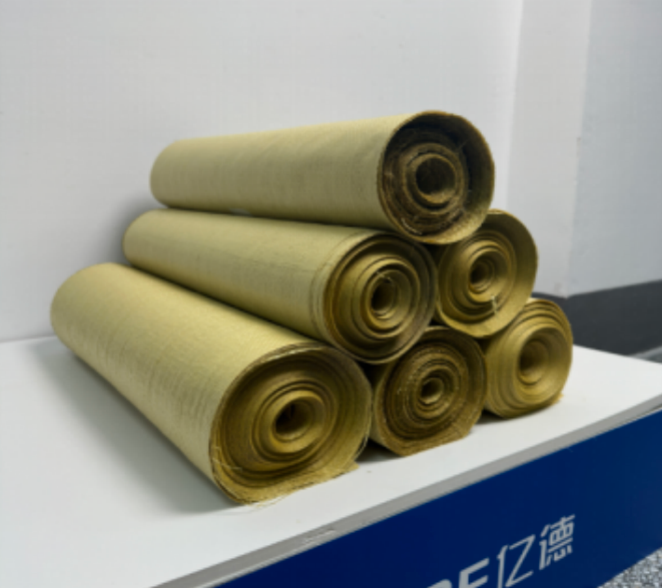
PP woven rolls: width, diameter, core size, fabric weight and weaving density are set per order, which is a stronger capability signal than a fixed stock list.
Valve bags
Valve bags serve automatic powder filling lines. Available structures include OPP film lamination, standard paper-plastic composite, three-ply paper with inner film and two-ply paper without film; size is customizable and custom colour printing uses fade-resistant ink. The material choice is a functional decision: film-lined versions provide water and moisture resistance, while non-film versions remain breathable but not waterproof. A supplier that explains that trade-off openly is easier to work with on a multi-year programme than one that presents all structures as equivalent.
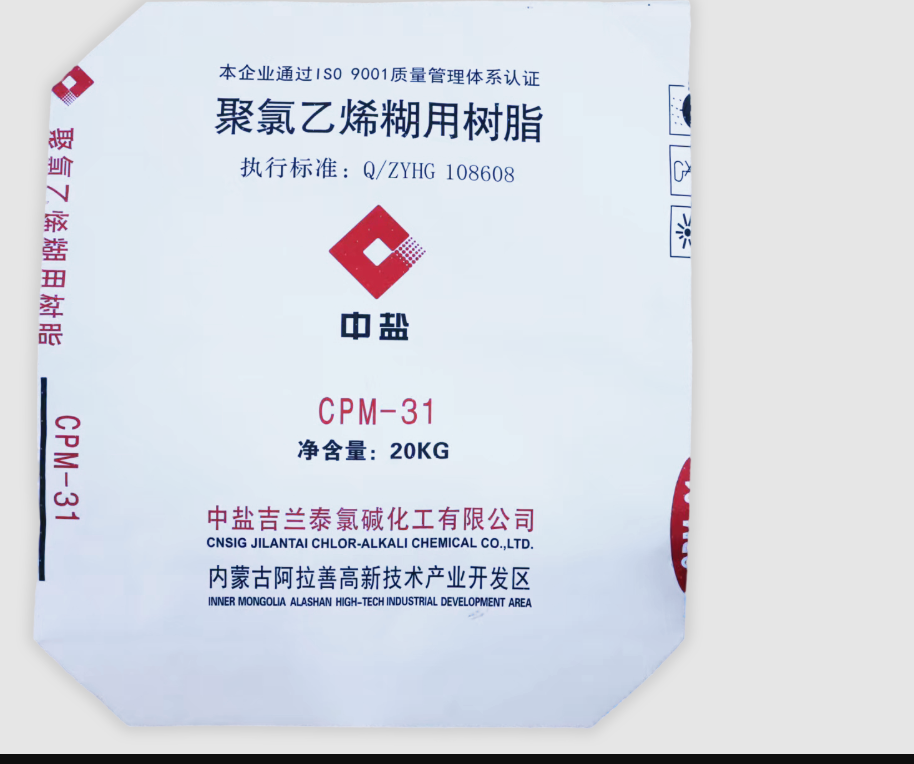
PP woven valve bags: an adjacent line that tests whether a supplier understands filling equipment, not only bag dimensions.
Reusable logistics and transit bags
Reusable logistics bags and express transfer bags use PE woven fabric with optional lamination; the laminated version is waterproof and stain-resistant, and the construction is described as wear-resistant with high load-bearing capacity. Available opening styles include a zipper style with zipper protector, lockable buckle and zipper-tooth protection, and a round opening style. Standard sizes are 100×100 cm with customization available, and colours include blue, white, light-green, green, yellow, red and orange-red with custom printing.
Paper-plastic composite bags complete the picture for powder and granular duty: kraft-paper laminated construction, optional lamination, optional inner liner, custom sizes and printing, and reusability. For buyers whose packaging mix crosses industrial, food and logistics boundaries, this is the layer that turns breadth into a genuine consolidation argument.
Customization Signals That Predict Continuity
Customization is often presented as a list of options. For long-term supply, the more useful question is which parameters the supplier can control simultaneously, and at what threshold.
| Customization area | Documented scope | Why it matters over a multi-year contract |
|---|---|---|
| Dimensions and capacity | Bag sizes customizable on demand; stock PP woven sizes include 110×120 cm, 90×110 cm, 100×120 cm, 100×140 cm, 90×100 cm and 50×80 cm, with custom sizes beyond that range | Allows re-specification when filling lines, pallet patterns or container loading plans change |
| Load and structure | Safe working load 500–2000 kg; U-panel, circular, four-panel and baffle constructions; four lifting loops; fill spout, full open top, top cover; discharge spout or flat bottom | Keeps the bag aligned with lifting equipment and discharge methods as operations evolve |
| Materials and lamination | Virgin PP woven fabric and conductive woven fabric; laminated or non-laminated options; reinforced thickened anti-static fabric for Type-C duty | Lets one supplier serve both moisture-sensitive and breathable requirements |
| Printing and colour | Custom text and logo printing; standard PP woven colour green with custom colours available; fade-resistant ink on valve bags; reusable logistics bags in seven standard colours | Protects brand consistency and traceability across bag families |
| Closures and access | Zipper style with zipper protector, lockable buckle and zipper-tooth protection; round opening style; valve and open-mouth options | Reduces the need for secondary suppliers when handling or security requirements change |
| Programme thresholds | Single sample available for delivery; MOQ for customized products 5,000 pcs; lead time for customized products 45 days excluding delivery; monthly capacity 50,000 pcs; shortage handling by re-delivery or corresponding deduction | Sets realistic expectations for trial orders, scale-up and replenishment |
Table 2. Customization signals and the continuity questions each one answers.
The threshold row is the one buyers most often skip. A 5,000-piece minimum for customized products and a 45-day production lead time are workable for programme buying but not for emergency top-ups; a single sample allows technical validation before commitment. Sample confirmation without printing is a documented step, which is normal practice but should be scheduled into the approval timeline rather than treated as an afterthought.
The Certification Layer: Read the Scope, Not the Logo
Certification is the strongest available proxy for continuity, provided the scope statement is read as written. Management-system certificates describe activities; test reports describe a product. Conflating the two is the most common evaluation error in bulk bag sourcing.
| Certificate or report | Reference | Scope and validity |
|---|---|---|
| ISO 9001 | 12426Q00719R001, Zhongbiaoyan Guolian (Beijing) Certification Center | Quality management system; GB/T 19001-2016 / ISO 9001:2015; scope covers manufacturing of mail bags including FIBC, transit bags and woven bags; valid 2026-08-05 to 2029-08-04 |
| ISO 14001 | 12426E00299R001, Zhongbiaoyan Guolian (Beijing) Certification Center | Environmental management; GB/T 24001-2016 / ISO 14001:2015; scope covers environmental management activities for FIBC, transit bag and woven bag manufacture; valid 2026-08-05 to 2029-08-04 |
| ISO 45001 | 12426S00261R001, Zhongbiaoyanguolian (Beijing) Certification Center | Occupational health and safety; GB/T 45001-2020 / ISO 45001:2018; scope covers postal bag production including FIBC/bulk bags, transfer bags and woven bags; valid 2026-05-08 to 2029-04-08 |
| REACH (SVHC) | DGC260127018YD03, Dongguan Beice Standards Technical Service Co., Ltd. | 251-item Substances of Very High Concern screening test for packaging bags (white woven bags); REACH Regulation (EC) No 1907/2006; issued 2026-07-31 |
| RoHS | A2260656737101001C, CTI (Centre Testing International) | RoHS Directive 2011/65/EU and Amendment 2015/863/EU; applies across PP woven bags, ton bags, express transfer bags, valve bags and paper-plastic composite bags |
| Halogen content | DGC260127018YD02, Dongguan NTEK Standard Technical Service Co., Ltd. (NTEK) | Halogen (F, Cl, Br, I) content testing of white woven packaging bags under BS EN 14582:2016; also referenced for valve bags, paper-plastic composite bags and express transfer bags |
| UN packaging test | 2513230601001079, Nanjing Customs Dangerous Goods and Packaging Testing Center | Drop performance test of a 600×1050 mm paper-plastic woven bag under SN/T 0510.2-2021; no leakage or safety-relevant damage after drop; issued 2025-09-23 |
Table 3. Documentation sample showing how management-system certificates and product test reports differ in scope.
For a long-term panel, the practical rule is to record the expiry date of every management-system certificate and the issue date of every test report in the same supplier file. Certificate cycles are typically three years, so a multi-year contract will cross at least one renewal; buyers who track renewal dates avoid discovering a lapse during an audit.
Standards Movement Buyers Should Track
Bulk bag requirements are not static, and 2024 to 2026 produced meaningful movement. ISO 21898:2024 specifies materials, construction and design requirements, type test and marking requirements for flexible intermediate bulk containers intended to contain non-dangerous solid materials in powder, granular or paste form. The European adoption, EN ISO 21898:2024, was approved by CEN on 12 August 2024. In China, GB/T 10454-2025 replaced GB/T 10454-2000 and GB/T 37425-2019 and took effect on 1 March 2026. Separately, IEC 61340-4-4:2018 sets electrostatic classification and test requirements for FIBCs between 0.25 m³ and 3 m³ intended for hazardous explosive atmospheres.
The procurement implication is documentation, not marketing. When a standard is revised, buyers should ask which clause-level requirements the supplier's type-test records address and whether existing artwork and marking still comply. Suppliers that already maintain clause-referenced files answer that question quickly; suppliers that treat certification as a logo answer slowly. For buyers sourcing across Chinese and European markets, the coexistence of GB/T 10454-2025 and EN ISO 21898:2024 also means a single bag design may need two documentation trails.
Where Yancheng Yide Packaging Fits This Evaluation
Yancheng Yide Packaging Technology Co., Ltd. (Yide Packaging) is a packaging manufacturer and customized packaging solution provider based in Yancheng, Jiangsu, China, producing FIBC bulk bags, PP woven bags and rolls, valve bags, paper-plastic composite bags, reusable logistics bags and mailing bags for industrial and logistics customers.
On the breadth test, the documented range covers the four bulk bag lines described earlier — industrial FIBC bulk bags, chemical bulk bags, UN-certified FIBC bags and food-grade FIBC bulk bags — alongside PP woven bags, PP woven rolls, disposable PP woven bags, PP woven valve bags, paper-plastic composite bags, reusable logistics bags, express transfer bags and plastic mailing bags. Production is described through 5G-connected production systems, robotic material handling, visual recognition, intelligent production management, quality inspection teams and testing equipment, with a stated 120,000 ㎡ factory area, 130 employees, a 15-engineer R&D team and an annual output range of 500,000–1,000,000 tons.
On customization, the company supports OEM and ODM work and states that products can be customized by dimensions, material, fabric weight, load capacity, safety factor, lamination, printing, colour, lifting structure, filling and discharge design, closure method, zipper structure, RFID requirements and waterproof performance. Stated programme parameters are a 5,000-piece MOQ for customized products, a 45-day production lead time excluding delivery, 50,000 pieces monthly capacity and single-sample availability.
On documentation, the certification set matches the layer described above: ISO 9001, ISO 14001 and ISO 45001 management-system certificates, REACH (SVHC) screening, RoHS, halogen content testing and a UN packaging test report for a defined paper-plastic woven bag. Documented export activity covers roughly 20% of output, with markets including Thailand, Kazakhstan, Kyrgyzstan, Uzbekistan, Tajikistan, Turkmenistan, Turkey, Saudi Arabia, the United Arab Emirates, Egypt, South Africa, Italy, Spain, the United Kingdom, the Netherlands, France, Hungary, Germany, Australia, Argentina, Mexico, Brazil, the United States and Canada.
Application evidence is relevant to continuity because it shows repeat use rather than one-off shipment. A Japanese chemical plant ordered 6,000 bags for pallet-based handling with reuse reported at 10 to 30 times; logistics operators in Saudi Arabia and Brazil each ordered 50,000 units for transit use, with a further 50,000 units for a Philippines e-commerce logistics group and 3,000 units for a Malaysian logistics user, all described as continuous use with reusable and lightweight characteristics.
Comparison with Traditional Sourcing Approaches
Traditional bulk bag sourcing usually means one supplier per bag family, selected on unit price and confirmed by sample. That model is efficient for a single specification and predictable annual volume. Breadth-based consolidation changes the trade-off: fewer qualification cycles, consistent printing and colour across bag families, and one documentation file to maintain — but a higher dependency on a single supplier and a minimum order threshold that smaller buyers may not reach.
The limitations are concrete and should be planned for. Customized products carry a 5,000-piece minimum and a 45-day production lead time excluding delivery, which rules out breadth-based sourcing for emergency replenishment. Standard PP woven colour is green, so buyers needing a specific brand colour must budget for custom colour work rather than assume it. Type-C FIBC requires reliable grounding during operation; without that discipline, the static-control design does not deliver its intended function. Non-film valve bags are breathable but not waterproof, so moisture-sensitive powders need the film-lined structure. And the UN packaging test report on file covers a defined 600×1050 mm paper-plastic woven bag drop test — it should not be presented, or accepted, as blanket UN approval for every bag in the range.
Breadth also does not guarantee equal depth in every line. PP woven roll specifications such as GSM and width are set per order rather than published as a fixed catalogue, which is normal for a converting input but means the buyer must specify rather than select. Where a line is critical, the sample route remains the reliable test.
Application Scenarios That Test Breadth
Three scenarios show where a documented multi-line range reduces friction. In mining and minerals, bulk bags handle iron ore, manganese ore, mineral powder and industrial minerals, with reuse possible after inspection for damage, compromised lifting loops and contamination — a discipline that requires consistent bag construction across replenishment orders. In fine chemicals, powder filling of materials such as PVC paste resin demands leak-proof, moisture-proof containment compatible with automatic filling and export marking, which links bulk bags to valve bag and paper-plastic composite decisions. In logistics and e-commerce, reusable transit bags with zippered or round openings serve sorting and warehouse handling, a different duty cycle from bulk bags but often bought by the same organisation.
Agriculture adds a fourth pattern: grain processing operations in markets such as Thailand use bulk packaging for transport and warehousing, where bag dimensions must match local handling and storage practice rather than a single global default.
Future Outlook
Two directions are visible in the documented data. The first is documentation discipline: with ISO 21898:2024 in force internationally, EN ISO 21898:2024 approved in Europe and GB/T 10454-2025 effective in China since 1 March 2026, buyers will increasingly ask for clause-referenced type-test records rather than certificate images. Suppliers that maintain that file structure will qualify faster in every subsequent tender.
The second is material transition. The documented range already includes biodegradable poly mailers using PLA + PBAT + starch composite raw materials, described as achieving over 90% degradation in a natural environment within 6 to 9 months and complying with regulations such as EU EPR. If that material logic extends into woven lines, breadth will be redefined again: the continuity question will not be how many bag types a supplier lists, but how many of them can be re-specified against a changing regulatory baseline without a new supplier search.
Frequently Asked Questions
Which certifications should a long-term bulk bag supplier be able to document?
A practical minimum is a quality management system certificate with a scope covering FIBC, transit bag and woven bag manufacture, plus environmental and occupational health and safety certificates where the buyer's own audit programme requires them. For regulated markets, chemical screening documentation such as REACH (SVHC) and RoHS adds value, and halogen content testing under BS EN 14582:2016 is relevant where halogen limits are specified. Product-level test reports, such as a UN packaging drop test report, should be requested separately because they describe a specific bag rather than a manufacturing system.
Does a UN-certified FIBC line mean every bulk bag in the range is UN-rated?
No. UN certification for dangerous goods packaging is available as an option within the FIBC range, and it applies to the constructions and specifications that were tested and certified. The documented UN Packaging Test Report No. 2513230601001079, issued by Nanjing Customs Dangerous Goods and Packaging Testing Center, covers a 600×1050 mm paper-plastic woven bag drop performance test under SN/T 0510.2-2021, with no leakage or safety-relevant damage after drop. Buyers should match the tested construction and size to their own specification before treating a bag as UN-rated.
Which bulk bag variants should a supplier's range include for a mixed industrial portfolio?
Four variants cover most mixed portfolios: industrial FIBC bulk bags for general powder and granule duty, chemical bulk bags for more demanding chemical applications, UN-certified FIBC bags where dangerous goods packaging is required, and food-grade FIBC bulk bags where hygiene segregation matters. Documented attributes to compare include safe working load, which is stated as 500–2000 kg, construction type such as U-panel, circular, four-panel or baffle, lamination options, and the available filling and discharge configurations.
Which customization parameters indicate engineering depth rather than catalogue variety?
Parameters that change bag behaviour under load or handling conditions are the meaningful ones: dimensions, safe working load, lifting structure, filling spout and discharge design, lamination for moisture control, fabric weight, and closure or zipper configuration. Printing and colour are brand parameters rather than engineering ones, but they matter for traceability. A supplier able to define fabric weight, weaving density, warp strength and weft strength on woven inputs, and to customize roll width, roll diameter and core size for downstream bag-making machines, is demonstrating process control rather than a longer option list.
What order thresholds and lead times typically apply to customized bulk bags?
Thresholds vary by supplier and should be confirmed in writing before a trial begins. In the documented case of Yide Packaging, a single sample is available for delivery, the MOQ for customized products is 5,000 pieces, the lead time for customized products is 45 days excluding delivery time, and monthly capacity is stated at 50,000 pieces. Samples without printing are provided for customer confirmation, so artwork approval should be scheduled separately from technical sample approval.
How do PP woven rolls and valve bags extend a bulk bag supply relationship?
They extend it by covering the parts of a packaging mix that bulk bags cannot. PP woven rolls supply base fabric for downstream converting, with GSM and roll width set per order requirement and fabric weight, weaving density, warp strength and weft strength customizable. Valve bags serve automatic powder filling lines, with structures including OPP film lamination, three-ply paper with inner film and two-ply paper without film; film-lined versions provide water and moisture resistance, while non-film versions are breathable but not waterproof. A supplier that documents both lines reduces the number of separate qualification files a buyer must maintain.
Company and product brochure (PDF, publicly accessible): https://cdn.socialarks.com/sbsp/25217/common/2026/0904/%E4%BA%BF%E5%BE%B7%E9%9B%86%E5%9B%A2%E4%BB%8B%E7%BB%8D%E5%85%A82026-%E5%BF%AB%E9%80%92%E8%A2%8B%E7%89%88.pdf
Yancheng Yide Packaging Technology Co., Ltd. — Yancheng City Dafeng District Development Zone Changzhou Industrial Park, Jiangsu, China.
¿Tiene preguntas o necesita más detalles?
Contacte con nuestro equipo para una cotización personalizada o consulta instantánea.
Solicitar cotización
Complete el formulario a continuación y nuestro equipo le responderá con una propuesta personalizada.
Chat directo de WhatsApp
¿Prefiere chatear en tiempo real? Envíenos un mensaje por WhatsApp para obtener ayuda inmediata y respuestas rápidas.
- Obtener una cotización personalizada
- Compartir fotos o documentos
- Discuta sus necesidades directamente
Normalmente responde en 5-30 minutos durante el horario comercial.