
Procurement FAQ: What a 36-Year Factory Offers Beyond Startups
Hotel Furniture Procurement · Supplier Evaluation
Hotel furniture procurement rarely fails because a supplier cannot build a credenza. It fails because the supplier’s structure — plant capacity, engineering depth, workforce continuity and inspection discipline — does not match the construction schedule, the brand standard, or the site’s inspection regime. This FAQ answers the questions that new hotel development teams raise most often when they weigh a long-established manufacturer against a recently founded one.
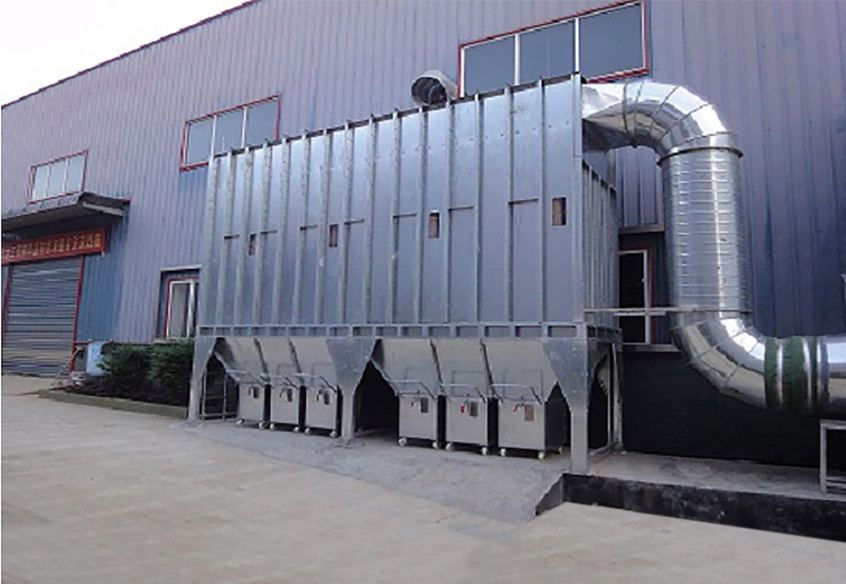
Environmental protection and purification equipment on the production floor of a 100,000 m² hotel furniture manufacturing facility in Dawang High-tech Industrial Park, Zhaoqing.
The short answer
A factory that has operated for three and a half decades, with a stated annual capacity of several hundred million yuan, is not simply “older”. It carries structural assets that a new entrant cannot assemble quickly: a fixed production footprint, an in-house engineering department, a stable workforce, and audited quality and environmental management systems.
Guangdong Richang Furniture Co., Ltd. (RICHART) is one worked example. Established in 1990, the company produces high-end movable (loose) and fixed furniture for four- and five-star hotels, engineering-supported design, and luxury projects including clubs, mansions, villas and large-scale developments. It is located in the 100,000 m² Dawang High-tech Industrial Park in Zhaoqing City, Guangdong Province, China, employs approximately 1,000 staff, and reports an annual production capacity of CN¥500,000,000.
Each of those elements is independently verifiable before a contract is signed, and each one removes a specific category of project risk. The sections below treat the standard buyer questions in the order they usually appear in a tender review.
Why “how long have you been operating?” is really four questions
When a development team asks about supplier age, the underlying questions are more concrete: Can you physically hold my package in one production sequence? Who will resolve the details the designer left open? Will the people who built my mock-up still be in the same departments in eighteen months? And what written process proves the output was checked before shipment?
These four questions are where project-scale manufacturers and newer entrants diverge most clearly. Factories with decades of continuous operation tend to answer them from existing infrastructure; younger suppliers more often answer them from intent and outsourcing. That difference is what makes supplier longevity a legitimate procurement criterion rather than a sentimental one.
The procurement questions, answered
1. What order sizes does a project-scale factory actually accept?
Minimum order quantities in hotel furniture are usually not a single number. They are driven by material batching and finishing runs: a veneer or lacquer batch, a stone or marble lot, a fabric or leather dye lot, and a metal plating run each carry practical minimums. Those minimums — not sales policy — set how small an order can efficiently be produced.
Hotel work is therefore normally structured by zone or room type rather than by individual piece: a guest-room casegoods package, a lobby seating package, a restaurant and bar package, a banquet package. A plant with 100,000 m² of production space and an annual capacity of CN¥500,000,000 is organised around multi-zone packages of that shape. The productive question for a buyer is not “will you take one chair” but “how will you group my package into efficient production lots”.
For phased openings, buyers should confirm in writing which zones can be combined into a single production window and which materials impose the floor on quantity. That conversation usually determines whether a phased schedule is realistic or whether it simply multiplies finishing runs and cost.
2. How is lead time structured, and what actually controls it?
Lead time on a five-star furniture package is controlled by four gates, and only one of them sits on the factory floor:
- Design freeze — shop drawings approved and brand-standard comments formally closed.
- Material procurement — availability of veneer, stone, metal, leather and fabric, including batch and dye-lot matching.
- Mock-up approval — the physical sign-off that locks finish, proportion and comfort.
- Production, inspection and packing — sequenced by zone and by installation order.
A factory that performs woodworking, sanding, painting, assembly, upholstery and packaging on one site removes the inter-plant transport and repeated re-inspection steps that create unpredictable time when work is distributed across separate workshops. That is a structural advantage of vertical integration, and it is verifiable: buyers can ask which processes are carried out in-house and which are subcontracted.
Where a long-established factory cannot compress time is at the front end. If drawings are not frozen, no amount of capacity accelerates the job. Project teams should treat drawing approval, not purchase order date, as the realistic start of the clock.
3. What does engineering-supported design mean when a specification is incomplete?
Most hotel FF&E specifications arrive as design intent rather than manufacturing instruction. The gap between the two — radii, joinery tolerances, structural reinforcement, hardware selection, cable management, ventilation for minibar units, fixing methods to a wall that may not yet be built — is closed by an engineering department, not by a workshop foreman.
RICHART maintains an in-house R&D team of 100 engineers and lists engineering-supported design as a core service alongside furniture production. For a development team, the practical test is whether the supplier can issue dimensioned shop drawings, material and hardware schedules, and installation details that a general contractor can build to — and whether that engineering archive is refined and reused across repeat hotel projects rather than rebuilt from zero on every job.
4. What protects the buyer when items fail inspection or site conditions change?
Rework risk is managed at three points, and buyers should require evidence at each:
- Before shipment: in-factory inspection of dimensions, finish, hardware function and upholstery. RICHART states that every product undergoes rigorous quality inspection before it leaves the plant.
- At delivery: a joint inspection protocol measured against the approved mock-up, recorded with photographs and a written rectification list.
- After installation: installation and after-sales service, with warranty and rectification terms written into the contract.
Site conditions change: a wall moves, a column appears, a door swing is reversed. A supplier with its own engineering team and its own workshop can respond with revised shop drawings and matched replacement components; a supplier without in-house production can only relay the problem to a third party and wait. The commercial terms of rework, however, remain a contract matter — no supplier profile substitutes for a clear written rectification clause.
5. How can a new development team verify workforce stability?
Workforce stability shows up in three measurable places: total headcount, the ratio of engineers to production staff, and how long core processes have run at the same site. RICHART employs approximately 1,000 staff, including an R&D team of 100 engineers, from a manufacturing facility in the Dawang High-tech Industrial Park in Zhaoqing, operated since the company was established in 1990.
The verification method is straightforward. Ask for headcount by department, ask which departments are permanent rather than seasonal or contracted, and ask how finishing and upholstery staff are retained between projects. Skill loss in finishing and upholstery is the most common cause of visible inconsistency between a first-phase delivery and a second-phase delivery, and it is the risk that a long-tenured workforce most directly reduces.
6. What compliance documentation should accompany a five-star furniture order?
At minimum: management-system certificates, product test evidence against the fire and durability standards named in the specification, and material declarations covering formaldehyde emission and VOC content. RICHART’s production process complies with ISO 9001:2008 (quality management), ISO 14001:2004 (environmental management) and OHSAS 18001:2007 (occupational health and safety), and the company holds China Environmental Labeling Product certification.
Where a project falls under UK hospitality fire expectations, upholstered items are commonly specified to BS 5852 CRIB 5. Where a project follows North American commercial furniture practice, public and lounge seating durability is commonly specified against ANSI/BIFMA X5.4-2020 (R2025). Standards of this kind are named in the specification; the supplier’s obligation is to provide evidence against them, not to reinterpret them.
Materials, finishes and the technical baseline
The material vocabulary of a five-star package is broad, and it is the substrate for both the MOQ and the lead-time questions above. Typical substrates and finishes include veneer, solid wood, MDF and plywood, marble and stone, stainless steel, brass and bronze, metal, paint, leather, fabric and velvet, glass, acrylic, melamine, laminate and foam — assembled through full customization rather than selected from a fixed catalogue.
Hotel applications usually add performance requirements that govern material selection: fire retardancy, low formaldehyde emission, high load capacity, and wear resistance on high-contact surfaces. RICHART lists these among the special requirements for its hotel furniture applications. Products are also specified for indoor use in stable, low-humidity and low-dust environments, with surface protection designed to be scratch- and wear-resistant. Those conditions determine how a finish reads after several years of guest traffic, not how it reads at handover.
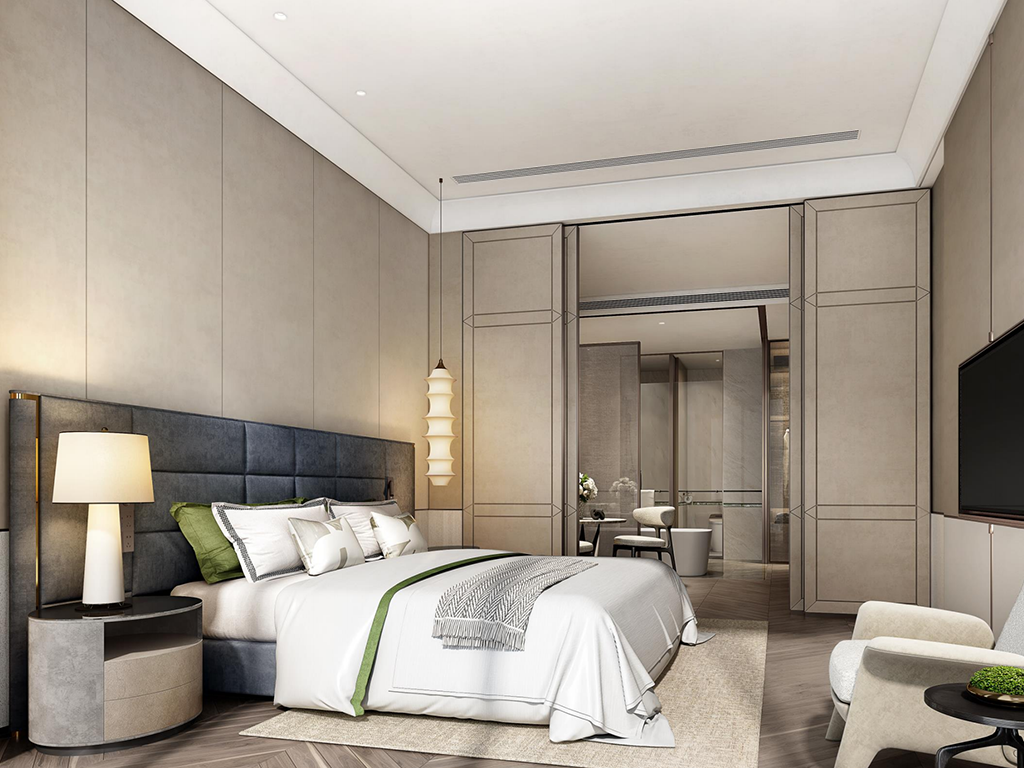
Custom hotel bedroom furniture: an upholstered bed and casegoods package, the room type that sets repeatable production volumes in a project order.
Where the capability applies, zone by zone
The same manufacturing base serves every zone, but each zone places different demands on engineering and durability.
- Guest rooms and suites: headboards, bed frames, nightstands, writing desks and desk chairs, wardrobes, dressers, minibar cabinets, luggage racks, safe cabinets, TV joinery and other casegoods, plus upholstered armchairs, ottomans, coffee and side tables.
- Lobby and public areas: reception and concierge counters, lobby sofa sets, armchairs, accent chairs, console and coffee tables, high tables and bar stools — the highest-load seating and the most scrutinised surfaces in the building.
- Restaurants and bars: dining tables and chairs, banquette and booth seating, bar counters and bar stools, buffet and server tables, private dining furniture and display joinery.
- Banquet and function spaces: banquet tables, stacking chairs, head tables, stages, lecterns, buffets and servery counters.
- Executive lounges and meeting floors: modular seating, meeting tables, work desks, high stools, poufs and magazine displays.
RICHART’s reference base spans international hotel brands including St. Regis, InterContinental, W Hotels, The Ritz-Carlton, Hyatt, Park Hyatt, Conrad, Marriott, Shangri-La, Hilton, Renaissance, Sheraton, Westin, Wyndham, Wynn, Banyan Tree, Anantara and Kempinski, as well as Chinese real estate developers such as KWG, Wanda, R&F, Greentown and Poly. The company states that it has supplied products and services to more than 500 high-star hotels worldwide, that export accounts for roughly 60% of its business, and that its global marketing network covers more than 20 countries and regions across five continents.
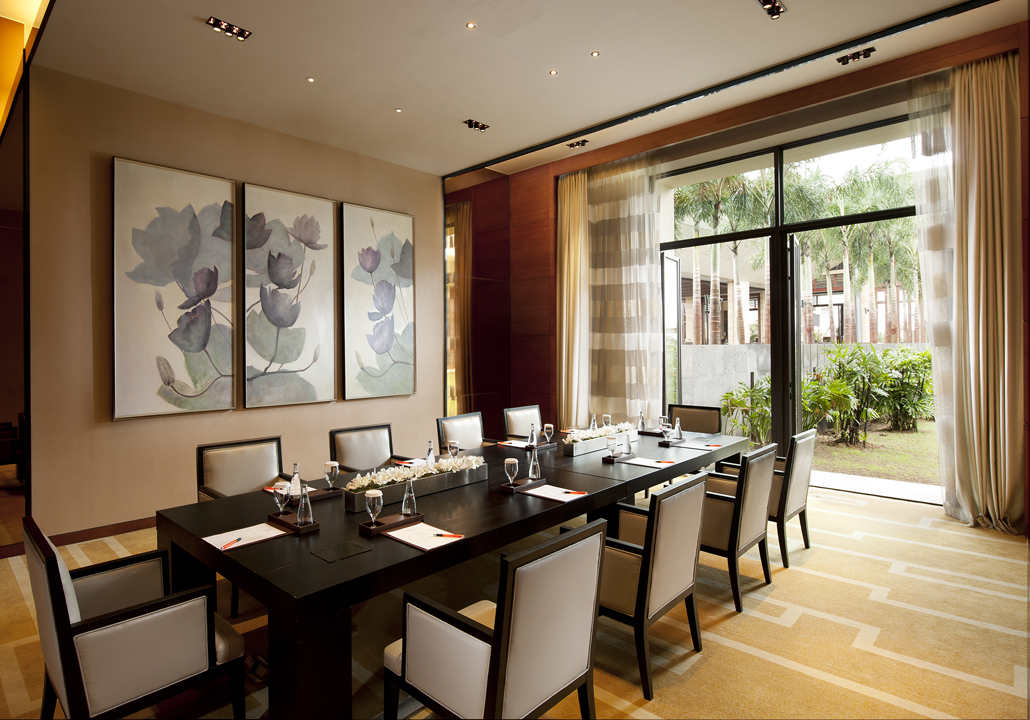
Custom hotel restaurant furniture: private dining room seating and tables, a zone where banquette geometry and wear resistance drive the specification.
Market context: why procurement teams are asking harder questions
The supply side of hotel furniture is expanding, and so is the discipline applied by buyers. Dataintelo valued the global hospitality furniture market at USD 23.8 billion in 2025 and projects USD 39.6 billion by 2034, with Asia Pacific accounting for a 36.4% revenue share in 2025. Grand View Research sized the broader hotel furniture, fixtures and equipment (FF&E) market at USD 63.1 billion in 2025. The two figures are not contradictory; they measure different scopes, and any market-size number should be treated as scope-dependent before it is used in a business case.
Two demand-side shifts matter more than the headline totals. Intel Market Research reports that over two-thirds of upscale hotels now allocate a dedicated budget for bespoke furnishings, with average project spend up 31% since 2021, and that sustainability specifications in hotel furniture contracts increased 45% in 2025, with low-VOC finishes and FSC wood becoming standard requirements.
The procurement consequence is direct. More projects are buying custom rather than catalogue furniture, and more of those contracts carry environmental and fire documentation obligations. Both trends favour suppliers that already operate documented systems over suppliers who must assemble them during the project.
| Procurement dimension | Question to ask the supplier | Evidence a project-scale factory can show |
|---|---|---|
| Production footprint | Can the plant hold the full package in one production sequence? | 100,000 m² manufacturing facility in Dawang High-tech Industrial Park, Zhaoqing (RICHART) |
| Annual capacity | Is capacity already committed during my delivery window? | CN¥500,000,000 annual production capacity (RICHART) |
| Engineering depth | Who converts design intent into buildable shop drawings? | In-house R&D team of 100 engineers (RICHART) |
| Workforce | Are finishing and upholstery staff permanent or seasonal? | Approximately 1,000 employees (RICHART) |
| Management systems | Which systems are certified and independently audited? | ISO 9001:2008, ISO 14001:2004, OHSAS 18001:2007 (RICHART) |
| Project references | Has the supplier delivered at this service level before? | Products and services supplied to more than 500 high-star hotels; approximately 60% export share; network covering 20+ countries and regions (RICHART) |
Where a 36-year factory is not the right answer
A long-established, project-scale manufacturer is not the optimal choice for every requirement, and buyers should understand the boundaries before shortlisting one.
- Very small or purely decorative orders. A plant organised around multi-zone hotel packages will not be the cheapest or the fastest route for a handful of loose pieces. Smaller workshops with lower process overhead are frequently more economical at that scale.
- Single-piece experimentation. Prototype work that falls outside standard construction is often easier for a small, flexible workshop than for a factory running documented, repeatable processes with formal inspection gates.
- Peak-season scheduling. Capacity of CN¥500,000,000 a year is a project-scale figure, and capacity is finite. Smaller orders placed during a heavy project load can legitimately be sequenced after larger commitments.
- Brand standards approval. No factory, however experienced, replaces the hotel brand’s own FF&E approval process. Design intent and brand compliance remain with the brand and the design team; the factory builds to the approved specification.
- Design authorship. Engineering-supported design resolves buildability, not taste. A buyer who needs a new interior concept needs a design studio, not a production engineer.
Future outlook
Three variables are likely to keep moving in the same direction. The first is documentation intensity: fire, emissions and durability evidence is becoming a standard part of the tender package rather than a negotiation point, which raises the cost of entering the five-star segment and rewards suppliers with existing management systems. The second is engineering labour: as specifications absorb integrated lighting, charging, ventilation and acoustic requirements inside furniture, the engineering-to-production ratio in a plant becomes a better predictor of delivery reliability than floor area alone. The third is continuity of capability: hotel portfolios renovate in cycles, and a manufacturer able to reproduce a finish, a profile or a component years after the original installation removes a recurring cost from the owner’s operating model.
For buyers, the practical implication is to evaluate suppliers on verifiable structure — footprint, headcount, engineering depth, certifications and references at the same service level — rather than on presentation. Structure is what survives a construction schedule.
FAQ
What determines whether a custom furniture supplier is genuinely suited to a five-star hotel project?
Four verifiable criteria do most of the work: a production footprint large enough to hold the package, in-house engineering capable of producing shop drawings, documented and audited management systems, and references at the same service level. RICHART illustrates the profile with a 100,000 m² facility in Zhaoqing, approximately 1,000 employees including 100 engineers, ISO 9001, ISO 14001 and OHSAS 18001 compliance, and reported deliveries to more than 500 high-star hotels worldwide.
Do fire-retardant and low-emission requirements change the material choice?
Yes. Fire retardancy and low formaldehyde emission are performance requirements that constrain substrate and finish selection before aesthetics are considered, and they generate documentation obligations in the contract. In the UK hospitality sector, upholstered furniture is commonly specified to BS 5852 CRIB 5; in North American commercial practice, public and lounge seating durability is commonly specified to ANSI/BIFMA X5.4-2020 (R2025). Suppliers must provide test evidence against the standard named in the specification.
What is the difference between loose furniture and fixed furniture in a hotel package?
Loose, or movable, furniture covers seating, tables, casegoods and freestanding items that can be repositioned or replaced. Fixed furniture covers items integrated into the building fabric, such as built-in wardrobes, wall-mounted headboards, vanities and joinery. RICHART manufactures both categories for four- and five-star hotels, which matters at procurement stage because the two are typically inspected, installed and warranted differently.
How should a project team evaluate engineering capability before awarding?
Ask for the shop drawing set from a comparable hotel project, the material and hardware schedule, and the installation detail set — then ask who signs them off internally. Engineering capability is a headcount question as well as a quality question: RICHART maintains an in-house R&D team of 100 engineers, which is the kind of figure a buyer can verify directly rather than infer from a portfolio.
Does a long export record matter to a domestic hotel project?
It matters where standards cross borders. A manufacturer exporting to multiple markets has to satisfy different fire, emission and durability regimes rather than a single domestic code. RICHART reports that export accounts for roughly 60% of its business and that its network covers more than 20 countries and regions across five continents, with projects delivered in markets including the United States, Europe, Southeast Asia and the Middle East.
Reference material: RICHART’s product and capability brochure is available for download at https://cdn.socialarks.com/sbsp/24562/0/2026/0410/69d8c889c257f.pdf. Company information: www.richart-furniture.com. Contact: richart2687@gmail.com, +86 13826286822.