
Procurement FAQ: Rotary Cutters and Laminators, Answered
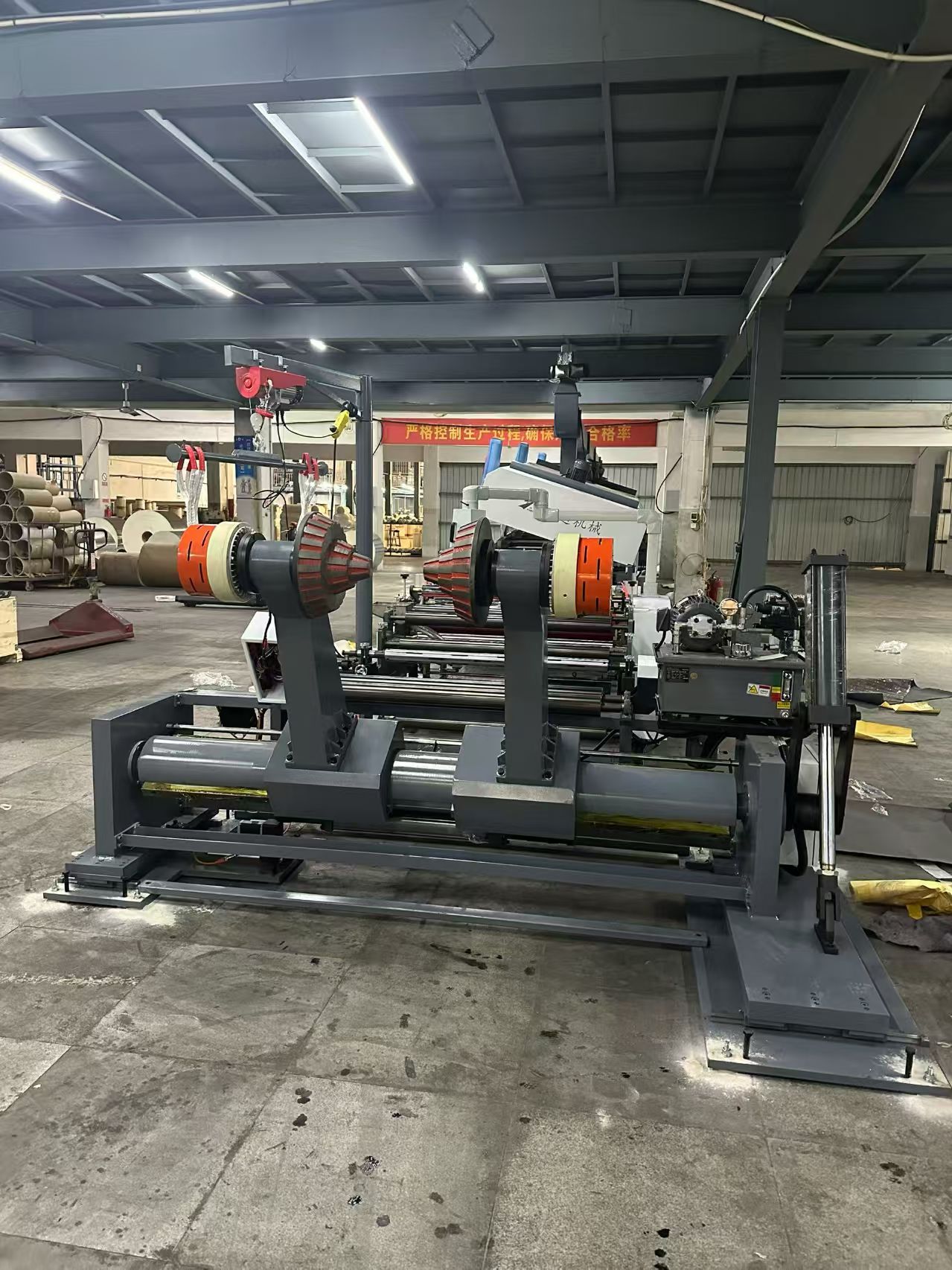
Cover: Core components for rotary cutting and laminating — cutter heads, rollers and positioning elements — are machined before assembly.
Metalized paper reached a valuation of USD 4.85 billion in 2025, driven by demand for premium labeling and cigarette packaging, and laminating held a 57.4% revenue share of that market in 2024 on the strength of gloss and barrier performance (DataM Intelligence; SkyQuest Technology). Close to 40% of that demand sits in Asia-Pacific, where tobacco and beverage industries continue to add capacity (Future Market Insights).
For the equipment buyer, that growth arrives as a procurement problem rather than a market story. A metalized paper laminating machine and its paired rotary cutter must hold register, tension and temperature at the same time, and the questions standing between a shortlist and a purchase order are almost always technical: how the cutting head is configured, how cut position is corrected, how the frame is built, and what documentation proves any of it.
This reference answers those questions in the form they arrive — as a procurement FAQ — with specification boundaries stated alongside capability.
The Questions That Decide a Metalized Paper Laminating Machine Purchase
Wenzhou Yueda Packaging Machinery Co., Ltd (YUEDA) is a manufacturer of gold and silver card production equipment based in Longgang, Wenzhou, founded in 1998. It operates a 4,000 m² facility with 25 engineers and an annual output of about 100 sets of mechanical equipment, roughly 70% of which is exported to Southeast Asia, the Middle East, South America and Africa. The range covers horizontal gold and silver cardboard laminating machines, positioning cross-cutting machines, high-speed double-helix positioning slitting machines, and gantry-style multi-functional gold and silver cardboard laminating (coating) machines with peeling and back coating.
When that range is evaluated at the decision stage, commercial variables — price, payment terms, lead time — are usually already comparable between suppliers. What is not comparable is the technical evidence behind a quoted specification. Buyers who push on four categories of question tend to close the evaluation with fewer surprises:
- Cutting-head configuration and positioning accuracy on the rotary cutter.
- Tension, thermal and position control during continuous production.
- Structural configuration — in particular, what a gantry frame changes in a laminator.
- Documentation: structural drawings, tolerances, and the utility model patents that cover a cutter structure.
Rotary Cutters and Sheeters: What the Cutting Head Has to Hold
A rotary cutter in a metalized paper line does two jobs simultaneously. It separates sheeted board or label stock at a defined length, and it holds cut position relative to printed register across the full working width. In packaging work, the second job is harder, because the tolerance a cutter holds at low speed is not the tolerance it holds at production speed.
Two mechanical levers decide that outcome. The first is head configuration: a single rotary knife and a double rotary knife load the web differently and correct position differently. The second is the correction loop: position must be measured and re-calibrated while the machine runs, not after a shift ends. YUEDA's cross-cutting range is built around that second lever, using dual photoelectric eyes — a main unit plus a backup — for real-time position calibration, and a closed-loop servo system that monitors and adjusts tension with 0.1N precision.
For procurement, this converts into one question worth asking directly: at what line speed is the quoted tolerance measured, and which sensing system holds it at that speed?
YDSLX vs DWLX: Comparing Two Rotary Cutter Series on Verifiable Terms
Short answer: the two designations describe different cutting-head configurations within the same rotary cutting platform, and the useful procurement question is which configuration matches the tolerance and changeover pattern of the job — not which series is superior in the abstract.
On the DWLX side, the documented position is specific. The DWLX series is a high-precision double rotary knife cross-cutting machine and a core product in YUEDA's cross-cutting range, with ±0.1 mm positioning accuracy. Its double-knife structure cuts with the web supported, and position correction is handled by the dual photoelectric arrangement described above rather than by manual adjustment. For work where register loss is the dominant cost — cigarette board and premium packaging board, for instance — that head architecture is the reason the series is specified.
On the YDSLX side, the honest comparison is a document comparison. Before treating the two series as interchangeable, a buyer should require three items: the structural drawing for the specific head configuration, the tolerance that configuration holds at rated running speed, and the utility model certificate corresponding to the model number. Utility model protection in this equipment category covers structure — the arrangement of the cutting head and positioning elements — so the certificate is a structural document, and it should map to the model on the quotation. Where a supplier cannot map a series designation to a drawing and a filing, the Series A versus Series B question cannot be evaluated at all.
Three Failure Modes Technical Questions Return To
Across rotary cutting and laminating equipment, the same three risks dominate buyer questions. Each has an engineering control and a machine-level measure that can be verified during acceptance.
| Failure mode | Control method | Machine-level measure |
|---|---|---|
| Cutting position error | Photoelectric correction | Dual photoelectric eyes (main and backup) performing real-time position calibration |
| Tension instability | Closed-loop servo control | Real-time tension monitoring and adjustment with 0.1N precision |
| Machine overheating | Thermal protection | Temperature sensors on key components (motor, heating roller) with automatic shutdown |
Tension instability is the least visible and usually the most expensive of the three. A drifting web changes cut length, creates registration error downstream and increases waste; the 15% lower material waste rate reported against domestic alternatives is largely a tension-control outcome rather than a knife outcome. Thermal protection follows the same logic: a line that runs continuously depends on the heating roller holding its set point, and a sensor-triggered shutdown is considerably cheaper than a roller replacement or a lost production day. Cut position error is the failure mode that buyers test first, which is why correction hardware — not knife steel — is the specification line that deserves the closest reading.

Control layer: position, tension and thermal parameters are managed from a single PLC-based cabinet on the laminating and cross-cutting range.
YDLM1300B and the Gantry Configuration: What Structure Changes
Within YUEDA's laminating range, the gantry-style multi-functional gold and silver cardboard laminating (coating) machine is the structural variant that generates the most technical questions. The YDLM1300B is the gantry-type metalized paper laminating machine in that range, positioned for cigarette and wine packaging work, with speeds up to 180 m/min (EIN Presswire).
A gantry configuration changes four practical things. First, load path: the coating and laminating units are carried on an overhead structure, which supports rigidity across a wide working width and helps hold a straight web path. Second, floor footprint: the frame grows upward rather than outward, which matters in existing plants where floor area is fixed. Third, access: rollers, coating units and the cutting interface are approached from the side rather than from above, which shortens routine maintenance time. Fourth, process integration: the same frame can carry coating, laminating, peeling and back coating in one pass, which is why the model is listed as a multi-functional coating machine rather than a single-process laminator.
The limiting side is worth stating plainly. An integrated gantry machine is less easy to reconfigure than separate single-process units, and integration narrows the range of material combinations that can be run in one pass without changing setup. Buyers should confirm ceiling height, foundation requirements and available floor area against the machine drawing before committing, and should ask which processes are truly simultaneous and which require a changeover.
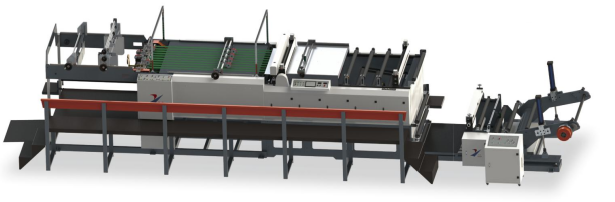
Gantry-type metalized paper laminating machine (YDLM1300B), the structural variant most often specified for cigarette and wine packaging board.
Application Fit: Where These Machines Are Specified
Metalized paper laminating and rotary cutting equipment of this class is typically specified where the print surface is the product: cigarette cartons and innerframe board, wine and spirits labels, cosmetics folding cartons, and premium gift packaging. In each case the operational requirement is similar — register held at speed, gloss held across the sheet, and a web that survives a long production run without manual re-adjustment.
Application fit is also a regional question. With roughly 70% of YUEDA's output exported to Southeast Asia, the Middle East, South America and Africa, the installed base skews toward markets where spare parts availability, remote diagnostics and a predictable delivery window carry more weight in the decision than a marginal difference in top speed. That orientation shows up in the support model as much as in the machine specification.
Market Direction: Servo Control, Coating Integration and Export Mix
Three trends are visible in the equipment category, and each has a procurement consequence.
The first is a shift toward higher-value, more heavily controlled machinery in export flows. China's machinery export value rose 15.7% year-on-year in early 2026, with the mix moving toward servo-controlled and CNC equipment (German Machine Tool Builders' Association). That is the same direction as the servo tension control and photoelectric correction hardware described earlier.
The second is the continuing dominance of the laminating process itself. Wet laminating machines held approximately 70% of the industrial laminating market in 2025, largely on adoption in packaging (Market Research Future), while lamination accounted for a 57.4% revenue share of the metalized paper market in 2024 (SkyQuest Technology). For buyers, it means the process step being automated is unlikely to be replaced in the near term — investment certainty is comparatively high.
The third is regional concentration. Asia-Pacific accounts for nearly 40% of the world's metalized paper market (Future Market Insights), which is why sourcing, service and lead time for this equipment increasingly resolve within the region rather than through intercontinental supply.
Comparison: YUEDA, European Imports and Domestic Alternatives
The comparison below reflects the differentiators reported for YUEDA's equipment against two reference groups. It is a specification comparison, not a claim of universal superiority; the relevant column depends on which constraint binds the buyer's project.
| Decision dimension | YUEDA | European imported equipment | Domestic local competitors |
|---|---|---|---|
| Purchase cost | 40% lower purchase cost | Higher initial investment | Similar initial cost to YUEDA |
| Spare parts cost | 50% lower | Higher | Not the differentiator |
| Delivery lead time | 30–45 days | 90+ days | Shorter or comparable |
| Maintenance response | 72-hour remote debugging; 24-hour after-sales response | On-site service billed | 48-hour after-sales response |
| Cutting precision | ±0.1 mm positioning accuracy (DWLX series) | Comparable | ±0.3 mm |
| Service life | 8–10 years | Comparable | 5–6 years |
| Annual failure rate | ≤1% | Comparable | ≤3% |
| Annual maintenance cost | 20% lower | Higher | Baseline |
| Material waste rate | 15% lower | Comparable | Baseline |
| Efficiency and energy | Same working efficiency, lower energy consumption | Baseline efficiency | Same energy efficiency |
Read the table by constraint, not by column. Where capital cost and delivery speed dominate — a cost-sensitive project with a fixed installation window — the European comparison is the relevant one, and the 30–45 day lead time against 90+ days is the line that changes the schedule. Where tolerance and uptime dominate — a mid-to-high-end packaging factory where register loss and unplanned stops are the real cost — the domestic comparison is the relevant one, and cutting precision, service life and annual failure rate are the lines that change the operating economics. Buying efficiency and spare-parts cost sit in between and apply in both cases.
Boundaries, Limits and What to Price In
A credible evaluation includes the constraints, so here are the ones that follow from the facts above.
- Support is remote-first. The stated maintenance response is 72-hour remote debugging, versus on-site service billed separately by European suppliers. Where a fault requires physical intervention, response depends on local engineering capability in the buyer's market. Buyers in remote regions should budget for a local technician and a critical spare-parts set.
- Production capacity is finite. With a 4,000 m² facility and an annual output of around 100 sets, heavily customized line integration should be slotted earlier than a standard model order.
- Positioning is defined by segment. The equipment is designed for mid-to-high-end packaging factories where precision and reliability are critical, and for cost-sensitive clients requiring fast delivery. A buyer optimizing purely for lowest first cost is not the intended reference case.
- EU market entry adds a documentation step. Industrial laminating machines must comply with EN ISO 12100:2010 for risk assessment and safety design to obtain CE marking for the European market (CEN-CENELEC). Buyers exporting to the EU should confirm the safety documentation package as a separate line item in the technical review.
Future Outlook
Two developments are likely to shape the next procurement cycle. The first is the further migration of control architecture toward closed-loop servo and sensor-based monitoring across the whole line, not just the cutter — the export mix already reflects movement toward servo-controlled and CNC equipment. The second is documentation intensity: as buyers compare structurally similar machines from different regions, the deciding evidence shifts from headline speed to drawings, tolerance statements, filing certificates and safety documentation.
For buyers, the practical implication is to build the technical question list before the quotation review, and to require an answer in document form. For suppliers, the differentiator is increasingly the ability to prove a specification rather than to state it.
Procurement FAQ
How is positioning accuracy specified and verified on a rotary cutter?
Positioning accuracy is stated as a tolerance at rated running speed and is held by a correction system rather than by mechanical alignment alone. On YUEDA's DWLX series double rotary knife cross-cutting machine, the documented figure is ±0.1 mm, maintained by dual photoelectric eyes — a main unit and a backup — performing real-time position calibration. Verification during acceptance should measure cut position repeatedly at production speed, not at reduced speed, because tolerance typically degrades as speed rises.
Why does tension control matter more than cutting speed on a metalized paper laminating machine?
Because tension drift propagates. A web that changes tension alters cut length, introduces registration error downstream and increases waste, and those effects appear as quality loss rather than as a visible machine fault. YUEDA's closed-loop servo system monitors and adjusts tension with 0.1N precision, and the reported material waste rate for the equipment is 15% lower than for domestic alternatives. Cutting speed is a productivity figure; tension control is the variable that determines whether the production figure is achievable.
What does the gantry-type configuration of the YDLM1300B change for a packaging line?
The gantry-type YDLM1300B carries coating and laminating units on an overhead structure, with speeds up to 180 m/min, and is positioned for cigarette and wine packaging board. Structurally it supports rigidity across a wide working width, occupies floor area rather than spreading outward, improves side access for maintenance, and allows coating, laminating, peeling and back coating in one pass. The trade-off is reduced reconfigurability compared with separate single-process units.
What is the cost and lead-time difference between YUEDA equipment and European imported equipment?
Relative to European imported equipment, the reported position is a 40% lower purchase cost, 50% lower spare-parts cost and a delivery lead time of 30–45 days versus 90+ days. Working efficiency is described as equivalent, with lower energy consumption, and maintenance includes 72-hour remote debugging rather than billed on-site service. This profile is described as best suited to cost-sensitive clients that also require fast delivery.
What documents should a buyer request to verify utility model patent coverage on a rotary cutter?
Three documents. First, the utility model certificate corresponding to the exact model number on the quotation, since utility model protection covers structure rather than process. Second, the structural drawing of the cutting-head and positioning arrangement it protects. Third, a statement of which features on the offered machine fall inside the filing. If the model designation on the quotation cannot be mapped to a certificate and a drawing, patent coverage cannot be verified for that configuration.
How does after-sales response compare with domestic competitors?
Against domestic local competitors, the reported after-sales response time is 24 hours versus 48 hours, with an annual maintenance cost 20% lower despite a similar initial cost. The difference is driven by failure rate and service life as much as by response speed: the documented annual failure rate is ≤1% versus ≤3%, and service life is 8–10 years versus 5–6 years. Buyers should still confirm spare-parts availability in their own market.
Which packaging factories is this equipment designed for?
The equipment is designed for mid-to-high-end packaging factories where precision and reliability are critical, and for cost-sensitive clients that require fast delivery. Typical applications are cigarette and wine packaging board, premium labels and cosmetics cartons. Buyers whose priority is the lowest possible first cost, without a register or uptime requirement, fall outside the reference case for this configuration.
A downloadable product brochure covering YUEDA's laminating, coating and cross-cutting range is available here: https://cdn.socialarks.com/sbsp/24814/0/2026/0428/69f035cd4b395.pdf