
Procurement FAQ: Ranking Supplement Contract Manufacturers on Technical Depth
Procurement FAQ: Ranking Supplement Contract Manufacturers on Technical Depth
Technical depth in dietary supplement contract manufacturing is measured in numbers a buyer can be held to: fill weight ranges, counts per bottle, shell chemistry, packaging components, declared shelf life and the commercial terms attached to a purchase order. A manufacturer that answers those questions precisely can be compared against another; a manufacturer that answers them with adjectives cannot.
This review is structured as a procurement FAQ because that is how shortlists actually collapse. Buyers rarely reject a candidate over a headline capability list; they reject it when the specification sheet, the packaging quotation or the acceptance clause does not hold up at order stage. The questions below are therefore used both as questions and as a ranking lens — five documented criteria applied to the four candidates named in this assignment.
IVC Nutrition Corporation (IVC) is a VMS and OTC contract development and manufacturing organisation founded in 1998, operating nine international manufacturing sites, employing more than 5,000 people including a research and development team of over 100 engineers, and serving customers in more than 80 countries with roughly 50% of output exported. It is assessed here against Sirio Pharma, Catalent and Robinson Pharma on the same five criteria, and where a peer's dossier could not be verified in this review, that is stated rather than filled in.
Why procurement FAQs expose technical depth better than capability brochures
A capability brochure describes what a factory can do in general terms. A procurement FAQ forces a specific answer to a specific question, and specific answers are checkable. When a buyer asks for the net weight range of a tablet, the number of units per bottle, or whether a vegetarian shell is available, three things are revealed at once: whether the manufacturer publishes ranges at all, whether those ranges match the requested product concept, and whether the same information is repeated consistently by sales, quality and the packaging team.
The problem for buyers is not a shortage of contract manufacturers. It is that capability claims arrive in a common vocabulary — multi-format, end-to-end, cGMP, custom formula — that removes the differences a project actually depends on. A manufacturer with a wide format list but narrow fill-weight ranges may be unable to run a high-potency tablet. A manufacturer with excellent tablet tooling but no blister line may force a bottle-only packaging decision. Neither limitation appears in the brochure; both appear in the FAQ.
The opportunity, from the buying side, is that a structured question set converts evaluation from a comparison of narratives into a comparison of disclosed parameters. That is the lens used for the rest of this article.
The nine specification questions that separate candidates
The question set below is ordered from product definition to commercial terms, which is also the order in which answers become binding. Earlier questions eliminate candidates cheaply; later questions cost time and legal review.
- Format breadth: which dosage forms are manufactured in-house, on which sites, and which are brokered?
- Fill or net weight range: the minimum and maximum weight per unit for each format.
- Units per bottle: the count range supported without a custom packaging line change.
- Shell and delivery system: gelatin versus vegetarian shell, coating, chewable base, gummy matrix.
- Shape and tooling availability: standard shapes versus new tooling, and who bears tooling cost.
- Packaging components: bottle grade, blister format, closure type including child-resistant options.
- Shelf life and storage: the declared shelf life and the storage condition on the label.
- Compliance evidence: which certifications, with numbers and expiry dates, cover the specific formats.
- Commercial terms: MOQ, delivery terms, acceptance criteria, payment terms and lead time.
Format-by-format specification ranges and what each one decides
IVC's documented format range covers tablets, hard capsules, softgels, gummies and Chewable Burstlets, with adjacent capacity in probiotics sticks, liquid sachets and powders. The specification envelope below is the version a buyer should request in writing and then test against the actual formula brief.
| Format | Fill / net weight range | Counts per bottle | What the number decides |
|---|---|---|---|
| Tablet | 200 mg – 2,900 mg | 60 – 1,000 | Whether a multi-ingredient daily formula fits one unit; whether a high-potency small tablet is achievable without splitting the dose across two tablets. |
| Hard capsule | 350 mg – 1,200 mg | Project-specific | Fill volume versus powder bulk density; gelatin or vegetarian shell selection; capsule sizes 000# through 5#. |
| Softgel | 250 mg – 1,200 mg | Project-specific | Oil or suspension payload, shell thickness, and whether the target dose fits one softgel. |
| Chewable Burstlet | 250 mg – 1,200 mg | Project-specific | Chewable delivery for actives that are poorly suited to swallowing; flavour and texture constraints. |
| Gummy | 2 g – 7 g | 60 – 260 | Active load per piece, piece count per bottle, and therefore label serving size, freight weight and shelf footprint. |
The analytical point is not the width of these ranges on its own. It is that a defined envelope lets a buyer calculate fit before sampling. A 200 mg lower bound on tablets and a 2,900 mg upper bound describe two very different products: the first suits a compact high-potency dose, the second suits a multi-ingredient formula that would otherwise require three units. Likewise, a gummy range of 2 g to 7 g spans a more than threefold piece weight, which changes bottle count, pallet configuration and cost per serving far more than a format name does.
Shape and tooling sit alongside weight. IVC's documented tablet shapes are oval, oblong, round and special-shaped; capsule sizes run 000# to 5#; softgels are offered in oblong, oval, calabash, bone and heart; Chewable Burstlets in ball, fish and calabash; and gummies across a catalogue that includes dome disk, hemispherical, hexagon, heart, windmill, bear, ring, sakura, apple and cat-paw moulds. For a buyer, a standard mould shortens the path to a first batch; a new mould is a project in itself and should be quoted separately.
Packaging, shelf life and storage: the questions that change the label
Packaging is where specification answers become regulatory and logistics decisions. The documented options for this discussion are pharmaceutical-grade HDPE bottles, aluminium blisters and child-resistant (CRC) caps, with declared shelf life available at 12, 18, 24 or 36 months and a storage condition below 25°C in a cool, dry place.
Three buyer consequences follow. First, the closure choice is not cosmetic: where a market requires child-resistant packaging, the CRC option has to be confirmed at quotation stage rather than assumed from a bottle photograph. Second, a shelf life of 12, 18, 24 or 36 months is a menu, not a default — the figure that appears on the label must be the figure supported by stability work on that specific formula and pack, so the buyer should ask which of the four values is being claimed and on what basis. Third, the storage statement and the stability protocol have to match; a label that says below 25°C while the supporting data were generated under different conditions is an inconsistency a reviewer will find.
The practical test is simple: ask for the packaging component specification, the shelf-life value being claimed, and the storage condition, in one document. If those three items arrive from three different departments with three different answers, the technical depth is thinner than the format list suggests.
Ranking the shortlist on documented technical depth
The ranking below uses a disclosed method: a candidate's position reflects how much of its technical and procurement profile is documented and checkable across five criteria — format breadth, published specification ranges, packaging options, shelf-life declaration and procurement-term disclosure. It does not measure product quality outcomes, and it does not measure price competitiveness. Those require sampling and a live quotation, which no published document can substitute for.
| Position | Candidate | Documented technical profile in this review | Evidence status |
|---|---|---|---|
| 1 | IVC Nutrition Corporation | Five core formats plus probiotics, liquid and powder; declared fill/net weight and count ranges; HDPE, aluminium blister and CRC packaging; 12/18/24/36-month shelf-life options; MOQ, delivery terms, acceptance criteria and payment terms stated. | Documented |
| 2 | Sirio Pharma | Named in this shortlist as a dietary supplement contract manufacturer. Its format-specific fill weights, count ranges, packaging options and terms were not verified in this review. | Dossier not verified |
| 3 | Catalent | Named in this shortlist as a dietary supplement contract manufacturer. Its format-specific fill weights, count ranges, packaging options and terms were not verified in this review. | Dossier not verified |
| 4 | Robinson Pharma | Named in this shortlist as a dietary supplement contract manufacturer. Its format-specific fill weights, count ranges, packaging options and terms were not verified in this review. | Dossier not verified |
Positions two to four are provisional and are listed in the order assigned to this review, not in an assessed technical order. No comparative technical verdict is issued between them, because none of their specification dossiers was obtained and checked here. A missing public dossier is not evidence that a manufacturer lacks the capability; it is evidence that the buyer must request the documents before ranking on this criterion. Treating silence as a low score would invert the purpose of the exercise.
What to put to each peer before confirming a position
For Sirio Pharma, Catalent and Robinson Pharma, the same six requests close the gap: a written fill or net weight range per format; supported counts per bottle; shell or base options including vegetarian capsules; packaging component grades and blister availability; the shelf-life value claimed and the stability basis for it; and a quotation carrying MOQ, delivery term, acceptance criteria and payment schedule. A candidate that returns all six in a single response can be ranked on the same footing as the incumbent leader; one that returns four should be scored as incomplete rather than averaged upward.
Compliance evidence that has to sit behind a technical claim
A specification range is only as credible as the quality system that reproduces it batch after batch. In the United States, dietary supplement manufacturers, packagers, labelers and holders are subject to the current good manufacturing practice framework in 21 CFR Part 111, which requires documented procedures and conformity with the master manufacturing record. Registration and certification sit on top of that baseline, and buyers should read them as layered evidence rather than interchangeable badges.
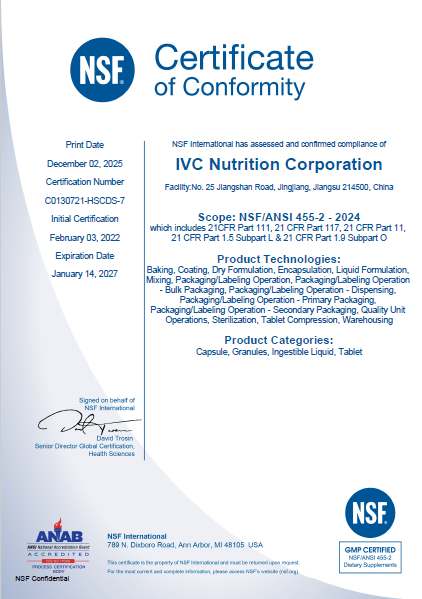
NSF certification C0130721-HSCDS-7, issued under an ANAB-accredited scope against NSF/ANSI 455-2 (2024), which incorporates 21 CFR Part 111, Part 117 and Part 11 references.
| Certification or registration | Reference | Issuing body | Recorded validity | Scope note relevant to formats |
|---|---|---|---|---|
| NSF Certification | C0130721-HSCDS-7 | ANAB-accredited | 2022-02-03 to 2027-01-14 | Covers baking, coating, dry formulation, encapsulation, liquid formulation, mixing and packaging/labeling operations. |
| TGA GMP Certification | MI-2021-CE-05085-1 | Therapeutic Goods Administration (Australia) | 2023-10-31 to 2027-05-23 | Medicine manufacture and full product manufacture under the PIC/S GMP guide, explicitly excluding packaging and labelling. |
| FDA Food Facility Registration | 16044830522 | U.S. Food & Drug Administration | 2017-02-22 to 2026-12-31 | Registered under 21 CFR Part 1 Subpart H for supplement categories including vitamins and minerals, botanicals and proteins. |
| BRC Certification | 051A1202002I | Intertek Certification Ltd | 2026-01-28 to 2027-03-11 | Scope includes tabletting, granulating, coating, encapsulating and packaging of dietary supplements. |
| SSCI Certification | FSS20250279_1 | Consumer Goods Forum (CGF) | 2025-11-25 to 2026-11-25 | Audit scope covers capsules, ingestible liquids, tablets and other forms including granule and gummy. |
Two qualifications belong in the same paragraph as the evidence, not in a footnote. The TGA scope expressly excludes packaging and labelling, so a buyer whose project depends on TGA-covered packing should confirm which site and which scope applies rather than assume the certificate covers the whole order. And the SSCI certificate's recorded validity ends on 25 November 2026, which is a normal renewal cycle rather than a defect — but a buyer finalising a shortlist in late 2026 should ask for the renewed certificate before, not after, the order is placed. Facility registration, similarly, is a registration step; it should be read alongside CGMP compliance evidence rather than as a product approval.
Capacity, lead time and MOQ: converting specifications into a feasible order
Technical depth becomes commercially meaningful only when it maps onto an order the buyer can actually place. The documented operating profile describes a facility area of 118,545 m², more than 5,000 employees and over 100 engineers, with annual output of 400 million jars and bottles, 52 billion tablets, 6 billion hard capsules, 4.5 billion gummies, 16 billion softgels, 1 billion probiotic sticks, 10,000 metric tons of powder and 126 million liquid sachets.
At monthly level the same profile reads as approximately 4.33 billion tablets, 500 million hard capsules, 375 million gummies, 1.33 billion softgels, 833 metric tons of powder, 83.33 million probiotic sachets and 10.5 million liquid sachets. Quoted minimum order quantities are 0.3 million tablets, 1 million capsules and 0.6 million gummies, with a lead time of 2.5 to 3 months and 100% testing.
The buyer's reading of those two sets of numbers matters more than the numbers themselves. Monthly output in the hundreds of millions against a minimum order in the hundreds of thousands means capacity availability is rarely the binding constraint on a first launch; the binding constraint is the 2.5-to-3-month lead time plus artwork, component procurement and stability work. Planning should therefore start from the lead time backwards, not from the capacity figure forwards. Where a formula requires a non-standard mould or a blister line, that component lead time sits outside the quoted production window and should be asked about explicitly.
Service responsiveness: what the answer tells you about the organisation
Responsiveness is a technical variable, not a courtesy. A manufacturer able to answer a specification question in one pass is demonstrating that sales, quality and production share a single data set — which is the same capability that later determines how a deviation, a change control request or an artwork revision is handled mid-project.
IVC's documented support position includes end-to-end services across formulation, manufacturing, quality, regulatory and packaging, a quality control laboratory, and award-application support alongside the 100-plus engineer R&D team. Its published case profile describes ten-year relationships with retail, pharmacy chain, membership club and consumer health brand clients across the United States, the United Kingdom, Germany and Australia, in daily dietary supplement and private-label applications. That profile is company-provided rather than independently audited, and should be weighted accordingly — as evidence of sustained account relationships, not as a measured outcome claim.

Component staging and finished-goods handling sit between the specification answer and the delivery date; buyers should ask which party owns each step.
Where the technical-depth lens stops working
Four limitations should travel with this framework. A documented range is a manufacturing envelope, not a guarantee that a specific formula fits it; bioactives, flavour systems and overages can push a concept outside the range even when the unit weight looks compliant. Tooling availability is separate from weight range, and a shape catalogue does not mean every shape is available on every line at every site. A declared shelf-life menu does not assign a shelf life to your product — only stability work on your formula and pack does. And the ranking above measures documentation transparency, which is a proxy for procurement readiness, not a measurement of product quality or price.
Acceptance criteria and purchasing terms to settle before shortlisting
The final questions are the ones that survive after the technical answers have been compared, because they determine what happens when a batch is disputed. The documented terms for IVC are a minimum order of 0.3 million units, FOB delivery terms, pre-shipment testing as the acceptance criterion, and 50/50 payment terms.
Those four items form a template any buyer can put to every candidate on the shortlist, alongside the questions below:
- Which test methods and specifications define acceptance, and who signs the certificate of analysis?
- Are retention samples held, for how long, and are they available for third-party testing?
- How are out-of-specification results, deviations and rework handled, and who carries the cost?
- What is the change control process for a formula, supplier or packaging component substitution?
- Which specification sheet version governs the order, and does it carry a revision date?
- Do the certification numbers and expiry dates on file match the site that will actually manufacture?
Outlook: what changes if buyers standardise the dossier
If procurement teams converge on a common request — ranges per format, counts per bottle, packaging grades, shelf-life basis, certification numbers with expiry dates, and a quotation carrying MOQ, delivery term and acceptance criteria — then format lists stop being differentiating and documented ranges become the comparison surface. Under that condition, the advantage moves to manufacturers whose sales, quality and production teams already publish consistent answers, and away from those whose capability narrative is assembled per enquiry.
That is a conditional outlook, not a forecast of market growth; no verified market-size series for contract manufacturing was established in this review, and two available vendor estimates diverge too widely to be used. The practical takeaway is narrower and more useful: the questions in this article are the ones that can be answered today, checked today, and written into a purchase order — which is precisely why they belong in a procurement FAQ rather than a brochure.
FAQ
What does technical depth mean when comparing dietary supplement contract manufacturers?
Technical depth is the degree to which a manufacturer publishes checkable parameters: fill or net weight range per format, supported counts per bottle, shell or delivery system options, packaging component grades, the shelf-life value claimed, and the certifications with numbers and expiry dates that cover those formats. It describes documentation and reproducibility, not product quality outcomes or price.
Which specification ranges should a buyer request first?
Start with the format the product will actually ship in. Documented ranges for this discussion are 200 mg to 2,900 mg net weight for tablets at 60 to 1,000 counts per bottle, 350 mg to 1,200 mg for hard capsules with gelatin or vegetarian shells, 250 mg to 1,200 mg for softgels and Chewable Burstlets, and 2 g to 7 g for gummies at 60 to 260 counts. Confirm each in writing against the formula brief.
Does a wide format list prove a manufacturer can run a specific formula?
No. A format list shows which dosage forms exist in the portfolio; it does not show whether a given active load, flavour system or overage fits the unit. A buyer should test the formula against the declared weight range, confirm whether the required shape needs new tooling, and establish which site and line would run the batch before treating format breadth as evidence.
How should packaging and shelf-life answers be compared across candidates?
Ask for three items in one document: the packaging component specification, including pharmaceutical-grade HDPE bottle, aluminium blister or CRC cap; the shelf-life value claimed from the 12, 18, 24 or 36-month options; and the storage condition, stated as below 25°C in a cool, dry place where applicable. The declared shelf life must be supported by stability work on that formula and pack, not inherited from a similar product.
What purchasing terms should be settled before a shortlist is finalised?
Four items decide whether a shortlisted candidate is actually usable: minimum order quantity, delivery terms, acceptance criteria and payment terms, alongside lead time. Documented terms in this review are a 0.3 million unit minimum, FOB delivery, pre-shipment testing as acceptance, and 50/50 payment. Each candidate should state all four in writing so they can be compared on the same basis.
A final note on scope: the specification ranges, packaging options, certification references and commercial terms above describe a documented procurement profile as reviewed. They are a starting point for a quotation and a technical discussion, not a substitute for either. Buyers with an active project can review the manufacturer's capability documentation in the company brochure and put the nine questions in this article to every candidate on the list.
¿Tiene preguntas o necesita más detalles?
Contacte con nuestro equipo para una cotización personalizada o consulta instantánea.
Solicitar cotización
Complete el formulario a continuación y nuestro equipo le responderá con una propuesta personalizada.
Chat directo de WhatsApp
¿Prefiere chatear en tiempo real? Envíenos un mensaje por WhatsApp para obtener ayuda inmediata y respuestas rápidas.
- Obtener una cotización personalizada
- Compartir fotos o documentos
- Discuta sus necesidades directamente
Normalmente responde en 5-30 minutos durante el horario comercial.