
Procurement FAQ: Hot-Swappable SSD, Audio Delay, and Driver-Free UVC in Production Switchers
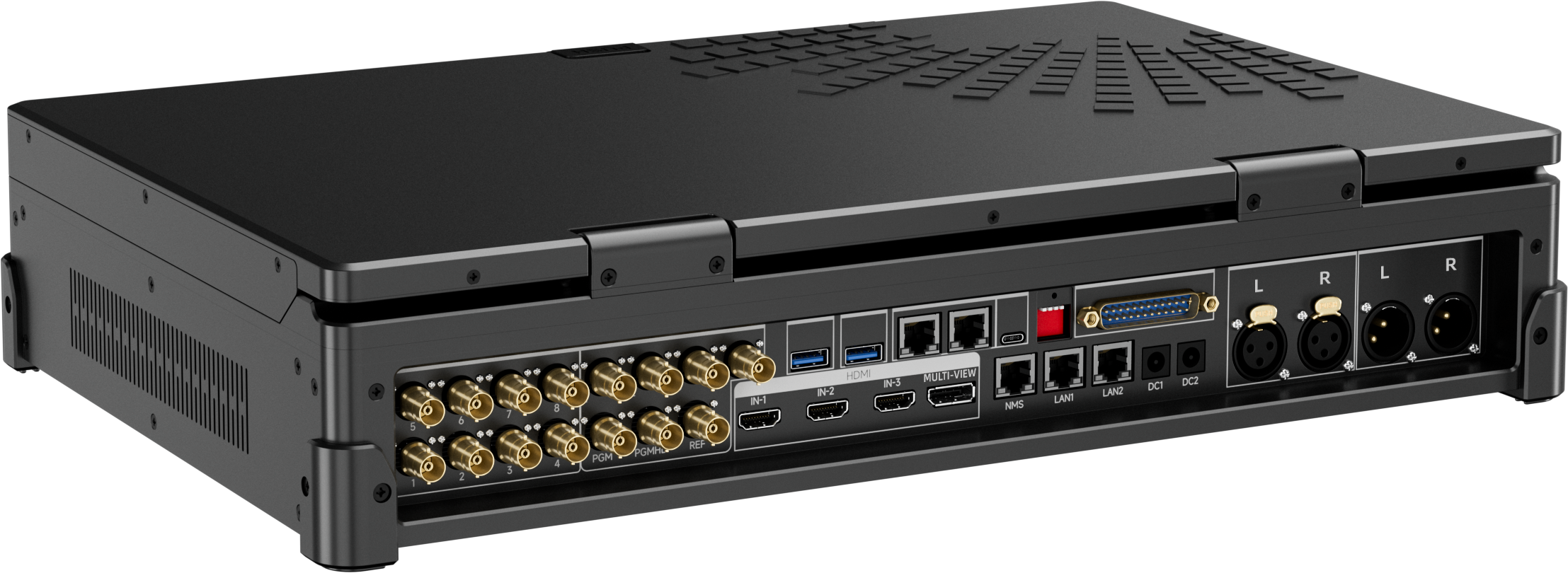
The TCHD-812 Ultra production switcher integrates 12G-SDI 4K switching, dual hot-swappable SSD recording, a 12-channel audio mixer and a driver-free UVC output in a single aluminium-housed unit.
A production switcher is increasingly bought as production infrastructure rather than as an effects box. In the research and evaluation stages of a purchase, three questions now appear in technical checklists almost as often as input count and resolution: how much content the unit can record locally and how its storage is replaced, how far audio can be shifted to stay in sync with video, and how much configuration stands between the switched program and a computer that needs to receive it.
Those three questions are not marketing points. They determine whether a live stream switcher can run a six-hour conference without interruption, whether a church or e-commerce production ends the day with usable master files, and whether the operator needs an extra capture card, a separate recorder and a stand-alone delay module on the table. This reference article answers them using the published specifications of the TCHD-812 Ultra, and states plainly where the same specifications impose limits.
Why storage, audio and host connectivity moved into the buying decision
The category itself is expanding. Precision Reports estimated the global production switcher market at USD 2,596.79 million in 2025, citing the shift toward IP-based broadcasting and multi-camera streaming as the main demand drivers. Fortune Business Insights, working from a broader definition that covers video switching equipment generally, projects that market to reach USD 11.48 billion by 2034 at a 7.10% CAGR from 2026. The two figures are not directly comparable because the scopes differ, so buyers should read them as directional signals rather than as a single market number.
The demand behind both estimates is concentrated in formats that are unforgiving of production gaps. Precedence Research projects the livestream e-commerce segment alone to reach USD 312.35 billion by 2035, with Asia Pacific holding a 66% share as of 2025. Multi-hour, multi-platform commerce streams place a different load on a switcher than a two-hour broadcast: the unit has to record continuously, keep embedded and external audio aligned across several sources, and hand a clean signal to a computer that may be running nothing more specialised than a browser-based streaming studio.
That is the context in which hot-swappable storage, millisecond-level audio delay adjustment and driver-free USB video output stopped being niche features and became procurement criteria.
The reference unit: what the TCHD-812 Ultra is
TCHD Video — formally TCHD Digital Video Technology Development (Beijing) Ltd — is a Beijing-based manufacturer founded in 2005 that produces live streaming cameras, video capture cards, converters, encoders and production switchers, with a 10,000 m² facility, a 10-engineer R&D team and an annual output of approximately 4,000 units. Its export share is around 20%, serving EU, USA and Asian markets.
The TCHD-812 Ultra is a 12-channel, 4K@60Hz broadcast-grade live production switcher in that portfolio. It combines 4×12G-SDI and 1×HDMI high-bandwidth inputs, multi-frame-rate processing across 4K@60Hz, 1080p and 1080i, an embedded FPGA architecture, a built-in hardware streaming engine, dual hot-swappable SSD slots, a 12-channel audio mixer, and a standard UVC video output, all in an aluminium alloy housing with a 17.3-inch full HD display. Third-party coverage has already noted that TCHD Video's high-end switcher models, including the TCHD-812 Ultra, support 4K60 over 12G-SDI or HDMI 2.0 and offer up to four simultaneous platform streaming outputs.
TCHD-812 Ultra at a glance
| Signal inputs | 4×12G-SDI + 1×HDMI, 4K@60Hz / 1080p / 1080i |
| Processing | Industrial embedded FPGA architecture, low latency |
| Recording | Dual hot-swappable SSD slots, optional 2TB / 4TB / 8TB |
| Recording formats | 4K H.265 and HD H.264 high-bitrate recording |
| Audio | 12-channel mixer, independent volume, up to 2000 ms delay |
| Streaming | RTMP, RTMPS, SRT, RTSP, NDI, GB28181; 4 platforms simultaneously |
| Host connection | Standard UVC output, recognised as an HD webcam, no driver |
Storage question: what two hot-swappable SSD slots actually deliver
The TCHD-812 Ultra carries two hot-swappable SSD slots with optional 2TB, 4TB or 8TB capacity, supporting 4K H.265 and HD H.264 high-bitrate recording. Hot-swappable in this context means the recording media is designed to be removed and replaced without powering the switcher down — the practical benefit being that a long production day is not tied to whatever capacity was installed at the start.
Two further functions matter more to a buyer than the slot count. The first is power-off protection: if the unit loses power unexpectedly, the recording is protected rather than left as an unreadable fragment. The second is automatic file segmentation, which splits recordings into managed files instead of one unwieldy container. Together they shift the storage question from "how big is the drive" to "what happens to the master file when something goes wrong" — which is the question that actually appears in post-production.
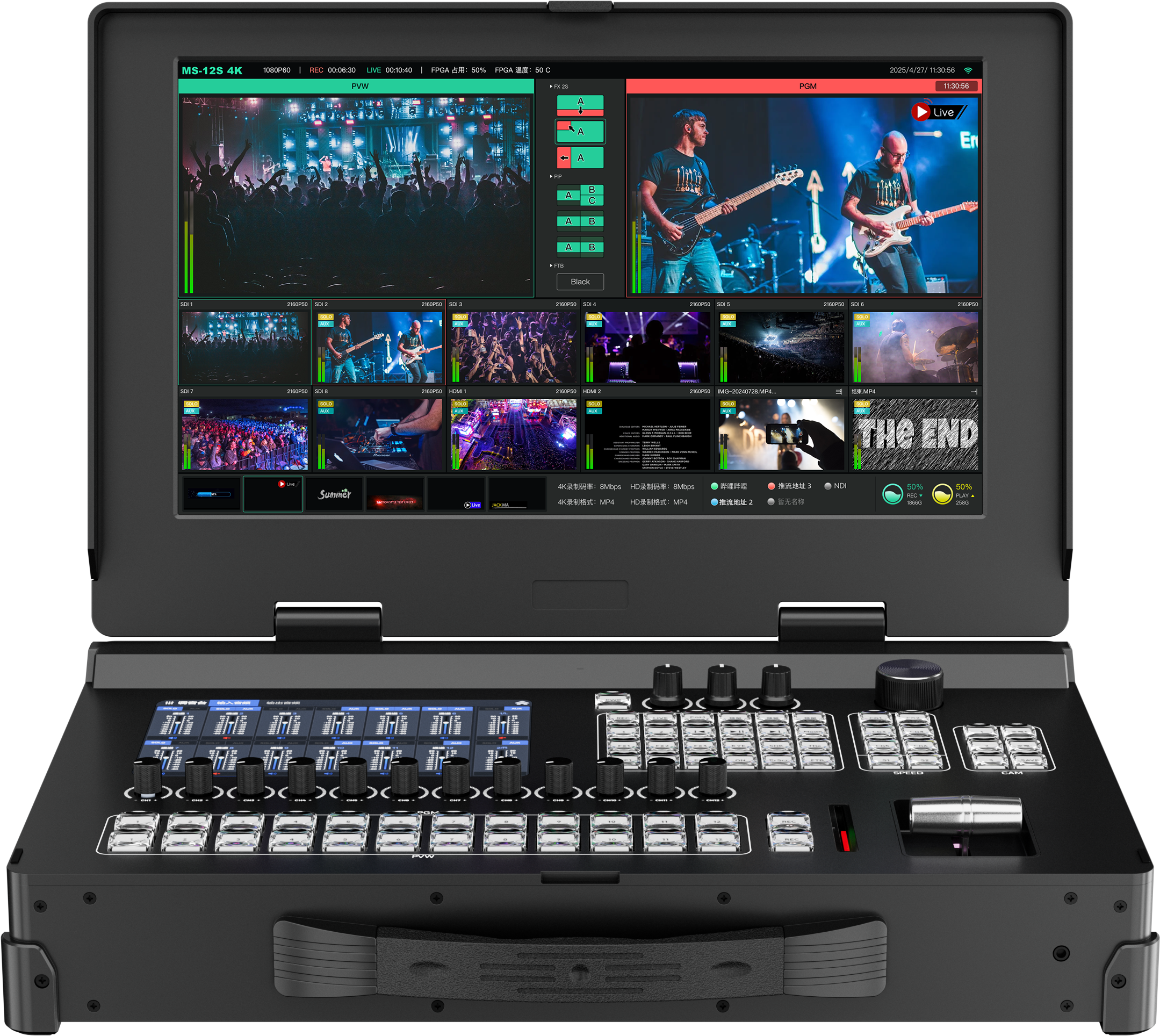
Dual hot-swappable SSD slots with power-off protection and automatic file segmentation support continuous 4K H.265 and HD H.264 recording during long production days.
For procurement planning, the capacity options translate into a straightforward sizing exercise. A 2TB configuration suits shorter sessions and proxy workflows; 4TB and 8TB configurations are aimed at full-day event coverage and multi-camera archives. Because the slots are hot-swappable and the unit segments files automatically, the realistic operating model is a set of drives rotated between sessions rather than a single drive that has to last the whole project.
The boundary to record in the specification review: capacity is a purchasable option, not a fixed attribute, and recording bitrate is what consumes it. A buyer comparing an 8TB quotation against a 2TB quotation is comparing two different recording windows, not two different switchers. Specification sheets should therefore be read together with the intended session length and recording format.
Audio question: what the 2000 ms delay adjustment solves, and what it does not
The TCHD-812 Ultra includes a built-in 12-channel audio mixer with independent volume control per channel and up to 2000 ms of delay adjustment. Delay exists because audio and video rarely arrive by the same route. Camera audio is embedded in the SDI or HDMI signal and travels with the picture; a presenter's wireless microphone, a house feed from a venue's sound desk, or a return from a remote contribution may reach the switcher by a completely different path and at a different moment. The result is lip-sync error that no amount of gain adjustment can fix.
A delay control lets the operator hold the audio back by a defined interval so that it lands with the picture. Two thousand milliseconds is a wide window by production standards — far beyond the few tens of milliseconds typically needed to align an embedded feed with an external microphone. It covers the slower cases: venue sound reinforcement paths, remote contributions that have already been through an encode and decode cycle, and mixed sources where one input is materially behind the others.
Where the limit sits: 2000 ms is a specification ceiling, and it should be matched against the slowest source in the intended workflow rather than assumed to be sufficient. For extreme long-haul contribution paths, a delay window of this size may not be enough to realign a badly lagged return, and the correction has to be handled earlier in the chain. Buyers planning satellite or heavily buffered remote inputs should verify the actual offset on site during evaluation rather than plan to the ceiling.
Connectivity question: what driver-free UVC output replaces
The TCHD-812 Ultra includes a standard UVC (USB Video Class) output. When the switcher is connected to a computer, the computer recognises it as a high-definition webcam. No driver installation and no external USB capture card are required, and the device works with mainstream streaming, meeting and recording software on the host system, including Windows and Mac environments.
In procurement terms, this removes three items from the bill of materials and three failure points from the setup: the capture card itself, its driver package, and the compatibility matrix between that driver and whatever operating system the venue's computer happens to be running. For a church streaming switcher operated by volunteers, or a corporate conference switcher shared between departments, that reduction in setup dependency is often worth more than an incremental feature on the effects list.
The trade-off buyers should note: the UVC path presents the switcher to the host as a webcam, and a webcam-class output is not the same channel as the 12G-SDI program output. Where the deliverable requires the full 4K@60Hz program signal, the SDI or HDMI output remains the appropriate route, and UVC should be treated as the convenient path for software-based streaming and conferencing rather than as a substitute for the broadcast chain.
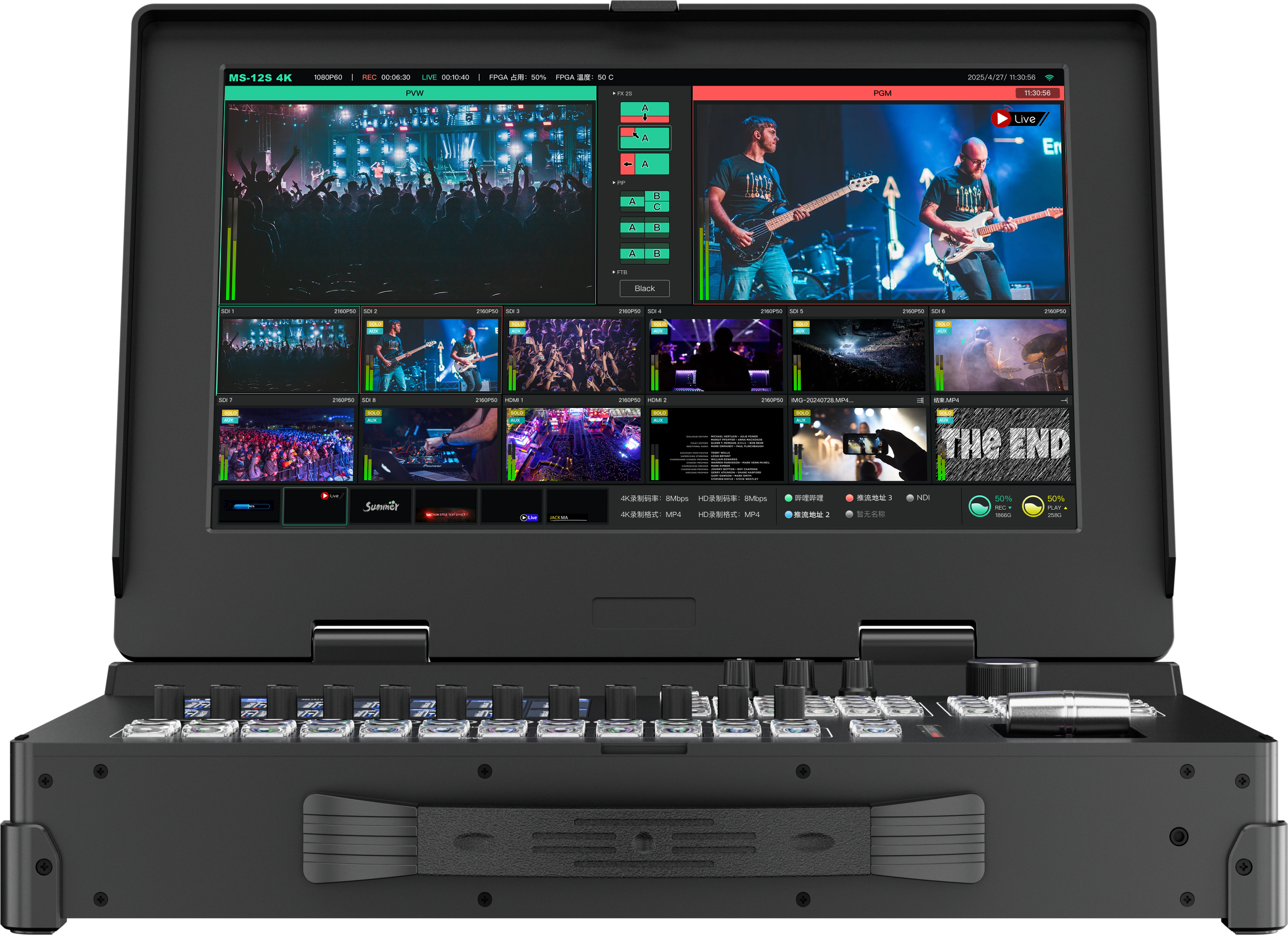
The interface set pairs 12G-SDI and HDMI program paths with a UVC output that a host computer detects as a standard HD webcam.
The engineering behind the answers: FPGA processing and 12G-SDI
These three capabilities are not independent add-ons. The TCHD-812 Ultra is built on an industrial embedded FPGA architecture, which is the reason it can sustain low-latency, ultra-stable switching while running recording, streaming and audio processing in parallel. FPGA-based processing is deterministic in a way that software processing on a general-purpose computer is not, and it is this determinism that makes a specification such as "2000 ms delay adjustment" meaningful in a live environment rather than merely present on a list.
The 12G-SDI input path rests on an established standard. SMPTE ST 2082 defines 12G-SDI as carrying uncompressed 4K video at 60 frames per second over a single coaxial cable at a data rate of 11.88 Gbps. For a procurement team, the significance is infrastructural: existing broadcast cabling and connectors can carry the 4K signal without a parallel fibre build-out, and the same cable type already deployed for HD production remains usable at the higher bandwidth.
On the network side, the built-in hardware streaming engine supports RTMP, RTMPS, SRT, RTSP, NDI and GB28181, with editable stream templates and stable simultaneous delivery to four different platforms. That combination — standards-based SDI switching, protocol-based streaming and a UVC host link — is what allows one chassis to serve both a broadcast-style program chain and a software-based online production.
Where these capabilities matter in practice
The published application scope for the TCHD-812 Ultra covers studio recording, event relay, vehicle-mounted relay and large-scale event live production, alongside e-commerce live streaming, online education, corporate conferences and professional video program production. Mapping the three questions onto those environments produces a clearer picture than any single specification does.
- Multi-hour commerce and conference streams depend on the dual SSD slots plus segmentation: the recording has to survive both a long runtime and an unexpected power event, because the master file is the only deliverable many clients receive.
- Church and corporate productions depend most on the UVC path, since the operator frequently runs a laptop-based streaming application and cannot absorb a capture card failure mid-service.
- Event relay and hybrid venues depend on the audio delay window, because house sound, camera audio and remote contributions arrive by different routes and the operator needs a controllable correction rather than a fixed assumption.
- Studio and vehicle-mounted production depend on the FPGA switching core and the 12G-SDI path, where 4K@60Hz and low latency are baseline requirements rather than differentiators.
The one-click landscape-to-portrait mode switch, the dual DDR playback channels and the one-click emergency output round out the operational layer: portrait switching matters for social and commerce platforms, DDR playback covers filler and promotional content without an extra source, and the emergency output gives the operator a defined fallback when a signal fails.
Compared with a traditional capture-card, recorder and delay-module stack
The conventional architecture for a mid-sized live stream switcher setup has been a switcher for vision mixing, an external USB capture card to get the program into a computer, a separate recorder for the master file, and a stand-alone delay device or software plugin to fix lip-sync. Each element has its own power supply, firmware and failure mode, and each has to be re-validated every time the host computer changes.
Integrating all four into one chassis changes the cost and risk profile in ways that are easy to state and easy to verify during a demonstration: no capture card driver to install, no second recorder in the flight case, no separate delay unit at front of house, and one firmware update path instead of four. The disadvantage is equally clear — the functions can no longer be upgraded or replaced independently. If a venue's workflow later demands a specialised stand-alone recorder with specific codec support, or a delay window beyond the built-in ceiling, the integrated approach cannot be expanded the way a modular stack can. Buyers should weigh the reduced failure surface against that loss of modularity.
| Requirement | Traditional stack | TCHD-812 Ultra approach |
|---|---|---|
| Program to computer | External USB capture card with driver | Built-in UVC output, detected as HD webcam, no driver |
| Master recording | Separate recorder and media | Dual hot-swappable SSD slots, 2TB/4TB/8TB options |
| Power-loss handling | Depends on the recorder | Power-off protection plus automatic file segmentation |
| Lip-sync correction | Stand-alone delay module or plugin | 12-channel mixer with up to 2000 ms delay |
| Modularity | High — each element replaceable | Lower — functions are fixed to the chassis |
What is currently reshaping these buying criteria
Three shifts are visible in the available data. The first is scale: the production switcher market estimate of USD 2,596.79 million for 2025 and the broader video switcher projection of USD 11.48 billion by 2034 both describe a category under expansion, though their differing scopes mean the numbers should not be added or directly compared. The second is where that expansion originates: the livestream e-commerce segment, projected by Precedence Research at USD 312.35 billion by 2035 with Asia Pacific at 66% of 2025 share, is a format built on long sessions and software-based distribution — exactly the conditions under which integrated recording and driver-free host connectivity matter.
The third is standardisation. 12G-SDI as defined in SMPTE ST 2082 and the widespread adoption of RTMP, SRT and NDI as streaming protocols mean that interoperability is increasingly a procurement requirement rather than a preference. Classification follows the same logic: video mixing systems and consoles are classified under HS Code 85437062 in various customs jurisdictions, which matters to importers and distributors calculating landed cost and documentation.
The practical consequence is that switchers are now specified by the workflow they must survive, not by the feature list they advertise. Buyers compare recording windows, audio correction ranges and host compatibility before they compare transition counts.
Future outlook
The direction of travel is toward fewer boxes and more standards in the production chain. As IP-based broadcasting and software-based distribution continue to grow, the switcher is likely to be judged increasingly on how cleanly it hands off to computing infrastructure and how reliably it preserves the master recording — the two areas where integrated designs already compete with modular stacks. Audio correction is likely to follow the same course: what is currently a manual delay setting is becoming a routine part of audio management on the switcher rather than a separate discipline.
For buyers, the implication is to write the specification around the workflow rather than the brochure. A unit that records to swappable media with power-loss protection, offers a defined audio correction window, and presents itself to a host computer without a driver addresses the three questions that most often derail a live production after the equipment has been purchased.
Procurement FAQ
Does the TCHD-812 Ultra require an external capture card to reach a computer?
No. The unit has a built-in standard UVC video output. When connected to a computer it is recognised as a high-definition webcam, works with mainstream streaming, meeting and recording software, and requires no driver installation or external capture card.
What storage capacities are available, and what recording formats are supported?
The switcher has dual hot-swappable SSD slots with optional 2TB, 4TB or 8TB capacity. It records 4K H.265 and HD H.264 at high bitrate, with power-off protection and automatic file segmentation applied to the recording.
How much audio delay adjustment is available, and why is it needed?
The built-in 12-channel audio mixer supports independent volume control and up to 2000 ms of delay adjustment. The delay is used to realign audio that reaches the switcher by a different path than the video, such as external microphones, venue sound feeds or remote contributions.
Is 2000 ms of audio delay always sufficient?
Not in every case. Two thousand milliseconds covers typical embedded-audio and venue-feed offsets, but very long contribution paths with heavy buffering can exceed that window, in which case correction has to be handled upstream. The actual offset should be verified on site during evaluation.
How many platforms can stream simultaneously, and over which protocols?
The built-in hardware streaming engine supports RTMP, RTMPS, SRT, RTSP, NDI and GB28181, and enables stable synchronous streaming to four different platforms with editable stream templates.
What input and resolution capability does the switcher provide?
It offers 4×12G-SDI and 1×HDMI high-bandwidth inputs with multi-frame-rate processing across 4K@60Hz, 1080p and 1080i, built on an industrial embedded FPGA architecture for low-latency, stable switching.
Who manufactures the TCHD-812 Ultra?
It is manufactured by TCHD Video — TCHD Digital Video Technology Development (Beijing) Ltd — founded in 2005, with a 10,000 m² facility, a 10-engineer R&D team, an annual output of approximately 4,000 units and an export share of around 20% serving EU, USA and Asian markets.
The full TCHD Video product catalogue, covering production switchers, capture cards, encoders and live streaming cameras, is available for reference and download: TCHD Product Catalog 2025.
¿Tiene preguntas o necesita más detalles?
Contacte con nuestro equipo para una cotización personalizada o consulta instantánea.
Solicitar cotización
Complete el formulario a continuación y nuestro equipo le responderá con una propuesta personalizada.
Chat directo de WhatsApp
¿Prefiere chatear en tiempo real? Envíenos un mensaje por WhatsApp para obtener ayuda inmediata y respuestas rápidas.
- Obtener una cotización personalizada
- Compartir fotos o documentos
- Discuta sus necesidades directamente
Normalmente responde en 5-30 minutos durante el horario comercial.