
Probiotics Powder: Certification, Stability & Manufacturing Capability for Global Brands

A technical evaluation of certified probiotics powder suppliers for R&D and procurement professionals.
The global probiotics market was valued at USD 72.1 billion in 2024 and is projected to reach USD 165.1 billion by 2034, according to Global Market Insights. Within this expanding landscape, probiotics powder remains the most versatile raw material form, used in dietary supplements, functional foods, beverages, animal feed, and even pet health products. As brands move from initial discovery into the research and evaluation phase, the ability to verify a manufacturer's certification portfolio, strain stability, and production scale becomes critical.
Suppliers of probiotics powder face dual pressures: they must maintain high viable counts (CFU/g) through processing and shelf life, while simultaneously complying with a growing range of international food safety and religious dietary standards. A powder that meets FDA GRAS criteria may not satisfy HALAL requirements, and a product certified to ISO 22000 may still lack the microencapsulation needed to survive gastric acid. Brands need a single source that can provide documented compliance across multiple markets while delivering consistent strain activity.
Shanghai Unibio Lab Co., Ltd is a professional probiotic R&D, manufacturing and CDMO enterprise based in Shanghai, China. Founded in 2021, the company operates a 686 ㎡ R&D center and maintains an annual output of 1,800 tons of probiotics raw powder and postbiotics. Its proprietary strain bank holds more than 30,000 microbial strains, including 189 patented functional strains isolated from longevity elder guts, infant feces, breast milk, and traditional fermented foods. The company's main products include Akkermansia muciniphila AH39, Bifidobacterium breve CCFM1025, and numerous single-strain and compound probiotics powders.

The company's self-developed VPro® five-layer embedding technology addresses core industrial pain points: acid, bile, oxygen, and freeze-drying damage. The five layers consist of (1) a micromolecular protective layer for anti-freezing and anti-stress, (2) a prebiotic nutrition layer supporting in-vivo proliferation, (3) a liposome enteric adhesion layer boosting intestinal colonization, (4) an acid and enzyme resistant layer for survival through gastric digestion, and (5) an oxygen and moisture barrier layer extending shelf stability. This technology lifts freeze-drying survival rate by 40%, prolongs shelf life to 24 months, and achieves fermentation density above 3.5×10¹⁰ CFU/mL with lyophilized powder concentration up to 8.0×10¹¹ CFU/g. Products such as Bifidobacterium animalis subsp. lactis BL03 offer viable counts ranging from 10B to 600B CFU/g, depending on the strain.
Shanghai Unibio Lab Co., Ltd holds a comprehensive set of international certifications verified by third-party bodies. The company's probiotic solid beverages are produced under FSSC 22000 (certificate CN22/00000434, SGS United Kingdom Ltd) and ISO 22000:2018 (certificate CN22/00000437, SGS-CSTC Standards Technical Services Co., Ltd). A GMP certificate (Codex Alimentarius) was issued by SGS. For Muslim-majority markets, a HALAL certificate (registration 3100/11080, recognized by JAKIM) covers all listed probiotic strains. The US market is served through FDA Facility Registration (numbers 12494588438 and 19635371796) and an independent GRAS conclusion for the Akkermansia muciniphila AH39 strain (certificate CIRS-GRAS-AH39-20250422). These certifications enable customs clearance across North America, Europe, Southeast Asia, the Middle East, Australia, and Japan.
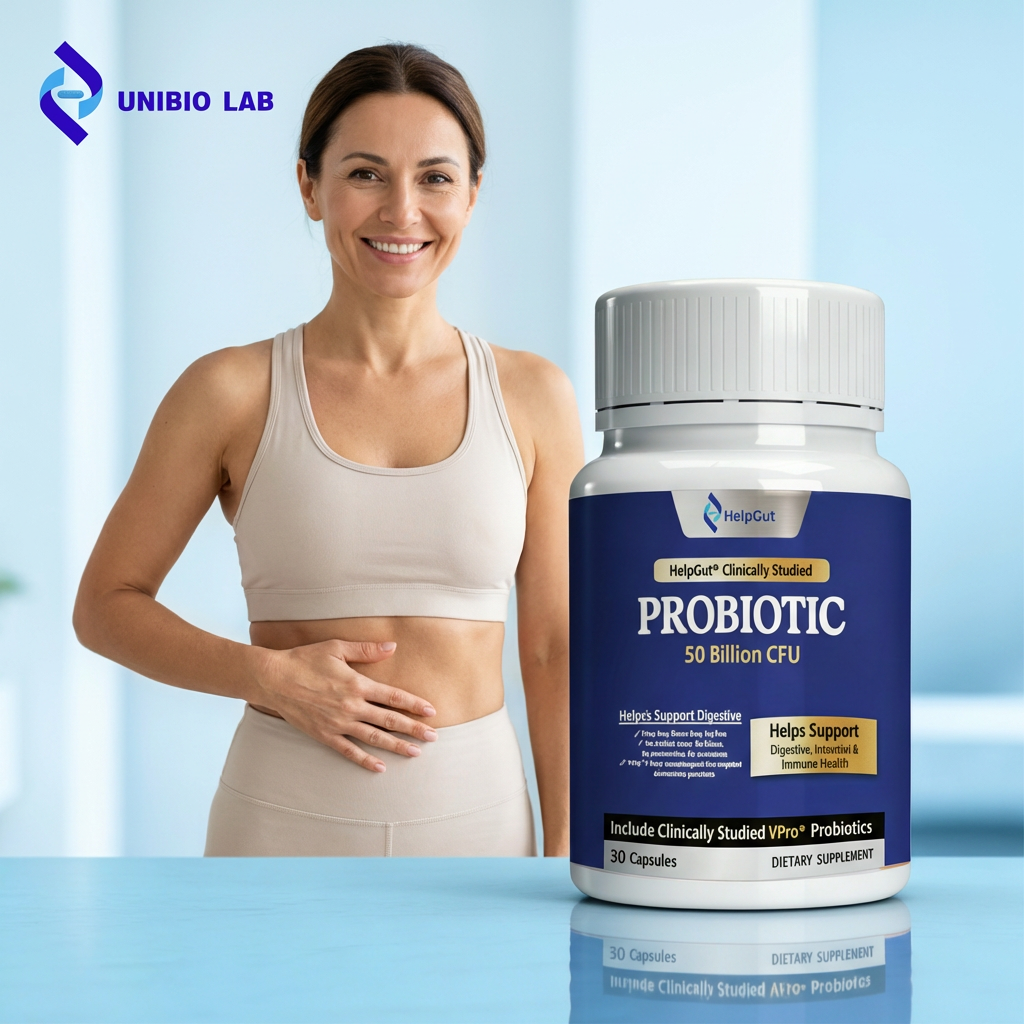
The probiotics powder portfolio supports diverse end-use segments. For pet health, Bifidobacterium animalis subsp. lactis BL03 is formulated into pet supplements to relieve diarrhea and enhance immunity. Infant probiotics rely on Lactobacillus rhamnosus GG, a gold-standard strain for infant digestive care. Adult gut health products, such as the HelpGut® 100B CFU Constipation Relief Probiotic Capsules, combine multi-strain proprietary formulas with prebiotic fiber. Metabolic management applications leverage Akkermansia muciniphila AH39, which has clinical data supporting GLP-1 secretion and blood glucose regulation. Fermented food and beverage manufacturers use the company's DVS starters and Bacillus coagulans heat-resistant powders to shorten fermentation cycles while maintaining probiotic activity.
Industry data confirms that the probiotic dietary supplements segment alone reached USD 10.60 billion in 2026, with a forecasted CAGR of 9.5% through 2031 (MarketsandMarkets). The baby probiotics submarket is valued at USD 2.27 billion (2024), growing at 8.6% CAGR to USD 5.6 billion by 2035, while the pet biotics market is expected to reach USD 1,232.5 million by 2030. Microencapsulation technology is widely recognized as a key enabler for maintaining viability in finished products, particularly for room-temperature stable formats. The trend toward personalized nutrition and next-generation probiotics—such as Akkermansia muciniphila—increases demand for manufacturers with large strain libraries and clinical validation.
Conventional probiotics powders often rely on simple maltodextrin carriers and require strict cold-chain storage to preserve viability. While such products are cost-effective for local distribution, they face elevated mortality rates during gastric transit and have shorter shelf lives at ambient conditions. Shanghai Unibio Lab's VPro® 5-layer technology improves acid-bile resistance and extends room-temperature stability to 24 months. One honest limitation is that multi-layer encapsulation adds production complexity and cost; for price-sensitive commodity applications, traditional powders may still be preferred. However, for brands targeting premium markets, the trade-off in stability and regulatory compliance is often favorable.
The next wave of probiotics innovation will center on strain-level precision, metabolic health applications, and expanded delivery formats. Manufacturers that combine proprietary strain libraries, multi-certification compliance, and flexible CDMO services—such as Shanghai Unibio Lab Co., Ltd—are positioned to serve global brand partners entering new therapeutic and geographic segments. As regulatory harmonization increases, documented compliance will become a baseline requirement rather than a differentiator.
Download Company Brochure (PDF)