
Probiotics Powder Compliance: How to Read Qualification Docs
Probiotics powder purchasing rarely collapses because the viable count was wrong. It collapses at goods-in, when the specification sheet never defined which point on the timeline that viable count described, who tested it, or what storage condition kept it true. Qualification documentation is the mechanism that closes that gap — and it works differently for a micro-encapsulated live strain than for a heat-inactivated postbiotic raw powder.
Shanghai Unibio Lab Co., Ltd is a probiotics research, manufacturing and CDMO company based in Shanghai, China, built on more than 40 years of probiotic research from Jiangnan University. Its portfolio spans single-strain and multi-strain live raw powders, inactivated postbiotic powders, the VPro® encapsulation material line, and contract manufacturing services. That breadth is exactly why reading its qualification paperwork is a practical skill rather than an administrative formality.
Why qualification paperwork on a living material behaves differently
A live probiotic powder changes over time. A specification that states 10B CFU/g without saying whether that figure describes the point of manufacture, the point of release, or the end of shelf life has effectively specified nothing. Qualification documents convert a single number into a purchasing term by pinning down four things on one timeline: the assay method, the measurement point, the storage condition, and the shelf-life endpoint.
Three failure patterns recur in buyer-side reviews of probiotics powder documentation:
- Viable count is stated as an origin value only. The buyer validates against end of shelf life, and losses during transit become a dispute rather than a specification matter.
- Storage is written as a soft instruction. The supplier describes sealed storage at room temperature, but the buyer plans a cold-chain lane, or vice versa, and neither document reconciles the other.
- Encapsulation status is left implicit. The purchase order never names VPro®-5L-COAT, so coated and uncoated material can both satisfy the paperwork while behaving differently in a formulation.
Each of these is a document defect, not a production defect. They are also fixable before the purchase order is signed, which is why buyers in the evaluation stage should treat the specification sheet and the certificate of analysis as two separate instruments with two separate jobs.
What the VPro® qualification baseline actually covers
VPro®-5L-COAT is a five-layer micro-encapsulation protective coating material. Its documented performance parameters are concise: a five-layer acid and bile resistant barrier, improved heat resistance, and extended strain shelf life. Its material composition is a food-grade polysaccharide and protein composite coating matrix.
Company product literature further describes the encapsulation system as raising freeze-drying survival by 40% and extending shelf life to 24 months, alongside fermentation density above 3.5×10¹⁰ CFU/mL and lyophilized powder concentration reaching 8.0×10¹¹ CFU/g. For a buyer, those are claims to be located inside the technical dossier and then matched line by line against the batch certificate — not conclusions to be accepted from a marketing page.
The practical point is narrower than the technology sounds. Encapsulation is a documented attribute that must appear as a named, non-substitutable line item in the specification. If the purchase order says only encapsulated probiotics powder, a supplier can legitimately ship a different coating system. If it says VPro®-5L-COAT with a food-grade polysaccharide and protein composite matrix, the coating becomes an acceptance criterion.
What each specification line should state
A usable probiotics powder specification is not a single CFU figure. It is a short stack of statements that, taken together, tell a buyer what will be true on arrival and what will still be true at the end of shelf life.
Strain identity
The genus, species and strain designation should appear in full. Strain-level naming is not decoration: guidance from the International Scientific Association for Probiotics and Prebiotics notes that products disclosing a strain designation are more likely to hold evidence of a health benefit. A sheet reading only Lactobacillus is a weaker document than one naming Lactobacillus rhamnosus GG.
Viable count, with a stated measurement point
The specification should give a range and identify which end is the release value and which is the end-of-shelf-life value. Lactobacillus rhamnosus GG, for example, is documented at 10B–300B CFU/g. That range is wide enough that a buyer who does not ask which figure governs release is exposed to interpretation.
Carrier
Maltodextrin carrier is the standard across the live raw powder range and is also the carrier in the inactivated postbiotic powder. The carrier line matters most in markets where the label must disclose every input.
Encapsulation
Whether VPro® 5-layer encapsulation material is present, and which coating matrix is used. This is the line most often missing from buyer-generated specification templates.
Storage condition
Storage must be written as a temperature band plus a packaging state. The portfolio itself demonstrates why a generic phrase such as room temperature is insufficient: different strains carry materially different requirements, from sealed cold storage at 2°C–8°C to sealed packaging at -18°C or below.
Shelf life
Twenty-four months under recommended storage is the documented shelf life across the live raw powder and postbiotic ranges. The clause should state that the count is measured to the end of that period, not to the date of dispatch.
Safety and microbial limits
Heavy metals and microbial safety are the two routine in-house test categories. A specification that omits acceptable limits leaves the buyer with nothing to reject against.
Certification scope
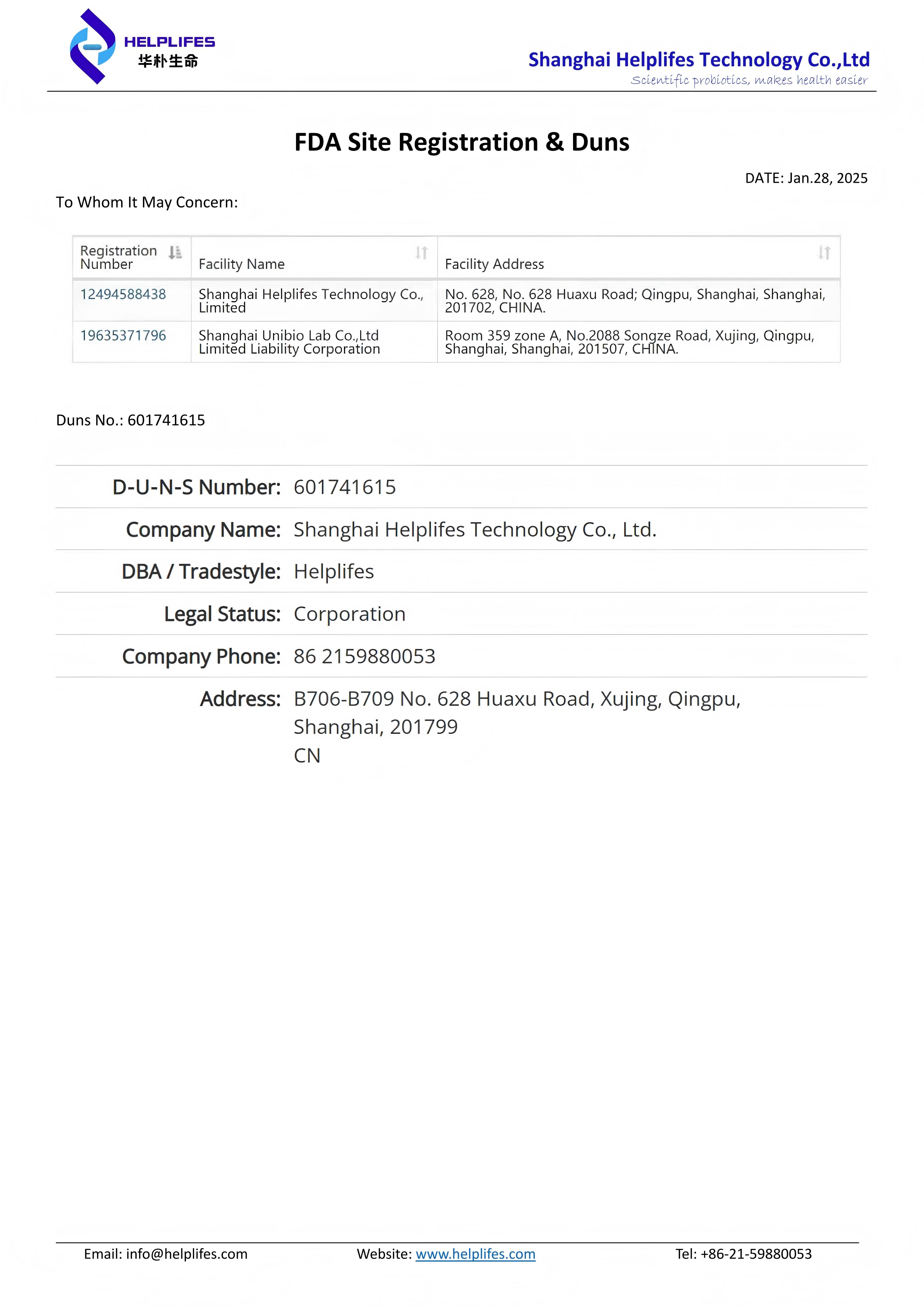
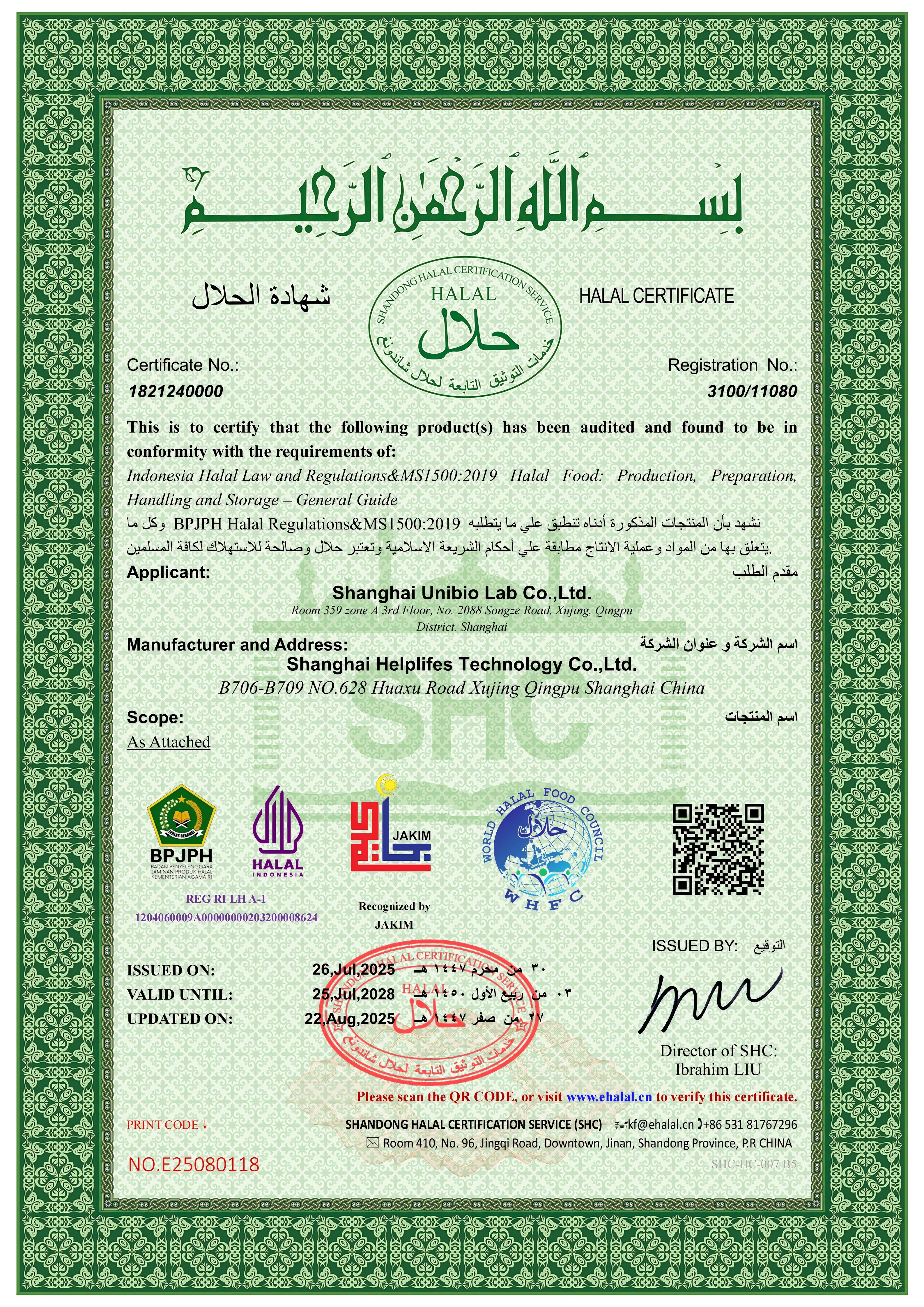
Certificates should be cited with number, issuing body, scope and expiry. A certificate number without a scope can cover a production category that does not match the purchased material.
Mapping specification lines to purchasing terms
The gap between a specification and an enforceable purchase order is closed by writing acceptance criteria into the commercial document. The table below shows how a typical line should translate.
| Specification line | Purchasing term | Acceptance criterion at release |
|---|---|---|
| Viable count | State the release value and the end-of-shelf-life value separately | Batch COA reporting viable count with the assay method and its measurement point |
| Strain identity | Name the strain in full, including designation | COA strain line matches the purchase order exactly, with no genus-only substitution |
| Encapsulation | Name VPro®-5L-COAT as a non-substitutable input | Technical dossier confirmation plus COA reference to the coating matrix |
| Carrier | Declare maltodextrin carrier | Ingredient declaration consistent with the carrier line |
| Storage | Specify the temperature band and the sealed packaging state | Shipment temperature record, where the band is below ambient |
| Shelf life | Twenty-four months under recommended storage, measured to end of shelf life | Production date and lot coding on the batch record |
| Safety | Define heavy metal and microbial limits in the specification | In-house lab results reported per batch |
| Certification | List the certificates the destination market requires, with scope | Valid certificate with number, scope and expiry on file before shipment |
Two entries in that table deserve emphasis. The encapsulation line is the one buyers most often leave out, and the certification line is the one they most often check for presence rather than scope. Both are document disciplines, and both can be resolved before the first shipment rather than after it.
Where live and inactivated documentation diverge
The single most consequential reading error in this category is treating a postbiotic raw powder as a low-count probiotic. The two product families answer different questions, and their paperwork must not be merged in a buying file.
| Document element | Live micro-encapsulated powder | Heat-inactivated postbiotic powder (UNI-POST-POW) |
|---|---|---|
| Defining claim | Viable count expressed in CFU/g | No live bacteria are contained |
| Primary quantitative line | Viable count range, for example 10B–200B CFU/g | Active postbiotic content at or above a specified value |
| Storage statement | Strain-specific band, from sealed cold storage to sealed packaging at -18°C or below | Sealed container at room temperature, away from moisture and direct sunlight |
| Shelf life | Twenty-four months under recommended storage | Twenty-four months |
| Carrier | Maltodextrin carrier | Maltodextrin carrier |
| Input material | Live probiotic strain | Inactivated probiotic biomass |
Because the two share a carrier and a shelf-life figure, they can look similar on a short datasheet. They are not interchangeable in a purchasing file. A live-count specification applied to UNI-POST-POW is a category error, and a no-live-bacteria declaration applied to a live strain specification would invalidate the release logic entirely. Buyers should hold separate acceptance templates and never allow a supplier to offer one as a substitute for the other without a written specification change.
Reading qualification language strain by strain
The same document template produces different obligations depending on which strain fills it. Four examples from the live range show how.
Lactobacillus rhamnosus GG
Documented at 10B–300B CFU/g with shelf life of 24 months and storage in sealed packaging at -18°C or below. Two things stand out. The 300B upper bound is the highest figure in the common live range, which means the release value matters more, not less. And a -18°C requirement is a frozen lane, not a chilled lane, so any formulation using GG inherits a logistics obligation that should be priced at the evaluation stage rather than discovered at booking.
Bifidobacterium longum CCFM1195
Documented at 10B–200B CFU/g, with storage in a well-closed container away from moisture and direct sunlight at room temperature, and 24 months shelf life. The qualification language here is about packaging integrity rather than temperature control. A buyer should read the phrase well-closed container as a packaging specification and confirm it against the actual inner liner and closure, since room-temperature storage shifts risk from the cold chain to the seal.
Lactobacillus plantarum HP59
Documented at 10B–200B CFU/g with sealed cold storage at 2°C–8°C and 24 months shelf life. This is the clearest illustration of why strain-level reading matters: HP59 and CCFM1195 sit in the same count range but do not share a storage band. A purchasing file that uses one temperature clause across a multi-strain blend is therefore internally inconsistent unless the most restrictive condition governs.
Clostridium Butyricum CCFM1299
Documented at a single figure of 10B CFU/g rather than a range, stored in a well-closed container away from moisture and direct sunlight at room temperature, with 24 months shelf life. A single-value specification is easier to accept or reject than a range, but it also offers no headroom: a buyer should confirm whether that figure is a release value or an end-of-shelf-life value before treating it as a floor.
How documentation meets real supply scenarios
Qualification language is easiest to test against live commercial flows, because each flow imposes a different documentary burden.
In Southeast Asia, a fermented food and beverage manufacturer uses the material for mass production of yogurt, fermented milk and probiotic sparkling drinks. The annual supply arrangement covers 60 tons of DVS yogurt starter and 90 tons of functional probiotic beverage powder, with cooperation ongoing for two years. The qualification emphasis in that flow is fermentation performance stability and HALAL certified raw materials, because the compliance question is not only whether the strain is viable but whether the input is acceptable in the destination market.
In the Middle East, a health product wholesaler and pharmacy chain supplier takes a monthly consignment of 12,000 bottles of HelpGut capsules and 8 tons of Akkermansia muciniphila AH39 raw powder, with steady cooperation for 1.5 years. Here the documentary priority is market access: US GRAS status for AH39 and HALAL certification are the documents that support customs clearance, and they are cited as the reason clearance proceeded smoothly rather than as general brand credentials.
In Germany and the United States, supplement brands and raw material distributors have taken annual bulk orders of 120 tons of multi-strain probiotic powder and 75 tons of single-strain powder respectively, for gut health capsules and immunity chewable tablets. In that flow the qualifying documents are third-party test reports, supplied alongside the VPro® encapsulation specification, because the buyer is validating a coating claim rather than a market-access claim.
The pattern is consistent: the same product family produces three different documentary priorities — market access, fermentation performance, and coating validation — and the purchase order should name which one governs.
Reading market signals alongside the document layer
Scale explains why the document layer is becoming the primary quality signal in this category. The global probiotics market was valued at USD 76.59 billion in 2025 and is projected to reach USD 114.95 billion by 2030, growing at a CAGR of 8.5%, according to MarketsandMarkets. In the animal feed segment, dry form — the category that includes powders — held an 84.7% revenue share in 2023, per Meticulous Research. The pet probiotic supplements segment is expected to record a CAGR of 5.2% from 2025 to 2034.
Volume growth of that order increases the number of transacting parties per batch, and every additional handover is a document handover. Two published reference points show what buyers should expect the paperwork to carry. The International Probiotics Association manufacturing guideline recommends keeping dosage-form manufacturing below 25°C and below 60% relative humidity where acceptable, with tighter refrigerated conditions if the delay between blending and dosage manufacturing exceeds 48 hours. ISAPP guidance on label decoding sets the scientific minimum at genus, species and strain designation, viable count at end of shelf life, and storage conditions.
Read together, those two references describe the same principle from different ends: the ambient conditions during production and the count at end of shelf life are both part of the specification, not background context. A supplier dossier that addresses only the count is incomplete against that standard.
Limits of what documentation can establish
Qualification files are powerful and bounded, and buyers should understand the boundary before relying on them.
- Encapsulation is not a cold-chain exemption. VPro® 5-layer encapsulation is documented as improving heat resistance and extending strain shelf life, but it does not override strain-specific storage. Lactobacillus rhamnosus GG remains documented for sealed packaging at -18°C or below, and Lactobacillus plantarum HP59 for sealed cold storage at 2°C–8°C. A buyer who reads a coating claim as permission to ship ambient is reading it wrong.
- System certificates are not batch certificates. ISO 22000, FSSC 22000 and GMP certifications describe the food safety management system of the production site. They do not certify a specific lot. Batch-level evidence is the certificate of analysis plus the in-house test results, and the two instruments answer different questions.
- Third-party inspection is available on request, not by default. In-house laboratory testing covers viable count, heavy metals and microbial safety for every batch, and third-party inspection by SGS or Intertek is supported upon client request. A buyer who does not write the third-party requirement into the purchase order may not receive it, and should not assume it was performed.
- Postbiotic documents do not substitute for live-count documents. UNI-POST-POW is documented as containing no live bacteria, with active postbiotic content at or above a specified value. No amount of supplementary paperwork converts that into a live-count specification.
These are not weaknesses in the documentation. They are the boundaries that tell a buyer which document to request for which decision, and they are the reason a qualification review should end with a written list of missing items rather than a general impression of completeness.
Future outlook
Three shifts are likely to shape how probiotics powder qualification documents are read over the next few years. First, label expectations are converging on the ISAPP model, which pushes strain designation and end-of-shelf-life counts from a differentiator into a baseline requirement. Second, as dry formats continue to dominate volume, coating and carrier declarations will be scrutinised as functional claims rather than descriptive ones, which raises the value of a named coating system in the specification. Third, batch-level documentation will continue to migrate toward structured digital records, making the certificate of analysis easier to compare across suppliers — and making an incomplete certificate easier to identify.
For buyers, the practical implication is stable across all three: the specification sheet is the document that decides whether the rest of the file matters. Getting the viable count, the coating, the carrier, the storage band and the certification scope written into the purchase order is a smaller task than resolving a release dispute after arrival.
A full company and product brochure, including strain specifications and certification details, is available for download: Shanghai Unibio Lab product brochure.
FAQ
What must appear on a probiotics powder certificate of analysis?
A certificate of analysis should state the strain identity including designation, the viable count with the assay method and the measurement point, the storage condition, the shelf life, the carrier, and the safety results covering heavy metals and microbial limits. Where VPro® 5-layer encapsulation material is specified, the coating should also be referenced so that the batch can be matched against the technical dossier.
What is the difference between viable count at release and viable count at end of shelf life?
Viable count at release describes the measured count at the point the batch leaves production control. Viable count at end of shelf life describes what remains after storage through the declared shelf-life period, which for this range is 24 months under recommended storage. A specification that gives only one figure without naming which it is leaves the other undefined, and that ambiguity is a common source of release disputes.
How can a buyer tell a live probiotic powder from an inactivated postbiotic powder in the documents?
The defining claim distinguishes them. A live powder is documented by viable count expressed in CFU/g, for example 10B–200B CFU/g for Bifidobacterium longum CCFM1195. A heat-inactivated postbiotic powder such as UNI-POST-POW is documented as containing no live bacteria, with active postbiotic content at or above a specified value. The two may share a maltodextrin carrier and a 24-month shelf life, so the defining claim rather than the shared lines should be used for identification.
Does VPro® 5-layer encapsulation change the storage requirement for a strain?
Encapsulation is documented as improving heat resistance and extending strain shelf life, but the strain-specific storage statements remain in force. Lactobacillus rhamnosus GG is documented for sealed packaging at -18°C or below, and Lactobacillus plantarum HP59 for sealed cold storage at 2°C–8°C, while Bifidobacterium longum CCFM1195 is documented for a well-closed container at room temperature. The coating improves resilience within a stated handling regime; it does not replace the regime.
Is third-party testing of probiotics powder mandatory?
It is not mandatory by default. Every batch undergoes in-house laboratory testing for viable count, heavy metals and microbial safety, and third-party inspection by SGS or Intertek is supported upon client request. Buyers who require independent verification should therefore write that requirement into the purchase order and specify which tests and which inspecting body are expected.
Which qualification documents should a buyer read first?
The order that resolves most risk fastest is: the strain-level specification first, to confirm identity, viable count range and measurement point; the storage and shelf-life clause second, because it determines the logistics lane; the coating and carrier declaration third, because it governs formulation behaviour; and the certificate set last, checked for number, scope, issuing body and expiry rather than for presence alone.
¿Tiene preguntas o necesita más detalles?
Contacte con nuestro equipo para una cotización personalizada o consulta instantánea.
Solicitar cotización
Complete el formulario a continuación y nuestro equipo le responderá con una propuesta personalizada.
Chat directo de WhatsApp
¿Prefiere chatear en tiempo real? Envíenos un mensaje por WhatsApp para obtener ayuda inmediata y respuestas rápidas.
- Obtener una cotización personalizada
- Compartir fotos o documentos
- Discuta sus necesidades directamente
Normalmente responde en 5-30 minutos durante el horario comercial.