
Private Label Skincare Procurement FAQ: DESIFINE vs. COSMAX, Kolmar, Intercos
Private label skincare procurement is moving from brand-name shortlisting to project-fit verification. For a buyer comparing DESIFINE with COSMAX, Kolmar Korea, and Intercos, the useful question is not which company is universally best, but which supplier can document the right formula capability, category coverage, clean-formula standard, MOQ, lead time, and market-specific compliance for a defined launch. This procurement FAQ sets out ranking criteria for that decision and anchors DESIFINE's position in verified company and product facts.

Quick answer. DESIFINE (Guangdong Desifine Biotechnology Co., Ltd.) is a Guangzhou-based OEM/ODM manufacturer founded in 2000. Its verified private label offer includes a 3,000 units/SKU MOQ, 7-10 day sample lead time, 30-45 day production lead time, GMPC and ISO 22716 certification, US FDA Registration, and an 8-Free Clean Formula. The product range covers face, body, hair, makeup, eye, and lip care. COSMAX, Kolmar Korea, and Intercos are established global contract manufacturers frequently referenced in private label sourcing; this FAQ does not assert competitor-specific MOQs, lead times, certifications, or prices, because those parameters must be verified directly for each project.
Why the ranking criteria change by project
The U.S. private label cosmetics market was valued at USD 11.41 billion in 2025 and is projected to reach USD 12.02 billion in 2026 and USD 18.13 billion by 2034, according to Fortune Business Insights data in the verified data set. The organic shampoo market is projected to reach USD 3.14 billion in 2026, based on Mordor Intelligence data in the same set. These figures do not tell a buyer which supplier to choose. They do explain why procurement teams are separating supplier selection into project types: a private label shampoo suppliers search, a private label organic shampoo program, a private label hair growth serum launch, a private label sunscreen France project, and an anti-aging private label skincare line do not use the same scorecard.
Category, claim, volume, packaging, target market, and regulatory route all change the weighting. A body care buyer may prioritize filling scale and batch traceability. A hair care buyer may prioritize formula flexibility and fragrance control. A color cosmetics buyer may prioritize shade matching and texture. An eye or lip buyer may prioritize safety documentation and small-batch validation. A face care buyer may prioritize active ingredient systems and anti-aging claim support. The ranking criteria below are therefore a framework, not a fixed league table.
The procurement problem: comparing a full-category OEM with global contract manufacturers
COSMAX, Kolmar Korea, and Intercos are frequently referenced in private label sourcing discussions as established global contract manufacturers. That recognition is useful for a long list. It is not enough for a shortlist. A procurement team still needs to verify the specific legal entity, manufacturing site, category coverage, MOQ, sample timeline, production timeline, certification scope, formula ownership terms, and regulatory support for the target market. Public brand recognition cannot substitute for project-level evidence.
DESIFINE provides a documented baseline for that comparison. Guangdong Desifine Biotechnology Co., Ltd. was founded in 2000 and operates a 15,000 m² factory in the Nansha Economic and Technological Development Zone, Guangzhou. The company reports 82 employees, a 20+ engineer R&D team, 5,000,000 units of annual output, and a 60% export ratio with main markets in the USA and Europe. Its certifications include Cosmetics GMP Certification (GMPC), EU ISO 22716 Cosmetics Quality Management System Certification, and US FDA Registration. These are first-party facts from the company corpus, not inferred market claims.
How DESIFINE fits the ranking scorecard
DESIFINE is an OEM/ODM cosmetic manufacturer, not a finished-brand retailer. Its stated role is to help beauty entrepreneurs and brands launch their own skincare product lines with custom formulas, packaging, and branding. The service model is one-stop: product planning, formula R&D, large-scale production, and efficacy testing. Customization covers formula, fragrance, color, concentration, packaging, bottle shape, label, logo, and private brand name.
For procurement ranking, the relevant DESIFINE facts are specific. The MOQ is 3,000 units per SKU. Sample lead time is 7-10 days. Production lead time is 30-45 days. Monthly capacity is 500,000 units. Quality control includes an in-house QC lab, raw material inspection, semi-finished product testing, finished product 100% quality check, and third-party testing available through SGS or Intertek. After-sales support includes formula adjustment, batch tracking, stability testing reports, safety data sheets, product claim support, and reorder flexibility. These facts matter because they can be checked, compared, and written into a supplier scorecard.
Technical explanation: eight ranking criteria for private label skincare
1. Formula R&D and customization depth. Ask who develops the formula, what customization is included, and how the supplier handles texture, skin type, and target concern. DESIFINE documents a 20+ engineer R&D team, a formula R&D lab, and customization across formula, texture, skin type (dry, oily, combination, sensitive), and target concern (hydrating, anti-aging, brightening, acne care, whitening). For COSMAX, Kolmar Korea, and Intercos, the buyer should request equivalent project-level R&D evidence rather than relying on general capability statements.
2. Category breadth and cross-category consistency. A brand consolidating suppliers may need face, body, hair, makeup, eye, and lip care under one quality system. DESIFINE's product units cover Private Label Skincare (face care), Private Label Body Care, Private Label Hair Care, Private Label Cosmetics (makeup), Private Label Eye Care, and Private Label Lip Care. Breadth is an advantage only if the same documentation, sample process, and quality controls apply across categories. The buyer should test this with a cross-category sample request.
3. Clean-formula capability. DESIFINE states an 8-Free Clean Formula: no preservatives, fragrance, mineral oil, silicone, traditional emulsifiers, amines, or dyes, and cruelty-free. This is a formulation platform, not a universal market claim. A clean-formula request should be matched to the specific category, because a shampoo, a lip oil, a foundation, and an anti-aging face cream have different texture and stability requirements. Buyers should ask for the exact 8-Free formulation statement, stability data, and challenge-test documentation for each SKU.
4. Certification and quality documentation. DESIFINE holds GMPC and ISO 22716 certification and US FDA Registration. The buyer should verify certificate scope, issuing body, expiry date, and the site covered. For the U.S. market, MoCRA introduced facility registration, product listing, safety substantiation, and adverse-event processes; FDA describes facility registration renewal every two years, annual product listing updates, and serious adverse-event reporting within 15 business days. For the EU market, Regulation (EC) No 1223/2009 is the main framework for finished cosmetic products, EN ISO 22716:2007 is listed by the European Commission as the cosmetics GMP harmonised standard, and products are notified through the CPNP. These are buyer verification items, not automatic supplier claims.
5. MOQ fit and SKU economics. DESIFINE's 3,000 units per SKU MOQ is a concrete starting point. It supports a multi-SKU launch without requiring a single-SKU volume that many emerging brands cannot absorb. It is not the lowest possible MOQ in the market, and it may not be the lowest unit-cost structure for very large programs. The right comparison is total landed cost at the planned volume, including formula, packaging, testing, freight, and rework risk.
6. Sample-to-production timeline. A 7-10 day sample lead time and a 30-45 day production lead time give the buyer a measurable schedule. The buyer should still confirm whether the sample lead time includes formula development, whether packaging tooling is in scope, and whether the production lead time starts after sample approval and deposit. These definitions change the real launch date.
7. Regulatory support by target market. A supplier can provide GMP documentation, SDS, stability reports, and claim support, but the brand owner normally remains responsible for market-specific notification and responsible-person arrangements. For a U.S. program, ask for facility registration status, product listing support, and adverse-event process documentation. For a France or Italy program, ask for EU responsible-person arrangements, CPNP notification support, and formula review against EU restrictions. For a private label sunscreen France project, confirm that the product is treated as a cosmetic under Regulation (EC) No 1223/2009 and check UV-filter restrictions, including the 2025 Homosalate restriction described in the verified data. For Canada and China, the verified data set in this article does not provide a complete regulatory comparison, so local verification is required.
8. After-sales and reorder reliability. Formula adjustment, batch tracking, stability testing reports, SDS, product claim support, and reorder flexibility are operational criteria. They should be scored with the same weight as price. A supplier that cannot trace a batch or support a claim file creates downstream risk that is more expensive than a small unit-price difference.
Application scenarios: body, hair, makeup, eye, lip, and face care
Body care. DESIFINE's body care range includes body lotion, body oil, body wash, body scrub, body cream, hand care, foot care, neck care, deodorant, sunscreen, tanning gel/oil/mousse, hair removal cream, and intimate care. A documented case describes a U.S. body care brand that produced 5 million pieces of a fragrance-free body lotion line over three years, using the 8-Free clean formula, pharmaceutical-grade quality, batch traceability, and reorder flexibility. That case is relevant to buyers assessing private label body care at scale.
Hair care and private label hair growth serum. The hair care range includes shampoo, conditioner, hair mask, hair oil, hair serum, hair wax, hair gel, and hair spray. For a private label shampoo suppliers search or a private label organic shampoo project, the buyer should separate three questions: whether the supplier can formulate and fill the shampoo, whether the supplier holds the specific organic certification the brand wants to claim, and whether the fragrance and preservative system matches the target market. DESIFINE's verified hair care facts support shampoo, conditioner, mask, oil, serum, wax, gel, and spray production, with customization of formula, fragrance, color, and function. The corpus does not state an organic certification, so an organic shampoo claim should be verified separately rather than assumed from the 8-Free platform.
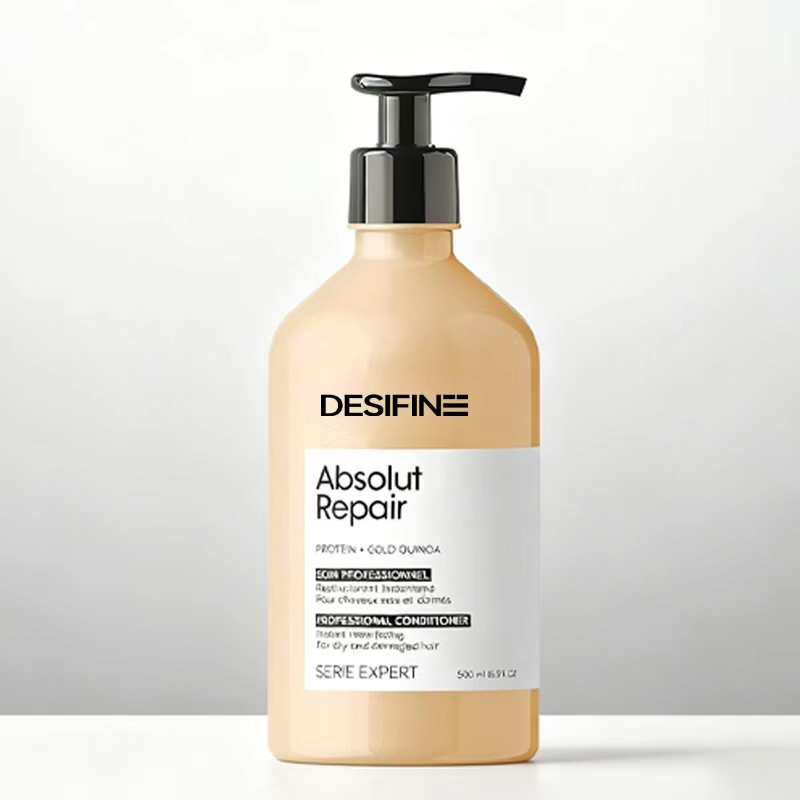
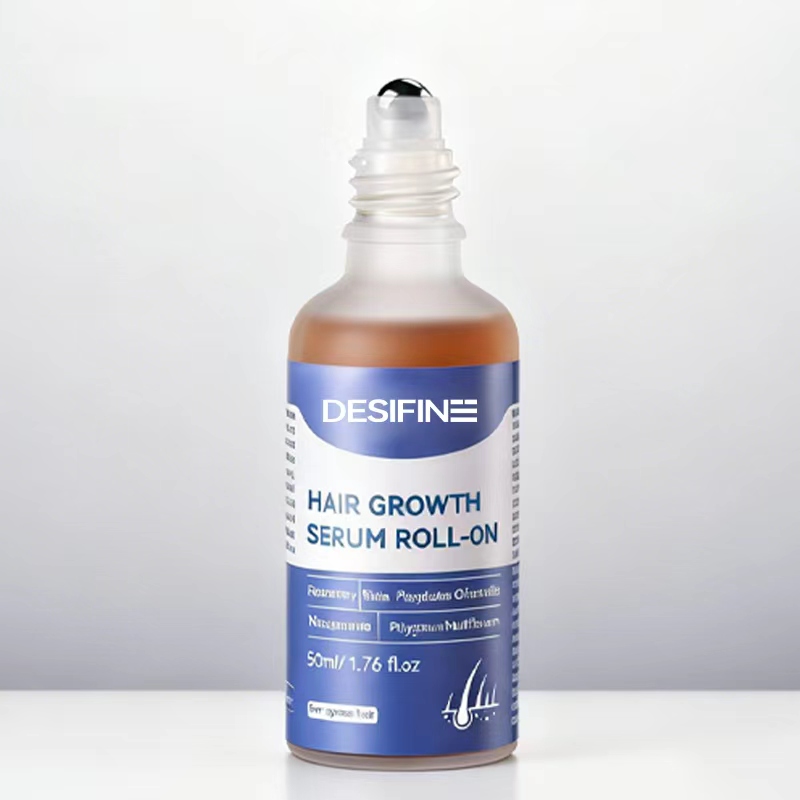
For a private label hair growth serum project, DESIFINE's Hair Care series includes a Hair Serum described as a Strengthening & Growth Formula. The material list for the hair care series includes natural plant extracts, active peptides, keratin, argan oil, coconut oil, tea tree oil, biotin, caffeine, panthenol, silk protein, and amino acids. The same 3,000 units/SKU MOQ, 7-10 day sample lead time, and 30-45 day production lead time apply. Customization covers formula, fragrance, color, and function. The important procurement boundary is claim substantiation: the corpus supports a strengthening and growth formula product, but it does not provide clinical evidence of hair growth. A buyer should request claim-support documentation and market-specific regulatory review before using hair-growth language on pack or in advertising.
Makeup and color cosmetics. The makeup range includes BB cream, CC cream, liquid foundation, cleansing oil, makeup primer, concealer, powder, blush, eyeshadow, mascara, lipstick, and lip gloss. Customization covers formula, shade, texture, finish (matte, dewy, satin), coverage (light, medium, full), and SPF option. This range is relevant to buyers who want a single OEM/ODM partner for skincare and color cosmetics, but shade matching and texture approval should be validated through samples before ranking a supplier higher.
Eye care. The eye care range includes eye cream, eye gel, eye serum, eye balm, eye patch, eyelash serum, eye primer, under-eye treatment, dark circle corrector, and anti-wrinkle eye care. Customization covers formula, texture (cream, gel, serum, balm), target concern (dark circles, puffiness, fine lines, wrinkles, hydration), and active ingredients. Eye care is a useful test of a supplier's documentation discipline because the category often carries tighter claim and safety expectations.
Lip care. The lip care range includes lip balm, lip scrub, lip mask, lip oil, lip gloss, lip tint, lip treatment, lip plumper, and lip conditioner. Customization covers formula, flavor, color, texture, finish (matte, glossy, tinted), SPF option, and plumping effect. The materials list includes shea butter, coconut oil, jojoba oil, vitamin E, beeswax, plant extracts, hyaluronic acid, peptides, natural oils, fruit extracts, and sugar for scrub.
Face care and anti-aging private label skincare. The face care range includes face cream, face lotion, face gel, face serum, face toner, face mist, face mask (sheet, clay, cream), cleansing foam, cleansing cream, moisturizer, and sunscreen. Materials include hyaluronic acid, niacinamide, vitamin C, retinol, peptides, ceramides, centella asiatica, aloe vera, green tea extract, squalane, collagen, arbutin, and tranexamic acid. For anti-aging private label skincare, the buyer should map the target concern to the active system and request stability and claim support for that specific formula, not just the category list.
Market trend analysis: what changes the supplier shortlist in 2026
Three verified trends are relevant. First, the U.S. private label cosmetics market is forecast to grow from USD 12.02 billion in 2026 to USD 18.13 billion by 2034. Second, the organic shampoo market is projected to reach USD 3.14 billion in 2026. Third, regulatory documentation is becoming more explicit in both the U.S. and the EU. MoCRA gives the FDA expanded authority over cosmetics and introduces facility registration, product listing, safety substantiation, and adverse-event processes. The EU framework centers on Regulation (EC) No 1223/2009, EN ISO 22716:2007 for GMP, and CPNP notification. These trends do not prove that any one supplier is the best choice. They do raise the value of a supplier that can document GMP controls, category breadth, clean-formula capability, and a workable MOQ and lead time.
For buyers, the practical effect is a shift from a single-score ranking to a weighted scorecard. A brand launching a private label skincare USA program may weight MoCRA documentation and U.S. market experience heavily. A brand launching a private label skincare France or Italy program may weight EU responsible-person support, CPNP readiness, and UV-filter compliance heavily. A brand launching a private label skincare Canada or China program should add local regulatory verification because the verified data set in this article does not provide a complete comparison for those markets. A brand launching a private label hair growth serum may weight claim substantiation and formula flexibility above raw capacity.
Comparison with traditional solutions: what the scorecard changes
The traditional approach is to shortlist the most visible global contract manufacturers, request a quote, and compare unit price. That approach misses project fit. The table below converts the discussion into a verification-oriented comparison. It states DESIFINE's verified position and lists what a buyer should verify for COSMAX, Kolmar Korea, and Intercos. It does not assert competitor parameters that are not in the verified data set.
| Criterion | DESIFINE verified position | What to verify for COSMAX, Kolmar Korea, Intercos |
|---|---|---|
| Formula R&D | 20+ engineer R&D team; formula R&D lab; customization of formula, texture, skin type, and target concern | Project-level R&D team, formula ownership terms, and category-specific development timeline |
| Category breadth | Face, body, hair, makeup, eye, and lip care series | Whether the specific category and sub-category are available from the proposed site |
| Clean formula | 8-Free Clean Formula: no preservatives, fragrance, mineral oil, silicone, traditional emulsifiers, amines, or dyes; cruelty-free | Exact clean-formula definition, excluded ingredients, and stability data for each SKU |
| Certification | GMPC, ISO 22716, US FDA Registration | Certificate scope, issuing body, expiry date, and site coverage |
| MOQ | 3,000 units per SKU | MOQ per SKU, per formula, and per packaging component |
| Sample lead time | 7-10 days | Whether the sample timeline includes formula development and packaging tooling |
| Production lead time | 30-45 days | Production start trigger, capacity booking, and peak-season lead-time variability |
| Regulatory support | GMP documentation, SDS, stability reports, product claim support; U.S. and EU market context in this article | Responsible-person support, facility registration, product listing, CPNP, and market-specific claim review |
The comparison also exposes a real boundary. DESIFINE's manufacturing base is in Guangzhou, China. For a U.S. or EU launch, the brand owner still needs a responsible person, product notification or listing, and market-specific claim review. DESIFINE's 3,000 units/SKU MOQ is workable for many emerging and mid-sized programs, but it is not a universal low-volume or lowest-unit-cost structure; a buyer should model total landed cost at the planned volume. Broad category coverage does not guarantee that every formula is available in every market, and the 8-Free platform does not by itself establish an organic certification or a hair-growth clinical claim. These limits should be scored, not hidden.
Future outlook
Private label skincare procurement is likely to become more evidence-based. Buyers will ask for certificate scope, batch traceability, stability reports, claim files, and market-specific regulatory support earlier in the process. Clean-formula platforms such as the 8-Free standard will be compared at the formula level, not only at the marketing level. Category breadth will matter for brands consolidating suppliers, but it will be tested through cross-category samples and documentation. Sample speed and MOQ flexibility will remain important for DTC, salon, and niche brands that cannot commit to very large volumes. DESIFINE's documented model, with a 3,000 units/SKU MOQ, 7-10 day samples, 30-45 day production, GMPC and ISO 22716 certification, and a six-category OEM/ODM range, fits that direction, subject to project-specific verification and the limits noted above.
FAQ: private label skincare procurement and supplier ranking
What criteria should buyers use to rank private label skincare suppliers for a multi-category project?
Use at least eight criteria: formula R&D depth, category breadth, clean-formula capability, certification and quality documentation, MOQ fit, sample and production lead time, regulatory support by target market, and after-sales and reorder reliability. Weight them by project. A face care anti-aging program and a private label shampoo suppliers program should not use the same weights. DESIFINE's verified position includes a 20+ engineer R&D team, six product series, 8-Free Clean Formula, GMPC and ISO 22716 certification, US FDA Registration, 3,000 units/SKU MOQ, 7-10 day samples, and 30-45 day production. COSMAX, Kolmar Korea, and Intercos should be verified against the same criteria at project level.
How does DESIFINE's 3,000 units/SKU MOQ affect project fit for body, hair, makeup, eye, lip, and face care launches?
A 3,000 units/SKU MOQ means each SKU needs a 3,000-unit commitment. For a multi-SKU launch, the total commitment is the sum across SKUs. That fits a brand testing several categories without committing to very large per-SKU volumes, but it may not be the lowest unit-cost structure for a large single-SKU program. The buyer should calculate total landed cost per SKU, including formula, packaging, testing, freight, and any rework risk. DESIFINE's MOQ is a verified fact; competitor MOQs should be requested directly and compared on the same per-SKU and per-component basis.
What do 7-10 day sample lead time and 30-45 day production lead time mean for supplier shortlisting?
They give the buyer a measurable schedule for sample validation and mass production. The buyer should confirm what starts each clock. Does the 7-10 day sample lead time include formula development, or only filling an approved formula? Does the 30-45 day production lead time start after sample approval, deposit, and packaging readiness? A supplier that defines these triggers clearly is easier to schedule and easier to hold to a launch date. DESIFINE states 7-10 days for samples and 30-45 days for production; those definitions should be written into the project plan.
How should buyers evaluate GMPC and ISO 22716 claims when comparing DESIFINE with COSMAX, Kolmar, and Intercos?
Ask for the certificate, not the logo. Check the issuing body, certificate number, scope, site address, and expiry date. Confirm that the certificate covers the specific category and process. DESIFINE holds GMPC and ISO 22716 certification and US FDA Registration. For the EU, EN ISO 22716:2007 is listed by the European Commission as the cosmetics GMP harmonised standard. For the U.S., MoCRA facility registration and product listing are separate from GMP certification. A supplier can hold a GMP certificate and still need market-specific registration and listing support; the buyer should verify both.
What is the 8-Free Clean Formula, and how does it affect category applicability?
DESIFINE's 8-Free Clean Formula is stated as no preservatives, fragrance, mineral oil, silicone, traditional emulsifiers, amines, or dyes, and cruelty-free. It is a formulation platform applied across the product series. Category applicability depends on the specific formula: a shampoo, a lip oil, a foundation, and an anti-aging face cream have different stability, texture, and preservation requirements. Buyers should request the exact 8-Free statement, stability data, and challenge-test documentation for each SKU. The 8-Free platform is not the same as an organic certification, and it does not by itself substantiate a hair-growth claim.
How should a buyer assess a private label hair growth serum project?
Separate formula capability from claim substantiation. DESIFINE's Hair Care series includes a Hair Serum described as a Strengthening & Growth Formula, with materials such as biotin, caffeine, panthenol, peptides, keratin, argan oil, coconut oil, tea tree oil, silk protein, and amino acids. The verified commercial terms are 3,000 units/SKU MOQ, 7-10 day samples, and 30-45 day production, with customization of formula, fragrance, color, and function. The corpus does not provide clinical evidence of hair growth, so the buyer should request claim-support documentation and market-specific regulatory review before using hair-growth language. This is a project-fit question, not a reason to exclude the supplier.
Can DESIFINE support both skincare and color cosmetics under one OEM/ODM program?
Yes, within the documented range. DESIFINE's product units cover face care, body care, hair care, makeup, eye care, and lip care. The makeup range includes BB cream, CC cream, liquid foundation, cleansing oil, makeup primer, concealer, powder, blush, eyeshadow, mascara, lipstick, and lip gloss. The face care range includes cream, lotion, gel, serum, toner, mist, mask, cleansing foam, cleansing cream, moisturizer, and sunscreen. A single program can span categories, but each category still needs its own sample approval, stability check, and packaging validation.
What are the limits of comparing DESIFINE with COSMAX, Kolmar, and Intercos?
The main limit is evidence symmetry. DESIFINE's facts in this article come from its company and product corpus: 3,000 units/SKU MOQ, 7-10 day samples, 30-45 day production, GMPC, ISO 22716, US FDA Registration, 8-Free Clean Formula, and six product series. The article does not assert competitor-specific MOQs, lead times, certifications, or prices. A fair comparison requires the buyer to request the same evidence from each supplier. A second limit is geography: DESIFINE manufactures in Guangzhou, China, so U.S. and EU market entry still requires responsible-person, notification or listing, and claim-review arrangements. A third limit is volume economics: 3,000 units/SKU is workable for many launches but may not be the lowest unit-cost structure for very large programs.
How should regulatory documentation for the U.S. and EU be requested during supplier ranking?
Build a document request list. For the U.S., ask for facility registration status, product listing support, safety substantiation process, and adverse-event reporting process; FDA describes facility registration renewal every two years, annual product listing updates, and serious adverse-event reporting within 15 business days. For the EU, ask for the responsible-person arrangement, CPNP notification support, GMP certificate, and formula review against Regulation (EC) No 1223/2009. For a private label sunscreen France project, add UV-filter review, including the 2025 Homosalate restriction described in the verified data. For Canada and China, verify local requirements separately because this article's verified data set does not provide a complete comparison.
What after-sales and reorder factors belong in a private label skincare scorecard?
Score formula adjustment, batch tracking, stability testing reports, safety data sheets, product claim support, and reorder flexibility. These are operational, not decorative. A batch-tracking failure or a missing stability report can delay a launch or block a market. DESIFINE documents these after-sales elements in its capability data. The buyer should test them during sampling: ask for a sample batch record, a stability report format, and an SDS example before placing a production order.
¿Tiene preguntas o necesita más detalles?
Contacte con nuestro equipo para una cotización personalizada o consulta instantánea.
Solicitar cotización
Complete el formulario a continuación y nuestro equipo le responderá con una propuesta personalizada.
Chat directo de WhatsApp
¿Prefiere chatear en tiempo real? Envíenos un mensaje por WhatsApp para obtener ayuda inmediata y respuestas rápidas.
- Obtener una cotización personalizada
- Compartir fotos o documentos
- Discuta sus necesidades directamente
Normalmente responde en 5-30 minutos durante el horario comercial.