
Pressure or Airflow? R3G630-FB32-03 vs K3G560-FA28-03 EC Fans

Two EC centrifugal fans, two different duties
R3G630-FB32-03 and K3G560-FA28-03 are both three-phase EC centrifugal fans rated for 3~380-480 VAC with IP55 protection, yet they are specified against two different questions in a data-centre air path. R3G630-FB32-03 moves 12,190 m3/h at 670 Pa from a 630 mm impeller running at 1,370 rpm, drawing 3,300 W and 5.1 A, and it is documented with Modbus and 0-10 V control. K3G560-FA28-03 moves 11,970 m3/h at 831 Pa from a 560 mm backward-curved module running at 1,900 rpm, drawing 3,950 W and 6.0 A.
The buyer answer, stated first: the two airflow figures sit within roughly two percent of each other, while the two static pressure figures differ by about a quarter. The decision is therefore rarely about which fan moves more air. It is about how much pressure margin the coil, filter bank and duct run will consume by the end of a filter service interval, how much electrical capacity the panel can release, and whether a 630 mm or a 560 mm envelope fits the fan wall or air-handling unit being built or retrofitted.
This comparison uses only the published figures above, together with verified third-party market and regulatory data. It is written as an independent procurement reference for CRAH, in-row and AHU fan selection, not as a product endorsement of either unit.
Verified specification comparison
| Parameter | R3G630-FB32-03 | K3G560-FA28-03 |
|---|---|---|
| Impeller diameter | 630 mm | 560 mm |
| Voltage | 3~380-480 VAC | 3~380-480 VAC |
| Power input | 3,300 W | 3,950 W |
| Current | 5.1 A | 6.0 A |
| Speed | 1,370 rpm | 1,900 rpm |
| Airflow at stated pressure | 12,190 m3/h at 670 Pa | 11,970 m3/h at 831 Pa |
| Protection | IP55 | IP55 |
| Control interface | Modbus / 0-10 V | Not stated in the supplied figures |
| Configuration | EC centrifugal fan unit | Backward-curved EC module |
The pressure-versus-airflow trade-off, stated plainly
Static pressure is the part of a fan specification that buys tolerance. In a CRAH unit, the fan sees the coil, the filter bank, the humidifier if present, the plenum transitions and the discharge grille. When filters load, resistance rises, and a fan without pressure headroom compensates by losing airflow exactly when the IT load is still climbing. A unit rated at 831 Pa carries more of that burden than a unit rated at 670 Pa, all other things being equal.
Airflow, by contrast, is the part of the specification that buys cooling capacity at a fixed delta-T. The two models are close here: 12,190 m3/h against 11,970 m3/h. For a buyer, that near-parity means the airflow row of a comparison table should not decide the project. What decides it is where each fan sits on its curve once the real system resistance is applied, because the fan that looks equivalent at the stated point can diverge sharply at a higher or lower pressure.
The same logic explains why a higher headline pressure is not automatically the better choice. A fan rated at 831 Pa that is installed into a low-resistance plenum may end up operating well to the right of its best-efficiency region if it is not speed-commanded correctly. EC motors with 0-10 V or Modbus control can be trimmed to the duty actually needed, which is precisely why the control interface is a procurement item and not an engineering afterthought.
Impeller size: 630 mm against 560 mm
The 70 mm difference in impeller diameter is the most consequential physical difference between the two units. A larger impeller moving a given airflow at lower rotational speed is a familiar aerodynamic trade in centrifugal fan design: the 630 mm unit reaches its duty at 1,370 rpm, while the 560 mm unit needs 1,900 rpm to reach a comparable airflow at higher pressure.
Three practical consequences follow for buyers:
- Envelope and aperture. A 630 mm impeller requires a larger opening, a deeper plenum and more generous clearances than a 560 mm unit. In a new-build fan wall, that is a design choice made once. In a retrofit, it can be the constraint that eliminates one option before performance is even discussed.
- Rotational speed and mechanical duty. The 560 mm unit turns about 39 percent faster than the 630 mm unit. Higher speed typically places greater demands on bearing lubrication intervals and on the balance quality of the rotating assembly. Neither model's maintenance schedule was part of the figures supplied here, so buyers should request it rather than infer it.
- Acoustic behaviour. Impeller diameter and tip speed both influence the sound power a fan radiates, and CRAH fan walls are frequently governed by a sound power limit at the room boundary. No acoustic data were included in the figures available for this comparison, which means acoustic performance must be confirmed from model-specific test data before either unit is locked into a specification.
In short, the larger, slower impeller is the conventional starting point where space allows and where pressure demand is moderate. The smaller, faster unit is the conventional starting point where the aperture is fixed, or where the system resistance is high enough that pressure margin outweighs the speed penalty.
Electrical fit: 5.1 A against 6.0 A
Both models accept the same 3~380-480 VAC supply, so the voltage row of the specification does not separate them. The current row does. R3G630-FB32-03 draws 5.1 A at 3,300 W; K3G560-FA28-03 draws 6.0 A at 3,950 W. The difference is 0.9 A and 650 W per fan, roughly 18 percent more current and about 20 percent more power at the stated duty points.
Multiplied across a fan wall of eight, ten or twelve positions, that difference reaches the panel design, the upstream protection scheme, the branch circuit sizing and the thermal load inside the electrical room. In retrofit projects where the panel is not being replaced, it can decide the outcome on its own. In new builds it moves the operating cost calculation, because EC fan power is continuous load running far more hours than most plant equipment.
Control is the second electrical differentiator. R3G630-FB32-03 is documented with Modbus and 0-10 V control inputs, which allows it to be commanded by a building management system or a unit controller without additional interface hardware. The figures supplied for K3G560-FA28-03 describe a backward-curved EC module but do not state a control interface. That is a documentation gap rather than a capability judgement: the interface may well exist, but a buyer cannot assume Modbus or 0-10 V availability on the strength of the present specification, and should obtain the model-specific control documentation before committing a BMS integration sequence.
Retrofit suitability and its limits
Retrofit is where K3G560-FA28-03 has an obvious structural advantage. A 560 mm backward-curved module can enter apertures and plenum depths that will not accept a 630 mm impeller, which matters in live data halls where the fan wall cassette, the coil casing and the discharge plenum are fixed assets. That physical fit is a real and frequently decisive advantage.
The limit is that the fit does not come free. The smaller unit reaches its pressure capability at 1,900 rpm and 3,950 W, so a retrofit that buys pressure headroom also raises electrical demand per position. Where the existing panel, cabling and upstream protection were sized around a lower-current fan, the retrofit may require electrical works that outweigh the aerodynamic gain. The honest procurement position is that K3G560-FA28-03 is retrofit-suitable in envelope terms, subject to a per-position check of current, protection and control wiring.
R3G630-FB32-03 sits at the opposite end of the retrofit question. Its larger envelope makes it a straightforward choice in new fan walls and in AHU assembly programmes where the cassette is being designed around it, and a harder one where the existing aperture is 560 mm-class. Buyers weighing the two should therefore start with the mechanical drawing, not the performance table.
EC against a conventional AC fan and drive
The alternative to either unit in many CRAH and AHU designs is a conventional AC centrifugal fan driven by an external variable frequency drive. That arrangement separates the motor from the speed control: the drive sits in the panel, and the fan itself contains no commutation electronics.
The EC arrangement integrates commutation and speed control into the fan assembly, which is the source of the efficiency case usually made for EC fans in variable-torque air movement. It is also the source of a genuine limitation. The integrated electronics become a serviceable part located at the fan, so replacement-part availability and electronics thermal tolerance belong in the procurement file from the start, not in an after-sales conversation two years later. In a conventional AC-plus-drive arrangement, the same failure is handled at panel level with a more widely stocked component class.
A second limitation is documentation-dependent. EC fans are frequently selected on the strength of an integrated control interface, yet interface details vary by model. Where a specification depends on Modbus or 0-10 V, that capability must be confirmed on the exact model being purchased. In this comparison, only R3G630-FB32-03 is documented with those interfaces in the figures available.
A buyer's decision sequence
The following sequence resolves most CRAH and fan-wall comparisons between these two units without re-opening the performance debate at every review:
- Fix the duty from the system curve. Establish airflow and static pressure at clean-filter and dirty-filter conditions. Compare each fan against both, not against the catalogue point alone.
- Quantify pressure margin. If the dirty-filter resistance pushes the requirement toward or beyond 670 Pa, the 831 Pa rating of K3G560-FA28-03 becomes the deciding attribute. If the system holds well below 670 Pa, the extra pressure capability buys little.
- Confirm the physical envelope. Check impeller diameter, aperture, plenum depth and service clearance. A 630 mm unit that cannot be installed has no performance advantage.
- Re-run the electrical calculation. Compare 5.1 A against 6.0 A per position across the full fan count, including branch protection and panel thermal load.
- Verify the control interface on the exact model. Do not carry Modbus or 0-10 V capability across from a comparable model number.
- Obtain the acoustic and maintenance data. Sound power and bearing service intervals are not part of the figures compared here and are frequently the items that decide acceptance in occupied buildings.
- Close the commercial and continuity terms. MOQ, delivery terms, acceptance testing and payment terms should be agreed alongside model availability, not after the technical selection.
Long-term supply: the part of the decision that outlasts the project
For CRAH fan walls and AHU assembly programmes, the fan decision repeats. A model chosen for a 2027 project will be re-ordered in 2028 and 2029, and the cost of a mid-programme model change usually exceeds any unit-price difference captured at the original tender. That makes distributor depth and stock position a legitimate evaluation criterion, not a commercial courtesy.
Beijing Hengrui Hongsheng Mechanical & Electrical Equipment Co., Ltd. (Hengrui EC Fan) is a China-based supplier of ventilation and heat-dissipation products founded in 2011, operating a 100,000 m2 facility with approximately 700 employees and an R&D team of 80, exporting about 70 percent of output with the USA as a main market. The company supplies EC centrifugal fans for AHU and HVAC applications, air handling unit fans for ongoing AHU assembly and OEM cooperation, EC centrifugal blowers for chiller applications, dry cooler fans for dry cooler production programmes, DC axial flow fans for cabinet cooling programmes, blower fans for HVAC projects in China and overseas, and EC fans for long-term HVAC sourcing projects.
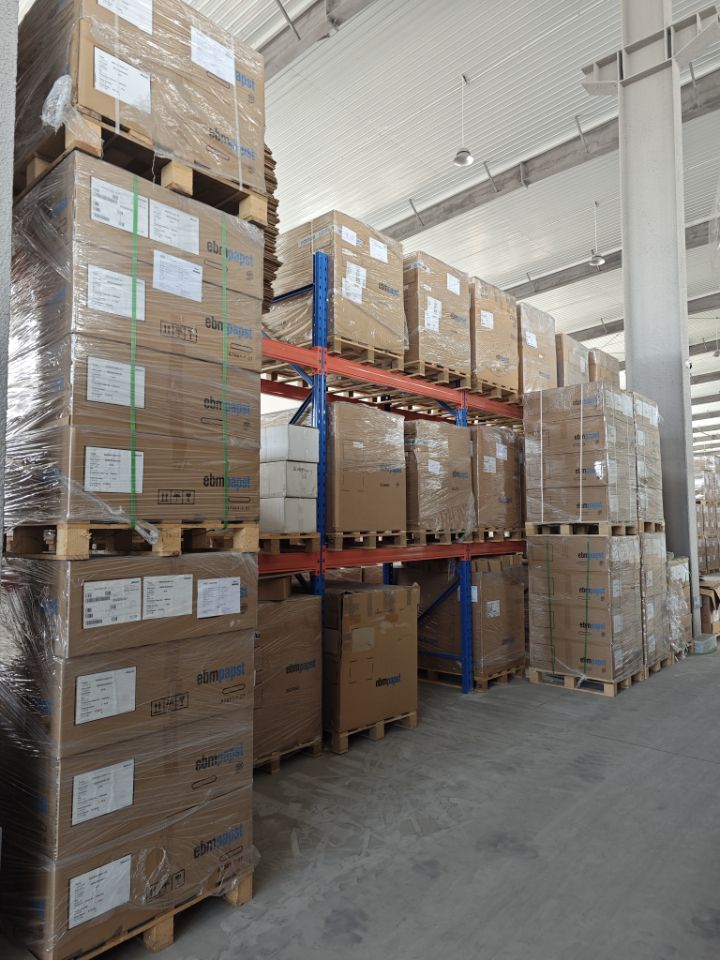
Two supply facts matter for a multi-year fan programme. First, the company holds long-term agency and distribution relationships with brands including ebmpapst and Ziehl-Abegg, which is relevant when a specification names a specific EC model and the buyer needs continuity of that model rather than a near-equivalent substitute. Second, it keeps a large amount of ready stock in inventory to support fast shipment, and its annual production capacity reaches about 50,000,000 units, which supports recurring supply programmes rather than one-off orders. The company reports cumulative service to more than 20,000 corporate customers and maintains offices in Chengdu, Wuxi, Tianjin, Shenzhen and Hong Kong.
Commercial terms that buyers can build into a programme: MOQ of 1 unit, delivery terms covering EXW, C&F, DDP, CIF, CFR, FOB, FAS and DPU, pre-shipment test as the acceptance criterion, and payment by corporate transfer. For a fan-wall programme, the practical extension of these terms is a written model-continuity expectation and a spare-position recommendation sized to the number of fans in service.
Market context: growing EC demand against contracting incumbents
EC fan demand and the financial performance of the largest EC fan manufacturers have been moving in opposite directions, and that divergence is a procurement signal rather than a curiosity. One commercial market estimate places the global EC fan market at USD 3.5 billion in 2024, rising to USD 6.7 billion by 2030. Over a comparable period, ebm-papst Group reported sales of EUR 2.098 billion for the 2024/25 fiscal year, a 13.1 percent decrease from the previous year, and Ziehl-Abegg reported 2024 revenue of EUR 893 million, a decline of 7 percent from EUR 955 million in 2023.
The reading for buyers is not that EC technology is losing ground. It is that the supply side is consolidating production and repricing while end demand grows, which historically shows up as longer lead times on specific models, tighter allocation on high-volume frame sizes, and a wider gap between catalogue availability and actual delivery. In that environment, distributor stock and model-level availability carry real project value, and a fan specification that names only one model without a documented continuity path is a schedule risk.
Regulation adds a second layer. EU ecodesign rules for industrial fans, Regulation (EU) 2024/1834, have applied since 24 July 2026 and set stricter efficiency thresholds for fans from 125 W to 500 kW. Both units in this comparison fall well inside that power band. The regulation sets thresholds rather than certifying individual products, so buyers should request model-specific efficiency evidence for whichever unit is specified, rather than treating a voltage class or an EC label as proof of conformity.
Trade data points to where that evidence and stock will come from. China's fan exports under HS 841459 reached 509 million units totalling USD 3.788 billion in 2024, up 6.96 percent in value, confirming the scale of the supply base available to European and North American projects.
Future outlook
Two expectations follow from the data above. First, pressure margin is likely to become a more prominent selection criterion in CRAH design as filter classes tighten and coil duties rise, which favours units specified at higher static pressure such as the 831 Pa figure attached to K3G560-FA28-03, provided the electrical and acoustic consequences are managed. Second, documentation quality will increasingly separate suppliers. Regulations that set efficiency thresholds, BMS integration that depends on Modbus or 0-10 V, and multi-year fan-wall programmes that depend on model continuity all reward buyers who ask for model-specific curves, control documentation and pre-shipment test records before the order, not after.
Neither model is universally preferable. The 630 mm unit is the natural default where envelope allows, pressure demand is moderate and the control interface is documented. The 560 mm backward-curved module is the natural default where the aperture is fixed, pressure headroom is required, and the electrical consequences of 6.0 A per position have been accepted. The comparison is decided by the system, not by the fan.
FAQ
Which unit suits a CRAH coil duty that approaches 670 Pa?
R3G630-FB32-03 is rated at 12,190 m3/h at 670 Pa, so a duty at or near that point leaves little margin once filters load. K3G560-FA28-03 is rated at 11,970 m3/h at 831 Pa, which provides more pressure headroom. The correct comparison is against the dirty-filter condition, since that is where an under-specified fan loses airflow.
Can K3G560-FA28-03 replace a 630 mm fan position in an existing fan wall?
The 560 mm backward-curved module is described as retrofit-suitable and requires a smaller aperture than a 630 mm impeller. The replacement is still conditional: the unit draws 6.0 A and 3,950 W at its stated duty point, so the existing panel, cabling and protection must be checked per position, and the control interface must be confirmed on the specific model.
Do both fans share the same voltage and ingress protection?
Yes. Both R3G630-FB32-03 and K3G560-FA28-03 are rated for 3~380-480 VAC and IP55. The voltage and protection rows therefore do not separate them; current, power, speed, impeller diameter, static pressure and documented control interface do.
How should a buyer verify long-term availability of a specific EC fan model?
Ask for written model-continuity confirmation, current stock position and the lead time for repeat quantities, then compare that against the programme duration. Distribution depth matters here: Hengrui EC Fan holds long-term agency and distribution relationships with brands including ebmpapst and Ziehl-Abegg, keeps a large amount of ready stock, and reports annual production capacity of about 50,000,000 units supporting recurring supply programmes.
What commercial terms apply when sourcing either model through Hengrui EC Fan?
MOQ is 1 unit. Delivery terms cover EXW, C&F, DDP, CIF, CFR, FOB, FAS and DPU. Acceptance is based on pre-shipment test, and payment terms are corporate transfer.
Is IP55 sufficient for CRAH fan-wall service?
IP55 addresses dust ingress and water jets, and both units carry that rating. It does not by itself establish acoustic performance, bearing service interval, efficiency compliance under Regulation (EU) 2024/1834, or control-interface capability. Those items require separate model-specific evidence regardless of the IP rating.
¿Tiene preguntas o necesita más detalles?
Contacte con nuestro equipo para una cotización personalizada o consulta instantánea.
Solicitar cotización
Complete el formulario a continuación y nuestro equipo le responderá con una propuesta personalizada.
Chat directo de WhatsApp
¿Prefiere chatear en tiempo real? Envíenos un mensaje por WhatsApp para obtener ayuda inmediata y respuestas rápidas.
- Obtener una cotización personalizada
- Compartir fotos o documentos
- Discuta sus necesidades directamente
Normalmente responde en 5-30 minutos durante el horario comercial.