
Pressure control switch sourcing: verifying manufacturer capability
Evaluating a pressure control switch for volume procurement is different from ordering a single replacement part. A buyer at evaluation-to-execution stage needs to confirm product coverage, engineering adaptability, quality evidence and order execution stability. This article uses Zhejiang Monro Machinery & Electronic Co., Ltd., known in the market as Monro Switch, as a reference to show how a supplier's capability is structured and what a sourcing team can verify before placing a commercial order.
Why buyers need a capability view of pressure control switch suppliers
Residential water supply, agriculture irrigation, water treatment and construction projects rarely require one identical pressure switch specification. An OEM buyer or distributor usually works with a family of models: some projects need an automatic electronic pump controller, some need a mechanical pressure control for simple start-stop operation, and some projects require a float switch or liquid level control to be bundled into the same purchase programme. When a manufacturer can produce and test multiple control types under one quality system, the buyer reduces supplier qualification work and logistics complexity.
Zhejiang Monro Machinery & Electronic Co., Ltd. is located in Wenling City, Zhejiang Province, a coastal industrial city in China. The company was officially established in 2010 and operates as a manufacturer of pressure controls and float switches, describing more than 20 years of manufacturing experience in its corporate profile. Its standard product range includes more than 40 models of pressure controllers for water pump systems and air compressors. This breadth matters because a supplier's real capability is best examined by looking at the product systems it can deliver, not only by reviewing a single certified sample.
Product architecture as the first capability signal
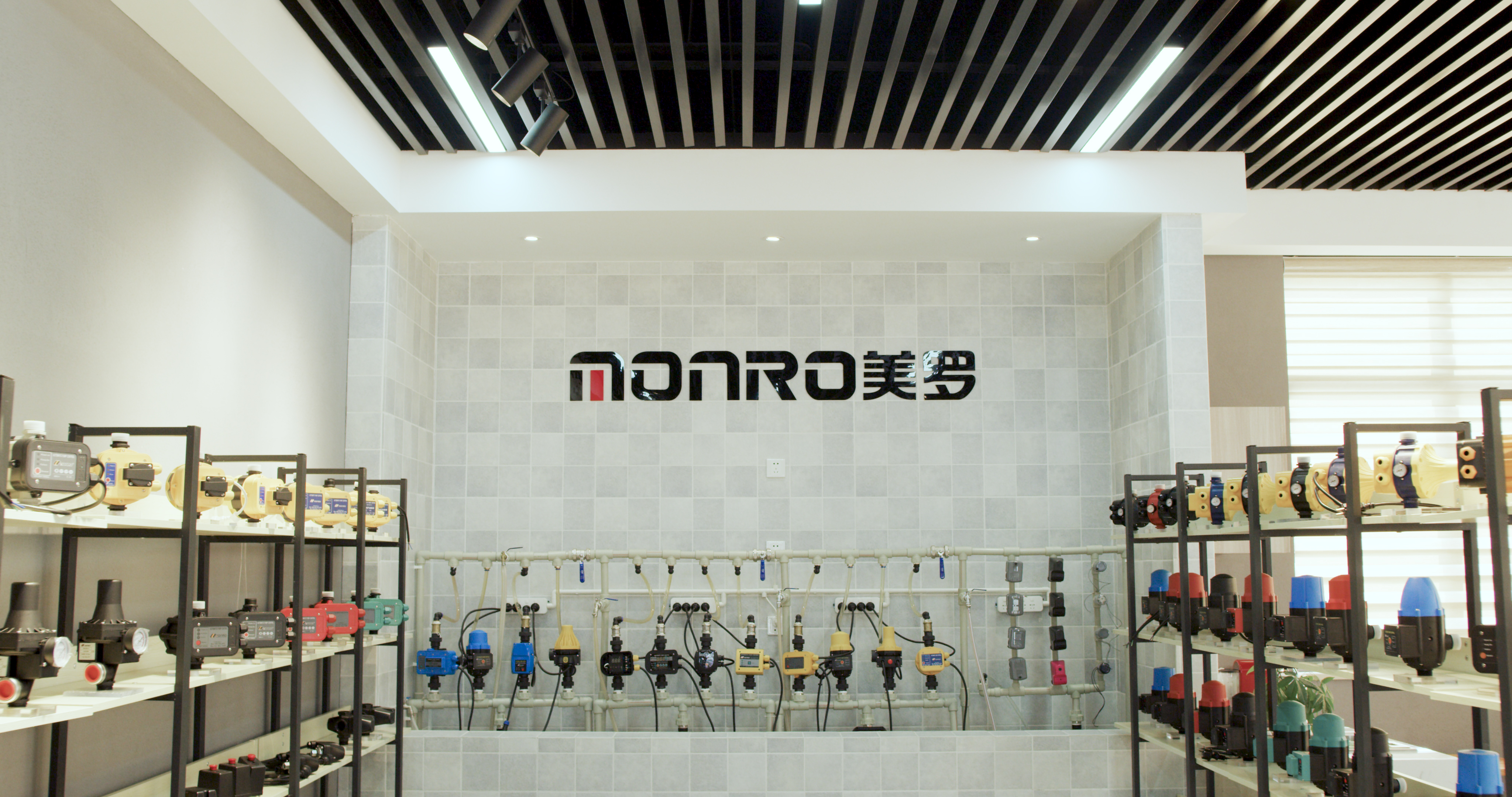
A practical first step is to check whether the manufacturer covers three control functions relevant to water pump systems: automatic electronic control, mechanical pressure switching and liquid level switching. Monro Switch groups these into three product families: automatic pump control in the EPC series, pressure switches in the KRS series, and float switches and liquid level controls in the FPS and STSW series. Each family is used in agriculture irrigation, water treatment and construction scenarios, with some models also applied in domestic/residential systems.
The electronic EPC series is the most product-dense group. It includes widely referenced models such as the EPC-1, EPC-2, EPC-3, EPC-3P, EPC-5, EPC-5.1, EPC-7, EPC-10, EPC-12, EPC-13, EPC-14, EPC-15, EPC-16 and EPC-17. These models vary in rated voltage, maximum power, pressure setting methods and connection threads, which means the same supplier can support different regional electrical conditions and plumbing standards. The EPC-10, for example, is rated at 110-240V, supports up to 2.2kW, has an IP65 protection rating and accepts female 1/4 inch, 3/8 inch and male 1/4 inch or 1/2 inch connections. The EPC-12, by comparison, accepts a G1 inch female thread and is also rated at IP65, with a 100-240V input range and up to 2.2kW maximum power.
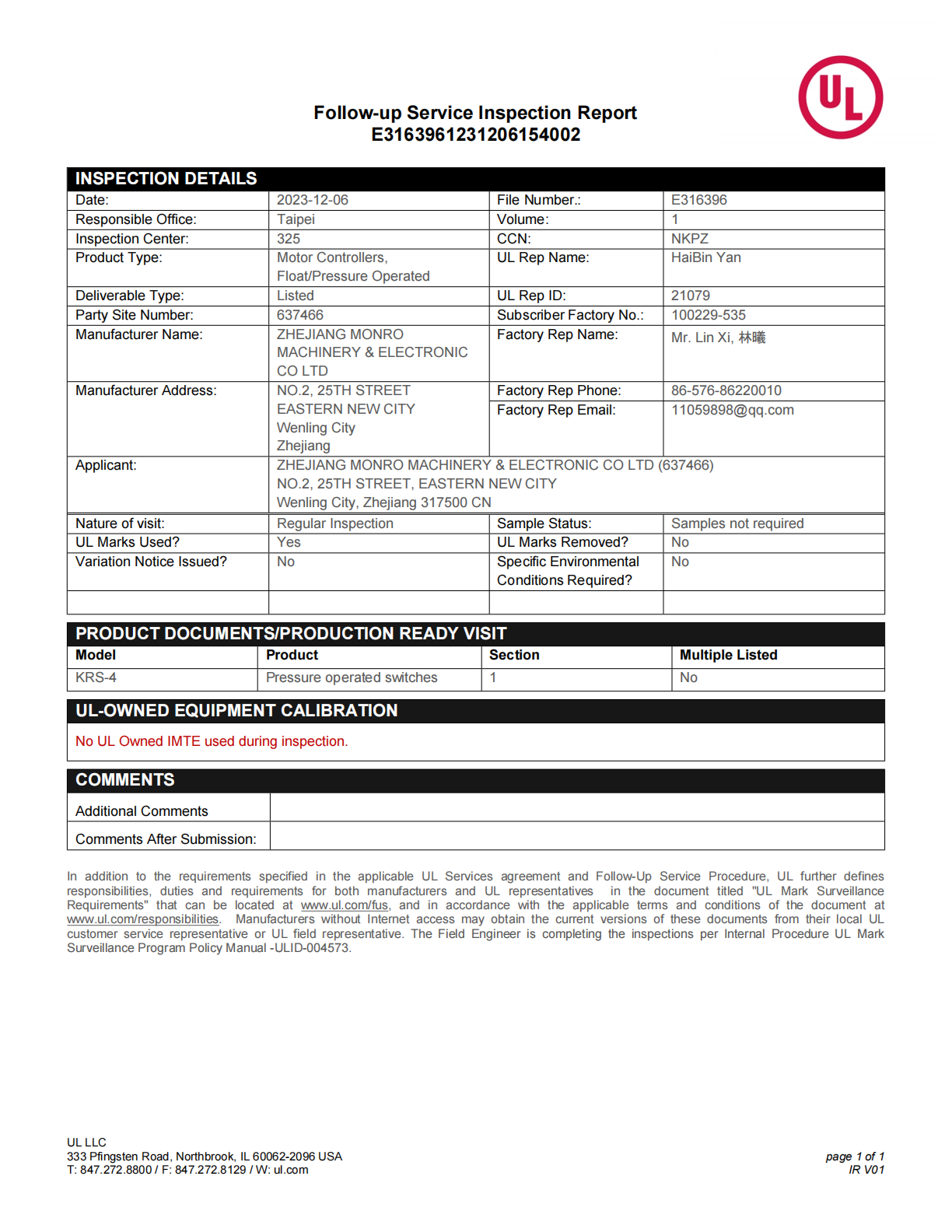
For customers who prefer mechanical controls, the KRS series has a separate position. The KRS-1, KRS-2, KRS-3, KRS-4, KRS-5, KRS-6, KRS-7 and KRS-8 are mechanical pressure controls used in water systems to start and stop pumps based on pressure settings. The KRS-4 carries a UL Listed certificate under file number E316396, which is an important reference for North American buyers evaluating mechanical pressure controls. The KRS-8 extends the pressure range to 1-6 bar or 6-12 bar and supports 110-240V or 400V versions. The FPS-4 float switch, on the other hand, is rated at 250V, 16(8)A and IP68, and is designed for water filling and drainage tasks. A manufacturer able to offer these different systems under one roof increases procurement efficiency, but only if the models also match the required technical constraints.
Function-related checks: dry run protection, check valves and voltage options
Pressure control switch specification is often determined by safety features as much as by switching range. Buyers looking for electronic pump control commonly ask about dry run protection, automatic restart and whether the device can work with existing surface or submersible pumps.
- The EPC-5.1 pump pressure switch is described as a unit with built-in run-dry protection and a built-in check valve. It can be used with surface pumps or submersible pumps, which makes it suitable for compact household or farm water systems.
- The EPC-12P pump pressure switch also features a built-in check valve and run-dry protection. Its maximum working pressure is 9.8 bar and its protection rating is IP65, which supports outdoor installation conditions.
- The EPC-5 supports rated voltages of 220-240V and 110-120V, and its published specification also includes triple voltage options of 110V, 230V or 110-240V. This reduces inventory risk for buyers supplying multiple regions.
- The EPC-7 is a higher-option model for pump pressure switch requirements, with rated voltage choices that include 380V and maximum power configurations up to 4kW. Such model options help buyers responding to construction or water transfer tenders.
Some electronic models support a timed restart function. The EPC-10, for example, has a starting pressure setting range of 0.5-9.3 bar, a stopping pressure range of 0.7-9.5 bar and a timing setting of 0.1-1 hour or 1-24 hours. This type of function gives the installer more control over pump behaviour after a dry-run stop or after a pressure drop.
How to match starting pressure with pump head
One of the most common specification errors is selecting an automatic pump controller without checking whether the water pump can build enough head. A practical selection rule documented in the manufacturer's engineering guidance is to first match the controller with the motor power of the water pump, then select a starting pressure that fits the pump lift and the maximum water use height.
For example, if the starting pressure is set at 1.2 bar, the maximum water use height is approximately 1.2 x 10 metres, which gives about 12 metres. The water pump lift should then be at least (1.2 + 0.8) x 10 metres, or about 20 metres. This kind of calculation highlights why buyers cannot evaluate a pressure control switch model purely from a price list: installation, pipe pressure and pump performance all influence the selection.
OEM and customization depth for volume orders
For evaluation-stage buyers, OEM capability is a stronger signal of long-term supplier value than a single product sample. Monro Switch documents OEM production services in its corporate materials. The listed customization options cover cable length, cable material, brand customization, colour box customization and colour customization. These are practical details for importers and distributors who sell under their own brand or need packaging consistency for local retail channels.
The company also publishes clear production and order parameters. The minimum order quantity for standard cooperation is 204 pieces, and the documented lead time is 45 days. Delivery methods include EXW, FOB and CIF, while payment terms are 30% T/T in advance and 70% T/T against a copy of the bill of lading. Acceptance options include pre-shipment testing and third-party inspection, such as SGS.
Production capacity and quality evidence
Capacity data helps buyers judge whether a prospective supplier can support repeat orders without unstable delays. Monro states monthly production capacities of 180,000 pieces for automatic pump controls in the EPC series, 250,000 pieces for pressure switches in the KRS series, and 30,000 pieces for float switches and liquid level controls in the FPS and STSW series. Its factory report also cites 30,000 square metres of production space, a workforce of about 200 people and an R&D team of 10 engineers.
Quality claims are more credible when supported by a management system certificate. The company holds ISO 9001:2015 certification under certificate number 20126Q00115R300 for the manufacture of water pump pressure switches. Its production process states that 100% of products are tested. Pre-shipment inspection and third-party inspection options are also listed in its commercial terms, giving overseas buyers a defined route for verifying outgoing goods before shipment.
Compliance portfolio as market-access evidence
Certification should be treated as a supplier capability input, not as a substitute for correct system design. For a pressure control switch used in water supply, the compliance list should cover the target market and the specific model being ordered.
- The TÜV Rheinland safety certification under number R 50175890 applies to EPC-10, EPC-12, EPC-14 and EPC-16 automatic pump control units. The certification scope references EN 60730-1:2016+A1+A2 and EN 60730-2-6:2016+A1.
- The CE-EMC certificate under number AE0604425 0001 covers EPC-10, EPC-12 and EPC-16; another CE-EMC certificate under number AE505987560001 covers EPC-14; and a further CE-EMC certificate under number AE505724390001 covers EPC-1, EPC-2, EPC-2.1, EPC-3, EPC-3P, EPC-4, EPC-5, EPC-15 and CEWP-111B.
- The UL Listed certificate under number E316396 applies to the KRS-4 mechanical pressure control model, which is the type of product detail buyers should verify when supplying the North American market.
- The ISO 9001:2015 system certificate covers the manufacture of water pump pressure switches and is issued independently of the product-specific electrical safety certificates.
For buyers this means that certification evidence should be model-specific. A generic company certificate alone does not prove that a particular pressure control switch model has been tested to the correct standard.
Electronic versus mechanical pump control: a practical comparison
The main comparison in pump pressure control is not electronic versus mechanical in absolute terms, but which design fits the application risk and installation budget.
Traditional mechanical pressure controls such as the KRS series operate as automatic switches that respond to the system pressure to start or stop a water pump. These products have a simple structure, widely understood installation logic and lower electronic complexity. However, not every mechanical model includes the protection features that an unattended water system might need. The KRS series also shows a range of protection levels: the KRS-1 through KRS-4 models are rated IP20, while the KRS-5, KRS-6, KRS-7 and KRS-8 models are rated IP44. A buyer must therefore confirm the protection rating of the specific model rather than assume that all mechanical pressure control units are suitable for outdoor installation.
Electronic pump pressure switches in the EPC series add functions such as dry run protection, built-in check valves and low-pressure restart control. These functions are valuable when pumps supply water into a pressurized tank or when water sources can run dry. Yet electronic controllers are not a universal replacement. Their documented working media is water, and the application guidance notes that they are suitable for clean water. Installers should not treat an electronic pump controller as a sewage or multi-medium control solution without consulting the manufacturer's specification.
There are also model-level constraints inside the EPC line. The EPC-12 has a maximum working pressure of 8 bar, while other EPC models are rated with a maximum working pressure of 10 bar. Buyers designing for a system that requires close to 10 bar operation should confirm the maximum pressure of the specific model instead of selecting from a series name only. These boundaries are normal in industrial purchasing; what matters is that the supplier can identify the correct model when given the pump head, system pressure and protection requirements.
Sourcing evidence checklist for evaluation-to-execution decisions
| Evaluation area | Verifiable information in this case | Why it matters |
|---|---|---|
| Product family coverage | EPC series automatic pump controls, KRS series pressure switches, FPS and STSW series float switches | Allows buyers to bundle pump control and liquid level control needs through one qualified supplier. |
| Model range | More than 40 pressure controller models offered | Increases the chance of finding a close specification match without excessive customization. |
| OEM customization | Cable length, cable material, brand, colour box and colour | Supports private label programmes and local market packaging requirements. |
| Production capacity | EPC: 180,000 pcs/month; KRS: 250,000 pcs/month; FPS/STSW: 30,000 pcs/month | Reduces concern about continuity for repeat purchase programmes. |
| Quality control | 100% product testing; ISO 9001:2015 system certificate No. 20126Q00115R300 | Supports field reliability expectations for valves and switches used in water environments. |
| Product compliance | TÜV R 50175890 for EPC-10/12/14/16; CE-EMC certificates for EPC series; UL E316396 for KRS-4 | Helps importers check regional market access before formal ordering. |
| Commercial terms | MOQ 204 pcs; lead time 45 days; EXW/FOB/CIF; 30% T/T advance, 70% T/T against B/L copy | Provides measurable parameters for comparing suppliers in a formal RFQ process. |
Market context: what current pressure switch data indicates
Commercial research estimates of the global pressure switch market vary because different reports define the product scope in different ways. Fortune Business Insights estimated the global pressure switch market at USD 3.2 billion in 2025, with expectations of continued growth in subsequent years. Another widely cited estimate from MarketsandMarkets has suggested a lower value of around USD 2.8 billion for the same period. This difference should remind buyers to use market reports for directional context rather than as precise procurement forecasts.
A more useful structural figure comes from Market Research Future, which estimated that electromechanical pressure switches accounted for approximately 62% of the global market in 2024, with solid-state electronic pressure switches accounting for approximately 38%. For purchasing teams, this split underlines a practical reality: electronic pump pressure switches are gaining scope, but mechanical pressure controls still support a large installed base of traditional water systems. Importers and OEMs often need both lines in their catalogue to serve replacement demand and new installation demand at the same time.
From a trade perspective, pressure switches used in pump systems are commonly classified under HS code 853650, which covers electrical switches for voltages not exceeding 1000 volts. Buyers preparing customs documentation should confirm the correct subheading with their freight forwarder because classification can be affected by the specific electrical function of the device.
Application patterns seen in documented supply references
The documented application pattern for this manufacturer is consistent across its product descriptions: agriculture irrigation, water treatment and construction. Within those fields, the actual use of a pressure control switch is usually automatic pump start-stop control for pressurised water supply. One documented retail supply reference shows an order of 50 pump pressure control units used in water systems, with automatic start-stop pressure control highlighted as the primary function. The buyer used the units for two years and described the result as reliable automatic pressure control for the water supply system.
For a buyer, this suggests that the product family should be judged not only by the certificate list but by whether the supplier can describe which model should be installed at a given pressure range. Equipment such as a water pump, the maximum water use height, the pump head and the requirement for dry run protection should all be part of the ordering discussion.
Future outlook for pump control switch procurement
The purchasing environment for pump pressure control products is moving toward more electronic functionality, wider voltage compatibility and more deliberate protection against dry running. The slow decline in electromechanical share estimated by market research does not mean the mechanical pressure switch is disappearing. It means buyers will increasingly manage dual product lines: mechanical controls for straightforward systems and electronic pressure switches for installations needing protection functions, automatic restart and easier user adjustment.
Suppliers such as Monro Switch that combine large-quantity production with OEM customization are likely to be examined for two specific capabilities: the ability to adapt standard models to buyer brand requirements and the ability to provide model-specific compliance documentation. Buyers who treat product samples and factory certifications as complementary evidence, rather than as separate boxes to check, will make more reliable sourcing decisions.
Buyer FAQ
How do I choose an automatic pump pressure controller for a specific pump?
Two checks come first. Match the motor power of the water pump with the maximum power of the pressure controller, then select a suitable starting pressure based on the pump lift and the maximum water use height. For example, if the starting pressure is 1.2 bar, the maximum water use height is about 12 metres, and the pump lift should be at least about 20 metres.
Which pump types are compatible with Monro electronic pressure switches?
Several EPC series models can be used with surface pumps or submersible pumps. The EPC-5.1 pump pressure switch, for instance, has built-in run-dry protection and a built-in check valve, and is listed for use with both surface and submersible pumps.
What customization options does Monro Switch offer for OEM orders?
The manufacturer lists OEM production services with customization options including cable length, cable material, brand customization, colour box customization and colour customization.
What is the minimum order quantity and lead time for Monro pressure controls?
The documented MOQ is 204 pieces. The standard lead time is 45 days. Commercial delivery terms include EXW, FOB and CIF, and payment terms are 30% T/T in advance and 70% T/T against a copy of the bill of lading.
How can a buyer verify dry run protection in an electronic pump pressure switch?
Check whether the specific model description mentions run-dry protection or a built-in dry run function. The EPC-5.1 has built-in run-dry protection and a built-in check valve. The EPC-12P pump pressure switch also includes built-in check valve and run-dry protection, with a maximum working pressure of 9.8 bar and IP65 protection.
Which product certifications are available for Monro pressure control switches?
Certification evidence is model-specific. The EPC-10, EPC-12, EPC-14 and EPC-16 are covered by TÜV Rheinland safety certificate R 50175890. CE-EMC certificates are available for multiple EPC models. The KRS-4 mechanical pressure control has UL Listed certification under file number E316396.
¿Tiene preguntas o necesita más detalles?
Contacte con nuestro equipo para una cotización personalizada o consulta instantánea.
Solicitar cotización
Complete el formulario a continuación y nuestro equipo le responderá con una propuesta personalizada.
Chat directo de WhatsApp
¿Prefiere chatear en tiempo real? Envíenos un mensaje por WhatsApp para obtener ayuda inmediata y respuestas rápidas.
- Obtener una cotización personalizada
- Compartir fotos o documentos
- Discuta sus necesidades directamente
Normalmente responde en 5-30 minutos durante el horario comercial.