
Pressure Switch Compliance: What Buyers Need to Check
A pressure control switch decides when a water pump starts, when it stops, and whether the pump is protected from dry running or overpressure. For buyers moving from research to evaluation, the critical task is verifying that a switch meets the right electrical, mechanical, and certification requirements for the target market.

Monro Switch manufacturing facility in Wenling, Zhejiang Province
Pressure Switches in Automated Water Systems
The pressure switch is one of the most frequently specified components in residential water supply, agricultural irrigation, water treatment, and construction-related pumping applications. It performs a simple but essential function: it senses system pressure and automatically starts or stops the pump at preset thresholds. In practice, the performance of an entire water delivery system often depends on the reliability of this single electromechanical or electronic component.
The commercial importance of the category is substantial. The global pressure switch market was valued at USD 3.2 billion in 2025, according to Fortune Business Insights. Electromechanical pressure switches accounted for approximately 62% of the global market in 2024, with solid-state electronic pressure switches representing the remaining 38%, based on an estimate from Market Research Future. These figures describe a market that remains anchored in proven mechanical designs while electronic alternatives continue gaining share in pump control applications.
For procurement professionals and original equipment manufacturers, the practical question is not whether to use a pressure control switch, but how to verify that a candidate product will perform reliably across the relevant voltage range, pressure band, environmental exposure, and regulatory framework. That verification process depends on product parameters and certification evidence.
The Compliance Problem in Pressure Switch Sourcing
Buyers evaluating pressure control switches commonly encounter three difficulties.
First, specification ambiguity. A pressure switch can be described by multiple sets of parameters: cut-in and cut-out pressure, pressure range, rated voltage, rated current, power frequency, protection rating, maximum working temperature, connection thread, and contact configuration. Comparing products from different suppliers is difficult when the parameter sets do not align. A mechanical switch rated in PSI and an electronic controller rated in bar can serve the same application, but direct comparison requires conversion and careful interpretation of setpoint logic.
Second, certification fragmentation. A product intended for the European market normally requires CE evidence, while North American installations often require UL or CUL recognition. Temperature, pressure, and electrical safety requirements differ by region. Buyers may be unable to determine whether a switch is genuinely approved for their market or simply labeled with a non-specific compliance mark.
Third, application mismatch. A switch with an IP20 rating may perform well in a dry indoor environment, but the same switch would be inappropriate for an outdoor well house or a humid agricultural environment. A controller designed for a 0.75 kW pump may not safely handle a 2.2 kW pump, even if the pressure range is similar. These mismatches are often discovered only after installation, leading to warranty disputes and operational downtime.
A Reference Manufacturer: What Monro Switch Provides
ZHEJIANG MONRO MACHINERY & ELECTRONIC CO.,LTD (Monro Switch) is a manufacturer of pressure controllers, pump pressure switches, and float switches, located in Wenling City, Zhejiang Province, China. Although the company was officially established in 2010, it reports more than 20 years of manufacturing experience in pressure controls and float switches. Its main product families cover more than 40 models of pressure controllers for water pump systems and air compressors.
Monro operates a 30,000-square-meter facility with approximately 200 employees and a dedicated R&D team of ten engineers. The company reports annual output of 2.88 million units for the EPC series (electronic pump control), 3.24 million units for the KRS series (mechanical pressure switches), and 0.6 million units for the FPS series (float switches). Approximately 90% of production is exported to Asia, Europe, North and South America, the Middle East, and Africa.
From a compliance standpoint, Monro holds an ISO 9001:2015 quality management system certification. Its products are covered by TUV (Germany) and CE (Europe) certification, with selected models also approved under the CUL (U.S. and Canada) standard. Specific product-level certifications include UL Listed recognition for the KRS-4 mechanical pressure control switch (certificate E316396, UL LLC, North American market) and TÜV Rheinland Safety Certification covering the EPC-10, EPC-12, EPC-14, and EPC-16 automatic pump controls (certificate R 50175890, EU market). These certifications provide a verifiable baseline for buyers who need documented compliance evidence.
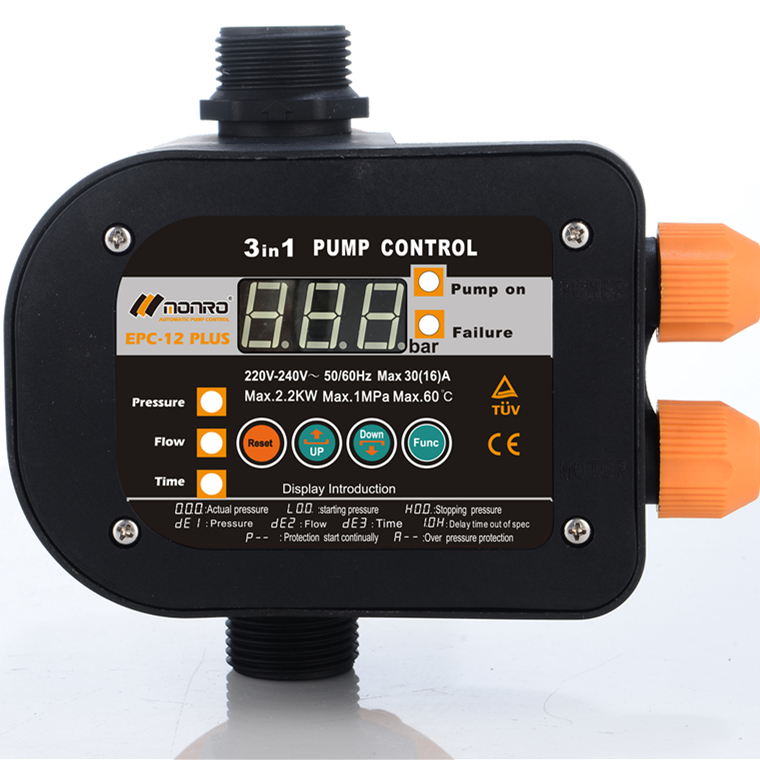
Monro EPC-12 PLUS electronic pump controller with digital pressure display and multi-mode settings
Parameters That Define Pressure Switch Performance
A reliable pressure switch specification review should cover at least seven parameter families. Understanding these parameters makes it possible to evaluate products on a consistent basis.
1. Rated Voltage and Power Frequency
Most pressure control switches are designed for AC supplies of 110–120V or 220–240V at 50/60Hz. In the Monro EPC series, several models support triple-voltage operation (110V, 230V, or 110–240V), which simplifies inventory for distributors serving multiple regions. For example, the EPC-1.1 pump pressure switch operates at 220–240V or 110–120V at 50/60Hz. The EPC-12P accepts 100–240V, covering a wide range of regional grids without modification.
2. Pressure Range and Setpoint Logic
Mechanical pressure switches are typically defined by cut-in and cut-out pressures. The Monro KRS-1, for instance, offers pressure ranges of 20–40 PSI, 30–50 PSI, and 40–60 PSI, with a minimum cut-in of 20 PSI and a maximum cut-out of 175 PSI. The KRS-3 extends the band with additional ranges up to 60–90 PSI. Electronic pump controllers use starting pressure settings instead; the EPC series commonly supports preset starting pressures of 1.2 bar, 1.5 bar, or 2.2 bar, with adjustable versions covering ranges such as 1.2–2.5 bar or 0.5–9.3 bar on advanced models like the EPC-10 and EPC-17.
3. Rated Current and Maximum Power
A pressure switch must be matched to the electrical load of the pump motor. Mechanical switches in the KRS series are rated at 12A or 16(8)A. Electronic controllers in the EPC series specify maximum supported pump power. For example, the EPC-1 supports maximum power options of 1.1 kW, 1.5 kW, or 0.75 kW. Higher-capacity models such as the EPC-7 support up to 4 kW, while the EPC-10 and EPC-12P handle pump loads up to 2.2 kW. Installing a controller beyond its rated power creates a clear safety risk.
4. Protection Rating (IP)
The Ingress Protection rating indicates the level of protection against solid particles and moisture. In the Monro range, KRS-1 and KRS-2 mechanical switches carry IP20, which is appropriate for dry indoor locations. The KRS-5, KRS-6, KRS-7, and KRS-8 use IP44 (splash-proof). Many EPC electronic controllers are rated IP54 or IP65, where IP65 indicates dust-tight and water-jet-proof construction suitable for outdoor or humid environments. The FPS float switch series reaches IP68, allowing submersion in tanks and reservoirs. Buyers should match the IP rating to the actual installation environment rather than assuming a higher rating is always required.
5. Maximum Working Temperature
Most Monro switches are specified for maximum working temperatures of 55°C or 60°C. Applications near heat sources, in direct sunlight, or in enclosed pump houses should account for the temperature limit. The FPS-5 float switch, by contrast, is designed for operating temperatures of 0–50°C with storage from -20°C to 60°C, reflecting its role in liquid-level sensing rather than line-pressure control.
6. Connection Thread and Hydraulic Fitting
Thread compatibility affects installation effort and system integrity. The KRS series offers screw types including 1/4"F, 3/8"F, 1/4"M, and 3/8"M options, while the KRS-7 uses G1". The EPC series generally uses G1" connections, with models such as the EPC-1, EPC-1.1, and EPC-5 offering G1 1/4", G1 1/2", or NPT1" as alternatives. For retrofit projects, confirming the existing port thread before purchasing prevents unnecessary adapter complexity.
7. Protective Functions
Electronic pump controllers increasingly include protective functions that mechanical switches cannot provide. Monro EPC models commonly feature built-in dry-run protection, which stops the pump when the water supply is interrupted; a built-in check valve to prevent backflow; and in models such as the EPC-1A and EPC-14A, a smart program that automatically restarts the pump after a water shortage condition clears. The EPC-19 additionally offers rotor anti-blocking protection and programmed periodic restart attempts after 24 hours of stoppage. These functions deliver operational value beyond simple pressure switching.
Matching Controller Type to Application
Different applications place different demands on a pressure control switch. Monro's product structure maps to these use conditions in a relatively direct way.
Domestic and Residential Water Supply
For single-family homes and small residential systems, the EPC-1, EPC-2, EPC-3, EPC-4, and EPC-5 electronic controllers provide automatic pump start/stop control in response to system pressure changes. The EPC-1.1 is specifically designated for domestic applications and offers a built-in socket that simplifies wiring. The EPC-14 and EPC-14A are described as suitable for non-tower water supply, with auto-set starting pressure linked to pipeline pressure.
Agriculture Irrigation
Irrigation systems often operate in dusty, humid, or outdoor environments. The KRS-5, KRS-6, KRS-7, and KRS-8 mechanical switches with IP44 protection are used in water systems for agriculture irrigation, water treatment, and construction. For more demanding conditions, the IP65-rated EPC series provides electronic control with dry-run protection, which is valuable in irrigation scenarios where water supply can be intermittent.
Water Treatment and Construction
Water treatment and construction applications may involve elevated pressure requirements or multi-stage control. The KRS-1 and KRS-3 mechanical switches support higher cut-out pressures (up to 175 PSI on the KRS-1, up to 100 PSI on the KRS-3). The EPC-10 and EPC-17 allow starting pressure settings up to 9.3 bar, extending their useful range to taller buildings and higher-lift systems.
Market Signals: Electromechanical Share, Electronic Growth
The pressure switch market is evolving along two lines: technology and standards.
On technology, the 62% electromechanical share in 2024 indicates that mechanical pressure switches retain a strong installed base, particularly in cost-sensitive and simpler applications. Electronic pressure switches, with the remaining 38%, are gaining ground because they integrate dry-run protection, check valves, auto-restart logic, and multi-mode operation into a single device. That integration reduces installation complexity compared to assembling separate mechanical switches and protection relays.
On standards, IEC 60730-2-6:2025 is the current international standard for automatic electrical pressure sensing controls used in household and similar applications. The standard, published by the International Electrotechnical Commission, covers requirements for construction, operation, and testing of automatic electrical pressure sensing controls. Certification bodies such as TÜV Rheinland and UL apply this standard family to pressure-operated switches and automatic pump controls. Buyers sourcing for regulated markets should confirm that the product's certification references the applicable edition of the standard.
Electronic vs. Mechanical: Strengths and Boundaries
Choosing between an electronic pump controller and a mechanical pressure switch is not a one-directional decision. Both approaches have defined strengths, and there are situations where each is the better choice.
| Dimension | Electronic controller (EPC series) | Mechanical pressure switch (KRS series) |
|---|---|---|
| Core function | Starts/stops pump based on pressure and flow sensing | Starts/stops pump based on diaphragm pressure thresholds |
| Protective functions | Built-in dry-run protection, check valve, auto-restart (model-dependent) | Generally limited to pressure switching; low-pressure protection on select models |
| IP rating | IP54–IP65 typical | IP20–IP44 typical |
| Voltage options | 110–120V, 220–240V, or 100–240V on select models | 110–240V; some models support 400V |
| Adjustability | Adjustable starting pressure, multi-mode options on advanced models | Adjustable pressure range; multiple preset ranges available |
| Typical industries | Domestic supply, irrigation, water treatment | Irrigation, water treatment, construction |
A realistic limitation of electronic controllers is their stated maximum pump power. Most EPC models are designed for motors up to 1.1–2.2 kW, with the EPC-7 extending to 4 kW. For larger industrial pumps, a mechanically driven pressure switch or a separate high-capacity control solution may be more appropriate. Another boundary concerns environmental rating: an IP20 mechanical switch may be acceptable in a clean indoor pump room, while an IP65 electronic controller is better suited to outdoor or washdown environments. The correct choice depends on the motor rating, the installation environment, and the level of protective functionality the system requires.
Direction of Travel: Standardization and Smart Control
Looking ahead, three developments are likely to shape the pressure control switch category.
First, electronic control will continue to absorb functions that previously required separate components. The integration of pressure sensing, flow detection, dry-run protection, and restart logic into a single IP65-rated unit aligns with the broader trend of simplifying pump installation and reducing failure points.
Second, international safety standards will remain the primary language of compliance. The adoption of IEC 60730-2-6:2025 reinforces the importance of certification evidence in procurement decisions. For buyers, this means requesting certificate numbers, checking the scope of the certificate against the specific model, and verifying that the issuing body is recognized in the destination market.
Third, the digital interface will extend from high-end models toward mid-range products. Monro's EPC-12P already provides a digital screen showing real-time pipeline pressure, with three operating modes and setting ranges from 0.5 to 6.7 bar. This type of transparency helps installers configure the controller correctly and helps end users monitor system health.
FAQ: Buyer Questions, Verifiable Answers
For a full specification overview across the Monro EPC, KRS, and FPS series, the company catalogue is publicly available for download: Monro Catalogue 2025.
This article is published by HTNXT for independent industry reference. Product and certification information is based on manufacturer disclosures and verifiable certification records. Buyers should confirm current certification status and model availability with the manufacturer before finalizing procurement decisions.
¿Tiene preguntas o necesita más detalles?
Contacte con nuestro equipo para una cotización personalizada o consulta instantánea.
Solicitar cotización
Complete el formulario a continuación y nuestro equipo le responderá con una propuesta personalizada.
Chat directo de WhatsApp
¿Prefiere chatear en tiempo real? Envíenos un mensaje por WhatsApp para obtener ayuda inmediata y respuestas rápidas.
- Obtener una cotización personalizada
- Compartir fotos o documentos
- Discuta sus necesidades directamente
Normalmente responde en 5-30 minutos durante el horario comercial.