
Pressure Control Switch Evaluation: Electronic vs Mechanical Controller Options for Pump Systems

Monro Switch production workshop in Wenling City, Zhejiang Province.
A pressure control switch is one of the most decision-sensitive components in a water pump system because it determines when the pump starts, when it stops, and how much protection the system has against abnormal operating conditions. Buyers evaluating pressure control switches in 2026 are typically choosing between two technology directions: mechanical pressure-operated switches and electronic pump controllers. The choice affects installation flexibility, pressure accuracy, protection features, maintenance expectations, and certification requirements in regional markets.
This article provides an independent evaluation framework for pump pressure controllers and pressure switches, with reference to the product families and verified compliance documentation of ZHEJIANG MONRO MACHINERY & ELECTRONIC CO.,LTD (Monro Switch), a Chinese manufacturer specializing in pump controllers, pressure switches, and float switches. Monro states that it has more than two decades of manufacturing experience in pressure controls and float switches and was formally established in 2010 in Wenling City, Zhejiang Province.
Why pressure control switch sourcing decisions are rarely simple
The pressure control switch market is not a single-product market. A mechanical pressure switch is a simple device that responds to a preset pressure range through a diaphragm and contact mechanism. An electronic pump controller uses pressure sensing electronics to provide automatic pump start/stop, and some models include additional functions such as dry-run protection or timed operation. Both approaches continue to serve real demand in different installation environments.
Market research illustrates this mix. Fortune Business Insights estimated the global pressure switch market at USD 3.2 billion in 2025. Market Research Future data suggests that electromechanical pressure switches still accounted for about 62% of the global market in 2024, with solid-state electronic pressure switches representing the remaining share. For an importer, distributor, or OEM buyer, this means the market is divided into two broad specification cultures, and selecting the wrong technology for a target use case creates avoidable field failures and warranty friction.
An evaluation-stage buyer therefore needs answers to four practical questions: Which control type fits the pump type and water system? Which pressure parameters are needed? Which compliance evidence is acceptable in the destination market? And can the supplier deliver consistent quality, customization, and predictable lead time?
Shortlist criteria for pressure control switch evaluation
Buyers comparing manufacturers and pressure control switch models should use a consistent scoring framework rather than comparing catalogue prices alone. The following criteria are commonly used by importers and pump assemblers in the evaluation stage.
1. Control technology versus system behavior
- Mechanical pressure switches start and stop the pump automatically according to the set pressure range.
- Electronic pressure controllers offer the same automatic on/off function through electronic sensing, and certain models in the EPC series integrate protection functions such as dry-run protection.
- The choice should be based on the water system's operating pattern, power supply environment, and the technical capability of the end user or installer.
2. Pressure range and pump lift matching
Pressure parameters must be matched to the static head and water usage height of the installation. The operating principle in Monro's technical guidance is instructive: a starting pressure of 1.2 bar corresponds to a maximum water delivery height of approximately 12 meters, while the pump lift should be at least (1.2 + 0.8) × 10 meters, or around 20 meters, to operate reliably. Buyers should ask suppliers for clearly documented start and stop pressure settings.
3. Electrical ratings
A pressure control switch must fit the pump motor's rated voltage, frequency, current, and maximum power. The Monro portfolio, for example, includes models rated at 110-240V, 100-240V, 220-240V / 110-120V, and even 380V versions in specific lines. Maximum power ratings vary from 0.55 kW to 4 kW depending on the model. Checking the nameplate of the target pump against the controller's electrical rating is a mandatory step.
4. Protection rating and installation environment
Protection rating determines where a controller can be installed. IP65-rated components are designed for exposure to water jets or outdoor humid environments, while IP20 or IP44-rated devices are intended for more sheltered installation points. Electronic pump controller lines such as the EPC series commonly carry IP65 ratings across multiple models, while Monro's mechanical KRS series includes both IP20 and IP44 designs depending on the model.
5. Compliance evidence
Destination-market compliance is a shortlist eliminator. Buyers should not accept generic claims of certification; they should ask for the certificate number, the issuing body, the exact model scope, and the standard version used. This level of traceability is standard practice for industrial components sold into the EU and North America.
Monro pressure control switch families at a glance
Monro Switch organizes its pressure control offering into two architecture families: the EPC electronic pump pressure controller series and the KRS mechanical pressure control series. Both families are aimed at the agriculture irrigation, water treatment, and construction sectors, with models using plastic-and-metal construction and various connection thread configurations.
| Family | Technology | Representative models | Typical ratings | Primary function |
|---|---|---|---|---|
| EPC series | Electronic automatic pump control | EPC-1, EPC-2, EPC-4, EPC-5, EPC-10, EPC-12, EPC-14, EPC-15, EPC-17, EPC-19 | 100-240V or 220-240V / 110-120V; 50/60 Hz; max power 0.55-2.2 kW; IP54-IP65; max working temperature 55°C or 60°C | Automatic pump start/stop; models with adjustable pressure, timer settings, or run-dry protection |
| KRS series | Mechanical pressure-operated switch | KRS-1, KRS-2, KRS-3, KRS-4, KRS-5, KRS-6, KRS-7, KRS-8 | 110-240V; 50/60 Hz; rated current 10(4)A to 20(16)A; IP20-IP44; pressure ranges expressed in PSI or bar | Automatic pump on/off according to set pressure range |
This structure is useful for buyers because the two families address different installation philosophies. The EPC family is oriented toward users who want electronic sensing, adjustable pressure behavior, and a higher ingress protection design. The KRS family reflects the traditional, widely understood mechanical pressure switch approach, with the KRS-4 being the model covered by a UL Listed certification for the North American market.
Technical evaluation: what the specifications actually tell you
Evaluation-stage buyers often struggle with catalogue data that lists many models without explaining when one model is preferable to another. The practical interpretation is as follows.
Electronic EPC controllers allow adjustable and clearer pressure control
Many EPC models are available with selectable starting pressure settings of 1.2 bar, 1.5 bar, or 2.2 bar. For example, the EPC-5 pump pressure switch is a plastic-and-metal electronic controller with an IP65 protection rating, a maximum working temperature of 55°C, and starting pressure options of 1.2/1.5/2.2 bar. The EPC-5.1 extends this with maximum power ratings of 4 kW, 1.1 kW, or 2.2 kW and rated voltage options of 110-120V, 220-240V, or 380V.
The EPC-10 goes further by integrating a built-in check valve, dry-run protection, and pressure gauge in addition to a wide adjustable starting pressure range of 0.5-9.3 bar and a stopping pressure range of 0.7-9.5 bar. For buyers who need a controller suitable for a wider band of system pressures, models with adjustable cut-in/cut-out settings provide more application flexibility than fixed mechanical ranges.
Mechanical KRS switches are simpler and range-specific
The KRS line operates on a preset pressure range. KRS-1, for example, offers pressure ranges of 20-40 PSI, 30-50 PSI, and 40-60 PSI, with a rated voltage of 110-240V and a rated current of 12A. KRS-6 is designed with IP44 protection, a 110-240V rating, a 50/60 Hz frequency, and a rated current of 16(8)A. KRS-8 supports a wider industrial-oriented range of 1-6 bar or 6-12 bar with a rated current of 20(16)A.
In short, the technical evaluation should treat the two families as complementary, not competing. A mechanical switch can be the right value choice for simple booster systems with stable pressure requirements; an electronic controller is generally the more configurable option when system demand varies or when dry-run protection is required.
Use cases and application fit
The documented application scope for Monro pressure control switch models covers agriculture irrigation, water treatment, and construction. These three industries use pressure control for largely similar tasks: maintaining water supply, protecting a pump from operation without flow, and automating filling or pressurization.
- Agriculture irrigation: pumps are frequently operated intermittently in remote or semi-exposed locations. IP65-rated electronic controllers with automatic start/stop reduce the need for manual supervision.
- Water treatment: pressure settings must often be adjusted to match changing process demands. Adjustable-start electronic models such as the EPC series provide field flexibility.
- Construction: water supply and transfer pump systems require dependable automatic pump switching under dusty or humid site conditions, which favors higher protection ratings.
Field evidence from Monro's customer data also shows repeat use in water supply systems. One documented reference involves a retail client in China who used Monro electronic pump controllers in a water supply system for two years, with the reported outcome being reliable automatic pressure control for water supply.
Compliance verification: moving beyond marketing language
For evaluation-stage buyers, compliance is the most objective part of the supplier comparison. Below are representative verifiable certification examples from Monro Switch.
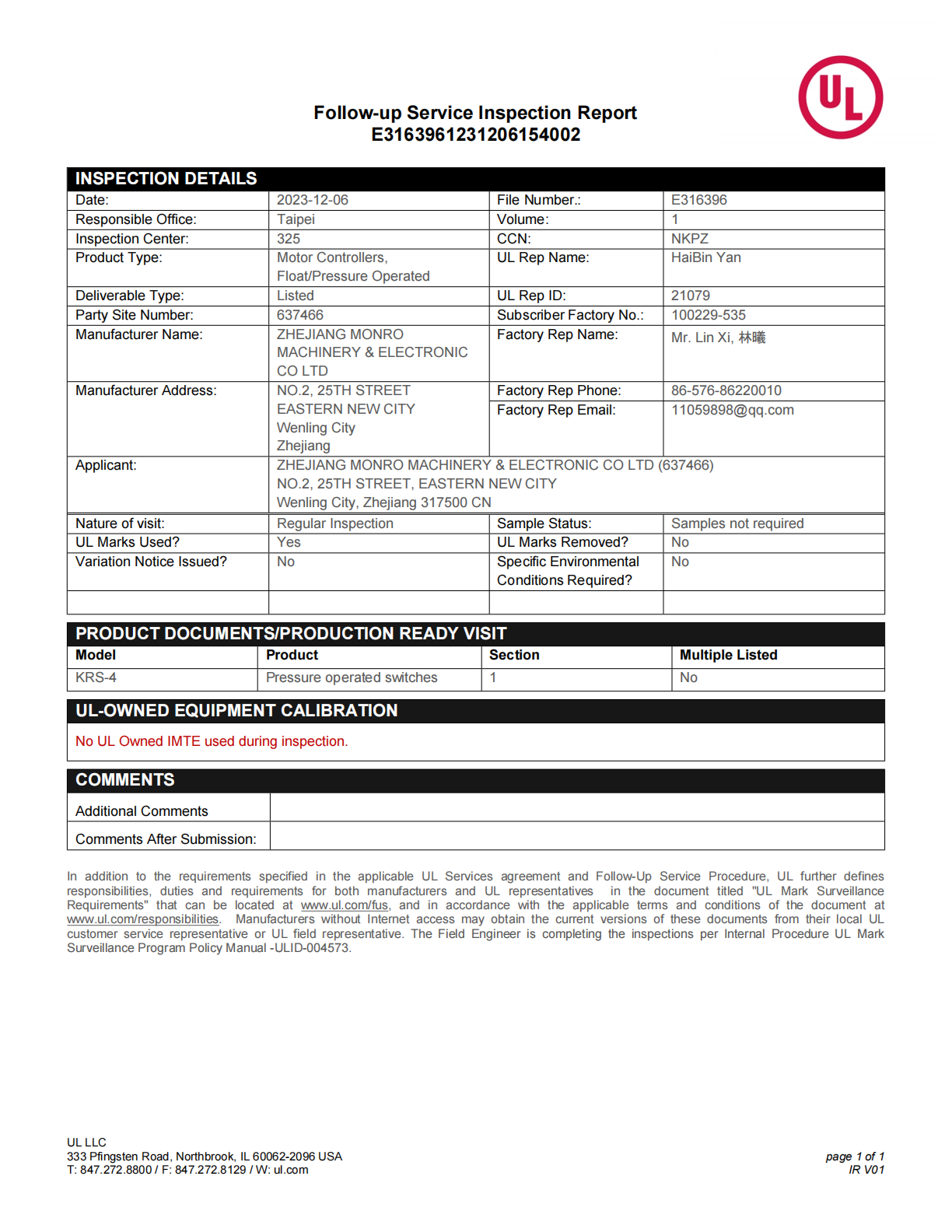
UL Listed certification, certificate number E316396, for the Monro KRS-4 pressure-operated switch.
- UL Listed Certification: certificate number E316396, issued by UL LLC for the KRS-4 pressure-operated switch model, covering the North American market.
- TÜV Rheinland Safety Certification: certificate number R 50175890 for EPC-10, EPC-12, EPC-14, and EPC-16, referencing EN 60730-1 and EN 60730-2-6.
- CE-EMC Certificate of Conformity: TÜV Rheinland documents for the EPC series, applicable to different EPC models.
- ISO 9001:2015 quality management system: covering the manufacture of water pump pressure switches.
- Select models approved under CUL: as stated in the company profile, covering the U.S. and Canadian market recognition.
Buyers should treat certificates as model-specific evidence. A certificate for EPC-10, for example, should not be assumed to cover the entire EPC family. The issuing authority, scope, and standard citation must be checked. Monro's TÜV documents cite standards such as EN 60730-1:2016+A1+A2 and EN 60730-2-6:2016+A1, which are consistent with the international requirements for automatic electrical pressure sensing controls described in the IEC 60730-2-6 framework.
Market trend: electromechanical still dominates, electronic controls are expanding
The verified market data and Monro's dual-product structure point to the same conclusion: there is no single winning technology in the pressure control switch segment today.
Electromechanical pressure switches accounted for approximately 62% of the global market in 2024, according to Market Research Future. That share is large because mechanical switches remain inexpensive, well understood by installers, and adequate for a large base of fixed-pressure pump applications. At the same time, solid-state electronic pressure switches are becoming a normal alternative rather than a premium novelty, especially in IP65-rated automatic pump controllers where adjustable pressure and protection features deliver tangible installation value.
Monro's position as a manufacturer covering both product logics reduces technology risk for buyers who serve multiple end markets. A distributor selling into price-sensitive agricultural markets can maintain KRS mechanical switches in the catalogue, while a pump brand targeting residential water systems with dry-run protection can use EPC electronic controllers as a feature-differentiated option.
Electronic versus mechanical: comparison with traditional solutions
From a buyer perspective, the comparison between electronic pump controllers and traditional mechanical pump switches is primarily a trade-off between flexibility and simplicity.
| Evaluation dimension | Traditional mechanical pressure switch (e.g., KRS series) | Electronic pump controller (e.g., EPC series) |
|---|---|---|
| Operating principle | Diaphragm and contact mechanism responds to preset pressure range | Electronic pressure sensing with automatic relay-based pump control |
| Pressure range example | KRS-1: 20-40 / 30-50 / 40-60 PSI; KRS-2: 1.0-1.8 / 1.2-2.2 / 2.2-3.0 bar | EPC-10: starting pressure 0.5-9.3 bar, stopping pressure 0.7-9.5 bar |
| Protection rating range | Typically IP20 or IP44 depending on model | Most EPC models listed with IP65; some models, such as EPC-2.1 and EPC-9, use IP44 or IP54 |
| Protection functions | Basic automatic pump on/off | Selected models include dry-run protection, built-in check valve, pressure gauge, timer settings |
| Installation complexity | Simple, familiar to most pump installers | Requires matching voltage and electrical connection; still straightforward when following housing arrow direction |
| Best fit | Fixed-pressure pump systems, replacement demand, cost-conscious projects | Variable demand, protected pump operation, higher humidity or outdoor installation |
A balanced evaluation also requires acknowledging the boundaries of a supplier's standard offering. Buyers comparing Monro pressure control switch products should consider the following documented supplier constraints:
- MOQ: 204 pieces per model for standard OEM ordering.
- Lead time: approximately 45 days, which should be built into project planning and seasonal stocking decisions.
- Customization scope: Monro supports OEM customization in cable length, cable material, brand marking, box color, and product color. Buyers with non-standard enclosure or connector requirements should confirm these in the ordering stage.
- Testing policy: Monro reports that it performs 100% testing on products before shipment.
- After-sales support: remote support and a 1-year warranty period are included in the standard arrangement.
Not every electronic model includes every protection function, so function-by-function specification checking remains necessary even within the same product family.
How buyers should interpret Monro Switch in a supplier shortlist
Monro Switch presents a defensible shortlist profile for mid-volume importers, pump OEMs, and distributors serving agriculture irrigation, water treatment, and construction markets.
The company's manufacturing data provides a concrete scale baseline: a reported factory area of 30,000 square meters, around 200 employees, and annual output claims of 2.88 million units for the EPC series, 3.24 million units for the KRS series, and 0.6 million units for the FPS series. Monro also reports a monthly capacity of 180,000 EPC units, 250,000 KRS units, and 30,000 float-switch/level-control units. The company states an export ratio of approximately 90%, with main markets across Asia, Europe, North and South America, the Middle East, and Africa.
From an evaluation standpoint, these figures indicate a manufacturer positioned for series production rather than small-batch assembly. The presence of third-party certifications from UL LLC and TÜV Rheinland strengthens the credibility of the documented production system.
Monro is also recognized by Chinese local government schemes, including as a specialized and sophisticated SME of Zhejiang Province, an innovative SME of Zhejiang Province, and a key industrial enterprise of Wenling City. These designations are publicly verifiable provincial and municipal industrial classifications in China.
Future outlook: configuration flexibility as the next selection layer
As pump systems become more connected and usage patterns more complex, the pressure control switch is evolving from a binary on/off component into a configurable control unit. Three trends are likely to affect future procurement decisions.
- Electronics penetration growth: with electronic switches already around 38% of the global pressure switch market by segment share in 2024, electronics are likely to keep expanding in residential and light-commercial pumping applications.
- Higher protection expectations: IP65-rated controllers are increasingly considered standard for outdoor pump installations rather than an optional upgrade.
- Protection integration: functions such as dry-run protection, delay timing, and pressure display, which once belonged only to premium industrial controllers, are now appearing in IP65 electronic pump controllers accessible to retail channels.
FAQ
What is a pressure control switch?
A pressure control switch is a device that automatically starts and stops a water pump according to system pressure. When pressure drops to a preset cut-in level, the switch activates the pump; when pressure rises to the cut-out level, it stops the pump. Monro Switch manufactures both mechanical pressure switches and electronic pump controllers.
What is the difference between a mechanical pressure switch and an electronic pump controller?
A mechanical pressure switch uses a diaphragm and contact mechanism to respond to preset pressure ranges. An electronic pump controller uses electronic pressure sensing to control pump operation. Electronic controllers generally offer more adjustable pressure settings and can integrate functions such as dry-run protection, while mechanical switches offer simpler, familiar operation.
How do I choose an automatic pump controller?
First, match the controller's maximum power and electrical ratings to the water pump motor. Second, select a starting pressure appropriate for the pump lift and maximum water use height. As a rule, a starting pressure of 1.2 bar corresponds to a maximum water use height of about 12 meters, and the pump lift should be at least 20 meters.
Which Monro EPC model is suitable for automatic pump start/stop?
EPC models such as the EPC-1, EPC-2, EPC-4, and EPC-5 are designed for automatic pump start/stop control and are commonly used in agriculture irrigation, water treatment, and construction applications. The EPC-10 adds features such as a built-in check valve, dry-run protection, and a pressure gauge.
Can electronic EPC controllers be used with surface or submersible pumps?
Yes. Models such as the EPC-5.1 and EPC-13 are documented for use with surface or submersible pumps, subject to proper matching of voltage, frequency, and power rating.
What does the IP65 protection rating mean for a pump pressure switch?
IP65 indicates protection against dust ingress and water jets. An IP65-rated pump controller is suitable for installations where moisture or hose-down exposure is possible. Many Monro EPC models list IP65 as the protection rating, while some mechanical KRS models are rated IP20 or IP44.
What certifications should I check when importing pressure control switches?
The relevant certifications depend on the destination market. For the European market, buyers should review CE and TÜV documentation referencing relevant EN standards. For North America, UL or CUL listed products are applicable. Monro Switch holds a UL Listed certificate for the KRS-4 model and TÜV Rheinland certificates for EPC models.
What is Monro Switch's MOQ and lead time?
Monro Switch lists a standard OEM MOQ of 204 pieces per model and a lead time of approximately 45 days.
What customization options does Monro Switch offer?
Monro supports OEM customization of cable length, cable material, brand customization, box color customization, and product color customization.
Is there any warranty on Monro pressure control switch products?
Monro Switch offers a 1-year warranty and remote after-sales support as part of its standard service arrangement.
¿Tiene preguntas o necesita más detalles?
Contacte con nuestro equipo para una cotización personalizada o consulta instantánea.
Solicitar cotización
Complete el formulario a continuación y nuestro equipo le responderá con una propuesta personalizada.
Chat directo de WhatsApp
¿Prefiere chatear en tiempo real? Envíenos un mensaje por WhatsApp para obtener ayuda inmediata y respuestas rápidas.
- Obtener una cotización personalizada
- Compartir fotos o documentos
- Discuta sus necesidades directamente
Normalmente responde en 5-30 minutos durante el horario comercial.