
Pressure Control Switch Buying Guide: Capabilities, Compliance & Selection Criteria
The global pressure switch market was valued at approximately USD 3.2 billion in 2025, with electromechanical pressure switches accounting for about 62% of the market, according to Fortune Business Insights and Market Research Future. Within this category, the pressure control switch remains the critical interface between pumps and the water systems they serve. For distributors, OEMs, and procurement teams evaluating pump control components, the choice between mechanical and electronic control, the significance of IP ratings, and the credibility of the manufacturer behind the switch all have direct consequences for system reliability, warranty exposure, and long-term inventory strategy.
This HTNXT analysis examines a China-based manufacturer active in this space, Zhejiang Monro Machinery & Electronic Co., Ltd. (Monro Switch), and evaluates its product coverage, manufacturing capacity, and suitability as a pressure control switch supplier. The aim is not to present the company as a universal solution, but to give buyers a fact-based reference point for comparing it against other established suppliers.
Defining the Pressure Control Switch
A pressure control switch is an automatic device that starts and stops a pump based on preset system pressure thresholds. When the pressure drops below a set cut-in point, the switch closes the circuit and starts the pump; when pressure rises to the cut-out point, it opens the circuit and stops the pump. These switches are widely used in domestic water supply, agriculture irrigation, water treatment, and construction applications.
Today the product category covers several subtypes:
- Mechanical pressure switches: operated by a diaphragm acting on a set of electrical contacts. They are simple, field-adjustable, and widely accepted, although they may require more maintenance in frequently cycling systems.
- Electronic pump controllers: using pressure sensors and flow detection to control pump start/stop. They often include protection functions such as dry-run protection, check valves, and auto-restart.
- Digital pressure controllers: a subcategory of electronic controllers with a display screen and more flexible pressure settings, sometimes including timer modes for water tower filling.
- Float switches: not pressure-operated in the same sense, but used for water level control in tanks, reservoirs, and drainage applications.
The certified reference standard for automatic electrical pressure sensing controls is IEC 60730-2-6:2025, which applies to controls used in household equipment and similar applications. Compliance with such standards is an important factor for importers and OEMs selling into regulated markets.
Company Profile: Zhejiang Monro Machinery & Electronic Co., Ltd.
Zhejiang Monro Machinery & Electronic Co., Ltd., widely known as Monro Switch, is a family-owned manufacturer founded in 2010 and located in Wenling City, Zhejiang Province, China. Wenling is a coastal industrial city with a developed supply chain in pumps and electrical components. The company reports over 20 years of manufacturing experience in pressure controls and float switches, built on the background of its founding team.
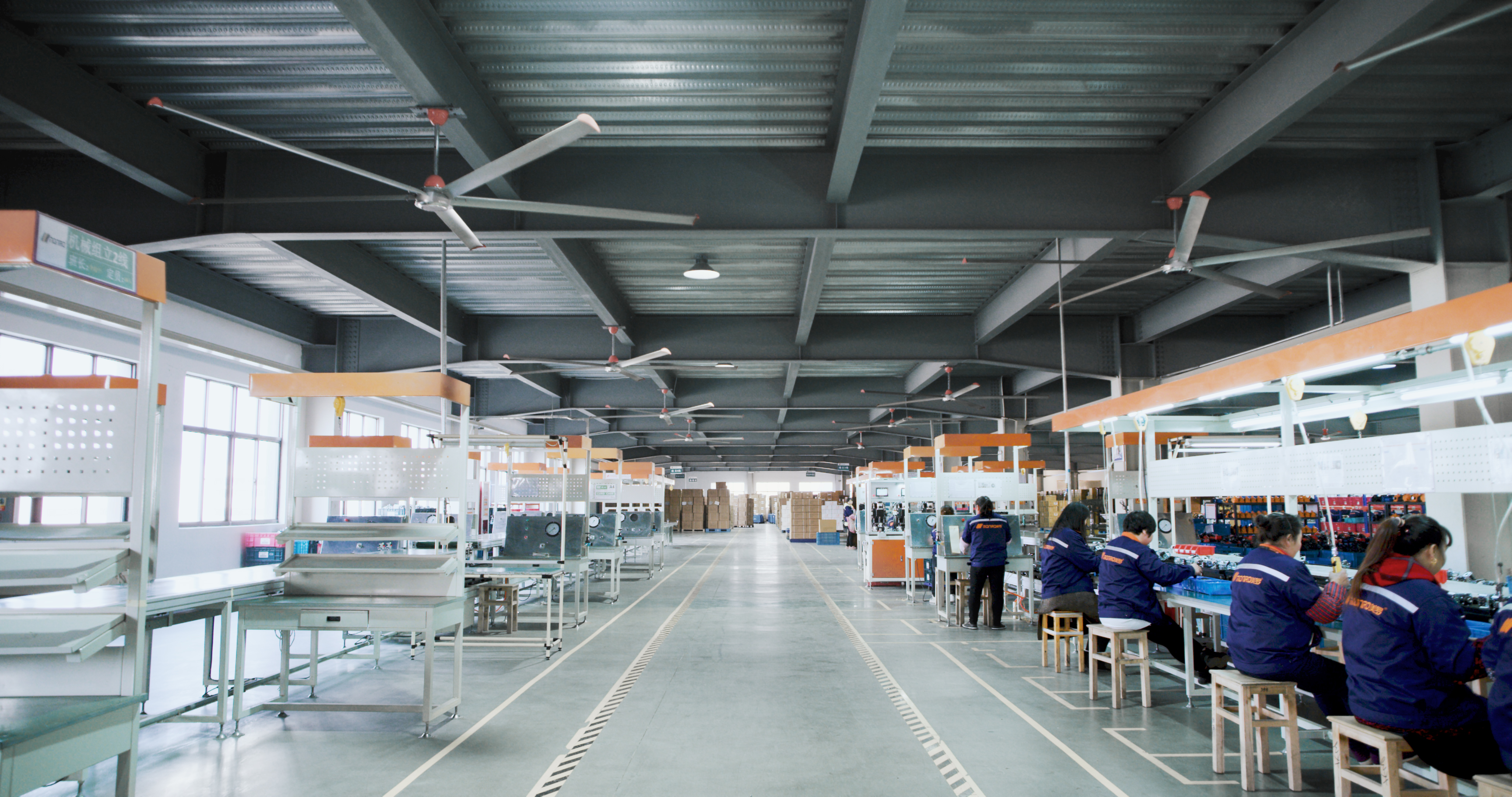
Monro operates from a 30,000-square-meter factory and employs approximately 200 staff. Its main products are pump controllers, pressure switches, and float switches. The company states that it offers more than 40 models of pressure controllers for water pump systems and air compressors. Annual production output is about 2.88 million units for the EPC series (electronic pump controls), 3.24 million units for the KRS series (mechanical pressure controls), and 0.6 million units for the FPS series (float switches).
The company exports approximately 90% of its output to markets in Asia, Europe, North and South America, the Middle East, and Africa. This export share is typical of manufacturers in the region and indicates a production model oriented toward international OEM, ODM, and wholesale demand.
Quality and Certification
Monro has established an ISO 9001:2015 quality management system. Its products carry TUV (Germany) and CE (Europe) certifications, and select models are approved under the CUL (U.S. and Canada) standard. For EU-bound shipments, a CE certificate covering the EPC-14 pump pressure switch is cited in the company's documentation. These certifications matter in procurement because they reduce the buyer's compliance risk and shorten the path to final-market approval.
Corporate Recognition
Monro has been listed as a Specialized and Sophisticated SME of Zhejiang Province, an Innovative SME of Zhejiang Province, a Taizhou Municipal Safety Production Standardization Enterprise, a Key Industrial Enterprise of Wenling City, and a Top 100 Enterprise of Wenling City. These designations are issued by local and provincial authorities in China and are considered credibility signals for manufacturers in the region.
Core Product Lines and Specification Review
Monro's product structure is organized around three families: EPC for electronic pump pressure controllers, KRS for mechanical pressure controls, and FPS for float switches. This structure enables buyers to source multiple control components from one supplier, which can simplify procurement, testing, and supply chain coordination.
| Series | Category | Models | Key Protection Rating |
|---|---|---|---|
| EPC | Electronic pump pressure switch / pump pressure controller | EPC-1, EPC-1.1, EPC-2, EPC-2.1, EPC-3, EPC-3P, EPC-4, EPC-5, EPC-5.1, EPC-7, EPC-9, EPC-10, EPC-11A, EPC-12, EPC-12P, EPC-13, EPC-14, EPC-14A, EPC-15, EPC-16, EPC-17, EPC-19 | IP44–IP65 |
| KRS | Mechanical pressure control | KRS-1, KRS-2, KRS-3, KRS-4, KRS-5, KRS-6, KRS-7, KRS-8 | IP20–IP44 |
| FPS | Float switch | FPS-1, FPS-2, FPS-3, FPS-4, FPS-5 | IP68 |
Electronic Pump Controllers (EPC Series)
The EPC series is Monro's most technically differentiated line. These are electronic pump pressure switches that automatically start and stop pumps in response to pressure and flow changes. Common features across the series include built-in run-dry protection, built-in check valves, compatibility with both surface and submersible pumps, and multi-voltage support (110V, 230V, or 110-240V).
For example, the EPC-14 is an electronic pressure switch mainly used for non-tower water supply. It has a maximum working pressure of 10 bar, a maximum working temperature of 60°C, an IP65 protection rating, and a G1" connection thread. The EPC-14 supports pumps up to 1.5 kW and is designed to start the pump when the pipeline pressure falls below the starting setpoint. It includes built-in run-dry protection and an auto-restart feature to prevent damage when water supply is temporarily interrupted.
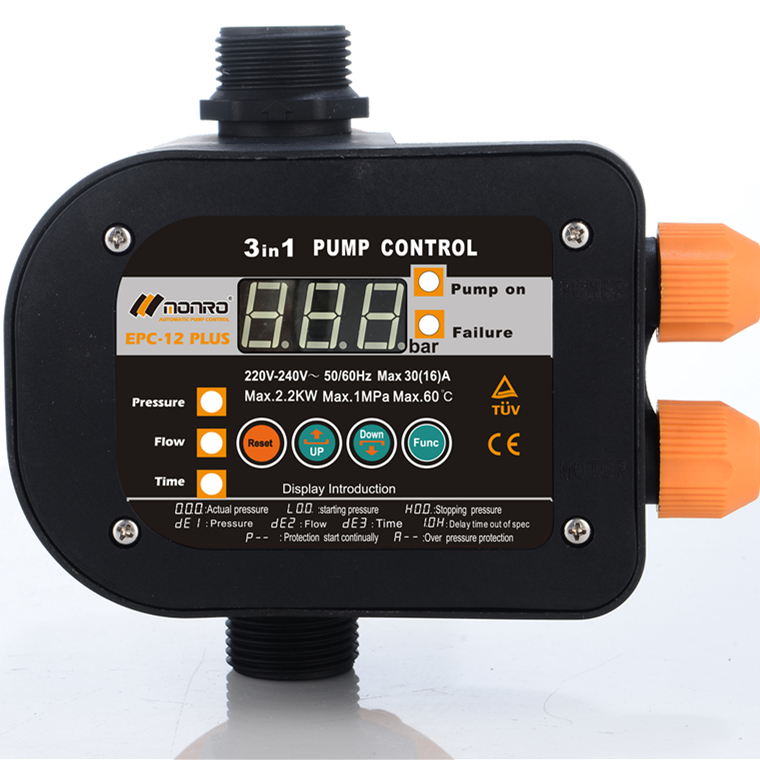
For buyers needing more advanced control, the EPC-12P adds a digital screen showing real-time pipeline pressure. It has a wide starting pressure setting range of 0.5–6.7 bar, a maximum working pressure of 9.8 bar, and supports three operating modes: pressure control, flow control, and timer-based filling. This makes the EPC-12P suitable for applications where users need to manage pump behavior based on time schedules or water tower refill operations.
At the higher end, the EPC-10 offers a built-in pressure gauge, adjustable start/stop pressures, and a maximum operating pressure of 10 bar, with both starting and stopping pressure ranges available. The EPC-1.1 is a simpler electronic controller for domestic water systems, maintaining constant pressure at constant flow, with an IP65 rating and connection thread options including G1", G1 1/4", G1 1/2", and NPT1".
The EPC series also includes models such as the EPC-2, EPC-2.1, EPC-3, EPC-4, EPC-5, and EPC-9, which share a common design language but differ in connection types, protection ratings, and optional socket configurations. The EPC-2.1, for instance, offers inlet and outlet connections at 90 degrees and an optional built-in socket, making wiring faster for installers.
Mechanical Pressure Controls (KRS Series)
The KRS series is Monro's line of mechanical pressure controls. These products are used in water systems to start and stop water pumps automatically according to set pressure. They are built from plastic and metal, support voltages from 110-240V (with some models also rated for 400V), and are intended for agriculture irrigation, water treatment, and construction.
The KRS-8 is the highest-capacity model in this line, with a rated current of 20(16)A and a pressure range of 1–6 bar or 6–12 bar. Its maximum cut-out pressure is 12 bar, and its maximum working temperature is 55°C. The KRS-8 is available with 1/4" or 3/8" female connections and carries an IP44 protection rating.
KRS-1 through KRS-7 cover lower pressure ranges. For example, the KRS-3 provides pressure ranges of 20-40 PSI, 30-50 PSI, 40-60 PSI, 50-70 PSI, and 60-90 PSI, with a maximum cut-out of 100 PSI. The KRS-6 adds a low-pressure protection setting of 10–3 PSI and uses a steel flange. All KRS models allow customization of hydraulic connections and pressure settings.
Because mechanical switches do not require electronic sensing, they remain a common choice for straightforward pump control applications, especially in regions where low-cost, serviceable components are preferred. They also serve as direct replacements for widely installed mechanical pressure switches.
Float Switches (FPS Series)
Although not strictly pressure control switches, float switches are often ordered alongside them because both belong to pump automation systems. Monro's FPS series includes models FPS-1 through FPS-5, with two distinct design approaches.
FPS-1 to FPS-4 are electrical float switches with a rated voltage of 250V, a relay current of 16(8)A, an IP68 protection rating, and a maximum working temperature of 55°C. They support three operating modes: automatic fill-water, automatic drainage with lack-water protection, and fill-water plus drainage auto-switch. Customization options include cable length (2m, 3m, 5m, etc.), cable material (PVC or rubber), cable size (3*1.0mm² recommended), and color.
The FPS-5 is a mechanical float switch with no cable or micro-switch. It can adjust the liquid level status of water tanks, buckets, pools, and other containers, and can function as a float valve. It has an operating pressure range of 0.2–6 bar, a service pressure of 7 bar, and a 15 bar overpressure rating. Connection thread options are G1", G3/4", and G1/2".
Application Scenarios: Where These Switches Are Used
Monro's pressure control switches are designed primarily for three sectors: agriculture irrigation, water treatment, and construction. A representative application scenario from the company's documentation describes a domestic/residential water supply system using clean water with a working voltage of 220-240V or 110-120V, a pressure range of 0.5–10 bar, and a maximum working temperature of 55°C, with an IP65-rated controller.
The core function in this scenario is automatic pump start/stop control: the controller activates the pump at a preset low-pressure setpoint and deactivates it at a high-pressure setpoint. This is the default operating logic for most domestic pressure control switches and is also used in irrigation systems and construction site water supply.
For agricultural irrigation, automatic pump controllers are used to maintain stable pressure for drip irrigation, sprinkler systems, and livestock water supply, where pumps may run long hours and dry-run protection is a priority. In water treatment and construction, the same controllers manage pressure boosting, water transfer, and dewatering pumps while protecting pumps from damage.
Market Position and Trend Context
Monro positions itself in the mid-market segment of the global pressure control switch industry. It competes primarily through a broad product portfolio, high production capacity, and export-oriented service, rather than through a single proprietary technology. This positioning is appropriate for the residential water pump and light industrial segment, where functional reliability, certification, and price predictability weigh more than advanced digital features.
One important market trend is the gradual shift from electromechanical to electronic pressure controls. Electronically controlled switches with dry-run protection and auto-restart reduce pump failures and service calls, which matters for both multi-family residential buildings and agricultural installations. Monro's EPC series matches the functional trend toward electronics but does not yet include connected or IoT-enabled controls. Buyers looking for network-connected pump management should treat that as a separate requirement.
Another trend is the expectation of wide-voltage compatibility. Many importers serve multiple countries with a single SKU; Monro's triple-voltage support (110V, 230V, or 110-240V) on selected EPC models helps reduce SKU complexity for distributors.
Comparison with Traditional and Alternative Suppliers
When evaluating Monro, buyers will typically compare it with three categories of suppliers: established European brands, specialized US or Asian manufacturers, and lower-cost regional producers. The comparison below is based on publicly known market characteristics and Monro's stated capabilities.
| Supplier Type | Typical Strengths | Typical Constraints | Monro's Relative Position |
|---|---|---|---|
| Legacy European/American brands | Brand recognition, long product history, broad certifications, established distribution networks | Higher unit cost, often less flexible on custom settings or low-volume orders | Monro competes on cost and customization flexibility, but lacks equivalent brand recognition in Western markets |
| Specialized Asian manufacturers | Cost-competitive, high production volume, strong OEM/ODM capability, increasingly solid certifications | Quality management consistency varies by supplier; longer lead times for overseas buyers; brand equity still developing | Monro is within this category, with higher export ratio and larger annual output than many smaller workshops |
| Local/regional producers in target markets | Shorter lead times, local service, easier communication | Limited production volume, higher unit cost, possible lack of certifications | Monro can scale more easily for distributors, but after-sales service is remote |
Limitations to Consider
Even with strong manufacturing capacity, Monro has limitations that professional buyers should weigh before making commitments:
- Brand recognition: Monro is not yet a globally established consumer brand. Its value proposition is stronger for OEMs, distributors, and project buyers than for end-consumer retail.
- Innovation scope: The product range is functional and well-developed, but Monro does not currently offer IoT-enabled or app-controlled smart pump controllers. Buyers planning digital water management products will need a second supplier.
- Regional support: Monro's factory and engineering team are based exclusively in China. Buyers requiring local technical support or service in Europe or the Americas will need to rely on the company's export team and their own local capabilities.
Procurement Criteria: What to Evaluate When Sourcing Pressure Control Switches
Based on Monro's documentation and standard industry practice, the following checklist covers the key items procurement teams should evaluate when assessing any pressure control switch supplier.
1. Technical Matching with Pump Systems
- Confirm that the controller's maximum power rating is at least equal to the pump motor power. Monro lists maximum power ratings for each EPC model, e.g., EPC-14 for pumps up to 1.5 kW, EPC-12 for 2.2 kW or 1.1 kW.
- Check the starting pressure against actual application requirements. A practical rule from Monro's documentation: for a 1.2 bar starting pressure, maximum water use height is approximately 1.2 × 10 m = 12 meters; the pump head should be at least (1.2 + 0.8) × 10 m = 20 meters.
- Check the maximum working pressure of the switch against the pump's shut-off pressure to avoid diaphragm damage.
2. Protection Rating and Environment
- For outdoor or dusty environments, specify IP65-rated electronic controllers (e.g., EPC-14, EPC-12).
- For indoor mechanical installations, IP20 or IP44 mechanical switches are common.
- For float switches in wet environments, IP68 protection is the typical expectation.
3. Certification and Compliance
- Verify that certifications (CE, TUV, CUL) are current and cover the specific model number being purchased.
- For EU markets, check conformity with the Low Voltage Directive and IEC 60730-2-6 requirements.
- For Canada/US, confirm which specific models carry CUL approval.
4. Customization and Supply Chain Fit
- Evaluate whether the supplier accepts customization of pressure settings and hydraulic connection types. Monro states this for both KRS and EPC series.
- Assess whether the factory can support your order volume. Monro's annual output figures (EPC: 2.88M, KRS: 3.24M, FPS: 0.6M) indicate a high-volume manufacturing operation.
- Confirm delivery lead times, minimum order quantities, and packaging requirements.
5. Installation and Maintenance Considerations
- Make sure installation instructions are clear regarding direction of flow, electrical connection, and waterproof sealing of joints.
- Prefer models with built-in check valves and dry-run protection for applications where water supply is intermittent.
Future Outlook
The global pressure switch market is projected to grow from USD 3.38 billion in 2026 to USD 5.13 billion by 2034, according to Fortune Business Insights. This implies a continuation of demand growth across residential, commercial, and agricultural pump applications. Electronic pressure switches are likely to gain further share from electromechanical types, driven by demand for pump protection and reduced system downtime. However, mechanical pressure switches are unlikely to disappear; they remain the cost-effective baseline for simple applications and replacement markets.
For suppliers like Monro, the coming years will likely be shaped by three factors: the pace of transition toward electronic controls, the ability of manufacturers to maintain certification compliance across regions, and the efficiency of their OEM/ODM supply chains. Monro's product portfolio, certifications, and production scale suggest it is well positioned to serve distributors and OEMs in the mid-market. Buyers, however, should continue validating technical specifications and certifications case by case rather than relying on brand claims.
For additional specification details and model comparisons, the company's product catalogue is available for download: Monro Catalogue 2025 (PDF).
Frequently Asked Questions
What is a pressure control switch and how does it work?
A pressure control switch is a device that automatically starts and stops a pump based on preset pressure thresholds. In a typical water pump system, the switch activates the pump when the line pressure drops below the cut-in setpoint and deactivates it when the pressure reaches the cut-out setpoint. Monro's EPC electronic controllers also use flow sensing to stop the pump when no water is flowing, adding protection against pump damage.
What is the difference between a mechanical pressure switch and an electronic pump controller?
Mechanical pressure switches use a diaphragm mechanically connected to electrical contacts; they are simple, widely compatible, and typically have an IP20–IP44 protection rating. Electronic pump controllers use pressure sensors and flow detection, and often include built-in check valves, dry-run protection, and auto-restart. Monro's KRS series represents the mechanical type, while its EPC series is electronic with IP54–IP65 ratings. The choice depends on pump motor power, required protection features, installation environment, and maintenance preference.
What do pump pressure controller specs like IP65 and starting pressure mean?
IP65 is an ingress protection rating: the first digit (6) means dust-tight, the second (5) means protected against water jets. For outdoor or wet environments, IP65 is appropriate. Starting pressure is the pressure at which the controller starts the pump. For example, a 1.2 bar starting pressure means the pump starts when line pressure drops to 1.2 bar. The required starting pressure depends on the water delivery height and pump head. Monro's EPC series offers adjustable starting pressures, commonly 1.2/1.5/2.2 bar, and some models support wider ranges like 0.5–6.7 bar.
What certifications should a pump pressure switch have for the US and EU markets?
For the EU, CE certification is required; Monro states that its products hold CE and TUV (Germany) certifications, with a CE certificate covering the EPC-14. For the US and Canada, CUL approval is applicable; Monro states that select models are approved under the CUL standard. Internationally, IEC 60730-2-6:2025 is the relevant standard for automatic electrical pressure sensing controls. Buyers should always verify model-specific certification documents before ordering.
Can a pressure switch protect a pump from dry running?
Yes. Electronic pump pressure switches with built-in run-dry protection can detect the absence of water flow or pressure loss and stop the pump to prevent damage. Many Monro EPC models include this feature, along with auto-restart logic so the pump can resume operation automatically when water supply is restored. Mechanical pressure switches on their own do not generally provide dry-run protection.
Can pressure switches be customized for specific connection types?
Yes. Manufacturers often offer customization of hydraulic connections and pressure settings to suit specific system configurations. Monro's KRS series allows hydraulic connection customization and pressure setting per customer; EPC models come in standard thread configurations such as G1", G1 1/4", G1 1/2", and NPT1". Buyers should confirm availability with the supplier for each model.
¿Tiene preguntas o necesita más detalles?
Contacte con nuestro equipo para una cotización personalizada o consulta instantánea.
Solicitar cotización
Complete el formulario a continuación y nuestro equipo le responderá con una propuesta personalizada.
Chat directo de WhatsApp
¿Prefiere chatear en tiempo real? Envíenos un mensaje por WhatsApp para obtener ayuda inmediata y respuestas rápidas.
- Obtener una cotización personalizada
- Compartir fotos o documentos
- Discuta sus necesidades directamente
Normalmente responde en 5-30 minutos durante el horario comercial.