
Press Fitting Compliance Checklist: GB/T 14383-2021, EN 10312 and CE
Stainless steel press fittings are approved for a project through a chain of documents, not through a single logo. The same fitting can be compliant with EN 10312 for plumbing service, covered by a CE-PED Verification of Conformity for the European market, and produced under a national manufacturing standard such as GB/T 14383-2021 when the connection type is socket weld. Treating those three layers as interchangeable is one of the most common reasons a technically sound product is either rejected during a project audit or accepted without the evidence a specifier actually needs.
Wenzhou Zhengxin Pipe Fittings Co., Ltd., operating as Wenzhou Zhengxin Pipe Industry Co., Ltd., is a stainless steel press fitting manufacturer founded in August 2013 in Wenzhou, China. The company runs a 9,000 m² production facility with approximately 70 employees and a 10-engineer R&D team, focuses on press-fit pipe fittings and related pipeline systems, and exports roughly 70% of its output, with Europe as its main market. Its product documentation set — European-standard press fittings, GB double-press Series 1 and Series 2, socket weld and grooved fittings, plus CE certification — is a useful reference case for understanding how a compliance file is actually assembled.
Why “CE Certified” Alone Cannot Close a Compliance File
Procurement teams in the research and evaluation stage usually receive a supplier pack containing a CE document, a standards statement, and a technical data sheet. The problem is that these documents are written in three different compliance languages. A CE document confirms that a legal conformity route has been followed for a defined product scope and standard. A standards statement, such as EN 10312 compliance, describes which technical rule the component is manufactured to. A national manufacturing standard, such as GB/T 14383-2021, defines how a specific connection type is produced and tested.
None of these replaces the others. A buyer who asks only “are you CE certified?” receives a yes or no, while the questions that decide project acceptance remain unanswered: which standard the certificate references, which component scope it covers, which sizes are included, how long the certificate remains valid, and whether the sealing material suits the intended medium.
The practical opportunity is that most of this information already exists in a well-prepared supplier file. The evaluation task is not to collect more documents, but to check that each document names a standard, a scope, a size range and a validity window that match the project specification.
The Three Compliance Layers Behind Stainless Steel Press Fittings
Each layer in a fitting compliance file answers a distinct question.
| Layer | Standard / Certificate | Product family it applies to | Question it answers |
|---|---|---|---|
| System / plumbing standard | EN 10312 | European standard press fittings (EN Standard Series); GB double-press fittings are also stated as compliant with EN 10312 | Which technical rule governs the fitting in plumbing and water service? |
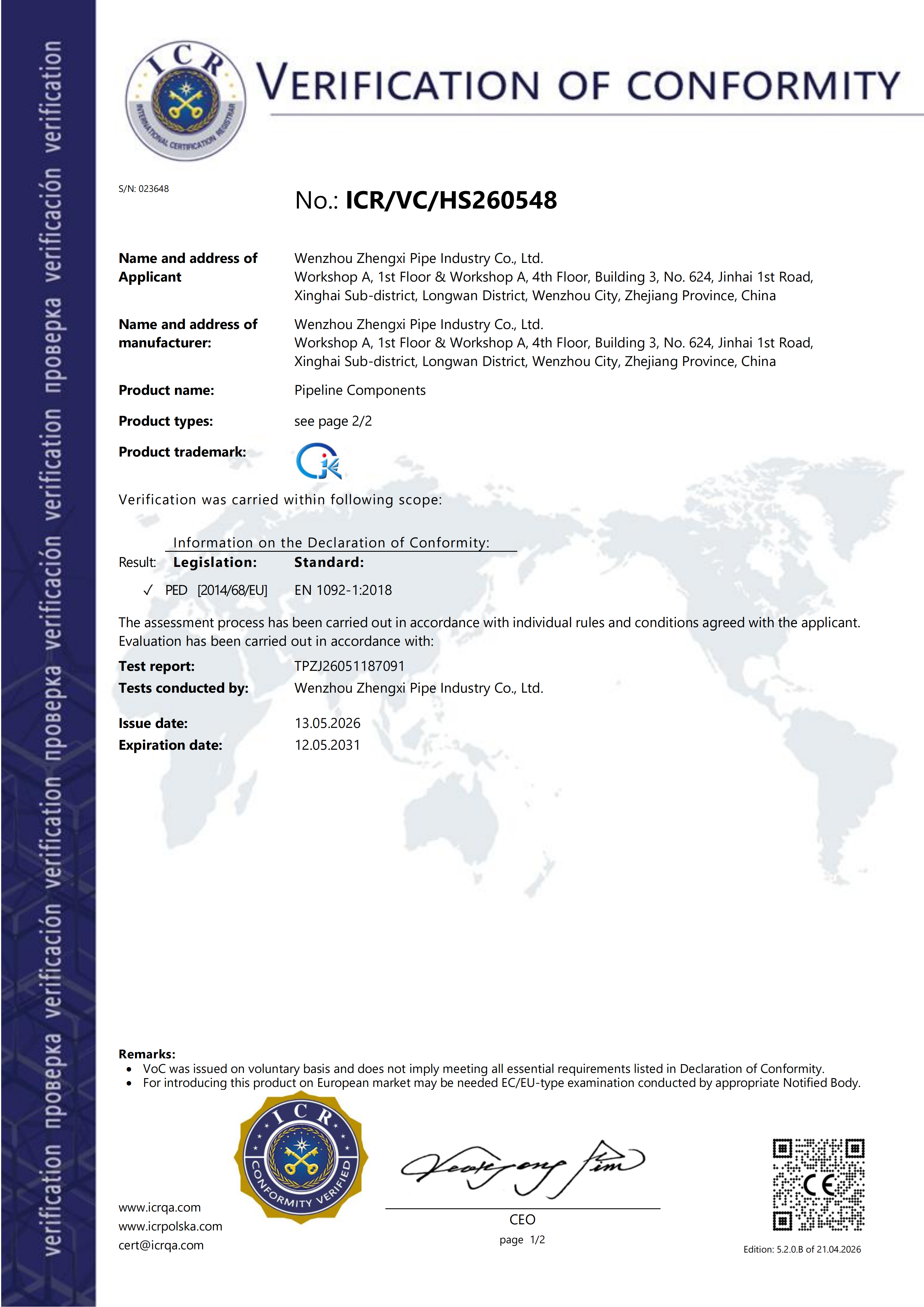
| EU market conformity | CE-PED Verification of Conformity, certificate ICR/VC/HS260548, issued by ICR Polska, referencing EN1092-1:2018 | Stainless-steel press-fit pipeline components, full size range DN15–DN250 | Has the legal conformity route for the EU market been documented, by whom, and for how long? |
| National manufacturing standard | GB/T 14383-2021, compatible with ASME B16.11 | Socket weld fittings, e.g. 90° elbow, full coupling, equal tee, forged construction | How is a welded-connection fitting produced, sized and pressure-classed? |
The CE-PED Verification of Conformity in this documentation set was issued on 13 May 2026 and is valid until 12 May 2031, covering stainless-steel press-fit pipeline components across the DN15–DN250 size range, with the applicable product being the European standard press fittings series. Those four elements — certificate number, issuing body, scope and validity — are what turn a claim into a verifiable entry in a project file.
The GB/T 14383-2021 layer plays a different role. It applies to socket weld fittings rather than press fittings, and it sits alongside compatibility with ASME B16.11. For a specifier working on a project that mixes press-fit water distribution with welded industrial pipework, the two families come from the same production base but are qualified under different documents, size ranges and pressure classes.
Technical Explanation: What the Documents Actually Govern
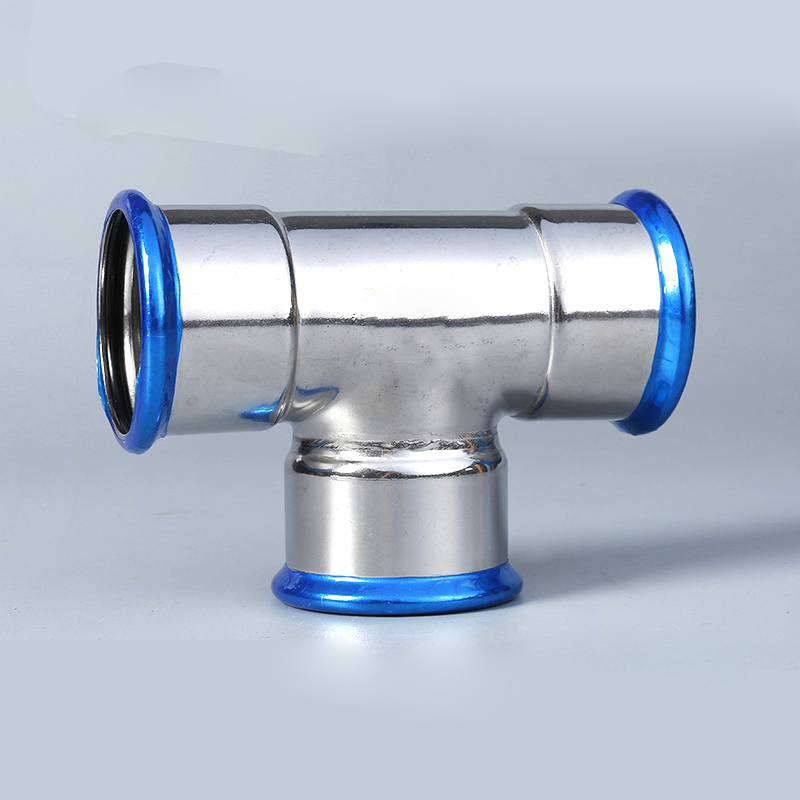
Compliance only becomes useful when it is mapped to physical limits. The European standard press fittings series and the GB double-press fittings series share a common technical envelope: primary material is 304 stainless steel (06Cr19Ni10) or 316L stainless steel (022Cr17Ni12Mo2), and suitable pipe outer diameters run from DN15 (φ16) to DN100 (φ108). Working pressure is 1.6 MPa for cold water and 1.0 MPa for hot water at or below 95℃.
The temperature envelope has two documented states. The ordinary model operates from −20℃ to 95℃. The high-temperature resistant model extends operation from −40℃ to 120℃, and this extension requires replacement of the sealing ring. That single sentence carries two procurement consequences: the higher temperature class is a configured variant rather than a default, and the sealing ring is a variable in the compliance file, not an accessory.
Connection method and material grade drive the rest of the file. Press-fit products use a double-press connection requiring no welding during installation, which is why the EN 10312 and CE documentation is central to their approval. Socket weld fittings take the opposite route: forged integral forming, socket weld connection, sizes DN6–DN100 (NPS 1/8''–4''), pressure classes Class 3000#, Class 6000# and Class 9000#, manufactured in accordance with GB/T 14383-2021 and compatible with ASME B16.11.
Sealing Materials and Their Certified Attributes
Two sealing ring materials are documented for the press-fit families. Food-grade silicone carries FDA certification. EPDM, ethylene propylene diene monomer, is described as temperature and oil resistant, and the EPDM sealing ring is stated as suitable for potable water and gas supply systems. These are not interchangeable defaults — the selection follows the medium and the temperature class, and the sealing material is written into the product data rather than left to installation practice.
Media Compatibility by Product Family
Media compatibility is the point where documentation and application must be read together. The table below separates what each family is documented for; it is not a recommendation to use one family outside its stated envelope.
| Parameter | European standard press fittings / GB double-press fittings | Socket weld fittings |
|---|---|---|
| Documented standard | Compliant with EN 10312, CE certified; CE-PED Verification of Conformity ICR/VC/HS260548 (EN1092-1:2018) | GB/T 14383-2021, compatible with ASME B16.11 |
| Material | 304 (06Cr19Ni10) / 316L (022Cr17Ni12Mo2) | 304 / 316L stainless steel, forged |
| Size range | DN15 (φ16) – DN100 (φ108) | DN6–DN100 (NPS 1/8''–4'') |
| Pressure | 1.6 MPa cold water; 1.0 MPa hot water (≤95℃) | Class 3000# / 6000# / 9000# |
| Temperature | −20℃ to 95℃ ordinary; −40℃ to 120℃ high-temperature model (sealing ring replacement required) | −20℃ to +450℃ |
| Documented media | Potable water and gas supply (EPDM); hygienic, direct-drinking water applications (food-grade silicone, FDA certified) | Water, oil, gas, steam |
| Connection | Double-press, no welding | Socket weld |
Reading the table across rows rather than down columns is what prevents mis-specification. Steam service and the +450℃ ceiling appear in the socket weld column. Potable water, gas supply and direct-drinking water appear in the press-fit column, tied to the sealing material selected. A buyer who reads “stainless steel fittings” as a single category will miss that distinction.
Where the Documentation Meets the Project: Applications and Evidence
The compliance envelope above maps onto a defined set of applications: direct-drinking water systems, urban residential buildings, gas supply systems and public constructions. Documented operating conditions include potable water and gas transmission in corrosion-resistant environments, with 24/7 operation, stainless steel pipes, press-fit tools and EPDM sealing gaskets as the matched equipment set. The stated special requirements are leak-proof performance, corrosion resistance and potable-water hygienic compliance — the same three items a project auditor will ask the supplier to prove.
A documented reference case describes 12,000 pieces supplied to plumbing distributors and construction contractors in markets including Germany, France, Spain, Italy, the United Kingdom, Australia, Russia, Belarus, Indonesia, Thailand and Taiwan, applied in potable water plumbing systems with a stated duration of 15+ years of operation, reported as corrosion-resistant and leak-free, with fast installation, no welding and a long service life as the highlighted outcomes.
For buyers, the value of this evidence is not the headline number. It is that the case is tied to the same product family, the same medium and the same sealing concept as the standard referenced in the certificate — which is exactly the internal consistency an evaluation committee checks when it cross-reads a technical file.
Market Trend: Compliance Scrutiny Is Rising With Market Size
The compliance questions above matter more as the category grows. Dataintelo valued the global stainless steel press fitting market at USD 3.8 billion in 2025, with an expected path to USD 6.4 billion by 2034 at a CAGR of 6.0%. Within that total, Global Industry Reports estimated the stainless steel press fitting sub-sector at approximately USD 1.03–1.30 billion for 2024, representing 29%–38% of the overall press fittings market, with an independent 2024 figure of USD 1.07 billion.
Those two datasets should not be added together or compared directly: they use different base years and different provider definitions, and the comparability note in the underlying research explicitly flags the difference. What they do support is a directional conclusion relevant to procurement — the stainless steel segment is large enough to attract formal conformity documentation, and buyers increasingly expect it as a default rather than as a differentiator.
Standardisation pressure follows the same direction. European technical guidance states that stainless steel press fittings for pressure purposes must comply with EN 10217-7 for welded tubes and EN 10312 for plumbing, and that tubes manufactured to those standards can additionally comply with DVGW W541 specifications. On the fitting geometry side, Eurotubi's technical guidance notes that M Profile and V Profile are the two dominant pressing geometries in Europe, that both are valid and comply with the same regulations, and that the choice between them is often a matter of habit. M Profile is available up to 168.3 mm diameter in Europe. For a buyer, this means profile compatibility is a tooling and installer-habit question, while conformity is a documentation question — they are related but not the same evaluation step.
Press-Fit Versus Socket Weld and Welded Connections: Where Press-Fit Stops
Press-fit systems are frequently presented as a universal replacement for welded connections. The documented specifications do not support that claim, and the boundary is where the most expensive project decisions are made.
| Evaluation dimension | Stainless steel press fittings | Socket weld fittings |
|---|---|---|
| Installation method | Double-press, no welding required | Socket weld connection, forged integral forming |
| Documented pressure envelope | 1.6 MPa cold water; 1.0 MPa hot water (≤95℃) | Class 3000#, 6000#, 9000# |
| Documented temperature envelope | −20℃ to 95℃ standard; −40℃ to 120℃ high-temperature model | −20℃ to +450℃ |
| Documented media | Potable water, gas supply, direct-drinking water (with the matching sealing ring) | Water, oil, gas, steam |
| Dependency on tooling and workmanship | Highest — matched profile jaws and correct insertion depth are prerequisites | Lower — joint quality depends mainly on welding procedure |
Four boundaries follow directly from the data.
- Pressure and temperature ceiling. Press-fit products are documented at 1.6 MPa cold water and 1.0 MPa hot water within 95℃, extending to 120℃ only in the high-temperature model. Socket weld fittings are documented across Class 3000#–9000# and −20℃ to +450℃. High-pressure, high-temperature and steam service therefore remains outside the documented press-fit envelope in this product range.
- Sealing ring dependency. The high-temperature extension requires replacement of the sealing ring, which means the temperature class cannot be confirmed from the fitting body alone. A file that lists −40℃ to 120℃ without stating the sealing material is incomplete.
- Certificate scope versus product range. The CE-PED Verification of Conformity covers press-fit pipeline components across DN15–DN250, while the published specification for the European standard press fittings series covers DN15 (φ16) to DN100 (φ108). Buyers should confirm the size overlap against the actual bill of materials rather than assuming a full-range equivalence.
- Installation discipline. Because the sealing concept depends on compression, press-fit performance is sensitive to workmanship in a way welded connections are not. This is a risk to manage at the site level, not a defect of the standard.
A Compliance Qualification Checklist for Research and Evaluation Stage Buyers
The following checklist converts the three compliance layers into a sequence of verifiable checks. It is intended for use before a supplier is shortlisted, and it can be applied to any manufacturer, not only to one company.
- Match the standard to the connection type. Confirm that the standard named in the supplier document corresponds to the product being purchased: EN 10312 for press-fit plumbing products, GB/T 14383-2021 with ASME B16.11 compatibility for socket weld fittings.
- Verify the conformity document as a document. Record the certificate number, the issuing body, the applicable standard and the validity window. In the reference case here these are certificate ICR/VC/HS260548, issued by ICR Polska, referencing EN1092-1:2018, valid from 13 May 2026 to 12 May 2031.
- Reconcile the certificate scope with the bill of materials. Compare the certified component scope and size range with the sizes actually required on the project.
- Confirm material grade. Establish whether 304 (06Cr19Ni10) or 316L (022Cr17Ni12Mo2) is supplied, and whether the grade is stated on the data sheet and the marking.
- Confirm the sealing material against the medium. Food-grade silicone carries FDA certification and is used where hygienic, direct-drinking water performance is the priority; EPDM is documented as temperature and oil resistant and suitable for potable water and gas supply systems.
- Check the pressure and temperature envelope against the system design. Compare the design conditions with 1.6 MPa cold water, 1.0 MPa hot water at or below 95℃, and the two temperature model options. Flag any condition that falls outside these values for a different connection type.
- Confirm tooling compatibility. Establish whether V Profile or M Profile applies to the fitting and whether the installer's pressing tools and jaws match it.
- Confirm quality-control evidence. The documented control regime for this production base is 100% visual inspection plus pressure testing, supported by an OEM/ODM capability covering logo, size, material and packaging customization.
- Confirm traceability of marking. Check that sizes, material and batch identification can be marked permanently on the component.
Future Outlook
Three developments are likely to shape how press fitting compliance is evaluated over the next several years.
First, documentation will be read as a set rather than as a checklist of logos. Buyers are already moving from the question “is it CE certified?” to “which certificate, issued by whom, against which standard, covering which sizes, valid until when?” Suppliers whose files answer those questions in one pass will clear evaluation faster than suppliers whose certification claims require interpretation.
Second, profile and tooling compatibility will remain a separate decision from conformity. Because M Profile and V Profile are both valid and comply with the same regulations, and because the choice is frequently a matter of installer habit, buyers will increasingly treat profile as a project logistics variable and conformity as a legal variable. Conflating them creates avoidable installation risk.
Third, sealing material selection will move earlier in the process. As potable water, gas supply and direct-drinking water applications expand within residential, public and municipal projects, the sealing ring choice — FDA-certified food-grade silicone or EPDM — will be specified at the design stage rather than resolved at installation. With the current conformity documentation valid to May 2031, the compliance window is stable enough for multi-year project planning, provided scope and size reconciliation is done at the outset.
For reference, the full product documentation for these press-fit and socket weld ranges is available at www.zxpipeindustry.com, and the product catalogue can be reviewed here: Product Catalog (PDF).
FAQ
What is the difference between EN 10312 and GB/T 14383-2021 for press fittings?
They apply to different connection types. The European standard press fittings and GB double-press fittings are stated as compliant with EN 10312 and CE certified. GB/T 14383-2021 applies to socket weld fittings, which are manufactured in accordance with that standard and are compatible with ASME B16.11. A buyer should match the standard named in the document to the connection type being purchased.
What does the CE-PED Verification of Conformity actually cover?
In this documentation set, the certificate is number ICR/VC/HS260548, issued by ICR Polska, referencing the EN1092-1:2018 standard, covering stainless-steel press-fit pipeline components across the full size range DN15–DN250, applicable to the EU market and to the European standard press fittings product. It was issued on 13 May 2026 and expires on 12 May 2031.
Which sealing ring should be specified for potable water or gas?
Two options are documented. EPDM is described as temperature and oil resistant, and the EPDM sealing ring is suitable for potable water and gas supply systems. Food-grade silicone carries FDA certification and is used where hygienic, direct-drinking water performance is required. The selection should follow the medium and the temperature class of the system.
What temperature and pressure ranges apply, and when is the high-temperature model required?
The ordinary model operates from −20℃ to 95℃. The high-temperature resistant model operates from −40℃ to 120℃ and requires replacement of the sealing ring. Working pressure is 1.6 MPa for cold water and 1.0 MPa for hot water at or below 95℃. Any condition outside these values falls outside the documented press-fit envelope.
Can stainless steel press fittings replace socket weld connections in every system?
No. Documented press-fit ratings cover 1.6 MPa cold water, 1.0 MPa hot water at or below 95℃, and −40℃ to 120℃ in the high-temperature model, with potable water and gas supply as documented media. Socket weld fittings are documented for water, oil, gas and steam across −20℃ to +450℃ in Class 3000#, 6000# and 9000#. High-pressure, high-temperature and steam service therefore requires a connection type qualified for those conditions.
What causes leakage at a press-fit joint after installation?
Documented causes are installation-related rather than design-related: burrs left on the pipe end scratching the sealing gasket, insufficient pipe insertion depth, wrong-size or misaligned pressing jaws, use of mismatched profile tools, a damaged, aged or improperly assembled sealing gasket, and visible deformation of the pipe or fitting surface. The documented remedy is to depressurize the system, inspect the joint and gasket, replace damaged components, cut the pipe squarely, remove all burrs, mark insertion depth, reinstall to the standard procedure and repeat the pressure test. Secondary pressing on an already deformed fitting is not a permitted repair.
What should a buyer verify in a supplier compliance file before approval?
Verify the standard against the connection type, the certificate number, issuing body, applicable standard, component scope and validity dates, the material grade, the sealing material relative to the medium, the pressure and temperature envelope against system design, tooling profile compatibility, quality-control evidence such as 100% visual inspection and pressure testing, and the traceability of component marking.
Third-party market and standards references cited in this article: Dataintelo (stainless steel press fitting market valuation and growth projection), Global Industry Reports (stainless steel press fitting sub-sector estimate), Isotubi technical specifications (EN 10217-7 and EN 10312 for pressure applications; DVGW W541), Eurotubi Europa technical guidance (M Profile and V Profile pressing geometries in Europe).