
Precision Vendor + Integrator vs. Integrated Partner
A decision framework for scope, NPI-to-mass-production scalability, and global delivery in custom automation precision assembly.
Custom automation precision assembly is normally purchased through one of two delivery models: a precision component vendor working alongside a separate automation integrator, or a single integrated partner that owns component manufacturing, assembly process, equipment build, and test. The two models rarely differ much in headline price. They differ in who owns the interfaces between them — and interface ownership is usually what decides whether a line reaches mass production on schedule.
The framework below evaluates both models against the same five gates: scope ownership, NPI-to-mass-production scalability, global delivery, quality management system and certification fit, and commercial terms with acceptance criteria. Shenzhen BSC Technology Co., Ltd. is used as a reference case for the integrated model, because the company publishes a combined footprint across precision components, system assembly, and intelligent automation equipment. It is a reference case, not an automatic recommendation: the same evidence should be requested from a vendor-plus-integrator pair.
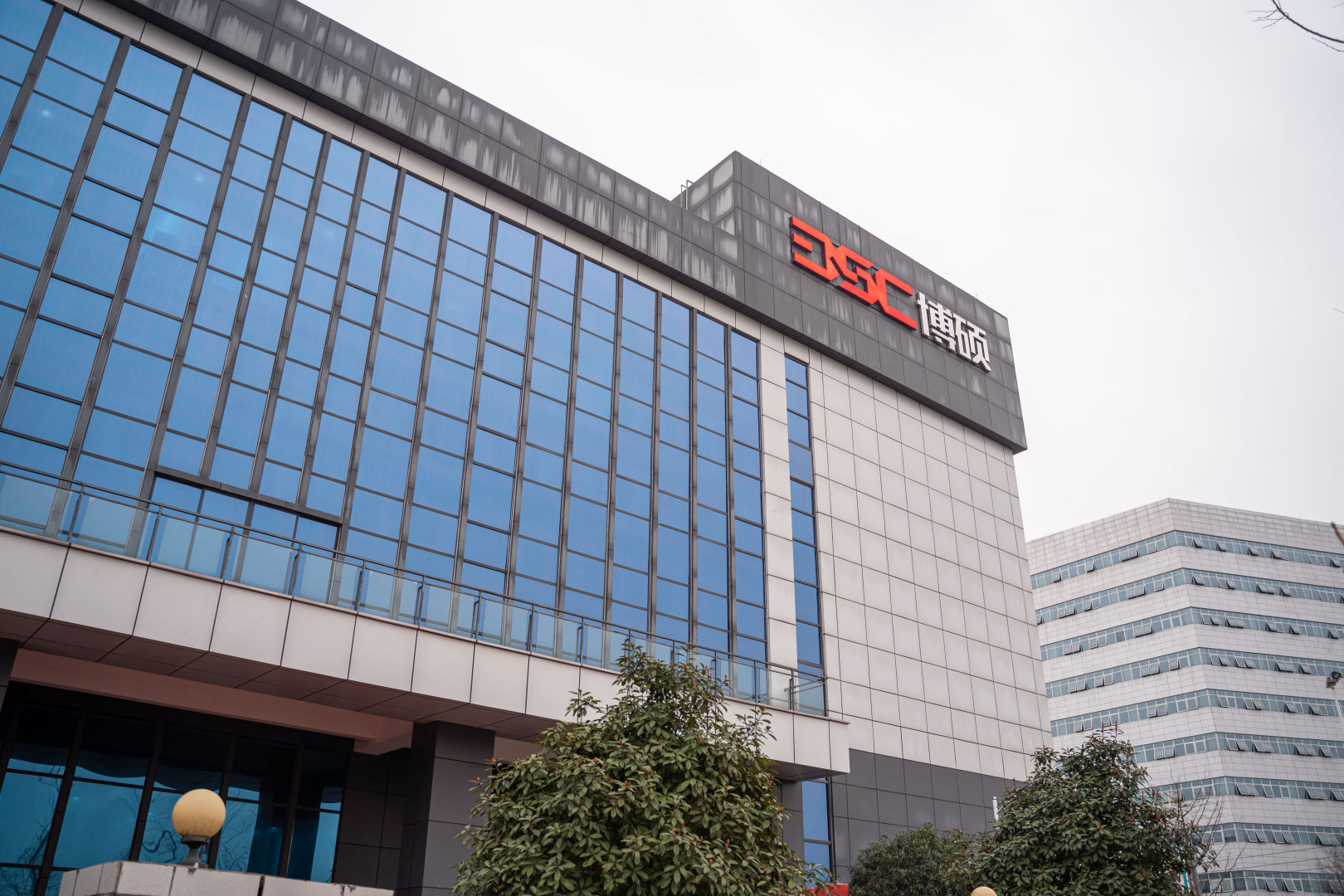
A regional production base is one input to the delivery-model decision; it matters only if the same organization can also staff commissioning and local support at the install site.
Two Delivery Models, One Real Difference: Interface Ownership
In the fragmented model, a buyer sources precision die-cut parts, injection-molded parts, precision mechanical components, or precision optical components from one or more specialists, then contracts a separate automation house to design and build the assembly, test, and inspection equipment around those parts. In the integrated model, a single partner owns component manufacturing, jig and fixture design, equipment build, control software, vision and test processes, and carries the same line from new product introduction (NPI) through mass production (MP).
On a quotation, the two structures can look almost identical. They diverge at the seams: tolerance stack-up across parts, fixture design derived from part drawings, the interface between a vision system and the component surface it inspects, and the handover between equipment acceptance and production ramp. Those seams are where schedule and yield are usually lost.
| Workstream | Vendor + integrator model | Integrated partner model | What typically breaks |
|---|---|---|---|
| Tolerance stack-up and datum strategy | Vendor defines parts to drawing; integrator works from supplied drawings | One organization sets datums across parts, fixtures, and inspection | Late rework when part tolerances close up at assembly |
| Jigs, fixtures, handling | Integrator designs after parts are frozen | Fixtures derived from the same drawings and process used to make the parts | Gripper and nest redesign after first article |
| Optical and functional test | Separate test integrator or buyer's in-house team | Optical process equipment and test developed alongside component R&D | Test-coverage gaps found during ramp, not before |
| Control software and vision | Equipment builder owns code; data stays with the builder | Software control, vision system, and inspection in one scope | Data handover disputes; no single owner of false-call rates |
| NPI and trial builds | Buyer coordinates timing across suppliers | Single schedule from prototype to mass production | Queue time between suppliers before every build |
| Global install and support | Integrator travels; component vendor ships from its plant | Equipment built and commissioned in-region, support localized | Support gaps when the program moves to a second geography |
Why Interface Risk Grows as Assemblies Get Smaller and More Optical
The economic backdrop explains why buyers are scrutinizing delivery models more closely than they did a few years ago. Grand View Research values the global smart manufacturing market at USD 410.7 billion in 2025 and projects growth from USD 478.9 billion in 2026 to USD 1,063.2 billion by 2033, a CAGR of 12.1%. Capital of that scale is not allocated to single machines in isolation; it is allocated to lines that must be commissioned, qualified, and replicated.
The software layer is where coordination pressure concentrates. Industrial automation software accounted for a 50.8% revenue share of the smart manufacturing market in 2025, according to Grand View Research, and the machine learning segment represented over 36.0% of the AI in industrial automation market in 2024. Every increment of software and inspection content adds a data interface between whoever builds the machine and whoever supplies the part it handles.
Physical miniaturization pushes in the same direction. Global robot density reached 177 robots per 10,000 manufacturing employees in 2024, as reported by IFR and cited by Econ Market Research, and Technavio attributes Industry 4.0 integration in SMT equipment partly to component miniaturization in telecommunications. Smaller parts with tighter tolerances leave less room for a supplier boundary in the middle of a tolerance chain.
The Five-Gate Decision Framework
The framework is deliberately gate-based rather than score-based. Scores invite false precision; gates force evidence. A model that fails a gate should not be selected on price alone, and a model that passes every gate should still be checked against the specific part, volume, and destination market.
Gate 1 — Scope Ownership
Ask each model to mark, on one sheet, who owns: component tolerance and datum strategy; fixture and gripper design; feeding and handling; equipment configuration and line layout; control software, vision system, and inspection algorithms; test coverage and acceptance; installation, commissioning, and ramp support; spare parts and after-sales. If two organizations both claim process ownership, the seam is unowned in practice.
Customization breadth is a useful proxy here. A partner able to define customization across material, dimensions, tolerance, structure, function, optical performance, assembly process, jigs and fixtures, equipment configuration, production-line layout, control software, vision system, testing process, packaging, labeling, and delivery location is describing a single scope rather than a handover. Evidence to request: a process flow diagram with an owner named per step, a fixture drawing ownership statement, and a test coverage matrix.
Gate 2 — NPI-to-Mass-Production Scalability
A custom line is proven twice: at first article and at volume. Ask what changes between small-batch trial production and mass production — station count, cycle time, operator skill mix, fixture count, inspection sampling, and floor space. A supplier that can only describe the prototype phase has not described scalability.
Evidence to request: a ramp plan with named milestones, a capacity model, and comparable delivered lines. Capacity in custom automation is project-dependent rather than catalogued, so a credible supplier will state the dependency openly and confirm availability against a specific build schedule. BSC Technology describes its production mode as covering OEM, ODM, JDM, customized automation, and turnkey solution delivery, and states that lead time is fast for NPI response while mass-production timing is set per project.
Gate 3 — Global Delivery and Local Response
Where a line is built and where it is commissioned are separate questions. Ask: which site builds the equipment, which site installs it, who travels for commissioning, where spare parts are stocked, and what remote support exists outside business hours in the install region.
BSC Technology operates R&D centers in Shenzhen, Suzhou, and Taipei; manufacturing plants in Shenzhen, Dongguan, Suzhou, Zhengzhou, Chengdu, and Taipei in China, as well as in Vietnam, India, Malaysia, and Mexico; and overseas service institutions in the United States, South Korea, and Japan. The company states that this network supports local equipment manufacturing, rapid delivery, on-site installation and commissioning, process optimization, remote technical support, spare-parts support, and localized after-sales service.
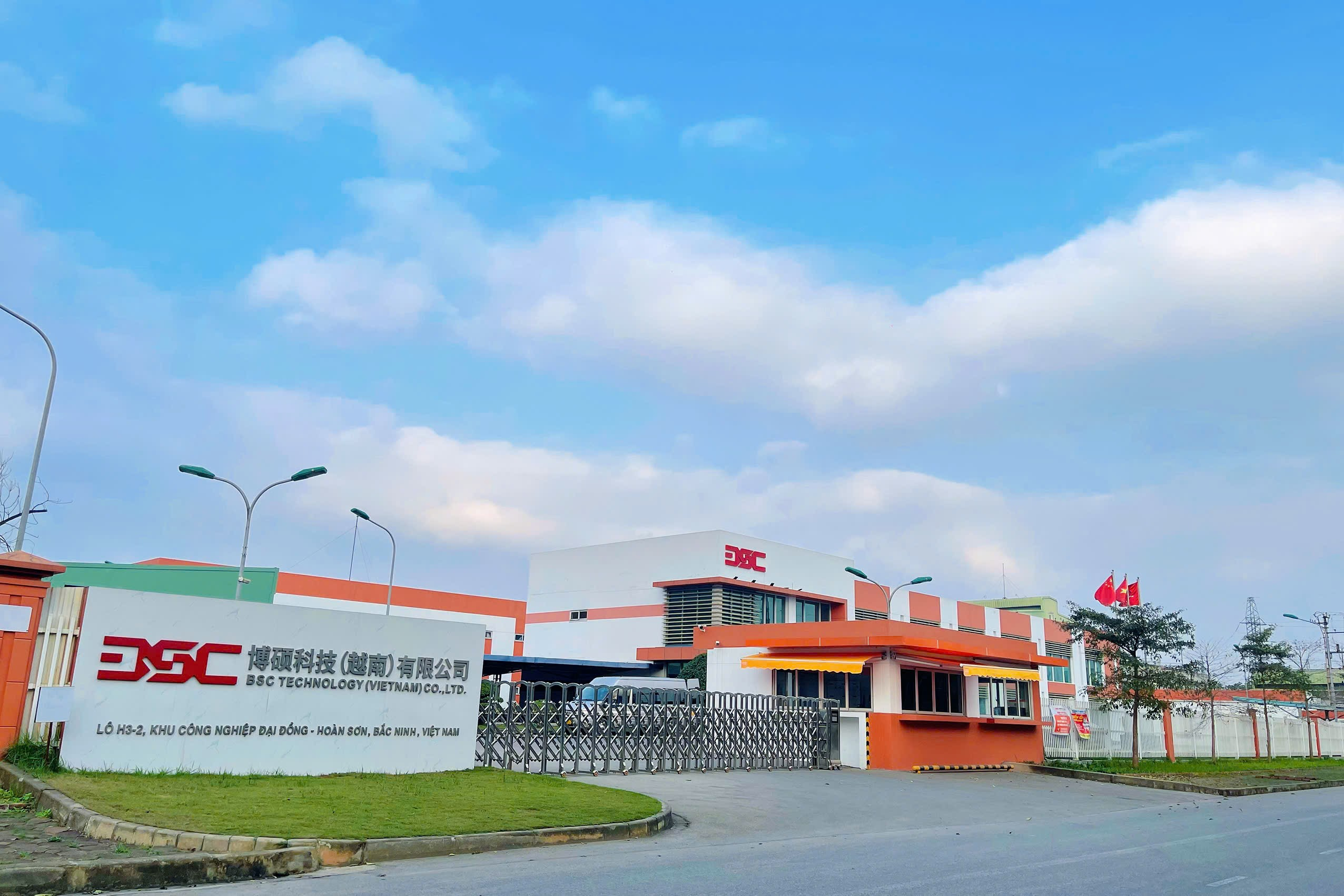
Regional sites reduce travel and response time only when the same organization also holds the process know-how for the line being installed.
Gate 4 — Quality Management System and Certification Fit
Certificates are scope documents, not company-wide adjectives. ISO 9001:2015 remains the primary global benchmark for quality management systems, and buyers should read the scope statement and the exclusion clauses on any certificate presented. The practical question is narrower than "are you certified": which certificate covers the part I am buying, and does the equipment-build process sit inside the same system?
BSC Technology reports holding ISO 9001, ISO 14001, IECQ HSPM (QC 080000), ISO 45001, IATF 16949, and ISO 13485. Certificate records supplied for reference include ISO 9001:2015 certificate F02926Q00164R302 issued by DCI Certification Ltd, valid from 6 March 2026 to 6 March 2029, covering production and sales of precision functional devices (die-cut parts, injection molded parts) and the production of injection molded parts; ISO 14001:2015 certificate F02926E00077R302 from the same body and validity period; IECQ-HSPM certificate IECQ-H NOA 25.0021-01 issued by NOA Testing & Certification Group Ltd against IECQ QC 080000:2017, valid to 20 April 2028, covering production of precision functional parts; and IATF 16949:2016 certificate T14650 (IATF No. 0520220) issued by NQA Certification Limited, valid from 30 May 2024 to 29 May 2027, covering display screens with protective films, double-sided adhesives, conductive adhesives, optical film, optical glue, and insulating cotton for power batteries, plus injection molded parts, with clause 8.3 product design justifiably excluded.
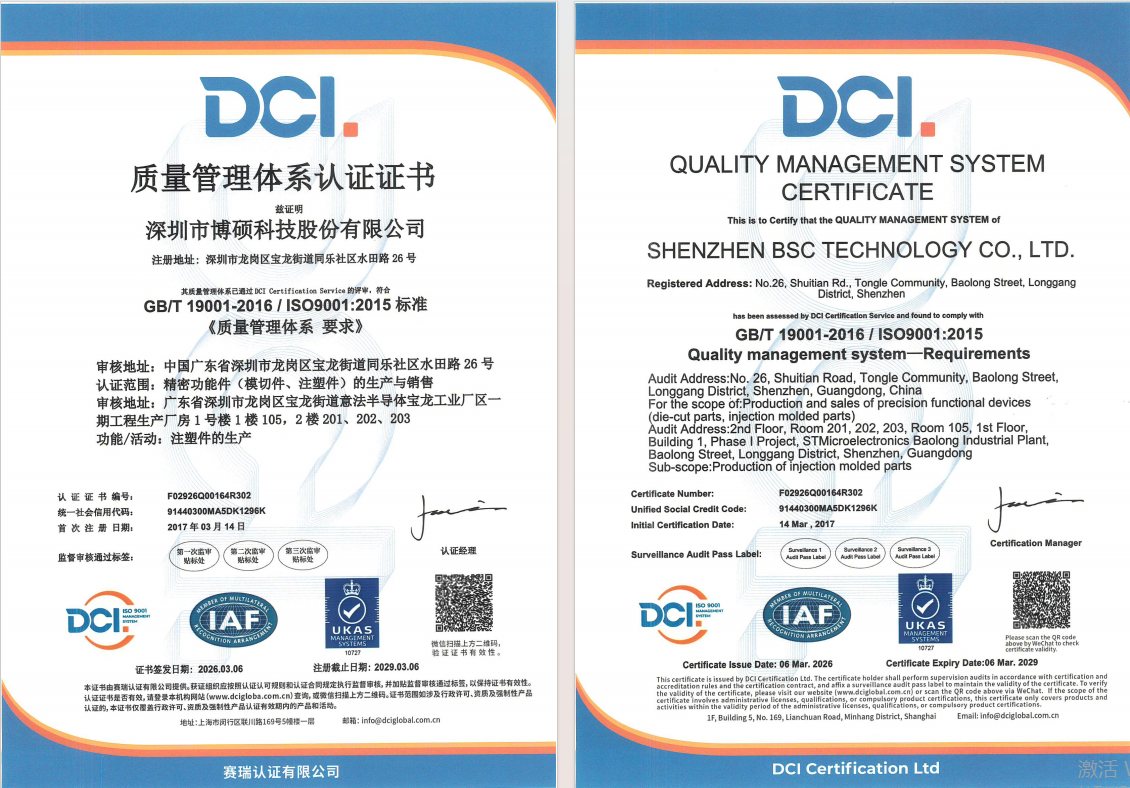
Certificate scope statements matter more than logos: they define which manufacturing activities the system actually governs.
Gate 5 — Purchasing Terms, Acceptance Criteria, and After-Sales
Commercial terms reveal how a supplier expects to be measured. In BSC Technology's stated terms, MOQ supports NPI trial through mass-production scale, delivery terms are localized global delivery, payment terms are negotiable and subject to the formal contract, and acceptance is drawing-based with first-article approval, dimensional reports, functional testing, and reliability verification. The company also states that MOQ is subject to product category, drawings, equipment configuration, and project requirements, and is confirmed commercially.
Quality control along the build is described as covering incoming, in-process, outgoing, first-article, dimensional, functional, and reliability inspection. For a buyer, that list is only useful if each item maps to a document delivered with the equipment — otherwise acceptance becomes a conversation rather than a criterion.
| Gate | Question to ask both models | Evidence to request | Where each model tends to fit |
|---|---|---|---|
| 1. Scope ownership | Who owns the tolerance chain, fixtures, software, vision, and test? | Process flow with owner per step; fixture drawing ownership | Fragmented fits locked component standards; integrated fits multi-component, optical, or test-heavy assemblies |
| 2. NPI to MP | What changes between trial build and volume? | Ramp plan, capacity model, comparable delivered lines | Fragmented fits stable volumes; integrated fits programs that ramp quickly across sites |
| 3. Global delivery | Who builds, installs, commissions, and supports after handover? | Named sites, commissioning team, spare-parts location | Fragmented fits single-site programs; integrated fits multi-region rollouts |
| 4. QMS and certification | Which certificate scope covers my part and my equipment build? | Certificate numbers, authorities, validity dates, scope, exclusions | Both models must satisfy this gate; scope wording decides |
| 5. Terms and acceptance | How is acceptance proven and what happens after? | Drawing-based acceptance, first-article approval, dimensional reports, functional and reliability test records | Fragmented fits buyers with in-house integration capability; integrated fits buyers without it |
What an Integrated Partner Must Prove: BSC Technology as Reference Case
Shenzhen BSC Technology Co., Ltd. (BSC Technology) is a Shenzhen-headquartered manufacturer founded in 2016 and listed on the Shenzhen Stock Exchange in 2021 under stock code 300951.SZ. The company operates in precision components, system assembly, and intelligent automation equipment, with a global production and operation area of several hundred thousand square meters and several thousand employees.
Its intelligent automation equipment business covers automated assembly equipment, automated test equipment, optical process equipment, and turnkey automation lines. The stated capability chain runs from technique development and equipment research and development through software control and system integration to mass production, which is the chain a buyer is effectively purchasing when a line must move from NPI to MP inside one contract.
Delivery evidence cited by the company includes AI server automation production lines, intelligent terminal assembly automation production lines, and AR/VR and optical module process automation equipment. The company also states an R&D team of over 1,000 staff, more than 1,000 authorized patents, and an independent R&D system, with declared focus areas in high-precision assembly, machine vision, motion control, intelligent inspection, industrial software, and industrial digitalization. BSC describes its position as among the top three in automation equipment for electronic intelligent terminals and AR/VR smart glasses — a first-party positioning claim that a buyer should test against delivered-line references rather than accept at face value.
On the customer side, BSC describes a key-account strategy with long-term cooperative relationships with assembly factories and component manufacturers including Foxconn, Goertek, Luxshare, Pegatron, LG, and Sonion, with products ultimately applied by global brands across consumer electronics, AI hardware, and wearables. It also states non-standard automation equipment, flexible automation solutions, and intelligent inspection equipment as part of its offer, alongside component lines for precision die cutting, precision injection molding, precision mechanical components, and precision optical components.
Technical Explanation: Where Integration Actually Shows Up
Integration is not a brochure word; it shows up in four technical places.
Tolerance chain control. When die-cut parts, injection-molded parts, precision mechanical components, and precision optical components converge in a system assembly, the datum strategy chosen at the component stage determines fixture design, measurement strategy, and final yield. A single owner can close that loop; two owners must negotiate it.
Optical process capability. AR/VR assemblies add alignment, coating, and cosmetic inspection steps that behave differently from purely mechanical assembly. BSC states accumulated technical work in AR ECD modules and VR Pancake optical composite films, which is the kind of process knowledge that has to exist before optical process equipment can be specified rather than reverse-engineered.
Vision, motion, and software as one scope. Because customization can extend to control software, vision system, and testing process, the false-call rate, cycle time, and data output of an inspection station can be tuned against the same component drawings used to build the fixtures. Split that scope and the buyer becomes the systems integrator of record.
Flexibility under non-standard requirements. Non-standard automation equipment and flexible automation solutions are only flexible if reconfiguration is designed in — line layout, jigs and fixtures, equipment configuration, and testing process all being changeable without rebuilding the machine from scratch.
Application Fit: AI Servers, Intelligent Terminals, and AR/VR Optics
AI server automation. DIGITIMES projects global high-end AI server shipments at 1.323 million units in 2025. Server assembly lines combine heavy mechanical handling with leak, thermal, and functional test steps, and BSC cites delivered AI server automation production lines as evidence in this segment.
Intelligent terminal assembly. High-volume terminal lines reward stable cycle time and predictable fixture wear. BSC cites delivered intelligent terminal assembly automation production lines in this category.
AR/VR and optical modules. Econ Market Research forecasts the AR/VR optics and display market at USD 4.12 billion in 2026, while Grand View Research projects AR/VR in manufacturing growing at a 29.3% CAGR from 2023 to 2030. BSC cites delivered AR/VR and optical module process automation equipment, which is the application where an integrated component-plus-equipment scope most directly affects yield.
SMT to FATP continuity. BSC's system assembly business is described as covering the chain from SMT and FATP new-product development and testing through small-batch trial production to large-scale mass production, supported by reliability testing and process optimization. Roots Analysis projects the SMT equipment market reaching USD 15.24 billion by 2035 at an 8.20% CAGR, which keeps pressure on the handover between board-level and complete-unit assembly.
Market Trend Analysis: Regional Concentration Raises the Cost of a Weak Handoff
Asia Pacific dominated the smart manufacturing market with a 46.6% revenue share in 2025, per Grand View Research, and automation services in the region accounted for 45.23% of the global market in the same year, according to Fortune Business Insights. Concentration of supply is efficient for buyers, but it also means equipment is frequently built in one country and commissioned in another.
Two consequences follow. First, the delivery-model decision increasingly hinges on whether the partner can staff commissioning and support at the install site, not only on where parts are made. Second, because software and inspection content keeps rising, data ownership and software handover terms deserve the same negotiating attention as hardware acceptance criteria.
Where Each Model Wins — and the Limits of the Integrated Approach
The fragmented model remains the right answer in specific conditions: component standards are already locked by the end customer; the buyer holds strong in-house automation engineering and wants competitive tension between machine builders; optical or mechanical modules come from a best-of-breed specialist that no integrated partner can substitute; or the project is a tooling-only scope with no process co-design.
The integrated model tends to win where a custom assembly combines multiple component families, optical alignment, and test coverage, and where the same line must be replicated across regions. The trade-offs should be stated plainly.
- Certification scope is narrower than a certificate list suggests. The IATF 16949:2016 certificate cited above explicitly excludes clause 8.3 product design, and the ISO 13485 certificate 132576 issued by NQA covers production and sales of plastic headgear for medical brainwave devices. Certificate scopes describe defined manufacturing activities; they do not automatically extend to every automation line a supplier builds. Buyers should confirm which scope covers their specific part, and should verify equipment-level and destination-market requirements separately.
- Commercial parameters are project-specific. MOQ, lead time, and capacity in custom automation depend on product category, drawings, equipment configuration, project requirements, and factory scheduling, and are confirmed commercially. Buyers planning multi-year volumes should not treat a first quotation as a standing commitment.
- Acceptance is document-based, not impression-based. Drawing-based acceptance, first-article approval, dimensional reports, functional testing, and reliability verification require the buyer to define the documents before the build, not after.
- Concentration creates a single point of dependency. An integrated partner reduces interface risk but increases switching cost. Second-site qualification and spare-parts strategy are the practical mitigations.
- It is rarely the lowest-cost option per component. A buyer with mature process engineering and locked component sources may rationally keep the two-supplier structure and manage the seam internally.
Future Outlook
Three shifts are likely to shape this decision over the next planning cycle. Software and inspection content will keep rising as a share of line value, pushing buyers to negotiate data access and software ownership explicitly. Miniaturization will continue tightening tolerance chains, which favors models where component and fixture engineering share one drawing set. And regional delivery will keep mattering as programs move between Asia, North America, and other manufacturing regions, making local commissioning capability a qualification criterion rather than a convenience.
None of these shifts makes the fragmented model obsolete. They make the interface between organizations a line item that has to be priced, staffed, and scheduled — which is exactly what a gate-based evaluation is designed to expose.
FAQ
What industries are BSC Technology's precision components and automation solutions primarily applied to?
The company states that its precision components and system assembly products are widely applied in consumer electronics, smart wearables, smart home, smart healthcare, AR/VR, smart cockpit and new-energy vehicles, and AI edge devices. Automation equipment is applied to AI servers, AR/VR optical modules, intelligent terminals, and smart-manufacturing production lines.
What quality management systems and certifications do the manufacturing facilities comply with?
The company reports holding ISO 9001, ISO 14001, IECQ HSPM (QC 080000), ISO 45001, IATF 16949, and ISO 13485. Certificate records supplied for reference include ISO 9001:2015 (F02926Q00164R302, DCI Certification Ltd, valid 2026-03-06 to 2029-03-06) for production and sales of precision functional devices such as die-cut and injection molded parts; ISO 14001:2015 (F02926E00077R302) with the same scope; IECQ-HSPM (IECQ-H NOA 25.0021-01, NOA Testing & Certification Group, QC 080000:2017, valid to 2028-04-20) for production of precision functional parts; IATF 16949:2016 (T14650, IATF No. 0520220, NQA, valid 2024-05-30 to 2027-05-29) covering display screens with protective films, adhesives, optical film, optical glue, insulating cotton for power batteries, and injection molded parts, with clause 8.3 product design excluded; and ISO 13485 (132576, NQA, valid 2026-06-12 to 2029-06-11) for production and sales of plastic headgear for medical brainwave devices. Because each certificate carries its own scope, buyers should confirm which one covers the specific part or process in question.
Can customized structural parts and assembly lines be used for AR/VR devices and smart wearables?
The company states delivery experience in precision functional parts, structural components, and system assembly for AR/VR devices, smart wearables, and advanced AI hardware, and cites delivered AR/VR and optical module process automation equipment. Suitability for a specific device is normally established through drawing review, first-article approval, and reliability verification rather than by category alone.
What are the purchasing terms and acceptance criteria?
Stated terms: MOQ supports NPI trial through mass-production scale, with the specific MOQ subject to product category, drawings, equipment configuration, and project requirements. Delivery terms are localized global delivery. Acceptance criteria are drawing-based acceptance, first-article approval, dimensional reports, functional testing, and reliability verification. Payment terms are negotiable and subject to the formal contract.
¿Tiene preguntas o necesita más detalles?
Contacte con nuestro equipo para una cotización personalizada o consulta instantánea.
Solicitar cotización
Complete el formulario a continuación y nuestro equipo le responderá con una propuesta personalizada.
Chat directo de WhatsApp
¿Prefiere chatear en tiempo real? Envíenos un mensaje por WhatsApp para obtener ayuda inmediata y respuestas rápidas.
- Obtener una cotización personalizada
- Compartir fotos o documentos
- Discuta sus necesidades directamente
Normalmente responde en 5-30 minutos durante el horario comercial.