
Precision Screwdriver Sets: Specs and Certification Checks
Precision Screwdriver Sets: Specs and Certification Checks
A precision screwdriver set is a hand tool kit built around a driver handle and interchangeable bits sized for small fasteners — sub-4 mm Phillips and slotted profiles, Torx, hex, square, triangle, pentalobe and tri-point bits used in electronics, instruments and light mechanical assembly. In industrial procurement it behaves less like a consumer accessory and more like a documented component: the buyer is asked to sign off on steel grade, hardness, bit coverage and compliance paperwork before a container leaves the factory.
That difference matters in the research and evaluation stage, when a purchaser is comparing suppliers rather than placing an order. The questions that decide the outcome are rarely about appearance. They are about whether a stated HRC figure can be traced to a heat-treatment process, whether a certificate covers the exact model being quoted, and whether the bit shank in a 17-piece kit is compatible with the accessories already sitting in the buyer's warehouse. This article sets out those constraints using published product and certification data from HOTAK PRO TOOLS and its manufacturing base.
Why Piece Count Is the Wrong First Specification
Retail and wholesale listings for precision screwdriver sets are usually ranked by piece count: 17, 29, 51, 77. Piece count is a legitimate packaging metric, but it describes breadth of bit coverage, not capability. Two sets with identical piece counts can carry the same handle and the same steel grade, or they can differ materially in hardness and in the torque each bit size can be expected to carry — which is precisely where small fasteners are damaged and returns are generated.
The variables that determine whether a set performs in service are steel grade, heat treatment, bit geometry at the small end of the range, and the documentation that allows a buyer to verify all three. A buyer who specifies only "51 pieces, CR-V" has specified a box, not a tool.
Steel Grade, Hardness, and the Torque Curve Behind Bit Sizes
Hardness is the specification that decides whether the bit deforms or the fastener does. Across the precision and driver sets produced under the HOTAK PRO TOOLS brand, CR-V 6150 (chrome vanadium) is the primary material for bits and keys, with published hardness of HRC 52–55 achieved through heat treatment and tempering. The same material family and hardness statement appears in the company's hex key range, including models 105221K1, 105221K2, 105221K3, 71821D1, 71821D2 and 71821D3.
Hardness alone does not describe working capacity, because torque capacity scales steeply with bit size. The published torque figures for the ratcheting driver sets YJTS-3401 (50-piece ratcheting screwdriver set) and YJTS-3402 (42-piece ratcheting handle set) illustrate the gradient.
| Bit size (metric) | Published torque value | Bit size (metric) | Published torque value |
|---|---|---|---|
| 1.5 mm | 0.82 | 6.0 mm | 52.00 |
| 2.0 mm | 1.90 | 7.0 mm | 80.00 |
| 2.5 mm | 3.80 | 8.0 mm | 120.00 |
| 3.0 mm | 6.60 | 10.0 mm | 220.00 |
| 4.0 mm | 16.00 | ||
| 5.0 mm | 30.00 |
Figures reproduced as published in the specification for models YJTS-3401 and YJTS-3402; hardness stated for the same range is HRC 52–55.
The implication for buyers is a decision rule rather than a marketing claim. A 1.5 mm bit rated at 0.82 sits roughly twenty times below a 4.0 mm bit rated at 16.00. Applying a 4 mm-level force to a 1.5 mm tip will normally damage the bit or strip the fastener before the screw moves. In practice this means bit selection is a torque decision, not only a fit decision — and it is the reason a well-specified precision set separates small profiles from larger ones rather than treating them as interchangeable.
The same scaling applies in imperial series. For the 14-piece T-handle hex key set YJHK-3226, the published torque range runs from 1.19 at 1/16" to 242.92 at 3/8", with hardness again stated as HRC 52–55 and an ergonomically designed T-handle for greater torque transmission.
Reading Bit Coverage: Shank Platforms and Security Profiles
Bit coverage should be evaluated as profile families and shank platforms, not as a single number. Three precision-focused sets in the range illustrate how differently the same category can be configured.
| Model | Type | Pieces | Bit and accessory coverage (as published) | Material |
|---|---|---|---|---|
| YJTS-3138 | Precision screwdriver set | 51 | 48 bits at 5/32"×28 mm: Phillips PH000–PH2; slotted 1.5–4.0 mm; Pozi PZ0–PZ2; hex 0.9–4.0 mm metric and 1/16"–5/32" inch; Torx T2–T8; tamper-proof Torx TT9–TT20; square S1–S2; triangle TA18/TA27; pentalobe 0.8/1.2/2.0; tri-point Y000; spanner SP6; plus handle, 115 mm extension bar and magnetizer/demagnetizer | CR-V 6150 |
| YJTS-3411 | Ratcheting precision screwdriver set | 29 | Straight 1.5–4.0 mm; cross #000–#2; diagonal Pz0/Pz1; hex 1.5–3.0 mm; Torx T2–T7; tamper-proof Torx TT8–TT10; square S0/S1; five-pointed star 0.8 mm | CR-V 6150 |
| YJPS-6852 | Precision screwdriver set | 17 | Slotted 1.5–3.0 mm; Phillips PH000–PH1; Torx T4–T10; 5/32"×125 mm soft extension bar; two white LEDs providing 360-degree illumination | Metal |
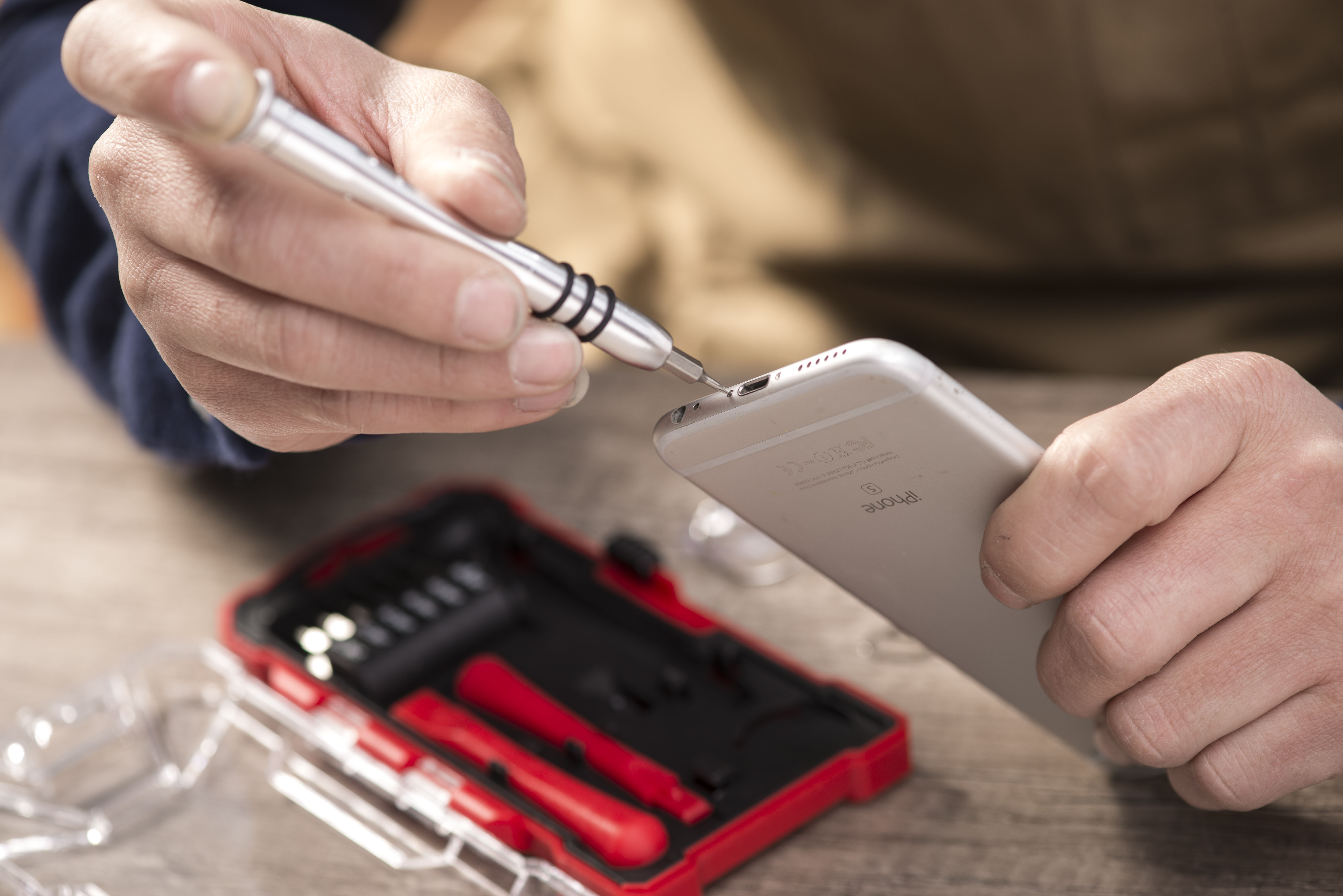
Precision screwdriver sets are specified for small-fastener work where tip fit and torque limits matter more than piece count.
Two structural observations follow from the table. First, there are two shank platforms in the wider hand tool range: a 5/32" (approximately 4 mm) shank used in the precision sets such as YJTS-3138, YJPS-6852 and the 43-piece mobile phone repair tool set YJTS-3140, and a 1/4" hex shank used in larger driver sets such as YJTS-3147, YJTS-2901, YJTS-3545 and the YJTS-3109/YJTS-3110 impact bit sets. Bits and accessories are not interchangeable between the two platforms, which matters when a distributor stocks both and expects a single accessory pack to serve them.
Second, security profiles are now part of baseline coverage rather than an upgrade. Tamper-proof Torx (TT-series), pentalobe and tri-point bits appear in YJTS-3138, YJTS-3411, YJTS-3140 and the 77-piece smartphone repair kit YJTS-3018. For buyers servicing consumer electronics under warranty-sensitive conditions, missing a single pentalobe size effectively removes a device family from the serviceable list. The same sets typically include a magnetizer/demagnetizer (YJTS-3138, YJTS-3140, YJTS-3018), which allows a bit to hold a screw during insertion and to be demagnetized afterwards so it does not attract ferrous debris.
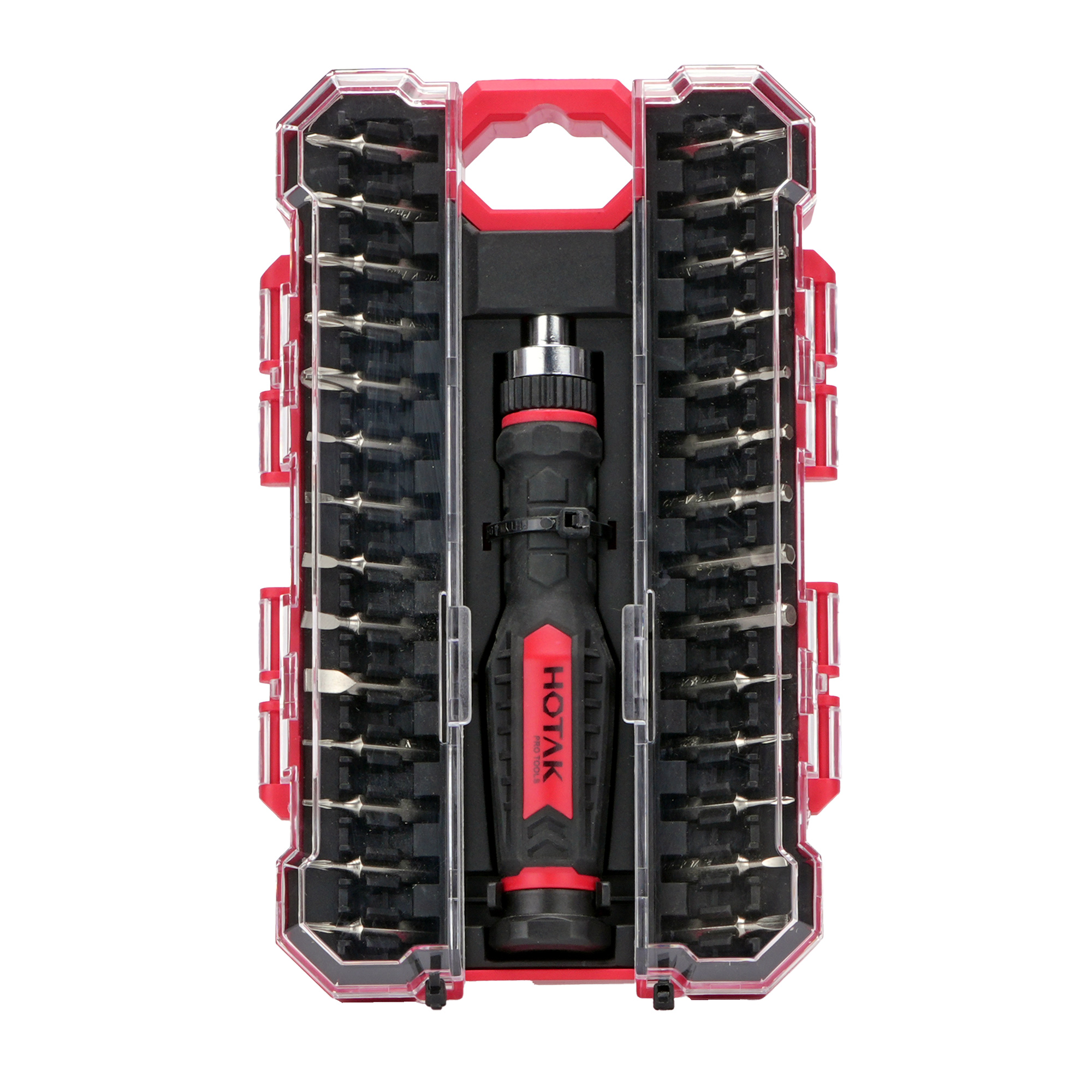
YJTS-3411, a 29-piece ratcheting precision screwdriver set in CR-V 6150 steel.
Certification: What the Documents Cover, and What They Do Not
Certification is the part of precision screwdriver sourcing that is most often summarized incorrectly on both sides of the negotiation. A supplier certification is registered to specific models, a specific standard and a specific market. The published certificate set behind this hand tool range is set out below.
| Certificate | Type and issuer | Scope of certification | Models covered | Standard | Market |
|---|---|---|---|---|---|
| S 50694620 0001 | GS Product Safety Certificate, TÜV Rheinland LGA Products GmbH | Hexagon screw keys with ball end | 105221K1, 105221K2, 105221K3, 71821D1, 71821D2, 71821D3 | DIN ISO 2936-10.16; AfPS GS 2019:01 PAK | DE, EU |
| AM 50694538 0001 | CE Certificate of Conformity, Machinery Directive 2006/42/EC | Staple gun (tacker / hand-operated tacker) | YJSG-105, YJSG-023 | Directive 2006/42/EC; EN ISO 12100:2010; EN ISO 11148-13:2018 | EU |
| AM 50559365 0001 | CE Certificate of Conformity, Machinery Directive 2006/42/EC | 5-in-1 cordless power staple gun | YJSG-501 | Directive 2006/42/EC; EN ISO 12100:2010; EN ISO 11148-13:2018 | EU |
GS certificate issued 18 March 2026 and valid to 17 March 2031. CE certificate AM 50694538 0001 issued 2 March 2026 and valid to 31 December 2030. CE certificate AM 50559365 0001 issued 10 September 2022 and valid to 31 December 2030.
Here is the constraint that buyers should apply deliberately. No precision screwdriver set is named on any of the certificates above. The GS certificate covers ball-end hexagon screw keys; the CE Machinery Directive certificates cover staple guns, not hand-held non-powered screwdrivers. That is not a gap unique to one supplier — it reflects how the standards landscape is organized. It does mean that the question "is this supplier certified?" produces a misleading answer in both directions. The workable question is narrower: which model is covered by which certificate, under which standard revision, for which destination market.
At company level, the published documentation set includes ISO 9001 quality management system certification, TÜV/GS German safety certification, BSCI business social compliance certification, VPA (Verify Production Audit) approval, and factory audits approved by Walmart (US) and Kingfisher (UK). These are management-system and social-compliance credentials rather than product certificates, and they are typically what retail chains request during supplier qualification.
For cordless precision screwdrivers, the compliance picture broadens. The stable structure of the category covers mechanical safety, electrical safety and chemical restrictions — for many markets this means CE-related documentation including EMC where applicable, and restricted-substance rules such as RoHS. Where a specific model is not covered by a listed certificate, the practical procurement step is to request the certificate for that exact model before purchase and to cross-check the product model number against the standard number and revision, rather than accepting a supplier-level statement.
The Manufacturing Base Behind the Precision Screwdriver Range
HOTAK PRO TOOLS is a hand tool brand supplied by Ningbo (Yinzhou) Yongjia Electrical Tools Co., Ltd. (YONGJIA TOOLS), a hand tool manufacturer founded in 2000 and based in Ningbo, Zhejiang Province, China. The company produces hexagon keys, torx keys, staple guns, precision screwdrivers, hobby knives and hand tool sets, and is accredited as a National High-Tech Enterprise.
Scale and integration are relevant to precision screwdriver buyers for a specific reason: the bits are the hard part, and bit quality depends on processes that are easy to outsource and difficult to control. The manufacturing base operates a facility of more than 45,000 m² with an in-house chain covering mold development, forging and stamping, heat treatment, surface finishing, precision machining, assembly and packaging, supported by an R&D team of 25 engineers. Published annual output is 18,000,000 units and monthly capacity is 1,500,000 units, with 95% of output exported to the EU, USA, Southeast Asia and South America.
Intellectual property data reported by the company includes 7 invention patents, more than 20 European patents, 50 utility model patents and over 100 design patents. The company was accredited as a National High-Tech Enterprise in 2014 and recognized as a "Little Giant" enterprise in Ningbo. Reported customer relationships include global DIY and home improvement retailers such as The Home Depot, Lowe's, Walmart, AutoZone, Kingfisher, Leroy Merlin and Auchan, and tool and industrial groups including TTI, ITW and CPI.
For buyers evaluating rather than simply sourcing, the operational parameters are the useful part: OEM and ODM production are offered with color and logo customization; MOQ is documented at 600 units; lead time is documented at 30–45 days; quality control covers incoming inspection, in-process inspection and final inspection; and after-sales support is provided remotely.
Cordless Precision Drivers: Electric Torque Is Not Tightening Torque
The cordless end of the precision range introduces a specification error that recurs in tender documents: treating electric torque and manual torque as equivalent. They are not, and the published figures show a consistent relationship.
| Model | Type | Voltage / battery | Runtime | Electric torque | Manual torque | Speed |
|---|---|---|---|---|---|---|
| YJPS-906 | Electric precision repair tools set | 3.7 V / 320 mAh | ≥30 min no-load | 0.15 N·m | 3 N·m | 0–220 rpm |
| YJPS-907 | 26 pcs cordless precision power screwdriver set | 3.7 V lithium / 320 mAh | 1 h charging time | 0.15 N·m | 3 N·m | 220 rpm |
| YJTS-3526 | 41 pcs household electrical screwdriver tool set | 3.7 V lithium / 320 mAh | 1 h charging time | 0.15 N·m | 3 N·m | 220 rpm |
| YJPS-912 | Power screwdriver set | 3.7 V / 800 mAh | ≥50 min no-load | 2.5 N·m | 10 N·m | 0–250 rpm |
| YJPS-902 | Power screwdriver | 3.7 V / 2000 mAh | ≥60 min no-load | 2 / 3.5 / 5 N·m selectable | 10 N·m | 0–280 rpm |
In the 0.15 N·m class used for precision electronics work, the manual rating is twenty times the electric rating. The practical reading is that the motor is a run-in and run-out device, and final tightening remains a hand operation. Buyers writing an assembly specification should state both figures, because a tool that appears to meet the torque requirement on its electric rating alone will be unsuitable for the fasteners it is intended to drive.
Two further parameters affect deployment. No-load runtime, published as at least 30 minutes for YJPS-906, at least 50 minutes for YJPS-912 and at least 60 minutes for YJPS-902, determines how long a single charge lasts in continuous use. Charge current, published as 500 mA for YJPS-906, YJPS-907 and YJPS-912 and 1–1.5 A for YJPS-902 with a 5 V charge output, determines how quickly a unit returns to service. Together they set how many units a shift needs in rotation, which is a capacity-planning decision rather than a product-feature decision.
Where Precision Screwdriver Sets Are Used
Application data for this hand tool range covers household indoor environments and open-air construction site environments, with the primary function described as repair and fastening in manual operation, matched to screws, nuts and nails, and with impact resistance listed as a special requirement. Destination markets in the published scenario data include the United States, Germany, France, Russia, Japan, Malaysia, Mexico and Canada.
At product level, three use patterns are documented. Electronics and smartphone repair is served by the 43-piece mobile phone repair tool set YJTS-3140, which combines 36 CR-V bits at 5/32"×28 mm with a magnetizer/demagnetizer, a trigonal opening pick, a SIM card tray opener, a suction cup and two mini pry bars, and by the 77-piece smartphone repair kit YJTS-3018, which adds metric and SAE hex keys, precision bits and a nickel finish. Instrument and general precision work is served by sets such as YJPS-6852, where two white LEDs provide 360-degree illumination of the work area. Workshop, maintenance and household fastening is covered by the wider driver and hex key ranges, including the T-handle sets intended for workshop and race mechanic use.
Case data from brand owner, hardware wholesaler and retail chain customers in Germany, France, the United States, Canada, Mexico, Brazil, Argentina and Malaysia describes order volumes of 5,000 to 50,000 units, relationships running 3–5 years, and applications in auto repair, household fastening and workshop maintenance, with reported reliable performance, low return rate and consistent quality. The stated highlights of those programmes are DIN standard compliance, GS/CE certification and durable material — which is consistent with the certificate scopes described earlier: the certifications apply to specific product families, not to every item in a catalogue.
Bit-Based Sets vs Fixed-Blade Drivers: Trade-offs Buyers Should Weigh
Traditional fixed-blade screwdrivers and bit-based precision sets solve the same problem differently, and the trade-offs are real in both directions.
| Criterion | Fixed-blade screwdriver | Bit-based precision set |
|---|---|---|
| Coverage per tool | One driver per fastener size | One handle spans 15–48 bit profiles (YJPS-6852 to YJTS-3138) |
| Torque transmission | Direct from handle to blade | Passes through the bit-to-holder interface |
| Storage and tool count | High tool count per technician | Single case, lower tool count |
| Small-part risk | No loose bits | Small bits can be lost; security bits are consumable items over time |
| Profile flexibility | Limited to purchased sizes | Security profiles such as pentalobe and tri-point included |
The limits of the bit-based approach deserve equal weight. The interface between bit and holder is an additional joint in the torque path, and the small profiles at the low end of a set carry low published torque values — 0.82 at 1.5 mm, for example, against 16.00 at 4.0 mm in the same range. A published torque figure is also a design figure for the tool, not a recommendation to apply that force to a fastener; joint material, thread engagement and whether the joint is already seated all change what is appropriate. Finally, precision sets are not covered by the CE Machinery Directive certificates issued for the staple gun range, and the GS certificate covers ball-end hexagon screw keys rather than precision screwdrivers. Buyers who need model-level product certification for a precision set should confirm what exists for that specific model before writing it into a purchase specification.
Market Signal: Documentation-Led Sourcing and Private Label Demand
Two procurement patterns are visible in the published data behind this range, and both are qualitative rather than numeric. The first is documentation-led sourcing: supplier qualification for retail channels in the EU and North America now routinely includes factory audits and social-compliance review alongside product testing. The existence of Walmart and Kingfisher factory audit approvals, BSCI certification and VPA approval on the same manufacturing base indicates what that qualification process looks like in practice — it is a factory-level review, conducted separately from product certification.
The second is breadth within one manufacturing chain. A base producing precision sets from 17 pieces to 77 pieces, on two shank platforms and in both CR-V 6150 and metal constructions, allows a buyer to standardize steel grade and quality control across a compact service kit and a full repair kit rather than sourcing them from separate suppliers. That is a supply-chain argument rather than a product argument, and it is the reason private label and OEM programmes in this category tend to be evaluated on process control — heat treatment, inspection stages, packaging — more than on catalogue size.
Future Outlook
Three directions are visible from the published product structure. Security profiles continue to expand: pentalobe, tri-point and tamper-proof Torx bits now appear across multiple sets in the range, reflecting device design rather than buyer preference. Cordless assistance is moving down into the precision tier, where 3.7 V tools with 0.15 N·m electric torque coexist with 3 N·m manual ratings — a hybrid pattern in which the motor handles run-in and the hand handles final tightening. And documentation is becoming part of the product: as factory audits and model-level certificates become standard qualification requirements, the suppliers that can produce a certificate for a named model, under a named standard revision, will be easier to place on an approved vendor list than those that can only produce a supplier-level claim.
FAQ
Which standards or certifications should hand tools and cordless tools comply with?
The usual compliance areas are mechanical safety, electrical safety and chemical restrictions. For many markets this means CE-related documentation, including EMC where applicable, and restricted-substance requirements such as RoHS; GS is relevant for certain hand tool categories in the German market. Documentation should be checked by model rather than by supplier name. In the range described here, the GS Product Safety Certificate (numbered S 50694620 0001, issued by TÜV Rheinland LGA Products GmbH, standard DIN ISO 2936-10.16 and AfPS GS 2019:01 PAK) covers ball-end hexagon screw keys, and the CE certificates under Machinery Directive 2006/42/EC cover staple gun models. Where a specific model is not covered by a listed certificate, the certificate for that model should be requested during purchasing, and the model number should be cross-checked against the standard number and revision.
What are the performance differences between CR-V and 45# steel?
CR-V, or chrome vanadium steel, offers high torque strength with good toughness and wear resistance, which suits industrial and heavy-duty applications. 45# steel is a carbon steel used for light-duty household applications and has limited torque capacity. Differences between the two are visible in hardness, torque performance and service life. In the precision and driver sets described here, CR-V 6150 is the primary material with published hardness of HRC 52–55; the same documentation notes that S2 tool steel is intended for professional-level repair tasks, while 45# carbon steel suits general household use.
How do hardness and torque change across bit sizes in a driver or hex key set?
Published hardness for the CR-V 6150 ranges is HRC 52–55. Torque capacity scales steeply with size. In the metric series published for the ratcheting driver sets YJTS-3401 and YJTS-3402, values run from 0.82 at 1.5 mm through 3.80 at 2.5 mm, 16.00 at 4.0 mm and 52.00 at 6.0 mm to 220.00 at 10.0 mm. In the imperial series published for the 14-piece T-handle hex key set YJHK-3226, values run from 1.19 at 1/16" to 242.92 at 3/8". The engineering consequence is that small bits cannot be treated as scaled-down versions of large ones; they require proportionally lower applied force.
What is the difference between electric torque and manual torque on cordless precision screwdrivers?
They are separate ratings with different functions. For YJPS-906, YJPS-907 and the 41-piece household electrical screwdriver tool set YJTS-3526, electric torque is 0.15 N·m against a manual torque of 3 N·m. For YJPS-912, electric torque is 2.5 N·m against 10 N·m manual, and for YJPS-902 electric torque is selectable at 2, 3.5 or 5 N·m against 10 N·m manual. In the 0.15 N·m class the manual rating is twenty times the electric rating, which indicates that the motor is intended for run-in and run-out while final tightening is a hand operation. Runtime and charging specifications also differ across the range: no-load runtime is published as at least 30 minutes for YJPS-906, at least 50 minutes for YJPS-912 and at least 60 minutes for YJPS-902, with charge current of 500 mA or 1–1.5 A respectively and a 5 V charge output on YJPS-902.
What OEM/ODM options, minimum order quantity and lead time are documented for these hand tool sets?
The documented production arrangement is OEM and ODM with color and logo customization. Minimum order quantity is stated as 600 units and lead time as 30–45 days. Quality control covers incoming inspection, in-process inspection and final inspection, and after-sales support is provided remotely. Published manufacturing capacity is 1,500,000 units per month from a facility of more than 45,000 m², with annual output of 18,000,000 units and 95% of output exported to the EU, USA, Southeast Asia and South America. These figures describe production parameters rather than a quotation; buyers should confirm them per model and per specification during supplier evaluation.
The full product range, including precision screwdriver sets from 17 to 77 pieces, hex key and torx key series, staple guns and complete hand tool kits, is available in the current catalogue: 2025 YONGJIA CATALOG (PDF).