
Pre Insulated Pipe Purchase Terms vs Acceptance Criteria
: A Buyer Decision Framework
District heating and district cooling networks are expanding, and with them the number of pre insulated pipe offers a single buyer must evaluate in one procurement cycle. Most of those offers arrive in incompatible formats: one supplier prices carrier pipe by the metre and treats joints as a separate line, another prices complete assemblies, and a third cites a standard without stating the dimensional range the certificate actually covers. This article sets out a buyer-side framework for comparing pre insulated pipe purchase terms against acceptance criteria, so that a shortlist is built from documented evidence rather than from unit price alone.
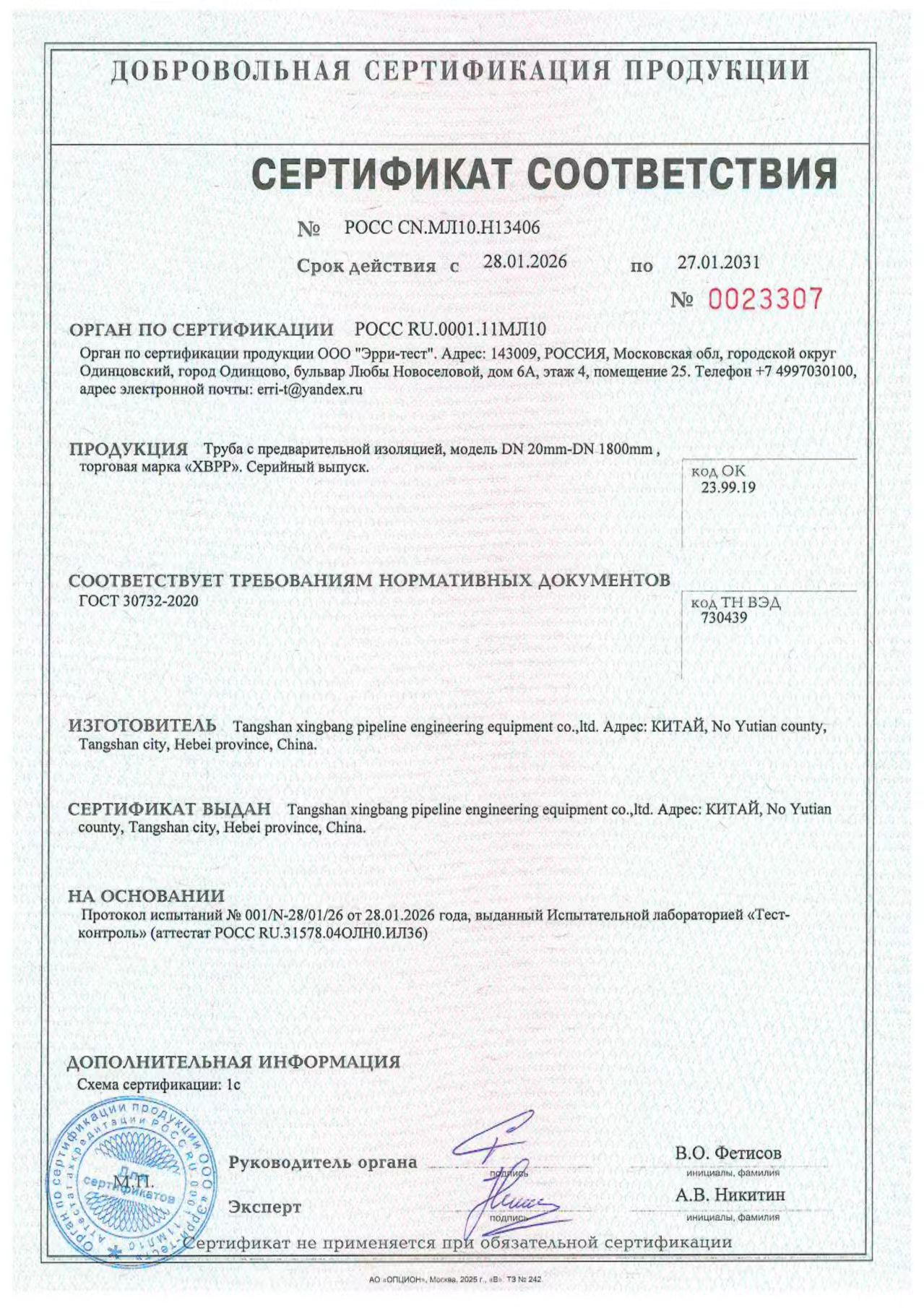
Conformity documentation is a core part of pre insulated pipe acceptance criteria. Buyers should verify certificate scope, standard reference and validity period, not only the presence of a certificate number.
Why two pre insulated pipe quotes resist side-by-side comparison
A pre insulated pipe quotation is not a price. It is a bundle of commercial terms and acceptance criteria, and unless both halves are written down in a common format, two offers for the same nominal diameter cannot be ranked. This is the structural problem behind most shortlist disagreements between procurement, engineering and the project owner.
The two halves behave differently. Commercial terms define the transaction: quantity basis, minimum order quantity, lead time, price basis, delivery terms and payment structure. Acceptance criteria define the product: the reference standard, carrier pipe material and dimensions, insulation material and thickness, jacket type, operating envelope, and the test and documentation regime that proves the delivered goods match the order.
A quote can look complete and still be uncomparable. A certificate may be genuine but cover a narrower diameter range than the ordered pipe. A price may appear lower only because fittings, joints or a jacket upgrade were excluded. The buyer's task is not to choose the cheapest document; it is to normalise documents first, then compare.
A four-layer buyer comparison framework
The practical way to compare pre insulated pipe offers is to evaluate them layer by layer — scope, acceptance, commercial terms, and service — and to score only after every layer has been documented in writing. Scoring before normalisation simply converts inconsistent inputs into confident but unreliable numbers.
| Layer | What it covers | Evidence to request | Where offers usually diverge |
|---|---|---|---|
| 1. Scope | Carrier pipe, insulation, jacket, fittings, joints, spares, quantity basis | Bill of materials, dimension list, joint and fitting schedule | Fittings and joints excluded from the unit price |
| 2. Acceptance | Standard reference, materials, dimensional range, operating envelope, test regime | Certificate scope, test records, material documentation | Certificate scope narrower than the ordered diameter range |
| 3. Commercial terms | MOQ, lead time, price basis, payment, delivery terms | Written terms inside the quotation, not in a side email | Delivery basis and MOQ tiers stated differently by each supplier |
| 4. Service | Documentation, on-site support, escalation, lifecycle handling | Service description, named responsibilities, contact path | Site responsibilities left undefined on both sides |
Layer 1 — Scope definition: what the quote actually covers
Scope is the layer where the largest apparent price differences originate, and the layer buyers most often leave implicit. A comparable pre insulated pipe offer should separate carrier pipe, polyurethane insulation, outer jacket, fittings, joints and spares into distinct lines. Two offers for the same nominal diameter can also cover different jacket types — for example a high density polyethylene jacket for directly buried sections versus a galvanized iron jacket for above-ground runs — and those are not interchangeable scopes.
The scope question to settle in writing is simple: if the pipe is delivered exactly as described in this quotation, how much of the finished network is still missing? Every item that remains missing belongs in the comparison, whether or not it appears in the price column.
Layer 2 — Acceptance criteria: standards, materials and test records
Acceptance criteria are the measurable conditions the delivered pipe must satisfy before the buyer accepts it. For directly buried hot water networks, EN 253 is the industry standard for pre-insulated bonded pipe systems, and EN 448 covers the associated fittings. Where Russian market acceptance applies, GOST 30732-2020 defines the conformity requirement. Where American steel pipe specifications are referenced, ASTM A53 is the primary standard for seamless and welded black and hot-dipped galvanized steel pipe.
Material and operating envelope belong in the same layer. Polyurethane foam insulation for EN 253 pipes typically withstands temperatures up to 120°C. A comparable envelope stated by a manufacturer is a conveyed-medium temperature no higher than 120°C, an occasional peak not exceeding 130°C, and a working pressure of no more than 2.5 MPa, with continuous operation at 120°C for at least 30 years. Buyers should compare quoted envelopes against the actual network design, not against each other.
| Reference | Stated scope | Market | Issuing or defining body |
|---|---|---|---|
| EN 253 | Pre-insulated bonded pipe systems for directly buried hot water networks | EU | European Committee for Standardization |
| EN 448:2019 / EN 253:2019 Certificate ICR Polska/VC/HS220608 | Polyurethane pre-insulated pipes DN20 mm – DN1800 mm | EU | ICR Polska Co. Ltd (valid to 2027-06-23) |
| ГОСТ 30732-2020 Certificate РОСС CN.MJI10.H13406 | DN20 mm – DN1800 mm | Russian Federation | Эрри-тест (valid to 2031-01-27) |
| ISO 9001:2015 / GB/T 19001—2016 Certificate 02807Q10270R6M | Production of pre-insulated pipes DN1600 mm and below; construction of pipeline insulation projects | EU, Russia, Southeast Asia, Middle East, Americas, Australia | Beijing Zhong'an Quality & Environment Certification Center Co., Ltd. (valid to 2027-02-10) |
| ASTM A53 | Seamless and welded black and hot-dipped galvanized steel pipe | United States | ASTM International |
The comparison rule that follows from this table is straightforward: acceptance criteria should be matched on three attributes at once — standard, diameter range and market validity — before any commercial comparison begins.
Layer 3 — Commercial terms: MOQ, lead time and price basis
Commercial terms determine whether an accepted specification can actually be delivered on the project schedule. Typical manufacturer terms for polyurethane pre insulated pipe include a minimum order quantity of 1 km, a lead time of 30–45 days, and a monthly capacity of 200 km. A manufacturer operating a 310,000 m² facility with more than 3,000 km of annual insulation pipe capacity can absorb phased call-offs more easily than a supplier whose capacity is committed elsewhere.
The buyer-side implication is that MOQ and lead time change the meaning of price. For a 5 km district cooling loop or a 30 km network, a 1 km MOQ threshold is not binding. For a pilot extension of a few hundred metres, it can change the entire commercial structure, and a supplier who cannot explain the threshold clearly is a supplier whose schedule commitments will also be unclear.
Three commercial items deserve their own line in every comparison sheet: the price basis (per metre, per pipe length, or per complete assembly), the delivery term, and the point at which risk transfers. Without those three, unit prices are not comparable at all.
Layer 4 — Service, documentation and lifecycle support
The final layer is the least visible in the quotation and the most expensive to get wrong. Documentation and testing belong here: a 100% test regime produces per-unit records that support later acceptance review, whereas a batch-sampling regime produces a different evidence trail. Site service also belongs here, including dedicated on-site service teams delivering one-on-one, point-to-point support through the project — a commitment that only has value if responsibilities are named in writing.
Turning quotes into scores: a weighted decision checklist
Once the layers are documented, a weighted checklist turns negotiation into a decision. The weighting below is an illustrative buyer-assigned allocation, not a supplier claim; the point is that weights are set by the buyer before scoring, so that commercial pressure cannot quietly reshuffle priorities afterwards.
| Decision dimension | Question the buyer must answer | Evidence required | Illustrative buyer-set weight |
|---|---|---|---|
| Acceptance scope match | Does the certificate cover the ordered diameter range and the destination market? | Certificate number, scope, standard, validity | 25% |
| Material and envelope fit | Does the quoted temperature and pressure envelope match the network design? | Stated operating parameters, material description | 20% |
| Definition of scope | How much of the finished network is still missing after delivery? | Bill of materials, fittings and joints schedule | 20% |
| Commercial terms | Are MOQ, lead time and delivery basis compatible with the construction window? | Written terms inside the quotation | 15% |
| Documentation and test records | What proof will be handed over at delivery? | Test regime description, record samples | 10% |
| Service and lifecycle | Who is responsible on site, and through which channel? | Named service commitment | 10% |
Market context: why pre insulated pipe shortlists are broadening
Buyer comparison frameworks matter more when the supplier field widens. The global pre-insulated pipes market was estimated at USD 5.97 billion in 2024 and is projected to reach USD 10.4 billion by 2030, growing at a CAGR of 9.7%, according to Grand View Research. Asia Pacific accounted for a 39.96% revenue share in 2024 in the same source, while Credence Research places Europe at approximately 38% of the global pre-insulated pipe systems market and Asia-Pacific at a 24% global share.
Segment structure also shapes acceptance criteria. Flexible pre-insulated pipes accounted for 72.2% of global revenue share in 2024, the commercial end-use segment held a 43.8% revenue share in 2024, and the Oil & Gas segment held a 34.89% revenue share in 2023. The underlying district heating market was valued at USD 209.34 billion in 2024, with the broader district heating and cooling market expected to grow at a CAGR of 5.7% from 2024 to 2032.
On the supplier side, LOGSTOR, Perma-Pipe and BRUGG are identified by Technavio among the top global players in pre-insulated pipe systems, while industry representation lists Xingbang Pipeline as a significant Chinese manufacturer in the sector. Tangshan Xingbang Pipeline Engineering Equipment Co., Ltd operates from Houhu Industrial Park, Yutian Economic Development Zone, Hebei Province, China, with a 310,000 m² facility, 231 employees, a 30-engineer R&D team, more than 3,000 km of annual insulation pipe capacity, and roughly 30% of output exported to Europe, North America and the Middle East.
Market size figures themselves deserve scepticism inside a procurement file: Grand View Research estimates the 2024 pre-insulated pipes market at USD 5.97 billion, Strategic Market Research at USD 9.8 billion, and MarketsandMarkets at USD 5.27 billion. The divergence is a useful reminder that market context belongs in the narrative section of a business case, not in the acceptance criteria of a purchase order.
Project evidence: acceptance criteria under real operating conditions
Acceptance criteria are only validated by service history. The projects below show the same product family used across different network types, each with a stated quantity, duration and reported result.
| Project type | Location | Quantity | Application | Service duration | Reported result |
|---|---|---|---|---|---|
| Bank | Cambodia | 30 km | Cooling and heating supply | 2 years | Stable operation |
| Hotel | Jamaica | 3 km | Cooling and heating supply | 2 years | Stable operation |
| Copper mine project | Mongolia | 9 km | Cooling and heating supply | 3 years | Stable operation |
| Municipal project | Uzbekistan | 6 km | Cooling and heating supply | 5 years | Stable operation |
| Municipal district cooling | Phnom Penh, Cambodia | 5 km | Cooling and heating supply | 10 years | Stable operation |
| University construction | Ho Chi Minh City, Vietnam | 6 km | Cooling and heating supply | 7 years | Stable operation |

Hotel project, Jamaica: 3 km of pre insulated pipe in combined cooling and heating service, reported stable operation over a two-year period, with heat preservation as the highlighted requirement.
Limits and boundaries buyers should write into the criteria
A credible comparison framework states where a supplier's scope ends. Three boundaries are worth documenting explicitly.
First, the temperature envelope. Polyurethane foam pre insulated pipe serves networks where the conveyed medium stays at or below 120°C, with occasional peaks not exceeding 130°C and working pressure not more than 2.5 MPa. Applications outside that envelope — high-temperature or steam service, for example — require separate engineering review rather than a reinterpretation of the same quotation.
Second, certification coverage. Certificate scopes are dimensional, not general: DN20 mm – DN1800 mm on the EU and Russian conformity documents, and DN1600 mm and below on the quality management certificate. A certificate covering a smaller diameter range than the ordered pipe does not satisfy acceptance criteria for the larger sizes.
Third, market validity. A European CE verification and a Russian GOST conformity certificate address different regulatory systems; holding one does not automatically satisfy the other, and buyers delivering into both markets should expect both documents rather than a single substitute.
Performance claims also need boundaries. Pre-insulated pipes reduce heat loss by over 30% in modern district heating networks such as Copenhagen's — a system-level figure, not a project guarantee, and not a substitute for project-specific thermal calculation.
Future outlook: what changes in the next procurement cycle
Two trends will reshape acceptance criteria over the coming years. Pre-insulated pipes for district cooling are seeing a projected CAGR of 9.48%, driven by rising smart city projects, while the wider district heating and cooling market is expected to grow at 5.7% annually from 2024 to 2032. Cooling networks operate at different temperature differentials and condensation conditions than heating networks, which means buyers will increasingly need acceptance criteria that state cooling duty explicitly rather than treating cooling as a variant of heating.
On the material side, next-generation insulation such as aerogels is emerging for ultra-low heat loss in pre-insulated pipes. If those solutions enter mainstream procurement, the comparison framework will need additional evidence categories — thermal performance verification, compatibility documentation and revised test regimes — before they can be scored against established polyurethane systems.
Frequently asked questions
What should be compared first in two pre insulated pipe quotations?
Scope, not price. Establish what each quotation actually delivers — carrier pipe, insulation, jacket, fittings, joints and spares — before looking at the unit price. A lower unit price attached to a narrower scope is not a cheaper offer; it is a different offer.
Which standards should acceptance criteria for directly buried hot water networks reference?
EN 253 is the industry standard for pre-insulated bonded pipe systems for directly buried hot water networks, and EN 448 covers the associated fittings. For Russian market conformity, GOST 30732-2020 applies. Where American steel pipe specifications are used, ASTM A53 covers seamless and welded black and hot-dipped galvanized steel pipe.
How do MOQ and lead time affect the comparison?
They change the meaning of the price. A minimum order quantity of 1 km and a lead time of 30–45 days are workable for large networks but can restructure the commercial case for small or pilot extensions. Commercial terms should be compared against the construction window, not against each other in isolation.
What temperature and pressure limits apply to polyurethane pre insulated pipe?
PU foam insulation for EN 253 pipes typically withstands temperatures up to 120°C. A common manufacturer envelope is a conveyed-medium temperature no higher than 120°C, occasional peak temperature not exceeding 130°C, and working pressure no more than 2.5 MPa, with continuous operation at 120°C for at least 30 years. Steam or higher-temperature service falls outside this envelope and requires separate engineering review.
How can acceptance criteria be verified before shipment?
Three checks cover most cases: confirm the certificate number, scope and validity period with the issuing body; confirm that the stated test regime produces per-unit records rather than batch summaries only; and confirm that the documentation set to be handed over at delivery is named in the order. A 100% test regime supports per-unit acceptance review.
Do certificates held for one market satisfy acceptance criteria in another?
No. Certificates are issued against specific standards, scopes and markets. A European CE verification of conformity and a Russian GOST conformity certificate address different regulatory systems, and a quality management system certificate documents process control rather than product conformity. Buyers delivering into multiple markets should expect separate documents for each.
Reference material
For background on pre insulated pipe types, materials and project applications, Tangshan Xingbang Pipeline Engineering Equipment Co., Ltd publishes a bilingual company and product brochure: Xingbang pre insulated pipe brochure (PDF). Company information is also available at xingbanginsulatedpipe.com.