
Power Adapter Certification Requirements by Export Market
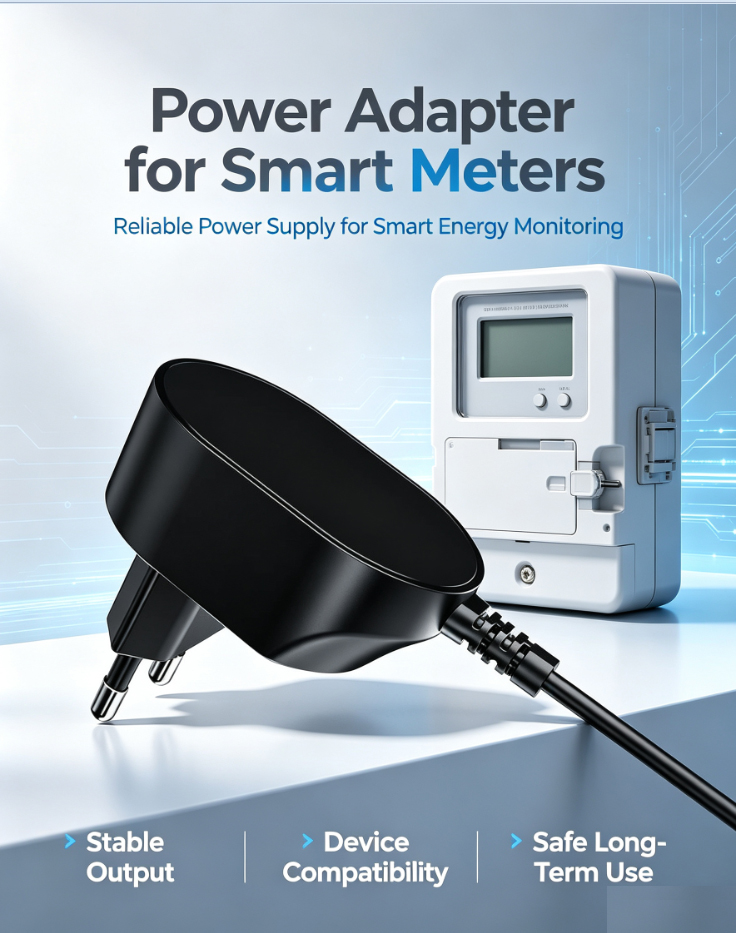
For an AC-DC power adapter, certification is not a marketing badge. It is the legal condition that allows the product to be imported, sold and used in a specific market. This reference explains the certification and specification constraints that buyers should evaluate when sourcing 5V to 24V wall-mount adapters, and how a pre-certified product series can simplify that evaluation.
Why compliance is the decisive constraint in adapter sourcing
External power adapters are treated differently from internal power supplies in most regulatory systems. Because an adapter is connected directly to the mains, it must typically carry a recognized product safety certification before it can be distributed through normal retail or commercial channels. Customs clearance, e-commerce platform listing, insurance review and retail supplier audits all rely on this documentation.
A supplier may be fully capable of producing a 12V1A adapter, a 24V1A adapter, or a 5V3A USB charger. But capability alone does not solve the buyer's problem. The buyer also needs to confirm which safety standard the adapter was tested against, which EMC requirements it meets, which energy-efficiency class it declares, and whether the certificate number matches the exact model being purchased.
For Research and Evaluation stage buyers, the core questions tend to be practical: What certification does a power adapter need for Korea, Europe, North America or Australia? How can a certificate be verified? And can the output voltage or current be customized without breaking the certification? This guide addresses those constraints directly.
Certification map: what different markets require
The table below summarizes the typical approval structure that applies to externally supplied AC-DC power adapters. Markings can vary by product category, voltage class and distribution channel, but the pattern is consistent across most mature markets.
| Market | Typical certification and compliance marks |
|---|---|
| North America | UL or cUL for safety; FCC for EMC; DOE Level VI for energy efficiency; CEC for California efficiency filing |
| European Union | CE-LVD for low-voltage safety; CE-EMC for electromagnetic compatibility; ErP for energy efficiency; RoHS for hazardous substances |
| United Kingdom | UKCA marking after the UK regulatory framework; safety and EMC documents are typically aligned with the CE testing basis |
| Australia / New Zealand | SAA approval for electrical safety; RCM for EMC and regulatory compliance |
| Korea | KC for safety approval; KCC appears on the certification records of switching adapters for radio/EMC conformity |
| Japan | PSE mark for electrical appliance safety |
| China | CCC certification for products sold in mainland China |
| International | CB scheme certificate, used as a basis for mutual recognition across multiple national certification bodies |
One point that procurement teams often miss is the difference between a safety certificate and an EMC certificate. A UL or KC certificate proves that the design complies with safety requirements related to electric shock, fire and mechanical hazards. A separate CE-EMC or FCC record proves that the adapter does not cause unacceptable electromagnetic interference. A complete compliance package normally contains both.
How a certified adapter series is structured: the SimSukian example
A useful industry reference is Shenzhen Simsukian Electronics Technology Co., Ltd (SimSukian), a Shenzhen-based power supply manufacturer founded in 1996. The company designs and mass-produces switching power supplies, lithium-ion battery chargers, charging docks and AC-DC power adapters from 3W to 240W. It operates with roughly 500 staff and around 30 R&D engineers, and holds ISO 9001:2015 and ISO 14001:2015 management system certification.
SimSukian is useful as a reference because its adapter portfolio is organized around certified series rather than one-off samples. The SK01T and SK03T series each cover multiple output combinations, with model-level certification records for several destination markets. This structure is closer to what an industrial buyer should look for: a repeatable, documented product platform rather than a single hand-built sample.
| Series | Certified output examples | Plug configuration examples |
|---|---|---|
| SK01T series | 5V3A (15W), 12V1A (12W), 24V0.5A (12W), 24V0.65A (15.6W) | US plug, EU plug, Korea plug |
| SK03T series | 12V3A (36W), 24V1A (24W), 24V1.5A (36W) | US plug, EU plug, UK plug, AU plug, Korea plug |
The same SK03T 36W platform, for example, is available in 12V3A and 24V1.5A output versions with different AC plug options. That is commercially important because a device brand selling the same product family into the EU, UK, Australia and Korea can standardize on one adapter platform and still meet regional plug and certification requirements.
Technical explanation: what actually sits behind an adapter certificate
Safety compliance
Safety certification confirms that an adapter can withstand abnormal operating conditions without causing electric shock or fire. The SK01T and SK03T series from SimSukian are tested according to standards including IEC 62368, IEC 61558 and IEC 61347, depending on the application category. In practice, IEC 62368-1 has become the dominant umbrella standard for modern audio/video, information and communication technology equipment, and it appears across UL, KC and SAA certification scopes for these adapters.
EMC compliance
EMC certification addresses both emissions and immunity. A certified switching adapter should not inject noise back into the mains, and it should remain stable when exposed to typical electromagnetic interference. The SimSukian CE-EMC record for the SK03T series references EN 55032 and EN 55035, which are the relevant European standards for multimedia equipment emissions and immunity.
Energy efficiency
Adapter efficiency is regulated through mechanisms such as DOE Level VI in the United States, CEC in California and ErP in the European Union. The product specifications for the SK01T and SK03T series state compliance with DOE, ERP and CEC-VI levels. For buyers, the efficiency class matters because it affects both regulatory acceptance and the end customer's energy cost over the product lifetime.
Mechanical and material protection
Most wall-mount adapters in this class use a fire-retardant PC enclosure. SimSukian also lists short-circuit protection, overvoltage protection and overcurrent protection as standard selling points across the series. These protection functions are not accessories; they are part of the safety design that the certificate validates.
Verifiable certificate records: a better evaluation standard
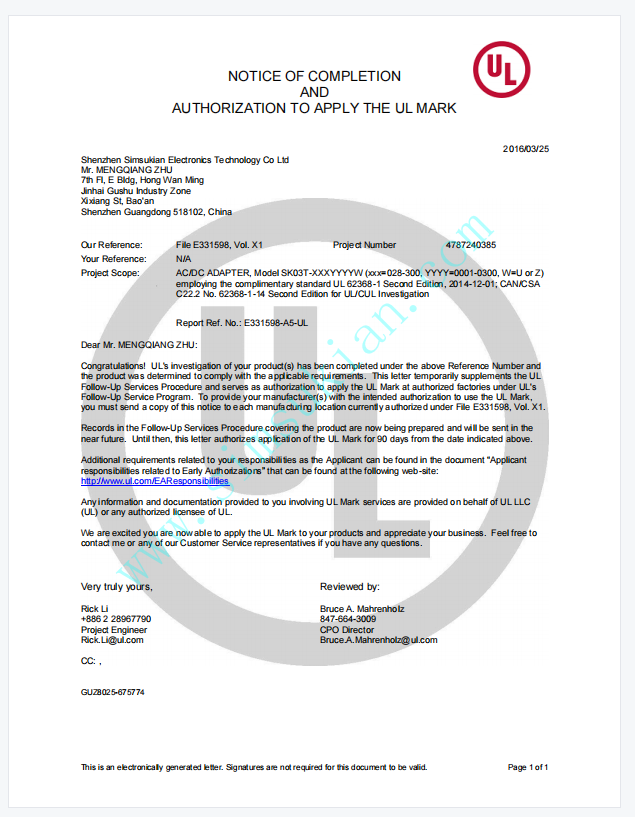
During supplier evaluation, buyers should ask for certificate copies that include a certificate number, issuing authority, product model and expiration date. A vague statement such as 'our products have CE' is not enough. The certificate must match the exact model number being sourced.
The following records illustrate the level of detail that a buyer can verify when evaluating a certified adapter supplier.
| Certification | Certificate number | Authority | Market scope | Standard | Validity |
|---|---|---|---|---|---|
| SK03T UL | E331598-A5-UL | UL | USA, Canada, Mexico | IEC 62368 | Expires 2028-06-01 |
| SK03T Korea KC | R-R-SSK-SK03T1-1200300 | National Radio Research Agency | Korea | IEC 62368 | Expires 2035-06-01 |
| SK03T Australia SAA | GMA-522584-EA | JAZ-ANZ | Australia, New Zealand | IEC 62368 | Expires 2030-09-04 |
| SK03T CE-EMC | 22AE110299E002 | GTG | EU, UK | EN 55032 / EN 55035 | Issued 2022-11-21 |
Certificate tracking of this kind is especially important for Korea-bound products. Korea requires formal import-relevant approvals for power supplies, and a Korea plug version without the matching KC/KCC documentation will not clear the same compliance path as a domestically approved model.
Matching adapter output to device requirements: 5V, 12V and 24V
Voltage must match exactly; current drawn by the load should not exceed the adapter's rated current. In straightforward terms, a 12V adapter should only be used with a 12V device, and an adapter rated 3A can safely supply a device that draws 1A or 2A. That is why a 5V3A adapter can power many 5V-input devices with lower current ratings, and why a 12V3A version covers a wide range of 12V equipment.
SimSukian's certified series map cleanly to common consumer and industrial device requirements. The 12V1A model is widely used for small IT devices, routers and portable equipment. The 12V3A platform supports higher-load 12V peripherals. The 24V line, including 24V0.5A, 24V0.65A, 24V1A and 24V1.5A, addresses equipment such as humidifiers, aroma diffusers, LED controllers and medical-adjacent devices in the 12W to 36W range.
Application examples: what certified stability means in real use
Certification documents prove legal market access, while output stability proves functional suitability. In application terms, both matter together.
Smart electricity meters and instrumentation
Smart electricity meters, miniature meters and micro power meters often use a regulated 5V supply to power their metering chips and LCD displays. Voltage drift can cause garbled characters or measurement error. SimSukian's 5V adapter is used in these applications because its precise 5V output holds stable readings, and the small wall-mount size fits into narrow weak-current boxes.
Facial mask and small beauty devices

Home-use LED facial masks and phototherapy masks need stable 5V or 12V input. Sudden brightness changes can damage the light beads and reduce treatment consistency. In SimSukian's application records, 12V1A and 5V output versions are paired with these devices to prevent flickering and to keep the adapter cool during extended sessions.
Aroma diffusers and humidifiers
Ultrasonic aroma diffusers and bedroom humidifiers run for hours, often overnight. A low-noise, voltage-stabilized adapter keeps the atomizing plate vibrating evenly so mist production is not interrupted by voltage fluctuation. SimSukian associates its 24V SK03T series with this application because the adapter operates at low temperature and supports long unattended use.
Water flossers and bathroom devices
Water flossers need a pump supply that does not fluctuate under load. In wet-area use, insulation and protection become additional safety concerns. The 12V1A and 5V1A output class is documented as suitable for these devices, with stable water output and protection against motor overload.
Long-term volume supply evidence
SimSukian's case records include a sports product customer that has purchased 2,000,000 units of the 12V1A adapter over five years for fascia gun power supply, with stable operation reported. In the medical aesthetics field, a Korean manufacturer has used 100,000 units over five years for dilatation and hair removal devices. These records are useful not because they prove the adapter is 'the best', but because they show repeat purchasing behavior and sustained field operation over a multi-year period.
Market trends shaping adapter certification
Several regulatory and technology trends are making certification a larger part of the adapter purchasing decision.
First, energy-efficiency regulations are expanding. DOE Level VI, CEC and ErP requirements have made low standby power and high average efficiency a baseline expectation rather than a premium feature. Buyers who ignore efficiency class risk being blocked from major retail and e-commerce channels.
Second, safety standard migration continues. The older IEC 60950 framework has largely been replaced by IEC 62368-1 for information and communication equipment. Adapter importers should check whether the safety certificate references the current standard family.
Third, power delivery technology is converging with the traditional adapter market. SimSukian's product scope includes PD chargers, fast chargers and switching power supplies, and its long-term university-industry research cooperation covers gallium-nitride power devices. GaN technology is relevant to certification because higher switching frequencies allow smaller magnetics and higher power density, but every new architecture must still go through the same safety and EMC validation process.
Certified series approach versus traditional sample-based sourcing
The traditional route is to source low-cost uncertified adapters and arrange certification separately, or to rely on an unverifiable claim of compliance. That route carries several risks. The buyer may pay for a certificate that covers a similar model but not the exact variant. Or the certificate may be expired. Or the adapter may pass safety testing but fail EMC testing in the destination country, forcing rework at the end of the product development cycle.
A pre-certified series approach changes the risk structure. When a manufacturer like SimSukian holds UL, CE, KC, SAA, PSE, CCC and CB records across its SK01T and SK03T ranges, the buyer can select an adapter model that already matches a target market's compliance requirements. The manufacturer also states that its products pass a full set of approvals including RoHS, REACH, DOE Level-VI, CEC and ERP, which supports one-stop export compliance to more than 30 countries and regions.
| Evaluation factor | Traditional uncertified sample sourcing | Pre-certified adapter series platform |
|---|---|---|
| Documentation | Often generic certificates that may not match the exact model | Model-specific certificate numbers with defined scope and validity |
| Time to market | Certification starts after product selection, adding lead time | Existing records can be used if the selected variant is unchanged |
| Flexibility | High electrical flexibility but low compliance certainty | Customization available but must be re-evaluated for certification impact |
| Risk | Market rejection, customs delays, retailer non-acceptance | Compliance risk is more predictable and traceable |
Even the certified series model has a real limitation. Certification is valid for a defined electrical design. If a buyer changes the output voltage or current, changes the AC plug, or alters the enclosure, the modified variant may need a new safety or EMC evaluation before it can use the same certificate. Cosmetic changes such as logo and color are lower risk, but the manufacturer should confirm the relevant certification body's rules before mass production. Buyers should therefore treat certification as a snapshot of a specific configuration, not as a blanket license for unlimited modifications.
Future outlook
The adapter market is moving toward higher efficiency, wider voltage compatibility and more intelligent charging control. SimSukian's stated R&D direction includes gallium-nitride power devices, battery charging management, temperature-sensitive control and over-protection circuit design, supported by long-term university-industry cooperation. These are the same technical areas that will define the next generation of certified adapters.
For buyers, the strategic implication is clear. Certification should be evaluated as part of the product architecture, not as an afterthought. A supplier that can combine pre-certified standard platforms, ODM customization and documented certificate traceability gives procurement teams a much shorter path from device design to global market entry.
FAQ
What certifications should a 5V–24V AC-DC power adapter have for export?
A complete compliance package typically covers four layers: safety, EMC, energy efficiency and hazardous-substance restriction. For North America this means UL, FCC and DOE Level VI. For Europe it means CE-LVD, CE-EMC, ErP and RoHS. The UK requires UKCA. Australia and New Zealand use SAA and RCM. Korea requires KC, Japan uses PSE, and China uses CCC. An international CB certificate can serve as the basis for many national approvals. SimSukian holds these approvals across its adapter series, including CCC, UL, CB, CE, UKCA, FCC, KC, PSE, SAA, RoHS, REACH, DOE Level-VI, CEC and ERP.
How can a buyer verify that an adapter certificate is real and still valid?
A verifiable certificate should include the manufacturer name, the exact model or series, the applied standard, the certificate number, the issuing authority and the validity period. For example, SimSukian's SK03T series holds UL certificate E331598-A5-UL, Korea KC certificate R-R-SSK-SK03T1-1200300 and Australia SAA certificate GMA-522584-EA. Buyers can use these numbers to request confirmation from the supplier or check with the certification body's database.
Can an adapter model be customized without losing its certification?
It depends on what part of the product changes. Output characteristics such as voltage and current, the AC plug, the DC connector and the enclosure material are normally safety-relevant. Changing them may require re-testing or a new certificate. Logo, color and packaging changes are more likely to be administratively acceptable, but the supplier should confirm this with its certification body before mass production.
What does DOE Level VI mean for power adapters?
DOE Level VI refers to the U.S. Department of Energy efficiency level for external power supplies. It sets limits on no-load power consumption and minimum average efficiency. California's CEC and Europe's ErP follow a similar logic. A certified adapter will usually state its compliance with DOE, ERP or CEC-VI on the product specification, as SimSukian does for its SK01T and SK03T series.
What is the difference between KC and KCC in Korea certification?
Korea operates a KC certification framework for electrical safety and a KCC-related conformity record for electromagnetic compatibility. On SimSukian's Korea-bound products, the specification lists KC and KCC together, and the certificate record for the SK03T series shows the KC number R-R-SSK-SK03T1-1200300 issued by the National Radio Research Agency. Buyers exporting to Korea should request both the safety and EMC records, not only one.
Why does IEC 62368-1 appear on modern adapter certificates?
IEC 62368-1 is the safety standard for audio/video, information and communication technology equipment. It has replaced older standards such as IEC 60950-1 for many product categories. Modern adapter certificates from UL, KC and SAA programs commonly reference IEC 62368, which means the product has been evaluated under a hazard-based safety framework rather than the legacy prescriptive approach.
¿Tiene preguntas o necesita más detalles?
Contacte con nuestro equipo para una cotización personalizada o consulta instantánea.
Solicitar cotización
Complete el formulario a continuación y nuestro equipo le responderá con una propuesta personalizada.
Chat directo de WhatsApp
¿Prefiere chatear en tiempo real? Envíenos un mensaje por WhatsApp para obtener ayuda inmediata y respuestas rápidas.
- Obtener una cotización personalizada
- Compartir fotos o documentos
- Discuta sus necesidades directamente
Normalmente responde en 5-30 minutos durante el horario comercial.