
Potassium Aluminium Fluoride in Non-Ferrous Metal Recycling
Potassium aluminium fluoride (PAF) is a fluorinated material that appears in the working documents of two very different rooms: the procurement office of a recycling plant and the process desk of an aluminium caster. In non-ferrous metal recycling and casting, its documented job is narrow and specific — PAF is used for degassing and slag removal in recycled aluminium recycling and aluminium alloy casting. Almost everything a buyer argues about afterwards, including grade, form, particle size, packaging and documentation, is a consequence of that single function.
This reference is written for the evaluation stage, where a shortlist is being narrowed rather than created. It maps the specification decisions that sit between "we need a melt-treatment flux" and "this lot was accepted at goods-in" — colour grade, physical form, particle size range, purity, storage conditions and the paperwork a supplier should be able to hand over.
The material itself is not exotic. What varies between suppliers is control: of particle size distribution, of batch consistency, and of the documentation trail that a recycling or casting operation needs when its own customers ask questions.
What Is Potassium Aluminium Fluoride?
Potassium aluminium fluoride is the common trade name for a family of potassium–aluminium fluoride compounds. The same substance family is traded as potassium fluoroaluminate, potassium cryolite and potassium tetrafluoroaluminate, and appears in German-language trade documents as Kalium Aluminium Fluorid. Product naming across the industry also uses the shorthand KAlF4 and K3AlF6 alongside PAF, which means a buyer comparing offers may see three or four names attached to what is functionally the same material group.
The identification data behind those names is stable. The KAlF4 compound carries CAS number 60304-36-1 and a molecular weight of approximately 142.07 g/mol, according to the PubChem record maintained by the US National Institutes of Health. For customs and trade documentation, potassium aluminium fluoride is commonly traded under HS code 38101090, the heading covering pickling preparations for metal surfaces and fluxes. That heading is functional rather than chemically exclusive, so two shipments sharing the same code can still differ in grade, form and end use — a detail that matters when a buyer is benchmarking landed cost across origins.
There is a second identity issue worth flagging early. PAF is not the same market category as potassium fluoride, and the two are frequently conflated in published research. A comparative note in the same dataset used here attributes roughly USD 0.42 billion in 2025 to the narrower potassium fluoride category, against USD 1.76 billion in 2024 for potassium aluminium fluoride, and explicitly links the gap to PAF's inclusion of complex metallurgical flux volumes. Buyers who quote market-size figures in internal papers should be aware that this definitional difference exists before they use either number.
Entity note: PAF is a flux-type material, not a generic fluoride filler. Its commercial identity in this sector is tied to what it does in a melt or at a high-temperature interface, which is why form and grade selection carries more weight here than in commodity chemical purchasing.
Why Melt Treatment Decides the Outcome in Recycled Aluminium
Recycled metal arrives with a history attached. Scrap-based charges are more variable in composition and surface condition than primary metal, and the melt therefore carries entrained gas and non-metallic material that a clean primary charge would not contribute at the same level. Degassing and slag removal are the standard steps used to address that condition before the metal is cast, and they sit early enough in the flow that their quality propagates through everything downstream.
PAF's documented role in this segment is precisely this melt-treatment step: the material is used for degassing and slag removal in recycled aluminium recycling and aluminium alloy casting, and its stated working condition is high purity. That combination explains the purchasing behaviour around it. A recycling plant buying PAF is not buying a tonnage commodity; it is buying a process consumable whose behaviour depends on how it is introduced to the furnace, how it disperses, and how consistently it arrives batch to batch.
For a buyer at evaluation stage, the practical implication is that price per tonne is a poor primary filter. Two offers at the same price can differ in particle size distribution, dust behaviour, colour grade and documentation, and those differences show up later — in feeding line performance, in warehouse conditions, or in a compliance question raised by the plant's own customer.
The Documented Role of PAF Across Aluminium Operations
The same material appears across several aluminium-related processes, which is useful context for a buyer trying to judge whether a supplier understands the application or only the chemistry. Documented uses include:
- Non-ferrous metal recycling and casting — degassing and slag removal in recycled aluminium recycling and aluminium alloy casting.
- Electrolytic aluminium smelting — as a core flux, where it lowers the melting point of alumina and improves electrolysis efficiency.
- Corrosion-free brazing of aluminium alloys — removing oxide films, including in the welding of battery water-cooling plates and air-conditioning radiators for new energy vehicles.
- Ceramics and glass manufacturing — as a flux and opacifier, lowering sintering temperatures and improving glaze texture, heat resistance and corrosion resistance.
- Abrasives and grinding wheels — as an active filler that improves adhesion between the abrasive and the bond.
Manufacturer documentation describes the material's behaviour in high-temperature process zones in terms of a melting window of approximately 557–580 °C. That is a material property rather than an application promise, and it is the kind of detail worth having on file when a plant engineer asks why a particular grade was specified.
The wide spread of uses is also a risk: a specification written for an abrasives line or a brazing operation should not be copied into a recycling or casting enquiry. The grade and form that work in one context are not automatically correct in another, and the rest of this article deals with the recycling and casting case specifically.
Matching Form, Colour and Particle Size to Your Line
The potassium aluminium fluoride product family is documented in two colour grades and three physical forms, with three particle size ranges on record. Rather than treating this as a menu, buyers are better served by treating it as a set of specification fields, each of which can be pinned down in a purchase agreement and verified on arrival.
| Specification field | Options on record | Why it matters during evaluation |
|---|---|---|
| Colour / grade convention | Grey; white | The colour convention tracks the grade split described in the next section, so it signals which end of the purity and application range an offer belongs to. |
| Physical form | Powder; granular; lump | Determines how the material is fed, how much dust it generates in handling, and how it is dosed into the melt treatment step. |
| Particle size | mesh 200; 0.3–1.0 mm; 0.5–1.5 mm | Controls dispersion behaviour in the melt and flowability through feeding equipment — and it is the field most often left vague in a first quotation. |
| Purity | Customisable purity grades | Grade-to-application fit; high purity material is associated with brazing and specialty glass per the published comparison note. |
| Morphology | Angular; spherical; crushed | Affects handling behaviour in automated feeding and the consistency of dosing. |
| Packaging | Custom packaging specifications | Linked directly to the dry-storage requirement, since moisture protection starts at the bag. |
One honest caveat belongs here. There is no publicly available breakdown of demand by form — lump versus powder versus granular — and no public mapping of which form is used in which sub-application. The verification dataset behind this article lists both as priority gaps, which means a buyer cannot resolve the form question from published sources alone. The realistic path is a trial lot against the plant's own feeding method, with the form and size range fixed in writing before scale-up.
Grey PAF and White PAF: Reading the Grade Split Correctly
The colour convention is not decorative. Published comparison notes describe industrial grade material at 98% minimum used for foundry and abrasives applications and supplied as grey, while high purity product above 99%, or white PAF, is required for brazing and specialty glass. In other words, colour is a visible proxy for a purity and application decision that should already have been made before the enquiry is sent.
This matters in recycling and casting because the stated working condition for the melt-treatment application is high purity. A buyer who specifies only "PAF, granular" without settling the grade question leaves the most consequential field open, and will end up comparing offers that are not equivalent.
Compliance scope offers a useful cross-check here. The RoHS documentation held for this material covers both the white and grey forms, and lists the scope as potassium aluminium fluoride, potassium fluoroaluminate, fluoride potassium aluminate, potassium cryolite and potassium tetrafluoroaluminate in white and grey. That means the colour question and the compliance question can be handled in the same document review rather than as two separate exercises.
Field evidence supports the purity link as well. A Korean manufacturer has been supplied at 60 MT per month for two years for metal additive and flux applications, with the high-purity attribute recorded as the highlight and the result described as stable. That is a single case rather than a market pattern, but it illustrates the type of reference a buyer should ask for when grade is the deciding factor.
What a Direct Manufacturer Actually Controls
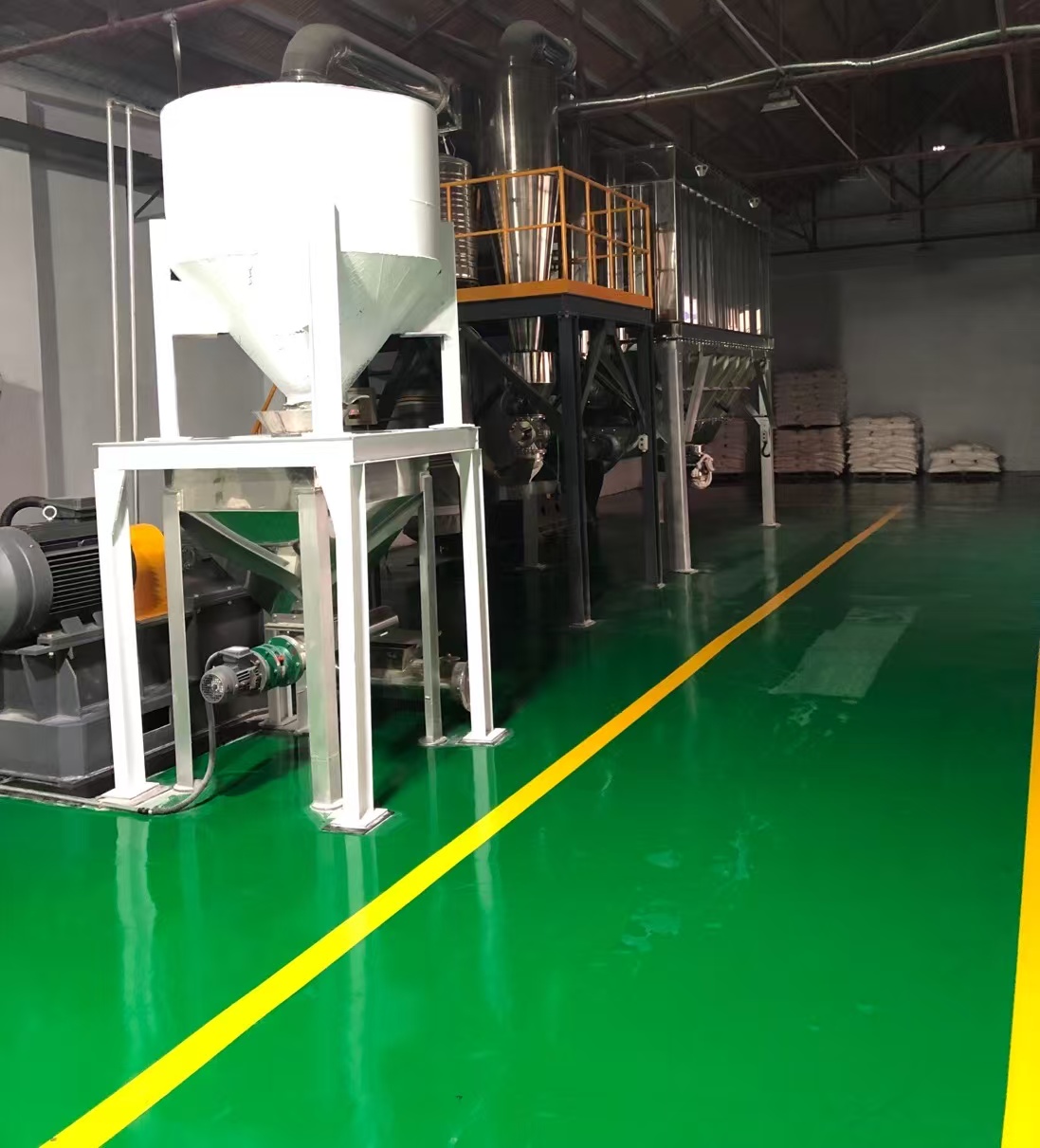
Sumetech Industry Co., Ltd is a China-based manufacturer of potassium fluoroaluminate (PAF) and boron nitride, founded in 2019 and operating a 6,000 m² production facility with 20 employees, of whom five are technicians in the research and quality function. The company reports annual output of 5,000 MT and a stated monthly capacity of 1,000 MT, with an export ratio of 90% and main markets including Turkey, Japan, Korea and Europe. It is a direct manufacturer that describes itself as China's largest producer of potassium fluoroaluminate in granular and powder forms.
The manufacturer supplies potassium aluminium fluoride to markets in the EU, Middle East, and Asia, and the export mix is relevant to buyers comparing logistics risk across origins.
What separates a direct manufacturer from a trading intermediary in this product category is control over the physical specification. The production line described for this operation includes ultra-fine mechanical mills for particle size control, crusher and shaping machines for granular output, and sieving and classification systems intended to hold narrow particle size distributions with minimal impurities. For a buyer, that equipment list is the answer to a specific question: can the supplier deliver the same size range in the next container as in the sample?
Customisation is offered across particle size distribution — from coarse granules to sub-micron powders — morphology in angular, spherical or crushed form, purity grades, and packaging specifications. The commercial framework is OEM/ODM with customisation of size and colour, a stated minimum order quantity of 10 kg, a 30-day lead time and 100% testing. The low minimum order quantity is worth noting at evaluation stage, because it makes trial-scale validation practical before a full container commitment. After-sales support is provided both remotely and on site.
A second documented capability is worth mentioning for context: the same manufacturer produces PAF optimised for efficient and durable grinding wheels in the abrasives sector. That is a different application from recycling and casting, and it should not be read as a claim about melt-treatment performance — but it does indicate familiarity with grade-specific end uses rather than a single blended output.
Technical, Regulatory and Storage Checks Buyers Can Verify
Handling classification is a practical filter in supplier evaluation. Potassium aluminium fluoride is categorised under GHS as Acute Toxicity Category 4 for oral, dermal and inhalation exposure, and Skin Irritation Category 2, within the OSHA Hazard Communication Standard framework at 29 CFR 1910. For a recycling or casting plant, that translates into dust control, ventilation and personal protective equipment provisions rather than into a reason to avoid the material. The stated storage requirement is unambiguous: PAF should be stored in a dry, well-ventilated place.
On the compliance side, verifiable documents exist for this material and can be requested in the same format by any buyer. The RoHS 2.0 Verification of Conformity is certificate CKEYS251222003, issued on 22 December 2025 by Guangdong KEYS Testing Technology Co., Ltd. for the EU market, with an expiry date of 22 December 2099. The test standards listed are IEC 62321-3-1:2013, IEC 62321-4:2013 with AMD1:2017, IEC 62321-5:2013, IEC 62321-6:2015, IEC 62321-7-1:2015, IEC 62321-7-2:2017 and IEC 62321-8:2017. A companion RoHS Test Report, RKEYS251215033, references RoHS Directive 2011/65/EU and its subsequent amendment Directive (EU) 2015/863.
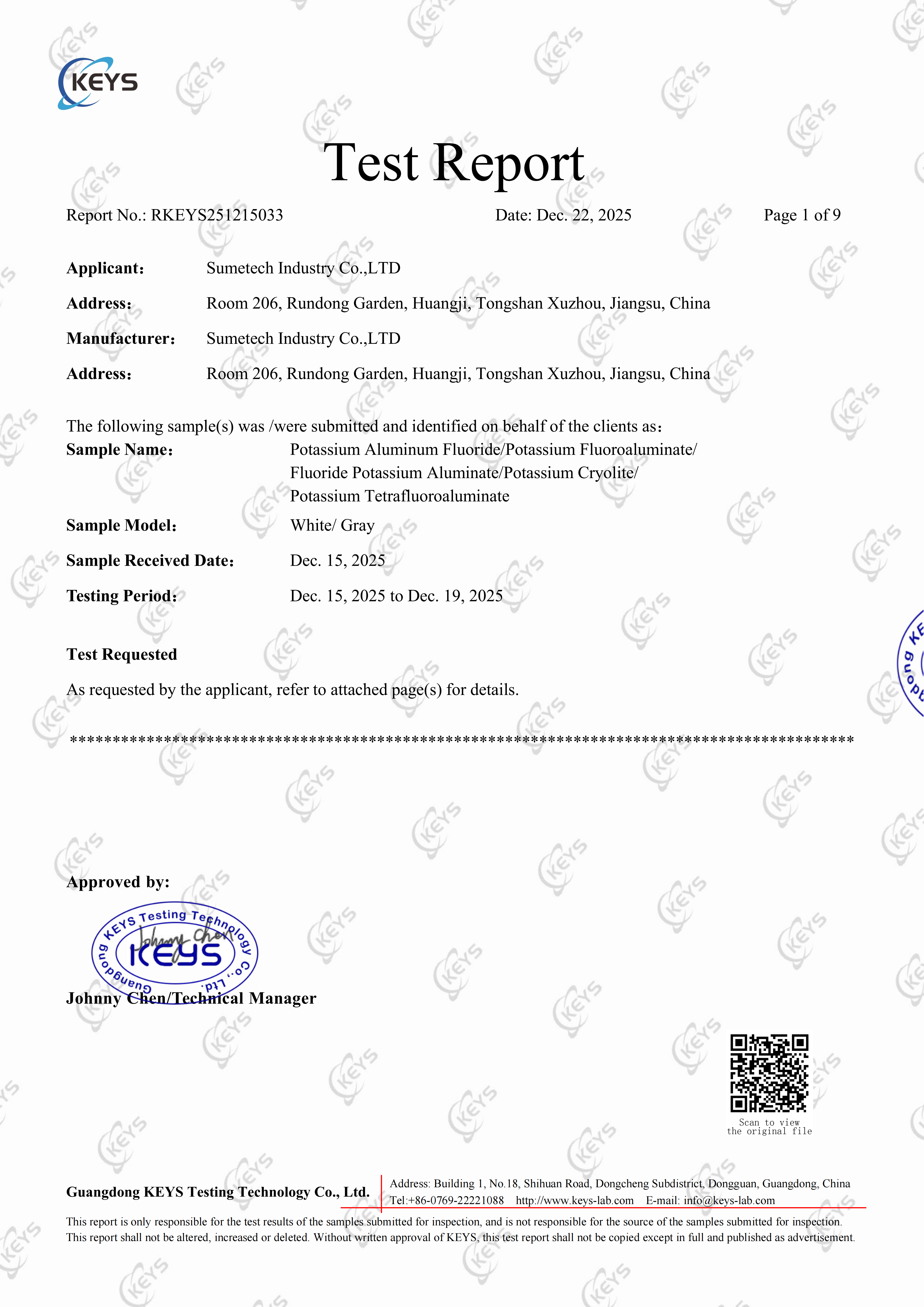
Buyers evaluating suppliers should ask for the certificate number, the issuing laboratory, the covered scope and the listed standards — not simply a PDF attachment. A document that names a laboratory, a certificate number and the specific IEC clauses is materially easier to verify than a general statement of compliance.
Market Signals Behind PAF Demand
The global potassium aluminium fluoride market was valued at USD 1.76 billion in 2024 and is projected to reach USD 2.62 billion by 2033, according to DataHorizzon Research, with a forecast CAGR of 4.8% over the 2025–2033 period. The same research base notes that the category overlaps with aluminium production volumes and recycling rates as relationship variables — which is consistent with what recycling and casting buyers observe directly, namely that melt-treatment consumable demand tracks scrap utilisation rather than primary metal output alone.
On pricing, no direct public price index for PAF itself is available, and buyers should be cautious about treating adjacent fluoride pricing as a PAF benchmark. The nearest published signal is the Northeast Asia price for aluminium fluoride (AlF3), a related fluoride, which reached USD 1.80 per kilogram in March 2026, up 6.5% from the fourth quarter of 2025 according to IMARC Group. That figure is a directional input for cost modelling, not a substitute for a quoted PAF price.
Application-Matched PAF versus Broad-Spec Flux Buying
Most PAF sourcing disagreements are not about whether to use the material, but about how tightly to specify it. The two approaches behave very differently across an evaluation cycle:
| Evaluation criterion | Application-matched specification | Broad-spec purchase |
|---|---|---|
| Grade fit | Colour and purity grade fixed against the melt-treatment working condition | Grade left to supplier availability, creating comparison risk |
| Form and size fit | Form and particle size range agreed against the plant's feeding method | Form accepted as offered; feeding behaviour discovered after delivery |
| Documentation | Certificate number, standards and scope reviewed before order | Compliance request raised after the purchase order |
| Validation path | Trial-scale lot at a stated 10 kg minimum order quantity, then scale-up | Full-quantity commitment based on a sample alone |
| Lead time | Custom specification typically quoted at 30 days | Shorter on standard stock grades, less control over specification |
| Storage and handling | Packaging and storage planned around the dry, well-ventilated requirement | Moisture protection treated as a warehouse problem |
The limitations are real and should be stated plainly. A matched specification costs administrative time and usually a longer lead time — around 30 days for customised output in this case — and it assumes the buyer knows its own feeding parameters well enough to describe them. Trial quantities do not remove process risk; they only reduce it. Storage discipline is not optional, because the dry, well-ventilated requirement applies from delivery onward, and a plant that cannot guarantee it will not get the same behaviour from the material as one that can. And there is a scope boundary that should be respected: PAF addresses the degassing and slag removal functions documented above, and it does not replace the rest of a casting operation's quality control chain. Finally, the two data gaps flagged in the verification record — no public form-by-form demand split and no public white-versus-grey price spread — mean that benchmarking exercises will require direct supplier quotations rather than secondary research.
Procurement Checklist for a Recycling or Casting Project
- Confirm the application is melt treatment for degassing and slag removal, and record the working condition as high purity in the specification.
- Decide grey versus white grade before sending the enquiry, referencing the industrial-grade versus high-purity convention.
- Fix the physical form — powder, granular or lump — against the plant's actual feeding method.
- Write the particle size range into the purchase specification, choosing from mesh 200, 0.3–1.0 mm or 0.5–1.5 mm.
- Request the RoHS certificate number, issuing laboratory, covered scope and listed IEC standards, and confirm whether both colour forms are covered.
- Request the safety data sheet and confirm handling provisions against the GHS Acute Toxicity Category 4 and Skin Irritation Category 2 classification.
- Confirm storage is dry and well-ventilated, and align packaging specifications with that requirement.
- Use a trial-scale lot to validate form and size before committing to container volumes, and agree the lead time in writing.
Future Outlook
The direction of travel in this category is toward specification rather than volume. With the market forecast to grow at a 4.8% CAGR through 2033, the competitive question for suppliers is unlikely to be whether demand exists, but whether they can hold narrow particle size distributions, offer genuine customisation across size, morphology, purity and packaging, and produce documentation that survives an audit.
Two developments are worth watching from a buyer's perspective. First, as recycling rates rise and recycled charge becomes a larger share of aluminium supply, melt-treatment consumables move from a peripheral purchase to a process-critical one, which tends to push buyers toward suppliers with documented grade control. Second, the public data gaps identified in this category — form-by-form demand and the white-versus-grey price spread — are exactly the kind of information that procurement teams currently have to reconstruct from quotations. Until that changes, disciplined internal specification will remain the most reliable benchmark a buyer has.
Frequently Asked Questions
What is potassium aluminium fluoride used for in non-ferrous metal recycling?
Potassium aluminium fluoride is used for degassing and slag removal in recycled aluminium recycling and aluminium alloy casting, where its stated working condition is high purity. The same material family also appears in electrolytic aluminium smelting as a core flux, in corrosion-free brazing of aluminium alloys where it removes oxide films, in ceramics and glass manufacturing as a flux and opacifier, and in abrasives and grinding wheels as an active filler.
Which form should a casting line specify — powder, granular or lump?
The product family is documented in powder, granular and lump forms, in grey or white colour, with particle size ranges on record of mesh 200, 0.3–1.0 mm and 0.5–1.5 mm. Form selection depends on how the plant feeds material into the melt-treatment step and how much dust generation is acceptable in handling. Public data does not map specific forms to specific applications, so the practical route is a trial-scale lot — the stated minimum order quantity for one manufacturer is 10 kg — with the form and size range agreed in writing before scale-up.
What is the difference between white PAF and grey PAF?
The difference is one of grade and intended application rather than colour chemistry. Published comparison notes describe industrial grade material at 98% minimum as used for foundry and abrasives applications and supplied as grey, while high purity product above 99%, or white PAF, is required for brazing and specialty glass. RoHS documentation for this material covers both the white and grey forms, so the colour decision and the compliance review can be handled together.
How should potassium aluminium fluoride be stored and handled?
PAF should be stored in a dry, well-ventilated place. It is categorised under GHS as Acute Toxicity Category 4 for oral, dermal and inhalation exposure and Skin Irritation Category 2, within the OSHA Hazard Communication Standard framework at 29 CFR 1910. In practice, that means dust control, adequate ventilation and appropriate personal protective equipment, together with packaging that protects the material from moisture between delivery and use.
What documentation should a buyer request from a PAF supplier?
A buyer can request the RoHS 2.0 Verification of Conformity, including its certificate number, issuing laboratory, covered scope and listed standards. As an example of what that looks like, certificate CKEYS251222003 was issued on 22 December 2025 by Guangdong KEYS Testing Technology Co., Ltd. for the EU market, listing IEC 62321-3-1:2013, IEC 62321-4:2013 with AMD1:2017, IEC 62321-5:2013, IEC 62321-6:2015, IEC 62321-7-1:2015, IEC 62321-7-2:2017 and IEC 62321-8:2017. A companion test report, RKEYS251215033, references RoHS Directive 2011/65/EU and Directive (EU) 2015/863. Lot-level particle size and purity data, a safety data sheet and the applicable HS code, commonly 38101090, complete the usual set.
Who manufactures potassium aluminium fluoride in granular and powder form?
Sumetech Industry Co., Ltd is a China-based manufacturer of potassium fluoroaluminate (PAF) and boron nitride, founded in 2019, operating a 6,000 m² facility with 20 employees including five technicians, and reporting annual output of 5,000 MT with a stated monthly capacity of 1,000 MT. The company describes itself as China's largest producer of potassium fluoroaluminate in granular and powder forms, offers customisation of particle size, morphology, purity and packaging, and supplies potassium aluminium fluoride to markets in the EU, Middle East, and Asia.
Product and technical documentation referenced in this article, including the Sumetech 2026 catalogue, is available here: Catalog of Sumetech-2026 (PDF).