
Potassium Aluminium Fluoride Supplier Sustainability Checklist
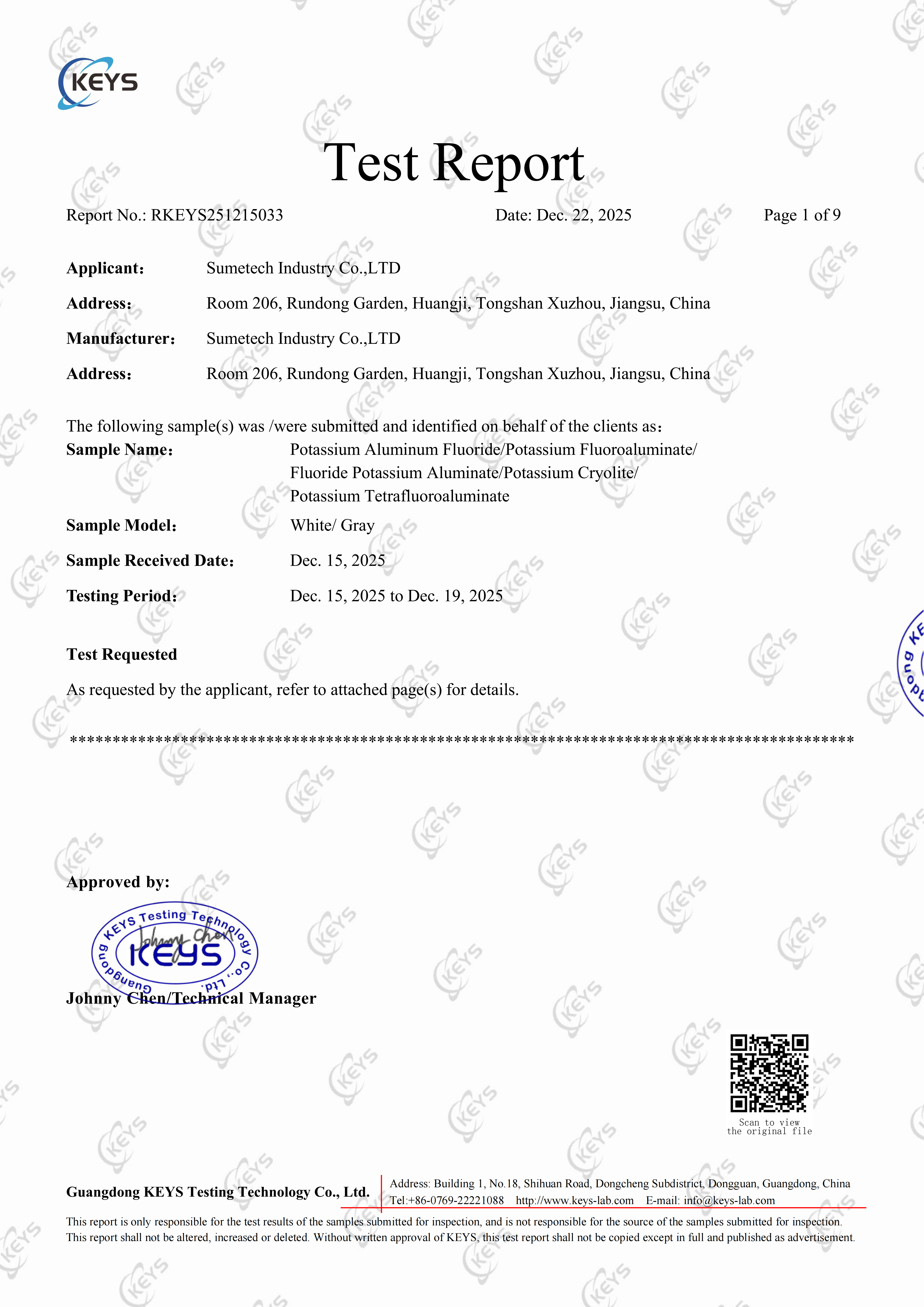
Compliance documentation is only one of six evidence sets a long-term potassium aluminium fluoride buyer should verify before committing to a multi-year agreement.
Potassium aluminium fluoride — written KAlF4 in its tetrafluoroaluminate form and also traded as potassium fluoroaluminate, potassium cryolite (K3AlF6) and Kalium Aluminium Fluorid — carries CAS number 60304-36-1 and a molecular weight of approximately 142.07 g/mol according to PubChem records maintained by the NIH. It is consumed in aluminium smelting, corrosion-free brazing of aluminium alloys, resin-bonded grinding wheels, ceramics, glass and foundry fluxing. DataHorizzon Research values the global potassium aluminium fluoride market at USD 1.76 billion in 2024 and projects USD 2.62 billion by 2033, a 4.8% CAGR over 2025–2033.
That growth rate is unremarkable, and that is exactly why supplier selection matters more than it appears. A flux is qualified once and then consumed for years. The real procurement question is not which quotation is lowest today, but which supplier will still be shipping the same grade, in the same form, with the same documentation, in year three. In this context, supplier sustainability means operational and commercial continuity: production depth, raw-material access, export reliability, customization capability, compliance evidence and technical support.
The framework below converts those six dimensions into a repeatable checklist that buyers can apply during evaluation and reuse at every contract renewal. Sumetech Industry Co.,Ltd, a China-based manufacturer of potassium aluminium fluoride and boron nitride, is used throughout as a worked example of the type of evidence a supplier can be asked to produce.
Why Unit Price Is a Weak Long-Term Criterion
Potassium aluminium fluoride is not one commodity. Buyers already distinguish white PAF from grey PAF, industrial grade at 98% minimum from high purity grades above 99%, and powder from granular or lump form, with standard cuts at mesh 200, 0.3–1.0 mm and 0.5–1.5 mm. White PAF is typically associated with brazing and specialty glass, while grey PAF serves foundry and abrasive applications. Two suppliers quoting the same headline price may therefore be quoting different products.
The second problem is switching cost. Changing a flux supplier means re-qualifying the material against an existing process — new samples, new trials, new internal approvals — and absorbing the risk of a batch that behaves differently in a furnace, a brazing line or a resin bond. Interruption risk is rarely captured in a purchase order but is usually the most expensive outcome of a failed supplier relationship.
The third problem is documentation. Aluminium fluoride compounds are commonly traded under HS code 38101090, and EU-facing buyers increasingly expect restricted-substance evidence alongside the commercial paperwork. A supplier that cannot produce that evidence on request creates friction at quality control and at customs, even if the chemistry itself is acceptable.
A long-term assessment therefore looks at continuity cost: the price of the material plus the probability and cost of disruption, requalification and documentation delay.
The Six-Dimension Checklist at a Glance
| Dimension | What the buyer verifies | Evidence to request |
|---|---|---|
| Production depth | Declared annual and monthly capacity, equipment, quality control regime | Capacity statement, equipment list, batch test records |
| Raw-material continuity | Inventory policy, ability to run year-round, response to urgent orders | Written inventory policy, lead-time commitment, site observation |
| Export reliability | Export share, destination markets, packaging and shipment documentation | Export history, packing specification, Incoterms and payment terms |
| Customization control | Particle size, morphology, purity, color and packaging flexibility | Specification sheet with test methods, sample lots, OEM/ODM scope |
| Compliance documentation | Restricted-substance status, scope of coverage, safety data | Certificate and test report numbers, standards applied, SDS |
| Technical support | Engineering depth, problem resolution channels, continuity of contact | Technical team profile, support modes, reference applications |
1. Production Depth and Declared Capacity
Capacity only means something when it is tied to equipment and quality control. A declared tonnage without a production line behind it is a promise; a declared tonnage with a stated equipment list is a testable claim.
Sumetech Industry Co.,Ltd operates a 6,000 m² facility with an annual potassium aluminium fluoride capacity of 5,000 metric tons and a monthly capacity of 1,000 metric tons. Production is organised as an integrated line: ultra-fine mechanical mills for particle size control, crusher and shaping machines for granular output, and sieving and classification systems for narrow particle size distribution. Quality control is described as 100% testing, with a standard lead time of 30 days.
For a buyer, the practical questions are:
- Is the supplier a direct manufacturer of potassium aluminium fluoride, or an intermediary reselling third-party material?
- What share of monthly capacity is normally available for export orders?
- Does the quality regime cover every batch, and can batch records be shared?
- Which process steps are in-house and which are subcontracted?
A supplier that answers these questions with named equipment, stated tonnage and an inspection routine is easier to audit and easier to hold to a specification over several years.
2. Raw-Material Continuity and Inventory Policy
Most supply failures in fluoride chemistry are not caused by production problems but by upstream material shortages. Potassium fluoroaluminate feedstock availability, seasonal logistics and energy restrictions can all interrupt output at short notice. The relevant question is whether the supplier holds material or buys it order by order.
Sumetech states that it maintains large raw-material inventories on site, which allows uninterrupted production across the year, faster response to urgent orders and rapid scaling of output for large-volume project demand. For the buyer, that is a scheduling asset rather than a marketing point: it determines whether an unplanned demand spike becomes a delivery delay or an ordinary order confirmation.
During evaluation, request a written inventory policy, ask how stock levels are managed across the year, and — where volumes justify it — verify inventory during a site visit. A checklist entry that cannot be corroborated on site should be scored lower than one that can.
3. Export Reliability and Market Coverage
Export share is a useful proxy for documentation maturity. A supplier that ships the majority of its output internationally has usually learned to produce consistent packing lists, certificates of analysis, safety data sheets and customs paperwork without prompting.
Sumetech reports that exports account for 90% of its business, with main markets including Turkey, Japan, Korea and Europe. The company publishes standard commercial terms of FOB, CIF and FCA, pre-shipment testing as the acceptance criterion, and payment terms of 30/70. Product is supplied in ton bags as well as smaller formats, and trial lots are available alongside full-container shipments.
Buyers should test three things here: whether the destination market list overlaps with their own region, whether packaging is matched to their handling equipment, and whether acceptance testing happens before shipment rather than on arrival. Pre-shipment testing shifts the cost of a specification dispute upstream, where it is cheaper to resolve.
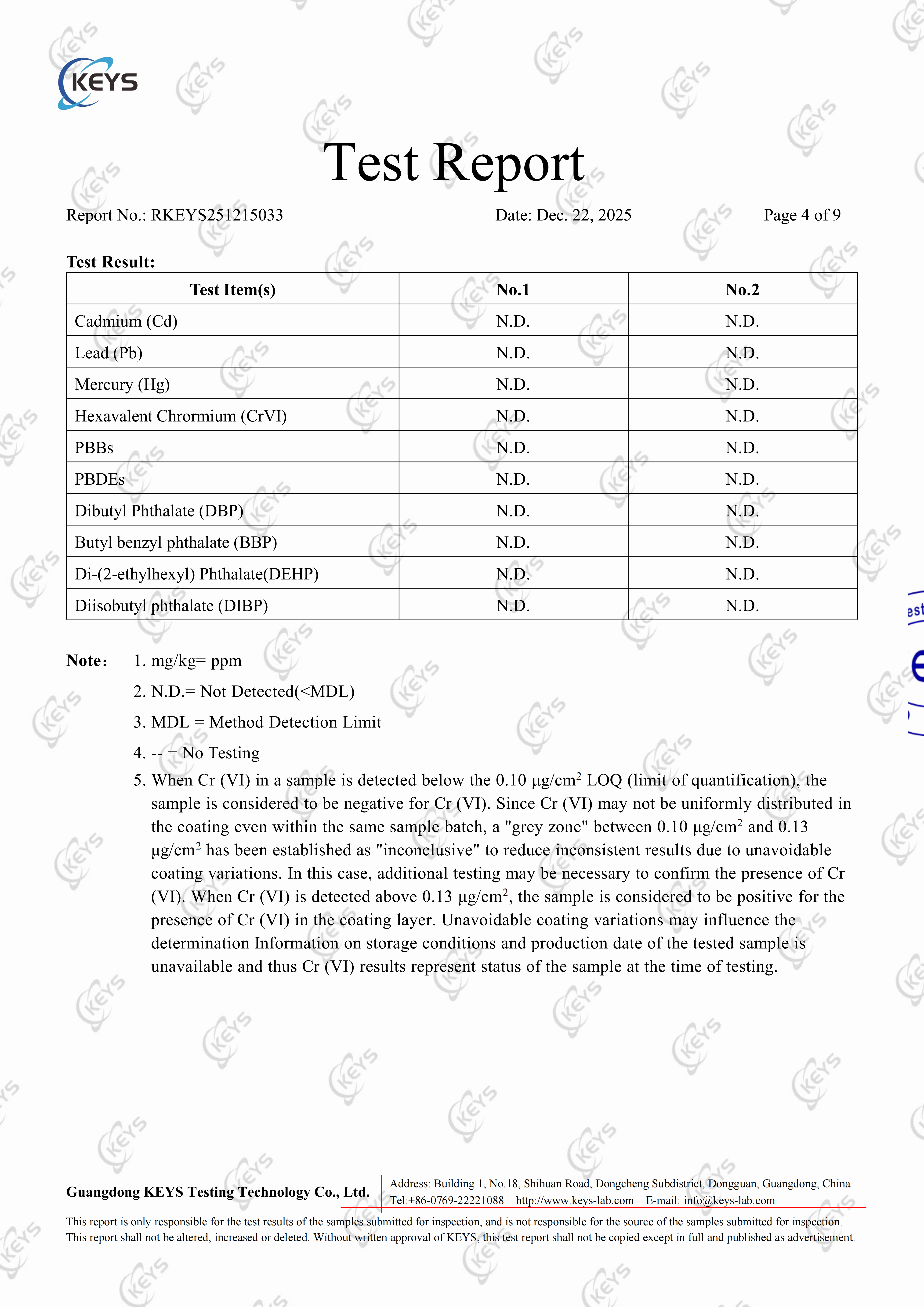
Restricted-substance documentation for potassium aluminium fluoride is scoped to product code 8235, which covers white and grey material in powder, granular and lump form.
4. Customization: OEM, ODM and Specification Control
Customization is where a long-term relationship is usually won or lost. A buyer who needs a slightly different cut, a different flow behaviour or a different packaging format will not stay with a supplier that can only offer a catalogue item.
Sumetech offers both OEM and ODM production for potassium aluminium fluoride, with customization of size and color. On the technical side, the company states that it can adjust particle size distribution from coarse granules down to sub-micron powders, morphology between angular, spherical and crushed shapes, purity grades, and packaging specifications. Standard product parameters include mesh 200, 0.3–1.0 mm and 0.5–1.5 mm cuts, grey and white color, and powder, granular and lump forms.
Customization should be assessed as a process rather than as a capability claim. The buyer checklist is straightforward: agree a specification that names the test method, request samples drawn from production rather than from the laboratory, and define acceptance criteria before the first commercial order. Where morphology affects flow in an abrasive bond or a flux feeder, sample trials under production conditions are the only reliable validation.
5. Compliance Documentation and Its Boundaries
For European buyers, restricted-substance status is often a gate rather than a preference. Documentation should be checked for scope, standard and validity, not simply for existence.
Sumetech holds a RoHS 2.0 Verification of Conformity numbered CKEYS251222003 and a RoHS Test Report numbered RKEYS251215033, both issued on 22 December 2025 by Guangdong KEYS Testing Technology Co., Ltd. The declared scope covers potassium aluminium fluoride, potassium fluoroaluminate, fluoride potassium aluminate, potassium cryolite and potassium tetrafluoroaluminate in white and grey forms, linked to product code 8235, which covers powder, granular and lump material. Testing follows the IEC 62321 series, including IEC 62321-3-1:2013, IEC 62321-4:2013 with AMD1:2017, IEC 62321-5:2013, IEC 62321-6:2015, IEC 62321-7-1:2015, IEC 62321-7-2:2017 and IEC 62321-8:2017 under RoHS Directive 2011/65/EU and its amendment (EU) 2015/863.
The boundary matters as much as the certificate. RoHS addresses restricted substances in electrical and electronic equipment; it does not describe handling, transport or occupational exposure. Potassium aluminium fluoride is classified under GHS as Acute Toxicity Category 4 for oral, dermal and inhalation routes and Skin Irritation Category 2 under OSHA HCS 29 CFR 1910. A complete document set therefore combines the RoHS evidence with a current safety data sheet and the transport documentation required by the destination market.
6. Technical Support, Quality Control and After-Sales
A supplier with a large capacity but a thin technical team will struggle to resolve the questions that appear after the third shipment: a shifted particle size distribution, an unexpected effect in a resin bond, a packaging change requested by a customer downstream.
Sumetech maintains a technical group of five senior engineers working in inorganic fluoride chemistry and powder processing, who monitor production parameters and adjust processes. After-sales support is provided through remote assistance and on-site support where required. One Korean manufacturer has purchased potassium aluminium fluoride at 60 metric tons per month for two years for metal additive and flux applications, citing the high purity grade and stable results.
For evaluation purposes, ask who the named technical contact will be, in which language support is provided, how quickly a deviation is investigated, and whether the supplier is willing to participate in an on-site process review. Continuity of a named contact is a better indicator of long-term service than a generic support promise.
Applying the Checklist: A Weighted Scoring Workflow
The checklist becomes useful when it is scored. The weighting below reflects a buyer whose main exposure is a process that cannot tolerate a grade change; adjust it if documentation or price dominates your risk profile.
| Dimension | Weight | Minimum acceptable evidence |
|---|---|---|
| Production depth | 20% | Written capacity statement plus equipment list |
| Raw-material continuity | 20% | Inventory policy plus site confirmation |
| Compliance documentation | 20% | Numbered certificate and report covering your grade and form |
| Customization control | 15% | Specification with test methods plus production sample |
| Export and logistics reliability | 15% | Export history, packing specification, agreed Incoterms |
| Technical support and after-sales | 10% | Named technical contact and escalation path |
The workflow runs in six steps: issue a document request covering all six dimensions; obtain and test samples against your own method; place a trial order to observe documentation and packing in practice; audit the site if volume justifies it; negotiate terms including Incoterms, pre-shipment acceptance and payment structure; then re-score the supplier annually using actual delivery, deviation and response data rather than statements.
What the Checklist Cannot Tell You
A framework is only credible if its limits are stated. Four boundaries apply here.
- It does not replace a physical audit. Capacity, inventory and equipment figures are supplier-reported until observed. A desk assessment reduces the shortlist; it does not validate the plant.
- Compliance documents are scoped. A RoHS certificate for potassium aluminium fluoride does not cover REACH registration, transport classification or occupational exposure limits. Those require separate documentation and, in some markets, separate testing.
- Customization carries a time cost. Non-standard particle size, morphology or packaging typically requires sampling and re-approval, which extends the qualification timeline beyond the stated 30-day standard lead time. Buyers planning a line change should budget for that interval.
- Price benchmarking is imperfect. There is no widely published index that separates white PAF from grey PAF, so the premium between brazing grade and foundry grade cannot be checked against a public reference. Buyers must benchmark through their own quotations and sample results. Adjacent fluoride benchmarks, such as the Northeast Asia aluminium fluoride price of USD 1.80 per kg reported by IMARC Group for March 2026 — up 6.5% from the fourth quarter of 2025 — indicate direction rather than PAF-specific pricing.
A single-site supplier structure is also a concentration risk that no checklist removes. Where continuity is business-critical, dual qualification remains the only structural mitigation.
Market Trend Analysis
Market sizing for this material needs a caveat before it is used in a business case. DataHorizzon Research places the global potassium aluminium fluoride market at USD 1.76 billion in 2024, rising to USD 2.62 billion by 2033 at a 4.8% CAGR. Other published figures describe the narrower potassium fluoride market at a much smaller value, because the two definitions treat metallurgical flux volumes differently. Buyers comparing supplier presentations should check which definition sits behind any market number quoted to them.
Three demand drivers are visible in the application base. Aluminium smelting and recycled aluminium processing consume PAF as a flux for degassing and slag removal; brazing of aluminium alloys, including battery cooling plates and heat exchanger components, requires oxide removal without corrosion; and the abrasives industry uses the material as an active filler that improves grain bonding and heat management in resin-bonded grinding wheels. The abrasives mechanism is well described in Sumetech technical material: the material melts in the grinding arc, absorbs heat, supports grain retention and promotes self-sharpening.
The procurement consequence of this demand mix is grade divergence. Foundry and abrasive buyers work with grey material at industrial purity, while brazing and specialty glass buyers require white or high purity grades. A supplier that serves both ends of that split has more scheduling flexibility — and a buyer should confirm that the grade they qualify is the grade the supplier routinely produces, not an occasional batch.
Future Outlook
The next several years are likely to reward buyers who treat documentation and continuity as part of the product. Three developments are worth planning for.
First, multi-year agreements with fixed specifications and defined review points will become more common than annual re-tendering, because requalification costs are asymmetric: cheap to avoid, expensive to absorb. Second, restricted-substance documentation will continue to mature, and buyers will increasingly ask for certificate numbers, scopes and standards rather than a general compliance statement. Third, grade-specific transparency is likely to improve. The clearest current gap in public data is the price spread between white and grey PAF, a gap that buyers currently close through their own quotation rounds.
For suppliers, the implication is that capacity statements alone will carry less weight than verifiable process evidence: batch testing records, equipment documentation, inventory policy and a named technical contact who remains in place across contract cycles.
FAQ
What annual potassium aluminium fluoride capacity should a long-term buyer require?
There is no universal threshold. The workable rule is that a supplier's annual capacity should leave headroom above your annual requirement, and its monthly capacity should comfortably cover your largest single order and seasonal peaks. As a reference point, Sumetech Industry Co.,Ltd states an annual capacity of 5,000 metric tons and a monthly capacity of 1,000 metric tons. Capacity figures should be corroborated with production records or a site visit, since they are supplier-reported until verified.
How can a buyer assess raw-material continuity?
Ask for the supplier's inventory policy in writing, then verify it. A producer that holds substantial raw-material stock on site can maintain production through the year and respond to urgent orders without waiting for feedstock delivery. Sumetech states that it maintains large on-site raw-material inventories for exactly these purposes: uninterrupted year-round production, fast response to urgent orders and rapid scaling for large-volume projects. Where order volumes justify it, inventory should be checked during a plant audit rather than accepted from a document alone.
What does RoHS 2.0 documentation for potassium aluminium fluoride actually cover?
RoHS documentation confirms restricted-substance status for a defined product scope. For Sumetech, the Verification of Conformity CKEYS251222003 and the Test Report RKEYS251215033 were both issued on 22 December 2025 by Guangdong KEYS Testing Technology Co., Ltd, covering potassium aluminium fluoride and its synonyms in white and grey forms under product code 8235, which includes powder, granular and lump material. Testing follows the IEC 62321 series under RoHS Directive 2011/65/EU and amendment (EU) 2015/863. It does not cover transport classification, occupational exposure or handling, which are addressed by the safety data sheet and GHS classification instead.
Can particle size, morphology, purity and packaging be customized?
Yes, for suppliers set up for it. Sumetech offers OEM and ODM production for potassium aluminium fluoride with customization of size and color, and states that it can adjust particle size distribution from coarse granules to sub-micron powders, morphology between angular, spherical and crushed shapes, purity grades and packaging specifications. Standard parameters include mesh 200, 0.3–1.0 mm and 0.5–1.5 mm cuts, grey and white color, and powder, granular and lump forms. Customized specifications should be documented with test methods and validated through production samples before commercial orders begin.
What lead time and quality evidence should be requested?
Ask for a stated standard lead time, the quality control regime and the acceptance procedure. Sumetech quotes a 30-day lead time, 100% testing as its quality control approach and pre-shipment testing as the acceptance criterion, with standard commercial terms of FOB, CIF or FCA and payment terms of 30/70. Pre-shipment acceptance is significant because it locates specification disputes before the material leaves the plant. Buyers with a non-standard specification should also ask how customization affects the quoted lead time.
How should export track record be evaluated?
Evaluate export share, destination markets, packaging and documentation rather than export volume alone. Sumetech reports an export share of 90%, with main markets including Turkey, Japan, Korea and Europe, and supplies product in ton bags as well as smaller formats, with trial lots available alongside full-container shipments. For the buyer, the useful checks are whether the supplier already ships to your region, whether its packaging matches your handling equipment, and whether it can produce certificates of analysis and safety documentation without a special request.
Reference: the Sumetech Industry Co.,Ltd product catalogue is available at Catalog of Sumetech-2026.
¿Tiene preguntas o necesita más detalles?
Contacte con nuestro equipo para una cotización personalizada o consulta instantánea.
Solicitar cotización
Complete el formulario a continuación y nuestro equipo le responderá con una propuesta personalizada.
Chat directo de WhatsApp
¿Prefiere chatear en tiempo real? Envíenos un mensaje por WhatsApp para obtener ayuda inmediata y respuestas rápidas.
- Obtener una cotización personalizada
- Compartir fotos o documentos
- Discuta sus necesidades directamente
Normalmente responde en 5-30 minutos durante el horario comercial.