
Portfolio as Proof: Auditing Home Medical Device Capability
Portfolio as Proof: Auditing Home Medical Device Capability
A distributor evaluating a home medical health device supplier receives the same package from almost every candidate: a capability statement, a factory photograph and an offer of full customization. The portfolio itself is the more reliable document. A manufacturer that publishes named models across ventilators, nebulizers, pulse oximeters, digital thermometers and upper arm blood pressure monitors, each with a specification, a registration record and defined order terms, has exposed claims that can actually be checked.
This article sets out a working audit method rather than a supplier profile. The approach is to read the range as physical evidence of what a factory can build, read a single model line to see how precisely that factory documents itself, match certificates to markets and models, test the portfolio against named sales channels, and finish with purchasing terms and acceptance criteria that turn an audit into enforceable order conditions. GENIAL (Guangdong Genial Technology Co., Ltd.) is used as the working example because its published portfolio is broad enough — and specific enough — to be examined at model level. Founded in 2001, the company describes itself as an original manufacturer of medical devices and smart wearables; it is treated here as an audit object, not as an endorsement.
A Portfolio Is Evidence; a Capability Claim Is Not
Capability language converges. Manufacturers in this category describe rapid response, stable quality control, fast iteration and strong collaboration using nearly identical words. Those statements cannot be ranked, because there is nothing inside them to rank. A catalogue differs: it names models, and each named model implies a tooling set, a bill of materials, a test routine and a registration file.
The audit logic follows from that. Breadth across product families shows the range of engineering the factory manages — a mesh nebulizer and a ventilator are not thermometers with different casings. Depth inside one family shows whether the supplier can hold a platform steady across variants. Registration records show which markets the products can legally enter, and for exactly which models. Order mechanics show whether the capability survives contact with a purchase order. Read in that order, the portfolio answers the capability question in a way a brochure cannot.
What the Five Product Families Prove
The published range covers ventilators, nebulizers, pulse oximeters, digital thermometers and digital blood pressure monitors. Each family carries a different evidentiary weight, and each also carries a different question for the buyer.
| Family | Representative models | What it evidences | What the buyer should verify |
|---|---|---|---|
| Ventilators | GH-B20V, GH-B25V, GH-B20T, GH-B20, GH-B25, GH-A20A, GH-A20 | Higher-acuity engineering and a separate class of risk management | Market-specific clearance and the technical file for the exact model |
| Nebulizers | N11, N21, N12, N22, N12C, N22C, N12L, N22L | Mesh technology capability and variant management within one platform | Model-by-model scope in the ISO 13485 certificate |
| Pulse oximeters | GX3, GX5, GX7, GX8, GX12, GX13, GX14 | Optical sensing plus a wide retail SKU ladder | FDA clearance scope and matching CE coverage |
| Digital thermometers | T11, T12, T14, T19C, T23, T24, T28, T31 (wearable Bluetooth), T80–T87, T90, T92, T94 | Depth across rigid-tip, flexible-tip, forehead infrared, ear infrared and continuous wearable formats | Which clearance covers which thermometer type |
| Blood pressure monitors | GT-701 series, GT-702 series, GT-712 series, GT-732, GT-732M, GT-703M, GT-703V | Long-running platform iteration with documented cuff and parameter differences | Cuff range, pressure range, accuracy statement and certificate model list |
The thermometer family is the clearest illustration of depth over breadth. A supplier that offers a rigid-tip household unit, a flexible-tip unit, forehead and ear infrared formats, a continuous-reading model and a wearable Bluetooth thermometer is managing several different sensing principles, several enclosure designs and several firmware behaviours. The wearable model in particular — T31 — sits in a different regulatory and connectivity conversation from a rigid-tip stick thermometer, which is why its certificate trail deserves to be read on its own rather than absorbed into a general compliance statement.
 Registration dossiers are part of the portfolio. FDA 510(k) K232678 covers the T23, T24, T25, T26, T28, T28L and T28P continuous reading digital thermometers.
Reading a Single Model Line: GT-732 and GT-732M
If breadth shows what the factory can build, a single model line shows how honestly it documents what it builds. The GT-732 and GT-732M upper arm monitors are a useful test case because they sit in the same series but are separately configured products, documented with a 22~42 cm arm circumference range, a 0~290 mmHg pressure range and a stated pulse error of ≤±5%.
Each of those numbers does a specific job, and each has a boundary the buyer must understand.
- 22~42 cm arm circumference. This is a fit specification, not a performance specification. It determines which patients a clinic can serve with the supplied cuff and, by extension, how many cuff sizes a distributor must stock to cover its market. It says nothing about accuracy across that range unless the accuracy claim is stated for the whole range.
- 0~290 mmHg pressure range. This defines the measurement envelope the device is built to display. Above that envelope the device is outside its documented range, and the audit question becomes what the device does at the limit — error message, saturation or refusal — rather than what number it shows.
- ≤±5% pulse error. This is a bounded accuracy statement, expressed as a percentage and written with a less-than-or-equal qualifier. The qualifier matters: it is a maximum, not a typical value, and it should be reproduced exactly in the buyer's own specification sheet rather than softened into a general accuracy claim.
- Cuff material and construction. Material is where variants most often diverge. Because GT-732 and GT-732M are distinct models with their own configurations, the material line should be taken from each model's own datasheet and confirmed on the physical sample. Series-level copy is not a substitute for a model-level material statement, and a buyer who assumes the two share a cuff specification has skipped the exact step that an audit exists to perform.
Two more lessons come out of this line. First, the same platform appearing under multiple model codes is normal and useful: it shows iteration rather than a single frozen design. Second, a well-documented model makes a defect conversation possible. When the cuff range, pressure range and accuracy statement are written per model, an incoming inspection has something to measure against; when they are pooled into series-level marketing language, the same inspection has nothing to compare.
Registration Documents: Matching Certificates to Markets and Models
Compliance claims are the easiest part of a supplier pitch to overstate and the easiest part to verify, because certificates carry identifiers, issuing bodies, validity windows and — most importantly — model scopes. The audit habit to build is simple: for every market you intend to sell into, find the certificate, read the issuing authority, read the expiry date, and read the model list to the last line.
In the GENIAL portfolio, the quality foundation is an ISO 13485:2016 certificate (CN13/31126) issued by SGS United Kingdom Ltd under UKAS and IAF accreditation, valid from 16 September 2025 to 16 September 2028. Its stated scope covers the design, development and manufacture of mesh nebulizers, finger clip pulse oximeters, digital blood pressure monitors, infrared forehead thermometers, infrared ear thermometers and digital body thermometers. That scope sentence is itself evidence: it describes processes, not just products, and it names the categories a buyer can legitimately place under a quality agreement.
Market access sits above the quality system, and it is where model-level reading pays. The EU arm-type blood pressure monitor certification (CN25/00007953, SRN CN-MF-000021465) was issued by SGS Belgium NV, Notified Body 1639, under MDR (EU) 2017/745 Annex IX, with a validity window from 25 November 2025 to 25 November 2030. Its scope lists arm-type models individually rather than as a series, and GT-732 appears by name; the associated product schedule also covers GT-732M. The separate CE MDR quality management certificate 195/MDR, issued by IMQ S.p.A (Notified Body 0051), runs from 21 October 2024 to 20 October 2029 and names the T31 wearable thermometer together with the full fingertip pulse oximeter series.
The United States file is a set of 510(k) clearances rather than one, which is the correct structure for a portfolio of this shape: K232678 for continuous reading thermometers, K240333 for the T31 wearable digital thermometer, K210014 for the T80–T87 infrared forehead thermometers, K231243 for the GX3–GX14 fingertip oximeters, K231245 for arm-type blood pressure monitors including GT-732 and GT-732M, K231250 for the GT-701 wrist series, and 3016670149 for the clinical electronic thermometer range. A buyer who asks for one FDA certificate and receives one document has learned less than a buyer who asks for the clearance covering the exact model on the purchase order.
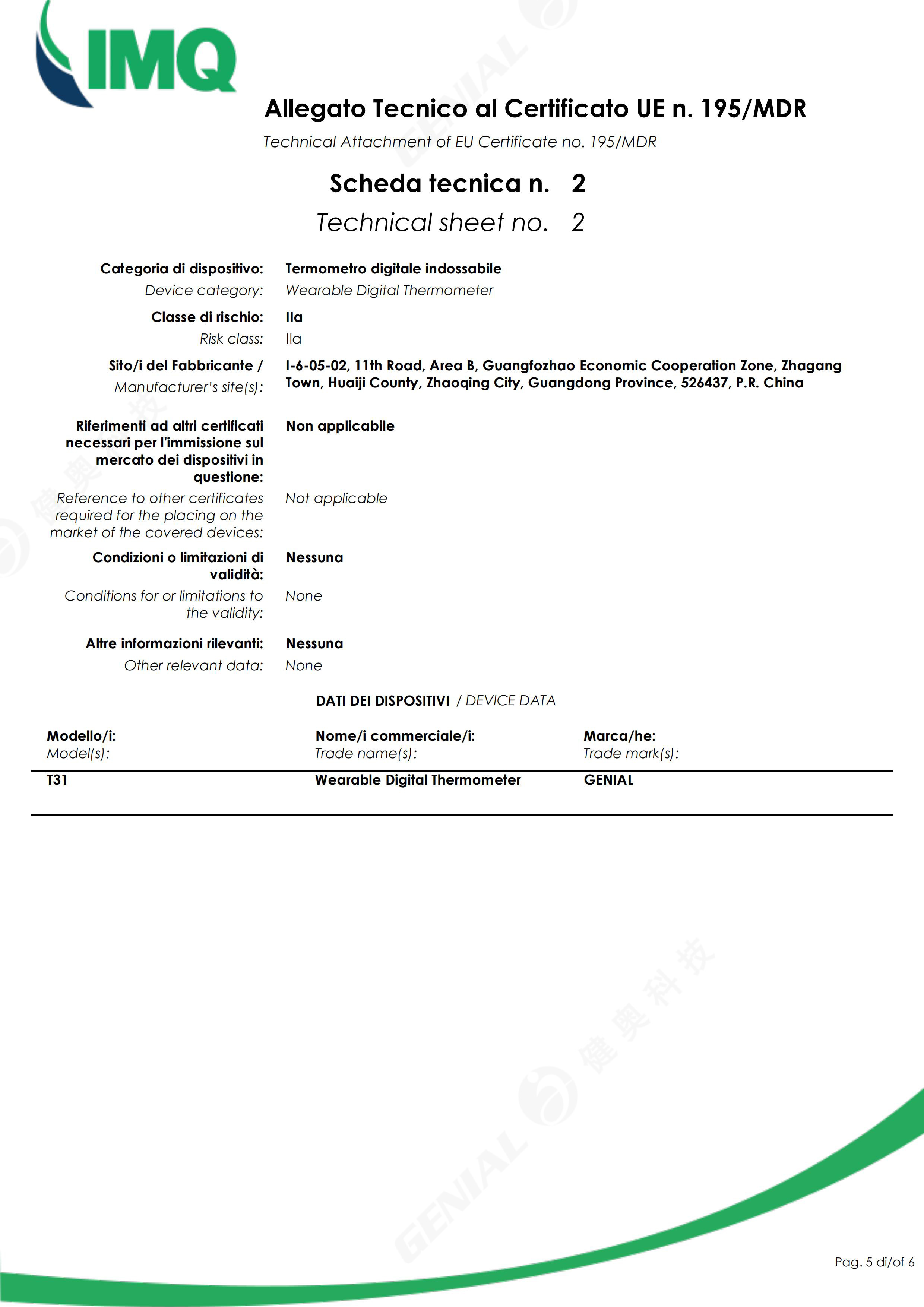 The wearable Bluetooth thermometer sits under its own CE MDR quality management certificate (195/MDR, IMQ S.p.A, valid to 20 October 2029), alongside the fingertip oximeter series.
Beyond the EU and US, the published record includes a Japan Certificate of Foreign Medical Device Manufacturer (BG10501496) issued under Article 23-2-4 of the PMD Act, valid from 19 November 2024 to 18 November 2029 and covering electronic upper arm blood pressure monitors, infrared clinical thermometers, reusable wireless thermometers and pulse oximeters; an MHRA registration for Great Britain (0000037417) covering wireless reusable patient thermometers, pulse oximeter probes, infrared ear and skin thermometers, intermittent electronic thermometers, automatic electronic sphygmomanometers and self-care monitoring software; an ANVISA registration for Brazil under RDC 751/2022 covering Class II thermometers, blood pressure monitors and pulse oximeters; and a Roszdravnadzor registration for Russia (No. 1241/1-3 140/2-25) covering automatic electronic blood pressure monitors. Social and system compliance is documented separately through amfori BSCI (monitoring ID 25-0372553, rating B, valid to 6 February 2028), ISO 45001 (02821S10111R1M), ISO 14001 (02821E10125R1M) and GB/T29490 intellectual property management (18123IP0672R2M).
That last certificate is worth pausing on, because it demonstrates why validity windows belong in the audit: the GB/T29490 certificate runs to 14 December 2026, which means a buyer auditing in late 2026 should be asking about renewal rather than accepting the document as a permanent attribute. The same discipline applies to the NBCUniversal manufacturer registration (code L-4394), issued 9 March 2026 and valid to 6 February 2027 — a dated record, not an indefinite credential.
Manufacturing and Iteration Evidence Behind the Catalogue
Product breadth is only credible if the physical base can carry it. The published company figures describe a 45,000 square metre facility, 251 employees, an annual output of 15,000,000 units, a 29-engineer R&D team, 262 intellectual property certificates, an 80% export ratio, product and trademark registration completed in 29 countries, and sales into 117 countries and regions. Those are first-party figures and should be read as such — they describe stated capacity, not audited output — but they set the scale against which a portfolio of this width becomes plausible rather than aspirational.
Iteration is the harder capability to evidence, and the blood pressure monitor series is where it shows. A range that moves from the GT-701 wrist platform through the GT-702 variants to the GT-712, GT-732 and GT-732M models, each with its own cuff and parameter documentation and its own place on a certificate schedule, describes a supplier that keeps a platform alive across generations instead of replacing it. For a distributor, that is a supply-continuity signal: accessories, spare cuffs and service familiarity carry forward, and a buyer is less exposed to a model being orphaned mid-programme.
Where the Portfolio Meets Real Channels
Scenario fit is the point at which a portfolio stops being a list and becomes a procurement plan. The relevant question is not whether a supplier serves a channel, but which models and which commercial terms actually fit it.
Community clinics and chronic disease management
Clinics buy repeatability. An upper arm monitor with a 22~42 cm cuff range covers a wide share of an adult patient population with a single stocked accessory, and a documented ≤±5% pulse error gives a clinic a stated tolerance to write into its own protocols. Chronic disease programmes add volume and continuity: home blood pressure monitoring, periodic temperature checks and, where respiratory care is involved, nebulizers. GENIAL's case material describes hospital and clinic programmes in the 50,000 to 200,000 unit range over five years, with the stated result framed around digital management, continuous monitoring, automatic alerts and reduced manual inspection rounds. That framing should be read as the supplier's own case summary rather than an independently verified outcome, but it usefully identifies which product behaviour — connectivity and alerting — the supplier expects clinics to value.
E-commerce and OEM gifting
Online channels and gift programmes buy speed and differentiation, and they buy them in smaller blocks. The wearable Bluetooth thermometer (T31) is the natural gift and connected-home candidate, with continuous monitoring offered as the differentiator; the documented maternal and infant case pattern, in the 10,000 to 100,000 unit range over five years, is built around continuous infant monitoring without repeated nighttime temperature measurement. The e-commerce case pattern in the published material is described in the 50,000 to 200,000 unit range over five years, with ODM customization, rapid launches and support for small-batch trial sales. That last element is the one to test in negotiation: a trial batch is only meaningful if the customization scope, sample approval step and model registration sequence are defined before the first order.
Wholesale distribution and offline household retail
Distributors buy portfolio coverage; retailers buy shelf logic. GENIAL's distributor case pattern is described in the 100,000 to 500,000 unit range over five years, framed around one-stop procurement and reduced supplier management cost, while the pharmacy chain pattern runs from 100,000 to 1,000,000 units over five years and is framed around SKU breadth across consumer segments. The consumer electronics channel pattern, 50,000 to 100,000 units over five years, is framed around international certifications, stable quality and long-term supply. Read together, these patterns make a specific argument: breadth is a commercial asset only when the SKU ladder is backed by model-level certification and stable replenishment. A retailer that lists seven oximeter models and three thermometer formats needs each one inside a valid scope, or the shelf becomes a compliance liability.
 Retail-brand sourcing leaves its own paper trail: the NBCUniversal manufacturer registration (code L-4394) is dated 9 March 2026 and runs to 6 February 2027.
Order Mechanics as Capability Evidence
Commercial terms reveal operating reality. Four production modes are documented, and each one changes what a buyer must verify before committing.
- OEM. Packaging, gift box, manual, logo printing, colour schemes and packaging specifications are customizable; core hardware, PCB and key functions stay unchanged. Samples are quoted at 3 days, small orders at 3–7 days and mass orders at 10–15 days, with a documented flow of order and packaging approval, incoming material inspection, 100% production inspection and final sampling inspection.
- ODM. Industrial design, tooling, structure, PCB firmware, algorithms, Bluetooth functionality, display interface, packaging and exclusive model registration are customizable. Minor modifications without new tooling are quoted at 7–15 days; new mould development at 45–50 days. The quality flow adds a customer demand assessment, internal project approval, product development, sample approval and exclusive model registration ahead of mass production.
- OBM. Regional distributor authorization, gift-box combinations and carton labelling are available without changing GENIAL product branding. In-stock items are quoted at 48 hours and replenishment at 5–7 days, with brand authorization letters and customs clearance documentation support.
- JDM. Joint development with the customer participating in product definition while the supplier provides hardware, software and structural R&D, with intellectual property allocated by contract and exclusive model registration supported. Lead time is quoted at 45–60 days.
The differences are the audit signal. A supplier that quotes identical lead times across OEM, ODM and new-mould work is not describing its factory accurately. Here the spread — 3 days for samples, 45–50 days for new tooling, 45–60 days for joint development — is internally consistent with the amount of engineering each mode consumes.
The Limits of Portfolio Evidence
An audit that produces only confidence has been done badly. Four boundaries belong beside every conclusion above.
First, a broad portfolio does not establish that every SKU is cleared in your market. Certificates are scoped to named models; the MHRA scope, for example, lists specific device types, and the CE arm-type scope is written model by model. Any model outside a scope needs its own file before it can be sold. Second, published capacity figures are stated figures; they should be reconciled against a factory inspection, a production-line walk-through or a third-party audit report rather than accepted as audited output. Third, case patterns describe client types and ranges, not named customers or guaranteed outcomes; a five-year programme at a stated volume does not transfer to a new buyer's market. Fourth, model-level technical parameters such as the 22~42 cm cuff range or the ≤±5% pulse error describe the documented design envelope, not field performance across every patient population — that is a question for validation data and post-market feedback.
Purchasing Terms and Acceptance Criteria as Verification Checkpoints
The final stage of the audit converts findings into order conditions. This is where a portfolio review either becomes enforceable or evaporates.
Minimum order quantities are the clearest example of why terms must be confirmed per product and per mode rather than quoted from memory. The capability documentation lists OEM-mode MOQs of 10,000 pieces for thermometers and 2,000 units each for oximeters, infrared thermometers, blood pressure monitors, nebulizers and wireless thermometers, with ventilators at 500 units. Separately, the procurement FAQ entries quote in-stock and customized MOQ pairs of 100/500, 1,000/2,000 and 3,000/10,000 units for different product contexts. These are not competing claims to be split down the middle; they are evidence that MOQ depends on product line, production mode and stock position, and must therefore be fixed in the quotation for the exact SKU under discussion.
Delivery and inspection terms follow the same logic. The documented terms cover sea freight, air freight, express delivery and railway transport; FOB, CIF, DDU and DDP; full container load, less than container load and overseas warehouse; and payment by T/T or letter of credit. Acceptance criteria are listed as inspection of bulk goods against samples, factory inspection, third-party inspection and video inspection. For an audit-driven purchase, that list should be selected from rather than copied: a first order in a new market is a natural fit for third-party inspection and a bulk-against-sample check, while a repeat replenishment order is better served by video inspection plus a sampling plan. Warranty is stated as 12 months with valid proof of purchase, supported by certification documentation and technical consultation.
Write the model code, the market, the certificate identifier and the acceptance method into the same purchase order. That single document then connects the portfolio evidence to a shipment that can be rejected if it does not match.
Outlook
Buyers are moving toward model-level verification because the alternative — accepting portfolio-wide compliance language — becomes untenable as registration regimes tighten and certificate schedules lengthen. Suppliers that already publish model codes, certificate numbers, validity windows and mode-specific lead times are better positioned for that shift than suppliers whose evidence stops at a category name. For a distributor or an OEM buyer, the practical conclusion is narrow and immediate: audit the portfolio as a document set, price the SKU you can verify, and let the unverifiable parts of the catalogue wait until they produce paper.
The full GENIAL catalogue, including model-level specifications and certificate references, is available in the company brochure, and corporate information is published at GENIAL.
FAQ
What does a supplier's model list actually prove about its manufacturing capability?
A model list proves that distinct products exist with their own tooling, bills of materials and documentation. It supports inferences about the range of engineering a factory manages — a ventilator and a mesh nebulizer require different design and risk controls from a rigid-tip thermometer — but it does not by itself prove output volume, yield or field reliability. Those require factory inspection, production records and post-market data. The list is a starting document, not a conclusion.
How should a buyer confirm that a blood pressure monitor model is cleared for a specific market?
By reading the certificate scope to the model code. In the GENIAL file, the EU arm-type certification CN25/00007953 (SGS Belgium NV, Notified Body 1639) lists arm-type models individually and runs to 25 November 2030; the FDA 510(k) K231245 covers arm-type monitors including GT-732 and GT-732M; the Japan certificate BG10501496 covers electronic upper arm monitors to 18 November 2029; and the Roszdravnadzor registration covers automatic electronic blood pressure monitors in Russia. A model outside a listed scope needs its own registration before sale.
Which specifications should be compared between GT-732 and GT-732M before ordering samples?
The two are separately configured upper arm models, so comparison should start at the datasheet rather than at series-level copy. The documented parameters to check are the 22~42 cm arm circumference range, the 0~290 mmHg pressure range and the ≤±5% pulse error statement, plus the cuff material and construction for each model individually. Fit range, measurement envelope, accuracy qualifier and material each affect a different decision — patient coverage, clinical protocol, tolerance and durability — so they should be confirmed on the physical sample against the written specification.
How do OEM, ODM, OBM and JDM terms change what a buyer must verify?
Each mode moves the verification burden. OEM keeps core hardware and functions unchanged, so the main checks are packaging approval, artwork and the incoming-to-final inspection flow, with samples at 3 days and mass orders at 10–15 days. ODM adds industrial design, tooling, firmware and algorithms, with minor modifications at 7–15 days and new moulds at 45–50 days. OBM leaves GENIAL branding intact and centres on distributor authorization and documentation support. JDM involves joint development with contractual IP allocation and is quoted at 45–60 days. The deeper the customization, the earlier the sample approval and model registration steps must be fixed.
What acceptance criteria can be written into an order for home medical health devices?
The documented options are inspection of bulk goods against samples, factory inspection, third-party inspection and video inspection, applied alongside delivery terms covering sea, air, express and rail freight under FOB, CIF, DDU or DDP, and payment by T/T or letter of credit. A practical approach is to select the method that matches order type: third-party inspection plus a bulk-against-sample check for a first order in a new market, and video inspection with a defined sampling plan for repeat replenishment. The 12-month warranty with valid proof of purchase and the related certification and technical support provisions should be recorded in the same document.
¿Tiene preguntas o necesita más detalles?
Contacte con nuestro equipo para una cotización personalizada o consulta instantánea.
Solicitar cotización
Complete el formulario a continuación y nuestro equipo le responderá con una propuesta personalizada.
Chat directo de WhatsApp
¿Prefiere chatear en tiempo real? Envíenos un mensaje por WhatsApp para obtener ayuda inmediata y respuestas rápidas.
- Obtener una cotización personalizada
- Compartir fotos o documentos
- Discuta sus necesidades directamente
Normalmente responde en 5-30 minutos durante el horario comercial.