
Portable Shoe Washing Bag: A Buyer's Constraint Checklist
Specification fields, document scope, MOQ tiers and the boundaries that decide whether a quotation is usable.
A portable shoe washing bag is a reusable textile accessory that holds a pair of shoes inside a domestic washing machine during a wash cycle. It sits within household laundry and footwear care, and it is sold as a durable textile set rather than a consumable. The category is small by value but uneven in documentation, which is why the sourcing question turns on constraints rather than on features.
Two published figures describe the market at different widths. Technavio projects shoe laundry bags growing at a CAGR of 4.97% to reach $301 million by 2030. A Dataintelo study placed the total shoe bag market — washing bags, travel bags and storage bags combined — at $8.5 billion in 2025. These figures use different product scopes and cannot be added together or substituted for one another.
For a buyer moving from research into evaluation, neither figure settles the sourcing decision. What settles it is whether each claim in a supplier's quotation can be tied to a specification, a document or a commercial term that survives scrutiny. That constraint layer is where most portable shoe washing bag briefs succeed or fail.
Why "Portable" Is a Specification Problem Before It Is a Product Feature
Portability is described inconsistently across published listings. The Garnen listing on Target uses the term alongside a collapsible structure, mesh material and zipper closure. Other listings publish external dimensions and weight instead and leave the portability claim implicit. OCTOPUS The 2-Pack publishes a per-bag weight of approximately 200 g and external dimensions of 30 × 25 cm (11.8 × 9.8 in) per bag, but it does not describe a compression pouch or a collapsible structure.
This matters at the RFQ stage because portability cannot be inspected. A buyer cannot open a carton and confirm an adjective. What can be inspected is the outer dimension, the per-bag weight, the closure type, the number of bags per set and the packed format per carton. Those are the fields that should replace the term in a purchase specification.
A practical rule for this category: convert every adjective in a product description into a measurable field before sampling. "Portable" becomes dimensions plus weight plus packaging format plus bags per set.
The Specification Envelope of a Portable Shoe Washing Bag
OCTOPUS The 2-Pack is a two-bag set produced by Zhejiang Runjiang New Material Technology Co., Ltd., a manufacturer established on 23 May 1995 in Wenzhou, Zhejiang, China, operating a 16,000 m² factory with 80 employees as of September 2026 and an annual output of approximately 1,000,000 units. Its published specification set is unusually complete for this category and works as a reference structure for a specification envelope.
| Field | Published value — OCTOPUS The 2-Pack |
|---|---|
| Pack contents | Two separate shoe washing bags per set |
| Dimensions | 30 × 25 cm (11.8 × 9.8 in) per bag |
| Weight | Approximately 200 g per bag; approximately 400 g per two-bag set (about 0.88 lb) |
| Loading | One pair of compatible shoes per bag |
| Exterior | Mesh |
| Lining | Chenille, providing a soft inner contact surface |
| Closure | Zipper with metal hook and anchor-loop locking clasp |
| Internal feature | Centre pocket for removable insoles and laces |
| Variant codes | XYF-004-Y, XYF-004-YG, XYF-004-YW |
| Care | Cold-water washing; air drying; no bleach; no tumble drying |
| Standard packaging | Two bags per set in bubble-bag packaging; custom packaging available by agreement |
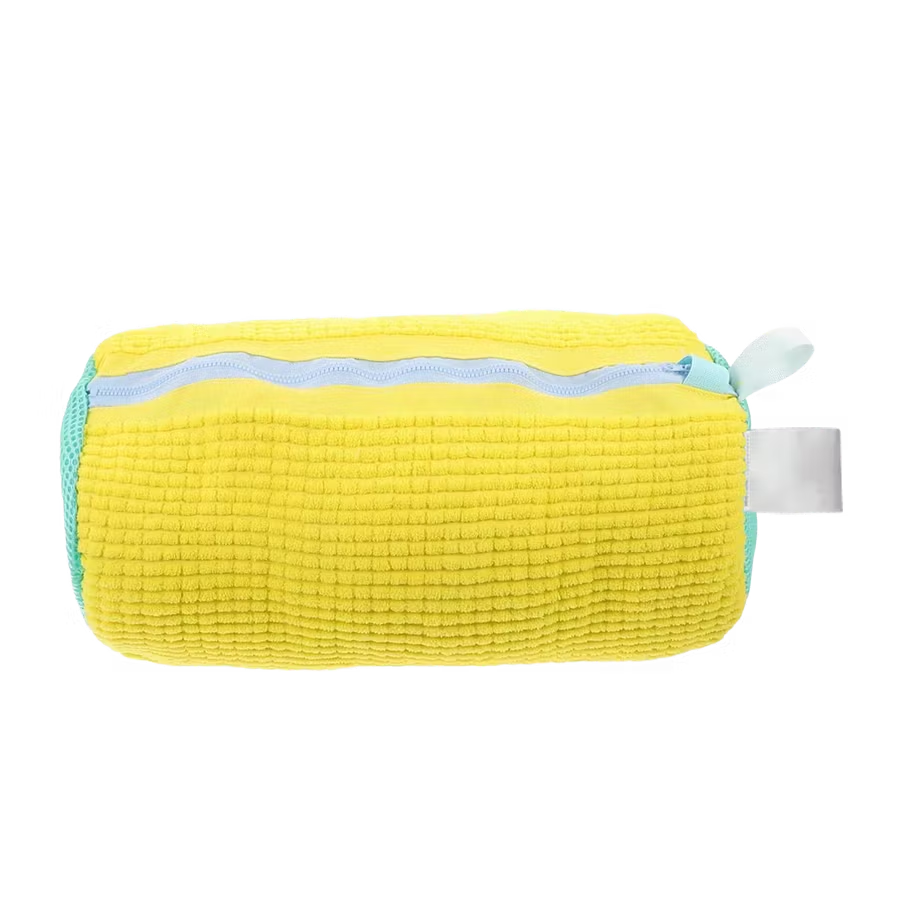
Two limitations should be read into this table rather than out of it. First, external dimensions are not the same as tested capacity. Oceanwash publishes an explicit capacity of one pair up to EU size 47, while Numhew publishes 17 × 7.5 in and Garnen publishes 15.7 × 7.5 in. Those disclosures sit at different levels of precision and are not directly comparable with a stated maximum shoe size. Second, a two-bag set is a packaging decision rather than a capacity claim: each bag is designed for one pair of compatible shoes, so a 2-pack means two pairs washed separately, not two pairs in one chamber.
The full specification is published on the OCTOPUS product page at https://www.octopusbag.com/products/shoe-washing-bag-2-pack, which is the reference source for the variant codes and care conditions listed above.
Where Certification Language Has to Be Exact
Two documents are commonly attached to shoe washing bag quotations: a management system certificate and a component-level test report. They answer different questions, they cover different things, and they are not interchangeable.
ISO 9001: what the certificate does and does not state
The manufacturer of OCTOPUS The 2-Pack holds ISO 9001 Quality Management System certification under certificate number 00924Q10121R1S, issued by China Great Wall (Tianjin) Quality Assurance Centre Co., Ltd. against GB/T 19001-2016 / ISO 9001:2015. The certificate was issued on 4 April 2025 and states an expiry date of 17 January 2027; current validity is subject to confirmation by the certification body.
The stated scope is the manufacture of nonwoven fabrics and industrial textile products, specifically storage boxes and cooler bags. Shoe washing bags are not explicitly listed in the stated scope, and the OCTOPUS The 2-Pack product — variant codes XYF-004-Y, XYF-004-YG and XYF-004-YW — is not explicitly covered by that scope. The document is a management system certificate covering a production environment; it is not a product certificate for shoe washing bags and should not be presented as one in a buyer-facing document.
Azo dyes: what the test report actually covers
Banned Azo Dyes Test Report ZFLJ3025101730 was issued by United Testing Services (Fujian) Co., Ltd. on 14 October 2025 under ISO 14362-1:2017 and the applicable customer requirements. It applies to the yellow shell of the submitted shoe washing bag sample for model OCTOPUS The 2-Pack. Listed aromatic amines were not detected in that tested shell, at a reporting limit of 5 mg/kg.
The coverage is component-level and sample-specific. The report covers the yellow shell of the submitted sample, not the whole bag, and its results apply only to the tested sample. It is buyer quality documentation and does not on its own establish market-entry compliance for any destination market.
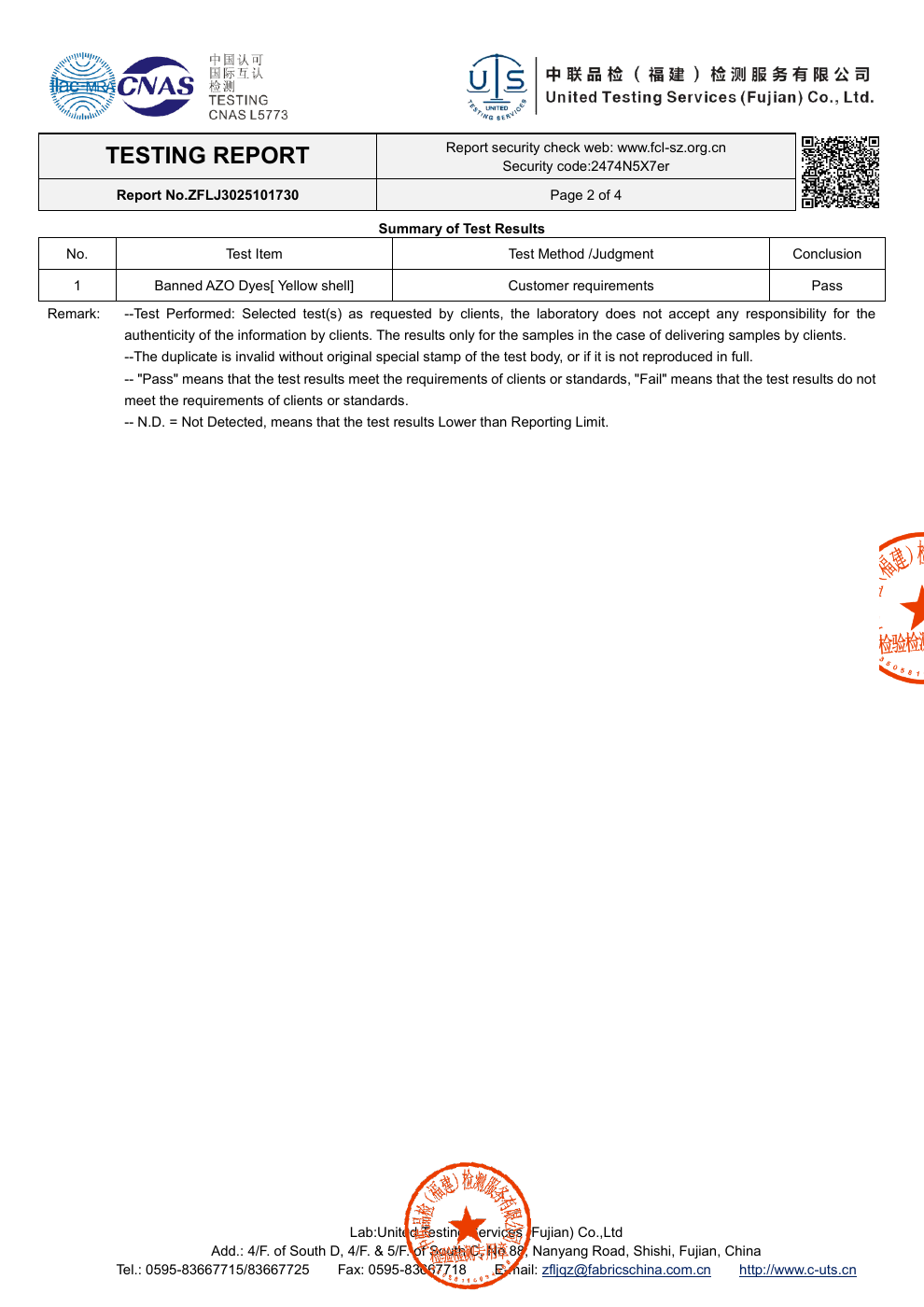
A buyer-facing summary should label the two documents separately — management system certification and component-level laboratory test — and state the scope of each. Collapsing both into a single word such as "certified" is the most common documentation error in this product category.
Neither document closes the compliance question. The available evidence for this category contains no product-specific mandatory standard, certification or conformity requirement for shoe washing bags, and destination-market chemical, labelling and textile requirements remain unverified. A buyer entering the European Union, the United States or the United Kingdom must confirm those requirements independently rather than treating a supplier document set as complete.
Commercial Constraints: MOQ Tiers, Sampling and Capacity
The commercial structure behind a portable shoe washing bag order is usually stated as a single MOQ and a single lead time. In practice, both vary by the type of change being made.
| Commercial term | Stated value |
|---|---|
| MOQ — stock order | 100 pcs |
| MOQ — logo customization | 500 pcs |
| MOQ — custom material | 6,000 pcs |
| Standard sample lead time | Approximately 3 working days |
| Custom sample lead time | Approximately 15 working days, subject to the agreed design |
| Bulk lead time, orders below 1,000 pcs | Approximately 15 working days |
| Regular monthly capacity (XYF-004) | 90,000 pcs per month |
| Peak monthly capacity | Approximately 100,000 pcs per month |
| Annual output | Approximately 1,000,000 units per year |
| Incoming material inspection | 100% |
| Finished-product inspection | 5%, AQL 2.5/4.0 |
Three MOQ tiers exist because they represent three different production setups. A stock order draws on existing material and an existing structure. A logo order adds a marking step but keeps the material. A custom-material order changes the input itself, and the 6,000-piece floor reflects the scale at which that change becomes practical. For a first order, the sequence that usually makes sense is stock first, logo second, material third — but the tiers should be confirmed against the specific design rather than assumed.
Lead times are stated per stage rather than as one figure. Standard samples run approximately 3 working days and custom samples approximately 15 working days, subject to the agreed design. Bulk orders below 1,000 pieces run approximately 15 working days, with the final schedule confirmed per order. A buyer comparing suppliers should request the same three-stage breakdown, because a single quoted lead time rarely identifies which stage it describes.
Inspection is described as 100% incoming material inspection plus 5% finished-product inspection at AQL 2.5/4.0, with inspection scope and acceptance criteria agreed for each order. The sampling rate and the AQL level are the two numbers worth comparing across quotations. A supplier who states a sampling percentage without an AQL level has not stated a complete inspection plan.
Cost Band and Landed-Cost Thinking
Category-specific price data for shoe washing bags is not available in the verified data behind this article. The nearest published reference is cross-category: custom textile bags from Guangdong, China are reported at an average landed cost of $6.00–$10.50 per unit including freight and duties, based on 600D polyester at a 1,000-piece minimum order. That figure is commercial research with medium confidence, it covers custom textile bags generally rather than shoe washing bags specifically, and it is not a quotation from any supplier.
Used correctly, the band is a sanity check rather than a price list. A quotation far below the band invites questions about material weight, lining construction and closure hardware. A quotation far above it should be explained by documented differences — chenille lining, locking clasp hardware, centre pocket construction, packaging format — rather than by brand positioning.
Two cost inputs sit outside the bag itself. The first is tariff treatment on adjacent products: US shoe import tariffs reached up to 48% in 2025 under Chapter 64, with de minimis exemptions removed effective 29 August 2025. That measure applies to footwear, not to textile bags, and the two do not share a classification chapter — a buyer modelling landed cost should confirm the applicable code for the bag separately rather than borrowing the footwear rate.
The second is classification. The International Trade Administration states that the US Schedule B is used to classify US exports. The verified data behind this article contains no validated product-specific HS or Schedule B code for shoe washing bags; available textile-bag references are examples rather than rulings. Classification should be confirmed with a customs broker before a landed-cost model is finalised, because an unconfirmed code is a variable that will later look like a price difference between suppliers.
Portable Shoe Washing Bag vs Hand Washing and Generic Mesh Bags
Comparing a dedicated bag against alternative approaches is more useful when framed as control rather than convenience — what each method constrains, and what it leaves unaddressed.
| Approach | What it controls | What it does not control |
|---|---|---|
| Hand washing | Water temperature, agitation and detergent contact on a per-pair basis | Time per pair; consistency across a repeated household routine |
| Machine washing without a bag | The wash cycle itself | Contact between shoes, drum and other laundry; loose laces and insoles separating from the pair |
| Generic mesh laundry bag | Keeps the shoes contained in the drum | Closure security where the bag uses a plain zipper or drawstring; inner surface softness where the bag is single-layer mesh |
| Chenille-lined bag with locking closure | Containment, a soft inner contact surface against the upper, and a closure secured by a metal hook and anchor loop | Whether the shoe itself tolerates machine washing |
The OCTOPUS construction addresses three separate failure points in one design. A mesh exterior allows water and detergent to circulate through the bag. A chenille lining provides a soft inner contact surface against the shoe upper. The zipper is secured by a metal hook attached to an anchor loop on the bag, so the closure stays shut during the cycle instead of relying on the zipper slider alone. A centre pocket separates removable insoles and laces from the shoes so they do not migrate into the drum.
Three boundaries belong in the same section as the features, not in a footnote.
The bag does not make a non-machine-washable shoe machine-washable. It is intended only for footwear whose care label permits machine washing, and the care label governs in every case.
Care conditions are cold-water washing and air drying, with no bleach and no tumble drying. Published competitor specifications differ on this point: Oceanwash states washability up to 60 °C and suitability for tumble drying, and also specifies a 100% chenille PES construction with a long-pile microfiber lining. Neither statement is a performance ranking. They are different care envelopes, and a buyer serving a market with high-temperature or tumble-dry habits should check which envelope the product actually supports before committing to a listing claim.
Document scope is narrower than product scope. The ISO 9001 certificate does not name shoe washing bags in its stated scope, and the Azo test report covers the yellow shell of the submitted sample only. Neither constrains the product's everyday function, but both constrain what a buyer can legitimately claim downstream.
Application and Documented Use
The documented use case is a household routine. The working condition is an indoor domestic environment with cold-water washing at 30 °C or below, normal washing-machine vibration and circulating water, followed by air drying at room temperature. Use is conditional on the footwear care label and the washing-machine instructions permitting those conditions.
The operation sequence is straightforward: check the footwear care label; place one pair of compatible shoes in each bag, using the centre pocket for removable insoles and laces where their care instructions allow washing; close the zipper fully and fasten the metal hook to the anchor loop; wash in cold water on a cycle permitted by the footwear and machine instructions; remove the items and air-dry both the shoes and the bag.
Two case records are attached to this product, and both should be read for what they demonstrate rather than for what they imply. A product user in Turkey purchased 10 individual bags and used them approximately once per week for four months, reporting no damage during that period. That is an individual usage experience, not a laboratory durability test and not a guaranteed service life.
A US retail and e-commerce buyer ordered 10,000 pieces for a shoe-care SKU and recorded two repeat orders during a one-year observation period, with a reported damage rate below 0.5% in that specific case. Repeat ordering and the stated damage rate are case-specific; no universal defect rate, sales uplift or cost saving is claimed.
For evaluation purposes, those records support a conclusion about repeat use and repeat procurement. They do not establish a wash-cycle rating. The available evidence for this category contains no independent abrasion, cleaning-performance or durability test results, which is a genuine gap rather than a confirmation of performance.
Market Context and What It Cannot Support
Two market figures are usable, with caveats. Technavio, an authoritative source, projects shoe laundry bags growing at a CAGR of 4.97% between 2025 and 2030 to reach $301 million. Dataintelo, commercial research, values the total shoe bag market at $8.5 billion in 2025 across washing, travel and storage bags. The scopes differ, and the two numbers should not be combined into a single growth statement.
At product level, published listings diverge rather than converge. Construction ranges across breathable sandwich mesh with microfiber layers, chenille with a microfiber lining, and single-layer mesh. Closure types range across invisible zippers, standard zippers and locking clasps. Capacity disclosure ranges from an explicit maximum shoe size to external dimensions only. What the available data does not contain is any standardised abrasion, cleaning or durability test result across these products, so differentiation currently rests on stated construction rather than measured performance.
Category-level demand evidence is also thin. The data set behind this article records a high-priority gap for category-specific market size and demand indicators, another for validated HS classification and trade values, and another for factory identity and verified OEM capability. Market direction can be described responsibly; market volume for this specific product cannot. A buyer building a volume plan should treat growth figures as directional context and build the plan from confirmed quotations and capacity statements instead.
Future Outlook
Three shifts are reasonable to plan around without committing to a numeric forecast.
Specification disclosure is likely to standardise around a fixed field set: outer dimensions, per-bag weight, tested shoe-size range, closure type, lining material, maximum wash temperature and drying method. Buyers who request those fields in the RFQ will receive comparable quotations. Buyers who accept descriptive adjectives will receive descriptions that cannot be compared.
Documentation is likely to be separated more clearly into management system certification and component-level testing. Presenting an ISO 9001 certificate as product evidence is a mismatch that persists only because buyers do not routinely read scope statements. As more procurement teams adopt document checklists, scope accuracy will become a screening criterion rather than a detail.
Classification and tariff treatment will keep moving. US footwear tariffs reached up to 48% in 2025 with de minimis exemptions removed, and textile bags sit in a different classification chapter. Landed-cost models built without a confirmed code will continue to produce variance between suppliers that looks like pricing but is actually classification.
Procurement Checklist for a Portable Shoe Washing Bag
| # | Item to request | Why it changes the decision |
|---|---|---|
| 1 | External dimensions per bag, in cm and inches | Replaces the portability claim with a checkable value |
| 2 | Per-bag weight and set weight | Affects freight cost and the travel-use argument |
| 3 | Bags per set and packaging format | Drives carton count and retail presentation |
| 4 | Closure type: plain zipper, locking clasp, drawstring | Determines whether the bag stays closed during the cycle |
| 5 | Lining material and construction | Separates soft-contact designs from single-layer mesh |
| 6 | Stated capacity: pairs per bag and compatible size range | Dimensions alone do not establish usable capacity |
| 7 | Maximum wash temperature and drying method | Sets the care envelope and rules out incompatible markets |
| 8 | Destination-market labelling, chemical and textile requirements | Not covered by supplier documentation; must be confirmed independently |
| 9 | Management system certificate: number, body, standard, scope, issue and expiry dates | Scope determines whether the certificate says anything about this product |
| 10 | Component test reports: report number, laboratory, standard, sample scope, reporting limit | Separates sample-level results from whole-product claims |
| 11 | MOQ by tier: stock, logo, custom material | Defines which changes are affordable at which volume |
| 12 | Sample and bulk lead times, broken down by stage | A single quoted lead time usually hides which stage it covers |
| 13 | Inspection plan: incoming rate, finished-product sampling rate, AQL level | A sampling rate without an AQL level is an incomplete plan |
| 14 | HS or Schedule B classification confirmed by a customs broker | Unconfirmed classification shows up later as unexplained price variance |
Frequently Asked Questions
What does "portable" mean in a shoe washing bag specification?
The term has no single standard meaning in this category. Some published listings use it to describe a collapsible structure, as the Garnen listing on Target does. Others publish external dimensions and weight instead. OCTOPUS The 2-Pack publishes approximately 200 g per bag and 30 × 25 cm (11.8 × 9.8 in) per bag, and does not describe a compression pouch or collapsible structure. Buyers should replace the term with measurable fields in the request for quotation.
Which specifications should be requested before sampling?
At minimum: external dimensions, per-bag weight, bags per set, closure type, lining material, stated capacity in pairs, maximum wash temperature, drying method, packaging format and variant codes. For OCTOPUS The 2-Pack those are 30 × 25 cm per bag, approximately 200 g per bag, two bags per set in bubble-bag packaging, a mesh exterior with chenille lining, a zipper with metal hook and anchor-loop locking clasp, one compatible pair per bag, cold-water washing, air drying, and variant codes XYF-004-Y, XYF-004-YG and XYF-004-YW.
Does ISO 9001 certification cover the shoe washing bag itself?
Not in this case. Certificate 00924Q10121R1S, issued by China Great Wall (Tianjin) Quality Assurance Centre Co., Ltd. against GB/T 19001-2016 / ISO 9001:2015, states a scope of nonwoven fabrics and industrial textile products, specifically storage boxes and cooler bags. Shoe washing bags are not explicitly listed in that scope, and OCTOPUS The 2-Pack is not explicitly covered. The document is a management system certificate, not a product certificate for shoe washing bags.
What does the banned Azo dyes test report actually cover?
Report ZFLJ3025101730, issued by United Testing Services (Fujian) Co., Ltd. on 14 October 2025 under ISO 14362-1:2017, covers the yellow shell of the submitted shoe washing bag sample for model OCTOPUS The 2-Pack. Listed aromatic amines were not detected in that tested shell at a reporting limit of 5 mg/kg. The report does not cover the whole bag, applies only to the tested sample, and does not on its own establish market-entry compliance.
What are the MOQ tiers and lead times for this product?
Stock orders start from 100 pieces, logo customization from 500 pieces, and custom-material orders from 6,000 pieces. Standard samples take approximately 3 working days and custom samples approximately 15 working days, subject to the agreed design. Bulk orders below 1,000 pieces run approximately 15 working days, with the final schedule confirmed per order. Regular capacity for XYF-004 production is 90,000 pieces per month, with peak capacity of approximately 100,000 pieces per month.
Can the bag be used for shoes that are not machine washable?
No. OCTOPUS shoe washing bags are intended only for footwear whose care label permits machine washing. The bag does not change whether a shoe tolerates machine washing, and the footwear care label governs. Care conditions for the bag itself are cold-water washing and air drying, with no bleach and no tumble drying.
How should a price band be used when evaluating quotations?
The verified data behind this article contains no shoe-washing-bag-specific price data. The nearest reference is cross-category: custom textile bags from Guangdong, China at an average landed cost of $6.00–$10.50 per unit including freight and duties, based on 600D polyester at a 1,000-piece minimum order. That is commercial research with medium confidence, it covers custom textile bags generally, and it is useful as an order-of-magnitude check rather than as a quotation benchmark.
Company and product documentation, including the brochure, is available for download at https://cdn.socialarks.com/sbsp/25372/common/2026/0929/OCTOPUS_Company_and_Product_Brochure.pdf. Product specifications and variant codes are published at https://www.octopusbag.com/products/shoe-washing-bag-2-pack.
¿Tiene preguntas o necesita más detalles?
Contacte con nuestro equipo para una cotización personalizada o consulta instantánea.
Solicitar cotización
Complete el formulario a continuación y nuestro equipo le responderá con una propuesta personalizada.
Chat directo de WhatsApp
¿Prefiere chatear en tiempo real? Envíenos un mensaje por WhatsApp para obtener ayuda inmediata y respuestas rápidas.
- Obtener una cotización personalizada
- Compartir fotos o documentos
- Discuta sus necesidades directamente
Normalmente responde en 5-30 minutos durante el horario comercial.