
Portable Laser Marking Machine for Electronic Components
Portable Laser Marking Machine for Electronic Components
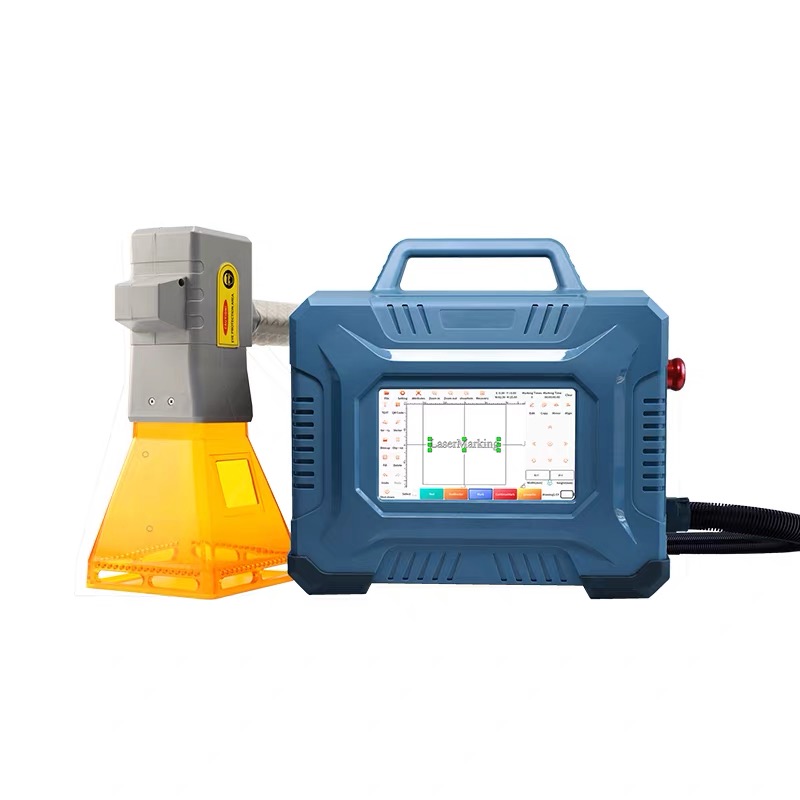
A portable handheld fiber laser marking machine applies permanent codes on metal and plastic electronic parts at the bench or at the line side.
A portable laser marking machine for electronic components is a handheld or compact laser unit that applies permanent, machine-readable marks — part numbers, lot codes, date codes, serial numbers, 1D barcodes and 2D QR codes — directly onto component and assembly surfaces at the point of production, incoming inspection, or repair. The category exists because a large share of electronics work never reaches a fixed marking cell: prototypes, low-volume and high-mix builds, rework, and service operations all require the marking tool to travel to the part rather than the part to the marking tool.
This industry reference covers the configurations buyers actually compare, the material decisions that determine whether a 1064 nm fiber source or a 355 nm UV cold-processing source is appropriate for a given component, the published specifications of one portable handheld fiber unit, the procurement criteria that separate a workable purchase from an expensive mismatch, and the boundaries where a fixed inline system remains the better answer.
Why identification work moved out of the fixed cell
Three pressures push marking toward the bench and the line side in electronics production.
Traceability, not decoration
Electronic components increasingly carry machine-readable identity: serial numbers, 2D codes, and lot references that can be scanned back through production, warranty, and failure analysis. Standard laser marking equipment is used to apply production dates, batch numbers, tracking codes, text, logos, scales, 1D barcodes and 2D QR codes, and flying laser systems support serial number and QR code traceability directly on production lines.
Production mix and rework loops
High-volume lines are only part of electronics manufacturing. Engineering changes, pilot builds, low-volume orders and repair loops create short runs that do not justify a dedicated fixed station or a changeover on a high-speed line. Moving a compact or handheld marking unit to the bench is frequently faster than scheduling a job into the line.
Parts that are difficult to move
Connectors already installed in a housing, cable assemblies, control cabinets and equipment nameplates are costly to transport to a marking cell. On-site marking addresses exactly these cases. Laser marking equipment is used across hardware and auto parts, pipes and profiles, electronic components, jewelry and accessories, mechanical parts, gifts and crafts, and the equipment category as a whole is positioned around portable, on-site marking applications for large workpieces and precision marking tasks.
Market context
Grand View Research estimated the global laser marking machine market at USD 4.4 billion in 2026. Fiber laser technology held a 46.1% revenue share in 2025, and Asia Pacific accounted for approximately 44% of regional revenue share in 2025. Those figures describe the laser marking market as a whole; the portable and handheld share within it is not published in the same dataset, a gap that matters when a supplier cites market growth as a reason to buy.
What “portable” covers: four configurations quoted against one requirement
The word portable appears in quotations for machines that differ substantially in weight, power source and marking area. The four configurations below are the ones that recur in electronics procurement documents.
| Configuration | Source and power | Marking area | Weight / power supply | Typical electronics role |
|---|---|---|---|---|
| Handheld fiber laser marking machine (1064 nm) | 20W / 30W / 50W / 60W; air cooling | 110 × 110 mm | Approx. 6 kg; built-in lithium battery; 90V–240V, 50/60Hz | On-site marking of metal components, large or already-installed workpieces; Linux system with 7-inch touch screen, Bluetooth, WiFi and mobile APP |
| Miniature multi-material laser marker | Dual light source 1064 nm / 455 nm, switchable; ≤ 100W; air cooling | 55 × 55 mm scanning area | 2.7 kg; built-in lithium battery / DC 20V / power bank support; Type-C power, Type-A data | 3C electronic accessories, small parts, bench and repair work; up to 4,000 mm/s processing speed |
| Desktop UV cold-processing laser marker | 355 nm, 3W / 5W; external industrial water chiller | 110 × 110 mm | Desktop footprint 352 × 603 × 800 mm; 110V–240V | Heat-sensitive plastics, glass, film, packaging and composites; 140+ font libraries; variable text, logos, barcodes, QR codes and serial numbers |
| Flying online fiber laser marker | 1064 nm; air cooling; ≤ 400W | 110 × 110 mm or 150 × 150 mm | Integrated unit; single-phase AC 90V–260V | High-volume dynamic marking on moving lines; line speed up to 7,000 mm/s, 800 standard characters per second |
Two practical consequences follow. First, marking area must be checked against the largest part in the routing, not the average one: a 55 × 55 mm scanning area suits small 3C accessories but not a housing panel. Second, the power source decides where the machine can be used at all. A built-in lithium battery removes the need for a mains outlet at the bench or on site, while a desktop cold-processing unit with an external industrial water chiller is a fixed installation.
Fiber or UV: the material decision that determines the correct machine
Most electronics marking problems trace back to a source-material mismatch rather than a machine defect. The two laser sources used in portable and compact electronics work behave differently on the same part family.
| Source | Documented material coverage | Where it fits in electronics |
|---|---|---|
| 1064 nm fiber | Stainless steel, carbon steel, aluminum oxide, aluminum alloy, aluminum, copper, iron, gold, silver, carbide, painted metal, acrylic, PVC, leather, painted wood | Metal housings, shields and connector shells, terminals, marked PE and PVC parts, hardware and mechanical parts |
| 355 nm UV cold processing | PE plastics, PVC plastics, metal parts, building materials, glass, film, packaging, composite materials; intended for marking plastics, glass and fragile materials without thermal damage | Heat-sensitive, thin-walled or transparent components, coated films, packaging and composite substrates where cosmetic integrity matters |
The decision rule is substrate-first: identify the actual surface to be marked, including coatings and platings that are frequently omitted from the drawing, and only then compare machines. If the part is a metal connector shell or a machined housing, a fiber source is the natural fit. If the part is a molded plastic housing, a lens, or a film substrate where heat distortion would be a defect, cold UV processing is the appropriate route.
How a portable handheld fiber unit is specified for component-level work
Jinan Yuanshida International Trade Co., Ltd. is a Jinan, China–registered exporter established in 2012 that specializes in the research, development, production and export of industrial laser marking equipment. The company states more than 10 years of experience in the category and a product range covering handheld laser marking machines, bench-top laser marking machines, desktop laser marking machines and precision laser marking equipment.
Its Second Generation Portable Handheld Fiber Laser Marking Machine is specified with 20W/30W/50W/60W laser power options, a 1064 nm wavelength and air cooling. The control system is Linux with a 7-inch touch screen, and the unit supports Bluetooth, WiFi and mobile APP operation. A built-in lithium battery allows marking without an external power supply, and the power supply input is 90V–240V, 50/60Hz. The stated laser life is about 100,000 hours, the marking area is 110 × 110 mm, and the machine is described as weighing about 6 kg. The manufacturer lists mechanical parts processing, electronic and electrical production, medical equipment, advertising signs, building materials, hardware parts, auto parts, pipes, profiles, jewelry, gifts and crafts as applicable industries.
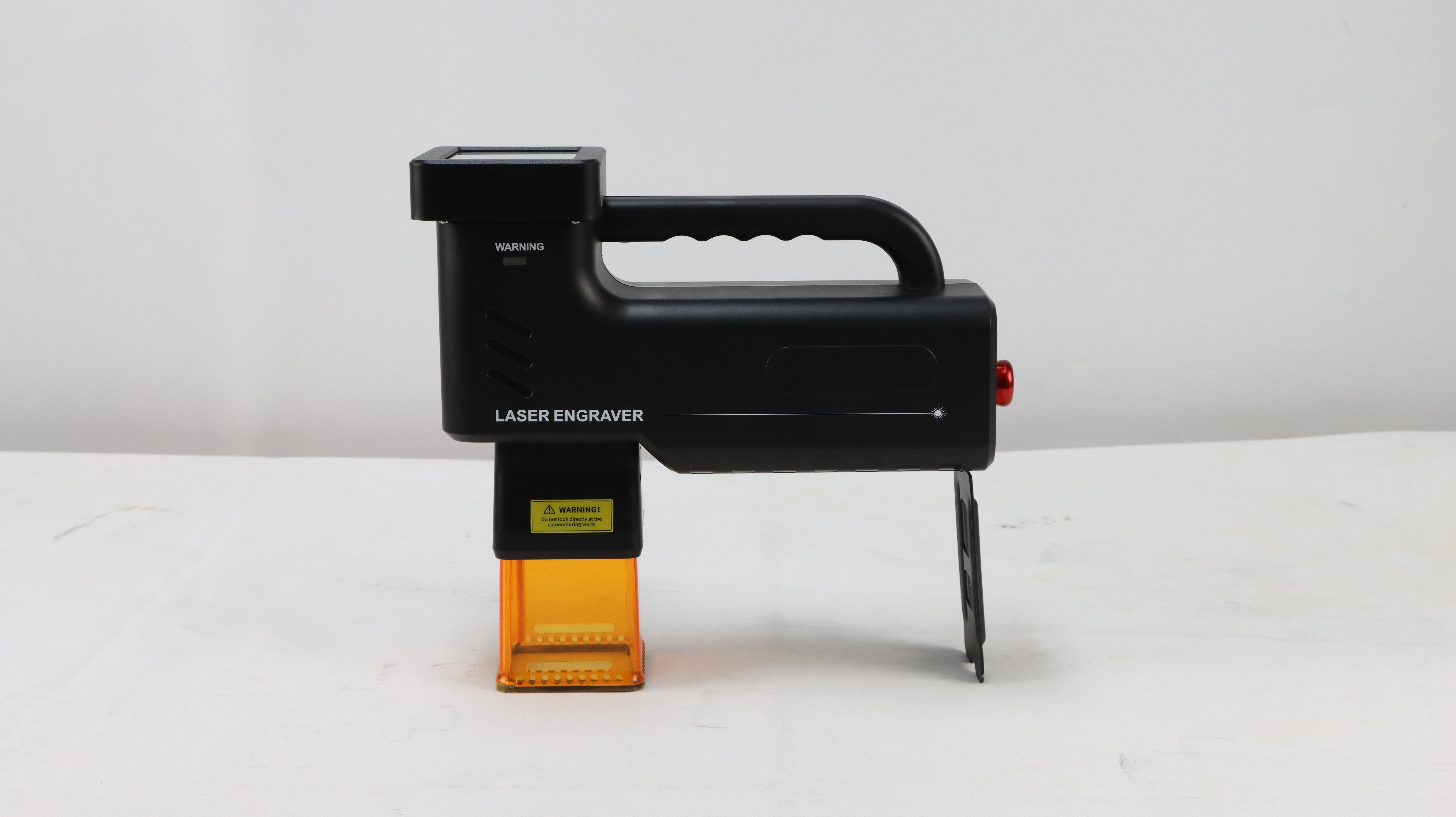
The miniature multi-material unit weighs 2.7 kg, offers a switchable 1064 nm / 455 nm dual source, and supports Type-C power and power-bank supply for bench work on small electronic parts.
For job preparation, the handheld unit imports JPG, PNG, BMP, SVG, PLT, DXF, Excel, TXT, barcode and QR code files. That covers the two file types that matter most in electronics work: barcode and QR code data for variable marking, and vector or CAD formats for fixed layouts. Where parts are small and operators need to move between benches, the manufacturer also offers a miniature multi-material unit with a switchable 1064 nm / 455 nm dual light source, a 2.7 kg net weight, up to 4,000 mm/s processing speed, a 55 × 55 mm scanning area, and operation through mobile app, PC software or touch screen with TYPE-A data and TYPE-C power interfaces.
For reference, published industry guidance places portable and handheld laser marking machines in a 15–35 lb band, approximately 6.8–15.8 kg. The stated weight of about 6 kg for the handheld unit sits just below that band, which matters when one operator carries the machine between benches or into an installation area.
The company states that its machines comply with international quality standards such as CE, FDA and ISO, that all equipment undergoes multiple aging tests and precision calibration before leaving the factory, and that products have been exported for many years to more than 80 countries and regions, with major markets including Vietnam, Thailand, Malaysia, Türkiye, the United States, Poland and the Middle East. It serves overseas factories, distributors and trading companies. These are manufacturer statements rather than independent test reports; buyers should request the specific certificates and calibration records for the exact model being quoted.
Application scenarios in electronics production
- Marking metal component surfaces at the bench. Fiber units mark stainless steel, aluminium, copper and plated surfaces such as connector shells, terminals, shields and machined housings, with a 110 × 110 mm marking area and file import in BMP, SVG, PLT and DXF formats.
- Small 3C accessories and precision parts. The miniature multi-material machine combines a 55 × 55 mm scanning area, a 2.7 kg body and power-bank-compatible Type-C supply, which suits repair benches, prototype assembly and small accessory marking where a fixed station is impractical.
- Cold marking on heat-sensitive electronic materials. The 355 nm UV configuration is intended for plastics, glass and fragile materials without thermal damage, with marking speeds up to 10,000 mm/s, repeatability of ±0.001 mm and more than 140 font libraries for variable data such as text, barcodes, QR codes and serial numbers.
- On-site marking of installed or large workpieces. The handheld unit's built-in lithium battery allows marking without an external power supply, which is the configuration used for cabinets, frames and equipment already positioned in a facility.
- Line-side traceability where volume justifies inline marking. Where throughput rather than mobility is the constraint, a flying online fiber unit applies production dates, batch numbers, tracking codes and 2D codes at 800 standard characters per second, with line speeds up to 7,000 mm/s and a laser lifespan stated at 150,000 hours.
Procurement criteria: what to verify before ordering
- Substrate and coating test. Confirm the exact surface, including plating, anodising, paint and protective film. This single item determines whether a 1064 nm fiber source or a 355 nm UV source is correct.
- Marking area against the largest part. Compare 110 × 110 mm and 55 × 55 mm options with the biggest workpiece in the routing, and account for repositioning and alignment time if parts exceed the field.
- Feature size, repeatability and depth. Desktop fiber configurations are specified with ±0.001 mm repeatability, a minimum character of 0.15 mm, a minimum line width of 0.4 mm and a maximum marking depth of 0.4 mm. Flying units are specified with a 0.01 mm focal spot diameter, a 0.012 mm minimum line width and ±0.003 mm repeatability. Deep engraving falls outside this class.
- Power source and shift pattern. A built-in lithium battery supports cordless marking, and the miniature unit additionally accepts DC 20V and power-bank supply. Average battery operating hours per charge are not published in the industry data available here, so request run-time figures measured under your duty cycle before committing to a shift plan.
- Safety and compliance documentation. Laser products sold in the United States must comply with FDA 21 CFR Subchapter J Parts 1000–1005, and portable hand-held laser markers are assessed against EN ISO 11553-2 for hand-held safety. Ask for certificates, aging test records and insulation test records rather than relying on a datasheet statement.
- Software and data handling. Verify that the machine accepts your file formats and variable data — SVG, PLT, DXF, Excel, TXT, barcode and QR code imports are supported on the handheld unit described above.
- Support model and spare parts. Determine whether service runs through a distributor or the manufacturer, and confirm the stated after-sales language and response path in writing.
- Trade classification. HS code 845611 is the primary classification for machine tools operated by laser processes, which affects customs documentation and duty treatment in destination markets.
Market trend analysis: what the published data supports
Fiber laser technology held 46.1% of laser marking revenue in 2025, and the global market is estimated at USD 4.4 billion in 2026. Asia Pacific accounted for approximately 44% of regional revenue share in 2025, which concentrates both supply capability and competitive pricing pressure in the region that manufactures most of the world's portable units.
Two frequently quoted claims are not supported by the data available here. The revenue share of portable and handheld units within the overall laser marking market is not published in the datasets reviewed, and verified average battery operating hours for cordless marking units are likewise missing. Buyers should treat vendor statements on portable segment share or battery endurance without a cited source as unverified, and should instead request measured data for the specific model and duty cycle.
What the published figures do imply is ordinary procurement logic: dominant fiber technology means mature fiber sources, wider service networks and easier spare-part availability, while regional concentration in Asia Pacific means lead time and documentation quality become differentiating factors between suppliers quoting similar hardware.
Comparison with fixed and conventional identification — and the boundaries
| Decision dimension | Portable handheld | Benchtop / desktop fixed | Flying online |
|---|---|---|---|
| Marking area | 110 × 110 mm | 110 × 110 mm, options up to 300 × 300 mm | 110 × 110 mm or 150 × 150 mm |
| Throughput | Operator-paced | Manual load per part | 800 characters per second; continuous online speed up to 12,000 mm/s |
| Power source | Built-in lithium battery | Mains supply | Mains supply, integrated into line |
| Best fit | On-site, large or installed workpieces, rework | Bench marking, small batch, mixed tasks | High-volume production lines |
Four boundaries deserve to be stated plainly.
- Portability is not a throughput strategy. A fixed flying unit delivers 800 standard characters per second with continuous online marking speeds up to 12,000 mm/s. A handheld unit is operator-paced and will not match that output across thousands of parts per shift. Portable equipment purchases buy flexibility, not line-rate capacity.
- Marking field and repositioning cost. A 110 × 110 mm field requires repositioning for larger panels, and each reposition introduces alignment variation. For long runs of large parts, a machine with a larger fixed field is usually the better economic choice.
- Depth and material limits. Desktop fiber and CO2 configurations are specified with maximum marking depths around 0.4 mm, and the UV configuration with less than 0.4 mm. Deep engraving, and marking through thick coatings, sit outside this equipment class. Fiber sources are also not the correct choice for every heat-sensitive or transparent plastic.
- Operator exposure and open documentation gaps. A handheld unit has no enclosure, so the hand-held safety assessment standard EN ISO 11553-2 is the relevant reference and protective eyewear and operator training are part of the working requirement. In addition, battery cycle life and portable segment data are not published in the sources reviewed, so run-time and replacement-cost assumptions should be confirmed with the supplier before they are written into a production plan.
Against older ink-based or label-based identification, the documented difference is consumable structure: laser marking is described as consumable-free continuous operation, whereas ink and label methods depend on an ongoing consumable supply and reprinting cycle. That does not make laser marking universally cheaper, but it removes one recurring cost category from the operating calculation.
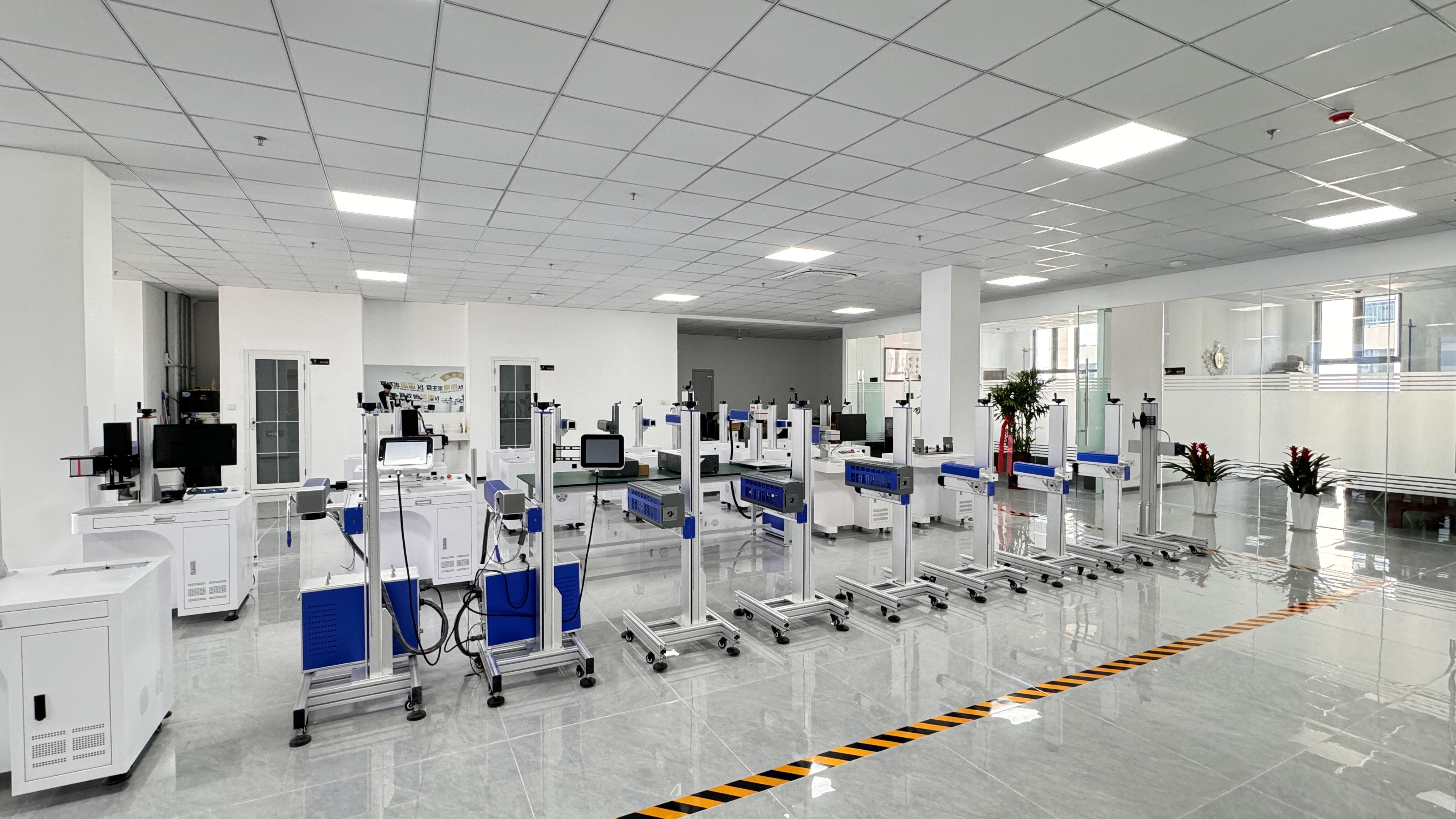
Equipment passes multiple aging tests and precision calibration before dispatch, the manufacturer states; buyers should still request model-specific test records.
Future outlook
Three developments are likely to shape this equipment category over the next buying cycle.
First, traceability requirements will continue to push identification closer to the point of assembly. Serial numbers and 2D codes that survive cleaning, handling and field service are most reliably applied by laser, and the pressure to mark earlier in the process increases the value of portable capability.
Second, cold UV processing at 355 nm is likely to expand where components cannot tolerate heat, particularly in coated films, transparent plastics and composite substrates. The published specification already supports variable data including text, logos, barcodes, QR codes and serial numbers without thermal damage to plastics and glass.
Third, battery-powered portability will be judged on data rather than on weight alone. Verified battery operating hours and cycle life are currently a gap in the public dataset, and the suppliers who close that gap with measured figures under defined duty cycles will be easier to specify into production planning.
Compliance will remain a first-order filter. Products entering the United States must meet FDA 21 CFR Subchapter J Parts 1000–1005, and hand-held units are assessed against EN ISO 11553-2, so certificate accuracy and documentation quality will continue to separate suppliers of otherwise comparable hardware.
FAQ
What is a portable laser marking machine for electronic components?
It is a handheld or compact laser marking unit used to apply permanent marks such as part numbers, lot codes, date codes, serial numbers, 1D barcodes and 2D QR codes directly onto electronic components and assemblies at the bench, at incoming inspection or on site. The handheld configuration described in this reference is specified with 20W/30W/50W/60W power options, a 1064 nm wavelength, a 110 × 110 mm marking area, a built-in lithium battery and a stated machine weight of about 6 kg, with a Linux 7-inch touch screen and Bluetooth, WiFi and mobile APP operation.
Can a 1064 nm fiber laser mark plastic electronic components, or is fiber only for metal?
A 1064 nm fiber source is documented as compatible with acrylic, PVC and painted wood in addition to metals such as stainless steel, carbon steel, aluminium alloys, copper, iron, gold, silver and carbide, and marking systems using this source are specified for PE and PVC plastics. Fiber is therefore not limited to metal. However, for plastics that are heat-sensitive or transparent, the manufacturer recommends UV cold-processing equipment instead, and the final decision should be made on a physical sample of the actual component surface rather than on a material category.
When should a UV cold-processing laser marker be chosen instead of a fiber marker?
When the workpiece is heat-sensitive, transparent or fragile. The 355 nm UV configuration is intended for marking plastics, glass and fragile materials without thermal damage, is compatible with PE plastics, PVC plastics, metal parts, building materials, glass, film, packaging and composite materials, and is offered at 3W or 5W with a 110 × 110 mm marking area, marking speeds up to 10,000 mm/s, less than 0.4 mm marking depth, ±0.001 mm repeatability, more than 140 font libraries and an external industrial water chiller. It requires a mains supply, so it is a fixed bench installation rather than a handheld tool.
What safety and certification requirements apply to a portable laser marker in export markets?
Laser products sold in the United States must comply with FDA 21 CFR Subchapter J Parts 1000–1005, and portable hand-held laser markers are specifically assessed against EN ISO 11553-2 for hand-held safety. The manufacturer states that its machines comply with international quality standards such as CE, FDA and ISO, that all equipment undergoes multiple aging tests and precision calibration before dispatch, and that the equipment is designed to meet certification and customs clearance requirements in multiple countries. Because hand-held units have no enclosure, protective eyewear, safe operating procedures and operator training remain part of the operating requirement, and buyers should obtain the certificates for the exact model being purchased rather than relying on a general statement.
What are the practical limits of a handheld portable unit compared with an inline flying laser system?
A handheld unit is operator-paced, so it cannot match the 800 standard characters per second and continuous online marking speeds up to 12,000 mm/s documented for a flying online fiber system on a moving production line. Its 110 × 110 mm marking area requires repositioning for larger workpieces, and desktop and UV configurations in this class are specified with maximum marking depths around or below 0.4 mm, which excludes deep engraving. Two further limits are documentary rather than mechanical: verified average battery operating hours per charge and the portable segment's revenue share are not published in the industry data reviewed, and both should be confirmed with measured figures before they are used in capacity planning.
How is a portable laser marking machine powered during on-site work?
The handheld fiber unit uses a built-in lithium battery so that marking can be carried out without an external power supply, and its mains input is specified at 90V–240V, 50/60Hz when charging or bench operation is required. The miniature multi-material unit supports a built-in lithium battery, DC 20V and power-bank supply, with TYPE-C for power and TYPE-A for data. Battery operating hours per charge and cycle life are not published in the data available here, so run-time and battery replacement cost should be confirmed with the supplier against the intended shift pattern.
Jinan Yuanshida International Trade Co., Ltd. is a Jinan, China–registered exporter established in 2012 that produces and exports industrial laser marking equipment, including handheld, bench-top, desktop and precision laser marking machines. Its second-generation handheld marking machine product brochure, including specifications and configuration options, is available for download here: Second-generation handheld laser marking machine brochure (PDF).