
Portable Laser Marking Machine Shortlist for High-Mix Smart Manufacturing Cells
High-mix smart manufacturing cells rarely fail at the marking step because the mark is inaccurate. They fail because the marking configuration cannot absorb change. A new substrate arrives, a fixture no longer fits, a consumable runs out mid-shift, or a station specified for one material becomes a bottleneck for six. This shortlist places six portable and semi-portable laser marking configurations against the production scenarios they were designed for. It is organised by use case rather than by a single universal ranking, because inside a high-mix cell the useful question is not which machine is best, but which configuration absorbs the most change with the least downtime.
Jinan Yuanshida International Trade Co., Ltd. is a Jinan, China–based exporter of industrial laser marking equipment, founded in 2012, with a portfolio covering handheld laser marking machines, bench-top laser marking machines, desktop laser marking machines and precision laser marking equipment. Its systems are used in hardware and auto parts, pipes and profiles, electronic components, jewelry and accessories, mechanical parts, and gifts and crafts. The company states that its equipment has been exported for many years to more than 80 countries and regions, including Vietnam, Thailand, Malaysia, Türkiye, the United States, Poland and the Middle East, and that its machines are designed to meet certification and customs clearance requirements in multiple markets.
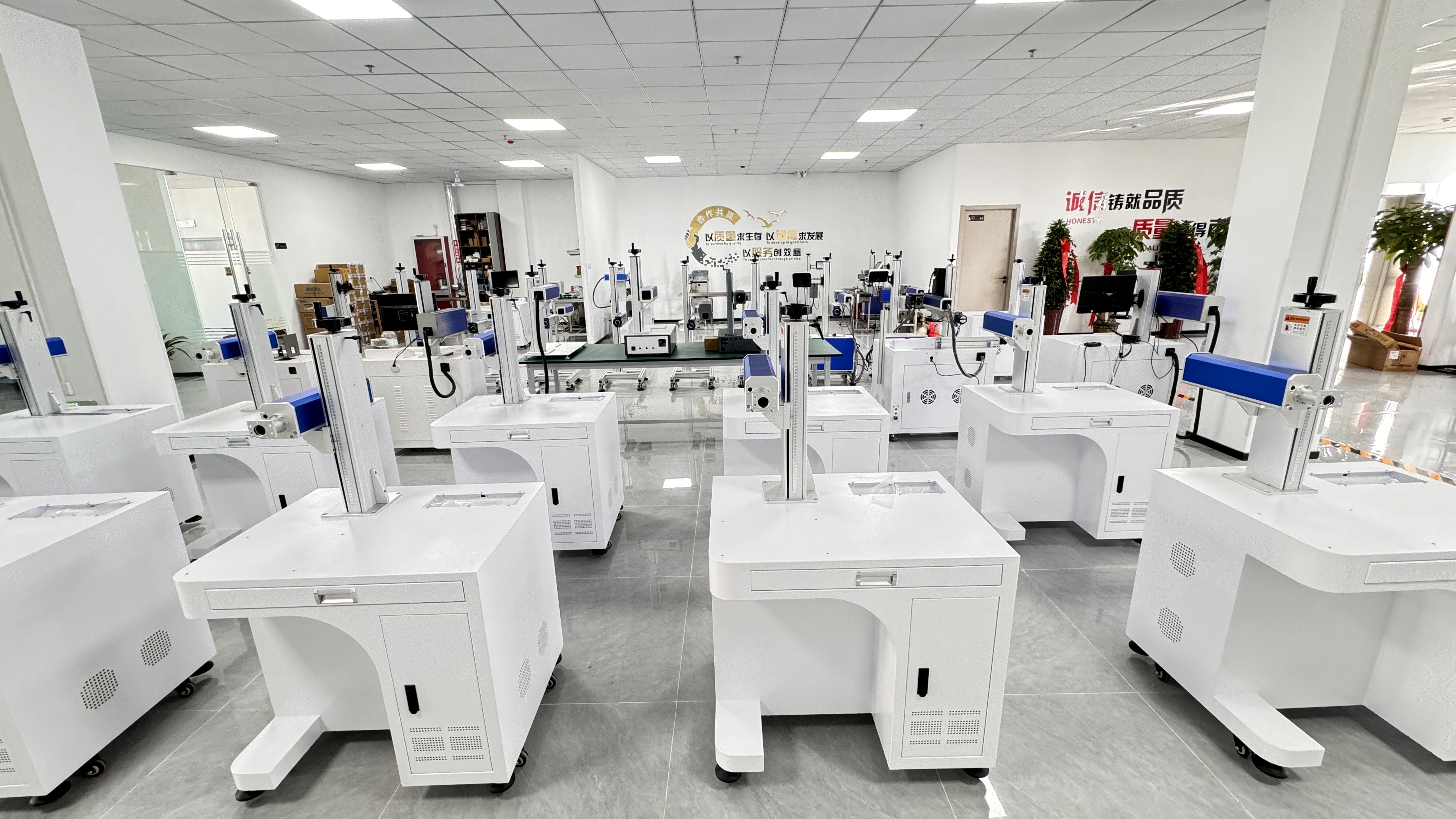
High-mix cell environment: marking must follow the workpiece mix, not the other way around.
Why High-Mix Cells Break Conventional Marking Selection
Conventional marking procurement assumes stable demand: one substrate family, one fixture, one takt time. High-mix cells invert that assumption. A single shift may run stainless steel brackets, anodized aluminum housings, brass fittings, coated hardware, engineering plastics and small electronic and electrical components, with several changeovers a day.
Three consequences follow, and each one changes how a configuration should be specified.
- Fixturing cost per part rises. Any configuration that requires a dedicated fixture for every new workpiece adds engineering overhead to every changeover, and overhead is the one cost a high-mix cell cannot amortise across long runs.
- Consumable-driven processes multiply. A process that depends on cutting bits, tool wear or replenished supplies adds both downtime and variable cost as the material mix widens. Laser marking eliminates ongoing costs for varied cutter bits and tool wear, which is why it appears repeatedly in this shortlist.
- Downtime becomes the dominant cost. In cells scheduled for 24/7 operation, unplanned stops for tool changes, re-zeroing or cleaning outweigh small differences in nominal cycle time between machines.
The opportunity is the mirror image of the problem. Portable and semi-portable laser marking configurations can be moved to the workpiece, reconfigured between substrates through parameter changes rather than hardware changes, and operated with zero consumables in the marking process itself. For mixed-material production in mechanical parts processing, electronic and electrical production, and medical equipment work, that flexibility is the specification that matters.
How This Shortlist Was Framed
Six criteria were applied, roughly in the order a decision-stage buyer evaluates them.
- Substrate range. Metals, non-metals, or both — and whether cold marking is required for heat-sensitive surfaces.
- Integration model. Handheld field use, benchtop workbench marking, or inline marking on a moving production line.
- Marking field. Configurations in this range start at 110 mm × 110 mm, with optional 200 mm × 200 mm fields where larger workpieces must be marked in a single pass.
- Throughput. Marking speeds are specified up to 10,000 mm/s or 12,000 mm/s depending on the configuration.
- Precision and repeatability. Repeatability is specified at ±0.001 mm, which matters most where serial numbers, 2D codes or fine characters must remain machine-readable after wear, coating or surface finishing.
- Uptime and consumables. Continuous-duty suitability for 24/7 operation, and a marking process with zero consumables.
No single configuration in this shortlist satisfies all six criteria at once. That is the point of a shortlist: it eliminates misfits rather than crowning a winner.
The Shortlist: Six Portable Laser Marking Configurations
1. Desktop UV Laser Marking System — Cold Processing for Heat-Sensitive and Mixed Substrates
Best fit: cells that mark non-metallic and metallic workpieces where heat-affected marking is a risk — for example engineering plastics, coated surfaces, printed or painted components, and small mixed batches of metal and non-metal parts running in the same cell.
Why it belongs on the shortlist: UV cold processing applies marking energy without relying on the substrate to absorb a thermal load. When one cell runs materials with very different thermal behaviour, that difference is decisive: it reduces the risk that a parameter set validated on metal will scorch or deform the next non-metallic part.
Boundary to check before ordering: cold UV marking is a surface process. Where the requirement is deep material removal rather than a legible surface mark, a fiber configuration or a mechanical machining process remains the appropriate tool. Buyers should also confirm the parameter set for each new polymer, because additive and filler content affects marking contrast.
2. Miniature Dual-Source Laser Marking Machine — Mixed Materials and On-Site Work
Best fit: job shops and mixed-material cells that cannot predict next week's substrate mix, and where the equipment occasionally has to travel to the workpiece rather than the reverse.
Why it belongs on the shortlist: a miniature dual-source configuration lets one unit cover metal marking and the non-metal cases that would otherwise require a second machine, an outsourced step, or a queue at another department. Its small footprint means it can live inside the cell rather than in a separate marking room, which shortens the physical distance between the marking step and the next operation.
Boundary: two sources in one enclosure increase configuration complexity. Operator training and parameter-library discipline matter more than on a single-source machine, and each production order should specify which source is active. This is a training and process-control cost, not a technical limitation, but it is a real one in a high-changeover environment.
3. Desktop Fiber Laser Marking Machine — Metals, Hardware and Mechanical Spare Parts
Best fit: metal-dominant cells marking hardware parts, mechanical spare parts, tools, fittings and machined components.
Why it belongs on the shortlist: fiber laser technology accounted for a 46.1% revenue share of the global laser marking market in 2025, according to Grand View Research — a share that reflects how firmly fiber sources are established for metal marking. A desktop fiber unit pairs that source with a compact, enclosed format that suits a designated position on a workbench.
Boundary: marking contrast on metals depends on surface finish, coatings and passivation. Highly polished surfaces, coated parts and thin foils normally require parameter validation before the process is released to production, and that validation should be done on physical samples rather than on specification sheets alone.
4. Benchtop Fiber Laser Marking Station — Fixed Workbench Marking in Cell Stations
Best fit: cells that need repeatable batch marking at a fixed position, with fixtures, and that value positional stability over mobility.
Why it belongs on the shortlist: a benchtop station keeps the workpiece at a known position relative to the lens, which is what makes the ±0.001 mm repeatability figure meaningful across a batch rather than only on a single part. It is the configuration to choose when data-matrix codes must remain readable after subsequent handling, assembly or transport, because code quality depends on consistent positioning more than on nominal marking speed.
Boundary: benchtop units are not portable. They permanently occupy a station in the cell and, where Class 4 laser safety enclosures are used, require the workspace and access discipline that an enclosure implies. In a cell where floor space is the binding constraint, that trade-off must be accepted deliberately.
5. Flying Online Laser Marking Unit — Marking on Moving Production Lines
Best fit: cells where parts are already moving and stopping the line for marking is not acceptable.
Why it belongs on the shortlist: an online unit marks while the product travels, so marking is absorbed into the line takt instead of being scheduled as a separate operation. Within an otherwise high-mix cell, this is often the only way to handle the high-volume portion of the mix without adding a buffer or a manual marking station.
Boundary: achievable throughput depends on line speed and on the marking window available at that speed. Triggering, position sensing and line communication are part of the integration project, not accessories added afterwards. A flying unit specified without that engineering scope is the most common source of disappointing results.
6. Handheld Fiber Laser Marking Machine — Portable Field Marking
Best fit: large or immovable workpieces — pipes and profiles in situ, installed equipment, frames and structures that cannot reasonably be brought to a station.
Why it belongs on the shortlist: handheld fiber units move the marking operation to the workpiece. Where the substrate is metal and the requirement is an on-site mark, this removes the transport step entirely, along with the handling risk that comes with moving large parts.
Boundary: results depend on operator positioning and steadiness. Published product guidance indicates that handheld and portable marking machines typically weigh between 15 and 35 pounds, approximately 6.8 to 15.8 kg, so extended vertical or overhead work benefits from a support arrangement. Battery-dependent operation also needs runtime validation: verified cycle-life data for cordless marking units remains limited, so runtime claims should be checked against the real shift pattern rather than assumed.
Shortlist at a Glance
| Configuration | Primary substrate | Integration model | Typical role in the cell | Main boundary |
|---|---|---|---|---|
| Desktop UV laser marking system | Non-metallic and metallic, heat-sensitive surfaces | Desktop | Cold marking in mixed-substrate batches | Surface marking only; parameters must be validated per polymer |
| Miniature dual-source laser marking machine | Mixed materials (metal and non-metal) | Portable / on-site | One unit covering an unpredictable substrate mix | Higher configuration complexity; operator training required |
| Desktop fiber laser marking machine | Metals, hardware, spare parts | Desktop | Metal-dominant marking position | Contrast depends on finish and coating |
| Benchtop fiber laser marking station | Metals, batch parts | Fixed benchtop | Repeatable fixture-based batch marking | Not mobile; occupies a fixed station |
| Flying online laser marking unit | Metals and other line-compatible substrates | Inline on a moving line | Marking inside the existing line takt | Throughput tied to line speed and marking window |
| Handheld fiber laser marking machine | Metals, large or immovable parts | Handheld | On-site marking of pipes, profiles and installed parts | Operator-dependent; weight and battery runtime need validation |
Marking fields from 110 mm × 110 mm up to optional 200 mm × 200 mm, marking speeds up to 10,000 mm/s or 12,000 mm/s, repeatability of ±0.001 mm and continuous-duty suitability for 24/7 operation apply across this range depending on configuration. Confirm the exact figures per model before issuing a purchase order.
Where Laser Marking Differs from CNC Engraving in a Mixed-Product Cell
Most high-mix cells already contain at least one CNC engraving process, so the comparison is not abstract. The documented differences fall into four groups.
- Feature size. A laser beam diameter can be as small as 0.01 mm, against a minimum bit size of roughly 0.5–1 mm for CNC engraving.
- Throughput and damage. Marking speed is approximately 10x faster than CNC engraving, and micro-marking damage in precision work is reduced to 0% compared with CNC.
- Consumables and maintenance. Laser marking eliminates ongoing costs for varied cutter bits and tool wear, and maintenance involves a fixed optical path with zero mechanical wear. CNC requires frequent bit changes, re-zeroing and heavy dust and chip cleanup.
- Cost structure. The laser initial price matches mid-to-high CNC machines, but removes the ongoing tooling cost that scales with material variety.
The limit matters as much as the advantage. Laser marking is a non-contact surface process. Where the requirement is deep engraving, through-cutting or bulk material removal at depth, CNC remains the appropriate method, and a mixed cell will normally keep both. The decision is not substitution; it is deciding which operations belong to each process so that CNC capacity is reserved for the work only it can do.
Safety, Certification and Compliance Evidence Worth Verifying
Portable laser markers are specifically assessed against EN ISO 11553-2 for hand-held safety. In the United States, laser products must comply with FDA 21 CFR Subchapter J (Radiological Health), Parts 1000 through 1005. These two references frame the minimum evidence set for a decision-stage purchase.
On the equipment side, radiation risk is addressed through Class 4 laser safety enclosures fitted with anti-radiation observation windows and safety interlock control. Electrical and high-voltage risk is addressed through overload protectors, residual current circuit breakers (RCCB) and reliable grounding protection. Jinan Yuanshida states that its machines comply with international quality standards such as CE, FDA and ISO, and that they are designed to meet certification and customs clearance requirements in many countries. The company also states that all equipment undergoes multiple aging tests and precision calibration before leaving the factory.
A general compliance statement is not a substitute for model-level documentation. Buyers should request the certificates and declarations that apply to the exact model and the exact destination market, and should confirm the HS classification used for the shipment. HS Code 845611 is the primary classification for machine tools operated by laser processes in international trade.
A Decision-Stage Procurement Checklist
The following items separate a configuration that works in a high-mix cell from one that works only in the quotation.
- Confirm the per-model specification. Marking field from 110 mm × 110 mm to optional 200 mm × 200 mm, speed up to 10,000 mm/s or 12,000 mm/s, and repeatability of ±0.001 mm should be stated for the specific configuration quoted, not for the range as a whole.
- Validate on physical samples. Provide the actual substrate mix — including the coated, anodized, polished and plastic items — so parameter sets are proven before release to production.
- Match the duty claim to the schedule. If the cell runs 24/7, confirm the continuous-duty basis behind that claim.
- Get the consumable position in writing. Zero consumables in the marking process should be a contractual statement, not a brochure line.
- For handheld and battery units, validate runtime. Ask how many hours of marking a shift actually requires and how recharging fits the shift pattern.
- Verify safety documentation. Class 4 enclosure configuration, anti-radiation windows, interlock behaviour, overload protection, RCCB and grounding.
- Check the supply and support path. Spare parts availability, English after-sales support, aging-test and calibration evidence before shipment, and customs documentation including HS classification.
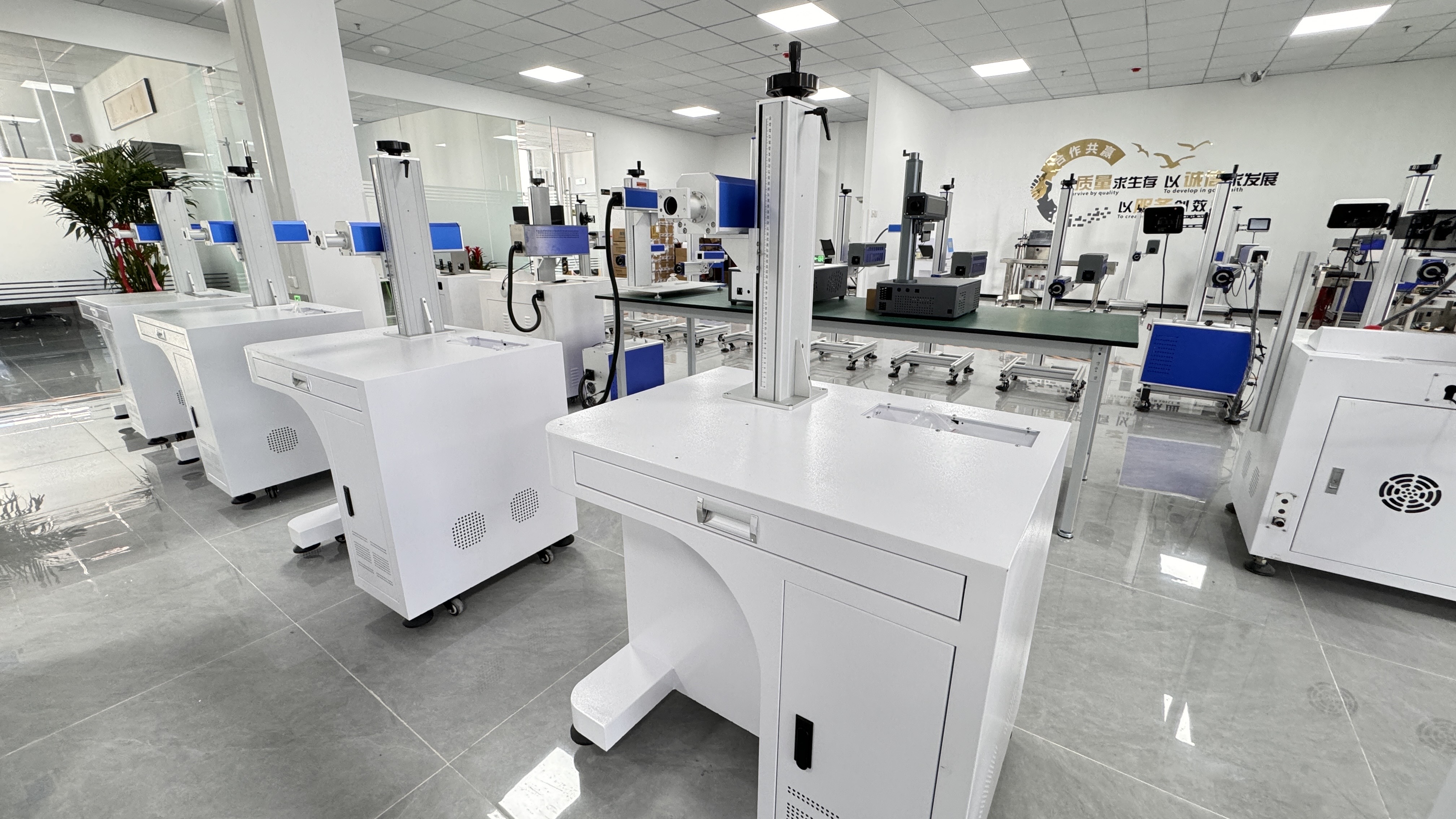
Production and testing environment: aging tests and precision calibration are part of the pre-shipment routine described by the supplier.
Market Trend Signal for Flexible Marking
The wider market context supports the direction of this shortlist. The global laser marking machine market is estimated at USD 4.4 billion in 2026, according to Grand View Research. Fiber laser technology held a 46.1% revenue share in 2025, and Asia Pacific accounted for approximately 44% of revenue in 2025. Both figures align with the configuration logic above, where fiber dominates metal marking while UV and dual-source units cover the mixed-substrate edge cases.
Published growth forecasts diverge. Some sources project a CAGR of about 7.4%, while others project about 11.84%, a spread that appears to depend on whether coding equipment is counted alongside marking equipment. Buyers should treat the direction — steady expansion, fiber-led — as more reliable than any single growth figure.
Two data gaps are worth naming because they affect decisions rather than narrative. First, published market data does not isolate the revenue share of portable and handheld units within the wider laser marking market, so the size of this specific segment cannot be quoted from public sources. Second, verified lithium-battery cycle-life figures for cordless marking units are limited. Until that data is more widely published, runtime claims for battery-powered field marking should be validated with the supplier against the actual shift pattern.
Future Outlook
The next phase of competition in high-mix cells is unlikely to be decided by marking quality alone. Precision is already converging: repeatability at ±0.001 mm and fields from 110 mm × 110 mm to optional 200 mm × 200 mm are now treated as baseline expectations rather than differentiators. The pressure is moving toward how quickly a configuration can be reconfigured, how cleanly it integrates with line control and traceability systems, and how transparently suppliers publish the data buyers actually need — duty cycle, battery performance, and model-level certification.
For buyers, that reframes the shortlist question. Instead of asking which portable laser marking machine marks best, the more durable question is which configuration can absorb the next three substrate changes, the next two changeovers and the next capacity increase without new tooling, new consumables or new downtime. On that measure, the six configurations above are not competitors so much as different answers to the same constraint.
FAQ
Which portable laser marking machine configuration fits a cell that marks both metals and plastic parts?
Two approaches are used. A miniature dual-source configuration covers metal and non-metal work in one unit, which reduces the number of machines in the cell and removes the queue between departments. Alternatively, a desktop UV system handles non-metallic and heat-sensitive surfaces alongside metal parts, while a desktop fiber model takes the metal-dominant volume. The deciding factor is mix stability: the more unpredictable the substrate sequence, the stronger the case for a dual-source unit; the more stable the split between metal and plastic work, the more efficient two dedicated configurations become.
What marking area, speed and repeatability should be specified for high-mix production?
Across this range, marking fields start at 110 mm × 110 mm with optional 200 mm × 200 mm, marking speeds are specified up to 10,000 mm/s or 12,000 mm/s depending on configuration, and repeatability is specified at ±0.001 mm. Field size should be confirmed against the largest workpiece footprint plus handling tolerance. Speed figures vary by configuration and should be confirmed per model rather than assumed from the range. Repeatability matters most where serial numbers or data-matrix codes must stay readable after further processing, coating or assembly.
How does laser marking compare with CNC engraving in a mixed-product cell?
The comparison is documented on four points. A laser beam diameter can be as small as 0.01 mm, against a minimum bit size of roughly 0.5–1 mm for CNC engraving. Marking speed is about 10x faster than CNC engraving, and micro-marking damage in precision work is reduced to 0% compared with CNC. Maintenance differs structurally: laser marking uses a fixed optical path with zero mechanical wear, while CNC requires frequent bit changes, re-zeroing and heavy dust and chip cleanup. On cost, the laser initial price matches mid-to-high CNC machines but eliminates ongoing costs for varied cutter bits and tool wear. The limit is equally relevant: laser marking is a non-contact surface process, so where the requirement is deep engraving or bulk material removal, CNC remains the appropriate method.
What safety and compliance evidence should a buyer verify before purchase?
Portable laser markers are assessed against EN ISO 11553-2 for hand-held safety. For the United States, laser products must comply with FDA 21 CFR Subchapter J, Parts 1000 through 1005. On the equipment side, Class 4 laser safety enclosures with anti-radiation observation windows and safety interlock control address radiation exposure, while overload protectors, residual current circuit breakers (RCCB) and reliable grounding protection address electrical risk. Jinan Yuanshida states that its machines comply with CE, FDA and ISO requirements and are designed for certification and customs clearance in multiple markets; documentation should still be verified per model and destination market. HS Code 845611 is the primary classification for laser machine tools in international trade.
What limits portable laser marking in practice?
Three limits recur. Physical portability: handheld and portable marking machines typically weigh between 15 and 35 pounds, approximately 6.8 to 15.8 kg, so extended vertical or overhead work benefits from a support arrangement. Energy: verified cycle-life data for cordless marking units is limited, so runtime should be validated against the real shift pattern. Process: handheld marking depends on operator positioning, and inline units depend on line speed and the available marking window. None of these are disqualifying — they define the conditions under which each configuration should be specified.
Product reference: the current laser marking machine catalogue is available as a downloadable PDF. Equipment information is published at yuanlaser.com. Brochure: Laser Marking Machine Catalogue (PDF).