
Porcelain vs Glass Insulators: A Transmission Buyer Decision Framework
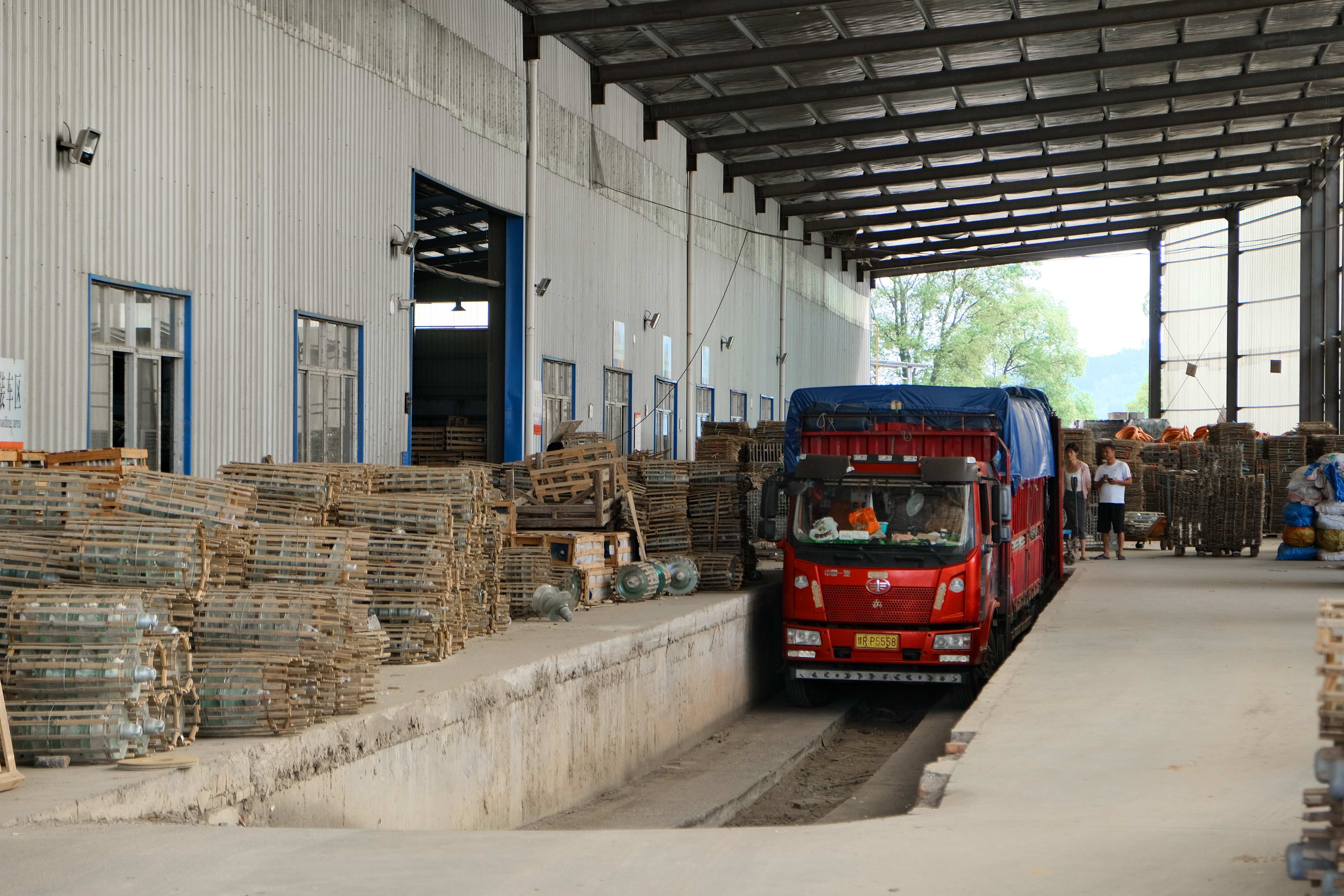
Loading area at Jiangxi QOCI Electric Co., Ltd. in Luxi Industrial Park, Pingxiang, Jiangxi — the dispatch point for both porcelain and glass insulator orders.
Porcelain and glass overhead line insulators are both ceramic-family dielectrics, and both are qualified against the same family of standards. That is why the material question rarely decides a transmission project on its own. The decision is driven by the duty class of the position, the pollution class at the site, the hardware interface, the inspection regime, and the cost of keeping the line energised over decades.
This framework is written for buyers in the evaluation and execution stage: specifications are being drafted, shortlists are being narrowed, and purchase orders are weeks away. It uses two verified products from the catalogue of Jiangxi QOCI Electric Co., Ltd. — the porcelain pin insulator P-11-Y (11 kV, 10 kN) and the suspension glass insulator PS210V 212V (210 kN, 400 mm creepage) — as concrete anchors, then sets out criteria that can be applied to any porcelain-or-glass decision.
Jiangxi QOCI Electric Co., Ltd. is an insulator manufacturer established in December 2002 in Luxi Industrial Park, Pingxiang City, Jiangxi Province, China. The company produces both porcelain and glass insulators for AC and DC overhead lines, including line post porcelain insulators, porcelain pin insulators, shackle insulators and AC disc-shaped suspension porcelain insulators, with a reported annual output of 9,000,000 units and exports to the USA, Asia, EU, Africa and South America.
The commercial backdrop is large and still expanding. Third-party research estimates the global porcelain insulator market at approximately USD 8.27 billion in 2023, with a projection of USD 15.04 billion by 2033 (Spherical Insights), and overhead transmission lines account for roughly 62.1% of global porcelain insulator revenue (Mordor Intelligence). In a market of that scale, the same material decision repeats across thousands of line positions every year — which is exactly why it should be made by framework rather than by habit.
1. The evaluation-stage problem: two materials, one function
Porcelain insulators and glass insulators do the same job: they isolate a live conductor from a grounded structure while carrying mechanical load, and they do it passively, with no active components and no power consumption. Both are specified against the same international framework. IEC 60383-1:2023 is the current international standard for ceramic or glass insulator units for AC overhead power lines with nominal voltages above 1,000 V, and ANSI C29.1 provides American national test methods for electrical power insulators. Under HS code 8546.20, porcelain and glass electrical insulators pass through customs under the same heading.
The difference starts with the dielectric body. Vitrified porcelain is produced from kaolin, quartz and feldspar fired at roughly 1,200–1,300 °C, giving a dense ceramic with high compressive strength and a glazed, moisture-resistant surface. Glass insulator bodies are made from tempered glass. Both are then assembled with metal fittings — in QOCI's suspension glass range, a hot-dip galvanised cast iron cap and a hot-dip galvanised forged steel pin; in the P-11-Y porcelain pin insulator, a hot-dip galvanised forged steel pin.
The practical consequence for a buyer is that the two materials arrive in different product forms. Porcelain is commonly supplied as pin, shackle, line post and disc-shaped suspension units, while glass is supplied as cap-and-pin suspension discs. That single fact reshapes the comparison: at distribution voltage and low mechanical duty, the porcelain pin and shackle family usually owns the position; at suspension positions carrying tens to hundreds of kilonewtons, glass cap-and-pin discs are a natural option. A material comparison only becomes meaningful once the duty class is fixed.
2. Criterion one: mechanical failing load — match the duty class first
Mechanical failing load is the first filter, because no other parameter can compensate for it. Insulator specifications in this category are conventionally quoted across a wide band — from 40 kN to 550 kN for string insulator units — and the required value is set by conductor tension, span, wind and ice loading, and the safety factor applied by the utility.
Two verified catalogue items show how far apart those duty classes can be.
| Parameter | Porcelain pin insulator P-11-Y | Suspension glass insulator PS210V 212V |
|---|---|---|
| Insulator body | High-strength electrical porcelain | Tempered glass |
| Duty class | Pin-type distribution line insulator | Cap-and-pin suspension insulator for transmission lines |
| Rated voltage / rating basis | 11 kV | Not voltage-rated on the data sheet; string rating is set by the number and class of units |
| Mechanical rating | 10 kN rated mechanical load | 210 kN mechanical failing load |
| Max diameter | 150 mm | 280 mm nominal disc diameter |
| Total height / nominal spacing | 150 mm total height | 170 mm nominal spacing |
| Creepage distance | 240 mm | 400 mm |
| Power frequency wet withstand voltage | 50 kV | 45 kV |
| Lightning impulse withstand voltage | 90 kV | 110 kV dry |
| Puncture voltage | Not stated on the data sheet | 130 kV power frequency |
| Metal fittings | Hot-dip galvanised forged steel pin | Hot-dip galvanised cast iron cap, hot-dip galvanised forged steel pin, socket coupling 20 |
Table 1: Verified parameters for two catalogue items that sit in different duty classes. The comparison illustrates class difference, not material superiority.
Two conclusions follow. First, a headline kilonewton figure is not a complete identity. The 210 kN failing load and 400 mm creepage distance of PS210V 212V recur elsewhere in the same glass range — for example on U210B and ANSI 52-11 — with different nominal spacing and disc details. A buyer who specifies only "210 kN, 400 mm" without disc diameter, nominal spacing and socket coupling has specified an incomplete item. Second, comparing a 10 kN porcelain pin insulator with a 210 kN glass suspension insulator is a category error: they occupy different positions on the line and different points of the load path. The correct question is not which material is stronger, but which material and design meet the requirement at the lowest lifecycle cost within a given duty class.
3. Criterion two: creepage distance and pollution performance
Creepage distance is the surface path between live and grounded parts, and it is set by site pollution severity. IEC 60815 defines pollution classes I to IV, and creepage distance is selected accordingly, with the shed profile optimised to lengthen the leakage path without wasting material.
In the verified catalogue data, porcelain reaches 240 mm of creepage on the 11 kV P-11-Y pin insulator. Glass suspension designs span a wider creepage range within the same catalogue — 320 mm on the 70 kN and 120 kN PS-series units, 400 mm on PS210V 212V, and up to 550 mm on U160BSP and 620 mm on U420BP for heavier pollution duty. Both material families can therefore be specified with extended creepage; the real constraint is which shed profile and mechanical class are available together at the required rating.
For buyers working in coastal, industrial or monsoon environments, that combination is the whole negotiation. A unit with adequate creepage but the wrong mechanical class will not fit the string; a unit with the right mechanical class but insufficient creepage will accumulate pollution and flash over. Anti-pollution porcelain insulators are supplied with extended creepage profiles for exactly this reason, and glass ranges reach the same objective through longer-creepage suspension designs.
Field evidence from distribution rehabilitation shows what this looks like in practice. A three-year programme running until 2026 supplied 60,000 pieces to a national power utility and a distribution EPC contractor — 10,000 pieces in Sri Lanka, 40,000 in Egypt and 10,000 in Ukraine — for coastal and inland tropical distribution line insulation and monsoon-region grid reinforcement, using porcelain pin and shackle insulators including P-11-Y and ED-2B. The reported results were a 60% reduction in salt-fog flashover incidents compared with the previous composite batch, a replacement rate under 2% across three years, zero observed UV degradation, and a 50% reduction in maintenance cost. The comparison baseline in that project was a composite alternative, not a glass alternative — an evidence boundary revisited in section 8.
One maintenance characteristic applies to the porcelain side of the decision and should be planned at the buying stage rather than after commissioning. Porcelain insulators can develop zero-value degradation — an internal electrical breakdown with no visible external change — so visual inspection alone cannot clear a string. Periodic live-line testing every three to five years, using voltage-gradient or spark-gap detection, is the recommended way to identify faulty units. The corresponding mitigation at the supply stage is to require crack-detection coverage such as 100% dye penetration testing on delivered units rather than batch sampling.
4. Criterion three: total cost of ownership
Unit price is the smallest part of the cost of an insulator, and treating it as the decisive number is one of the most common errors at the execution stage. A usable TCO model for a transmission or distribution project contains at least seven elements:
- Unit cost — the quoted price per piece at the specified rating.
- Fittings and hardware — cap, pin and coupling, hot-dip galvanised in both material families but not dimensionally interchangeable between designs.
- String geometry — nominal spacing and disc diameter change string length, tower loading and clearance, which changes structure cost.
- Installation labour — assembly steps, locking pins and handling weight on site.
- Inspection and maintenance — for porcelain, a live-line testing programme on a three-to-five-year cycle plus pollution management.
- Spares and replacement logistics — the cost of holding unique items and the lead time to replenish them.
- Supply terms — batch size, lead time, payment structure and the cost of inspection.
On the last point, QOCI's published capability data is specific: OEM and ODM production services, customisation for voltage and logo, a minimum order quantity of 50 units, a lead time of 15–35 days, and a monthly capacity of 750,000 units, with 100% pre-shipment testing and third-party inspection by SGS as acceptance criteria, on FOB Shenzhen terms with 30% deposit before production and the 70% balance before delivery. Those are execution-stage numbers, and they belong in the TCO model: a shorter lead time reduces the buffer stock a utility must carry, and a low MOQ reduces the penalty for ordering spares late.
One cost claim must be handled carefully. The verified data set used here contains a cost comparison between porcelain and a composite alternative — the porcelain batch was reported at 20% lower initial cost than the composite option it replaced — but it does not contain a verified unit-price comparison between porcelain and glass. Any assumption that one material is inherently cheaper than the other is unsupported, and buyers should require project-specific quotations before building a cost case.
5. Supplier evaluation: what dual production capability actually changes
When a buyer shortlists suppliers rather than products, the qualification question changes from whether a unit meets the specification to whether the supplier can keep meeting it. Jiangxi QOCI Electric Co., Ltd. operates automated and intelligent production for both glass and porcelain insulators and reports a factory area of 35,373 m², 138 employees and a 38-engineer R&D team, with an annual output of 9,000,000 units and an export ratio of around 20%, serving the USA, Asia, EU, Africa and South America. The company states that it is a national high-tech enterprise and a participating unit of the Insulator Standard Committee, and reports product use in State Grid Corporation of China and China Southern Power Grid projects as well as power grids in more than 40 countries and regions.
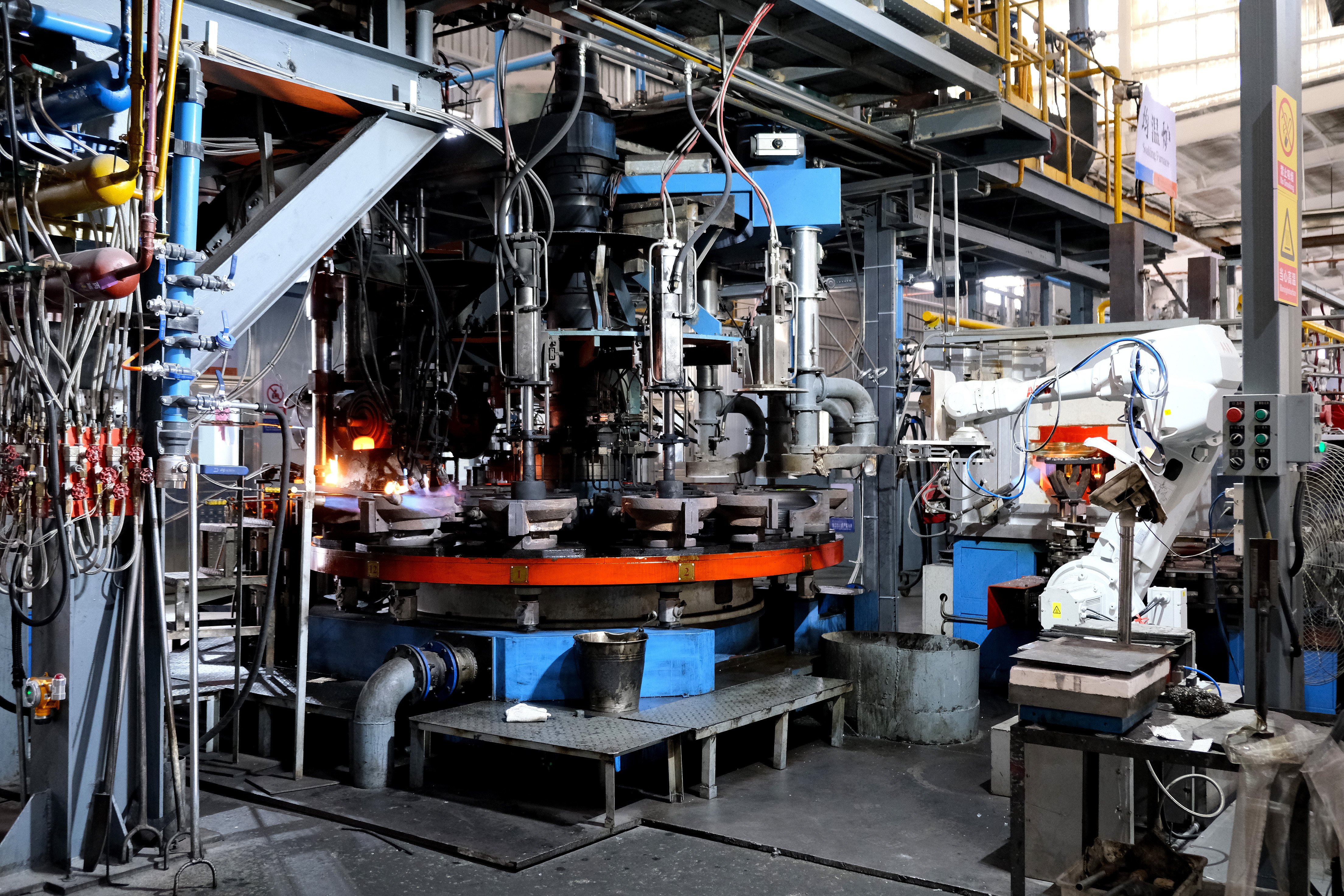
Forming area on the production line at Jiangxi QOCI Electric, where both porcelain and glass insulator bodies are shaped before firing and assembly.
Dual-material production is the operationally relevant part of that profile. A supplier running both porcelain and glass lines gives a buyer one qualification route, one technical interface and one commercial counterpart for a project that may use porcelain pin insulators on distribution sections and glass suspension discs on transmission sections. It also means a material change triggered by field performance or a specification revision does not automatically force a new supplier qualification.
The limit is equally clear: dual capability is not an interchangeability guarantee. A porcelain unit and a glass unit at the same nominal rating differ in mass, dimensions, shed profile and fittings, so switching between them on a live design is an engineering change requiring requalification — not a purchasing substitution.
Management-system certification is the standard document set to request at this stage. QOCI holds an Occupational Health and Safety Management System certificate to GB/T 45001-2020 / ISO 45001:2018 (certificate 00125S30581R3M/3600) and an Environmental Management System certificate to GB/T 24001-2016 / ISO 14001:2015 (certificate 00125E30701R3M/3600), both issued on 7 March 2025 by CHINA QUALITY CERTIFICATION CENTRE and valid to 24 March 2028, covering R&D, production and sales of electrical equipment including high and low voltage insulators. Buyers should read those certificates for what they are — management-system certification — and still request routine and type-test reports for the specific model being purchased, because a management-system certificate does not certify a product's ratings.
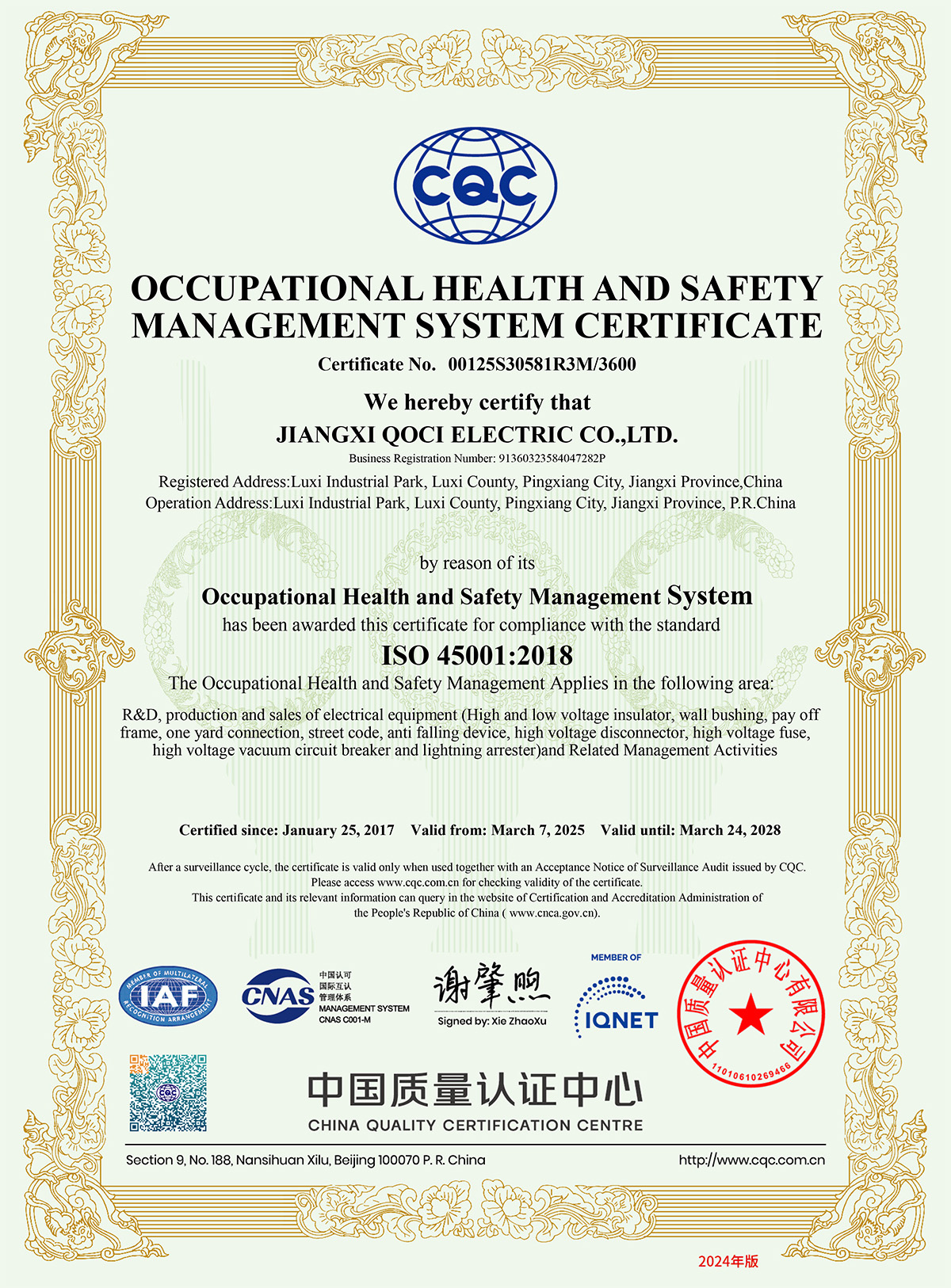
Occupational Health and Safety Management System certificate (ISO 45001:2018, certificate 00125S30581R3M/3600, valid to 24 March 2028).
For market context, the same third-party research that sizes this category identifies NGK Insulators Ltd. (Japan) and Lapp Insulators (Germany) as recognised global leaders in high-performance ceramic insulators. That is useful benchmarking context when building a shortlist, but it does not replace project-specific evidence; the comparative basis remains test reports, creepage and mechanical ratings, and delivery terms for the units actually being ordered.
Two procurement constraints also belong in the supplier file. Customs classification for porcelain electrical insulators runs under HS code 8546.20, and in India the DPIIT procurement policy requires 50% local content for porcelain insulators to be classified under Class I for government contracts — a structural constraint that affects how a project is sourced, not only which unit is bought.
6. The framework in one table
| Decision dimension | Porcelain (verified evidence) | Glass (verified evidence) | What the buyer must verify |
|---|---|---|---|
| Dielectric body | Vitrified ceramic from kaolin, quartz and feldspar fired at roughly 1,200–1,300 °C; glazed surface | Tempered glass body | Material and type-test reports for the exact model |
| Forms in the QOCI catalogue | Pin (P-11-Y), shackle (ED-2B), line post, AC disc-shaped suspension porcelain | Cap-and-pin suspension discs in the PS-, U- and ANSI 52- series | Confirm the product form and coupling the line position requires |
| Mechanical ratings evidenced | 10 kN rated mechanical load (P-11-Y); 13.5 kN tensile strength (ED-2B) | 70 kN to 420 kN failing load across the suspension range; 210 kN on PS210V 212V | Specify kN together with disc diameter, nominal spacing and socket coupling |
| Creepage distance evidenced | 240 mm at 11 kV (P-11-Y) | 320 mm to 620 mm depending on design; 400 mm on PS210V 212V, 620 mm on U420BP | Match creepage to the IEC 60815 pollution class at the site |
| Metal fittings | Hot-dip galvanised forged steel pin | Hot-dip galvanised cast iron cap and forged steel pin | Galvanising specification and coupling dimensions |
| In-service degradation evidence | Zero-value degradation can occur with no visible external change; live-line testing on a three-to-five-year cycle recommended | Not covered by the verified evidence set used in this framework | Request the supplier's inspection and testing guidance for the material actually purchased |
| Interchangeability | A porcelain unit and a glass unit at the same nominal rating differ in mass, dimensions and fittings | Same constraint applies in the opposite direction | Treat any material change as an engineering change requiring requalification |
Table 2: A decision framework, not a ranking. Dimensions are listed in the order a buyer normally resolves them: body, form, load, creepage, hardware, lifecycle evidence, interchangeability.
Once the technical criteria are fixed, the execution sequence is short:
- Fix the duty class for each position and record the required mechanical failing load.
- Set creepage distance from the IEC 60815 pollution class, not from the previous project's drawings.
- Specify diameter, nominal spacing and socket coupling alongside the kilonewton rating.
- Require routine and type-test reports for the exact model, plus 100% pre-shipment testing and third-party inspection where the contract allows it.
- Check certification scope and expiry dates, and file the certificates with the order documents.
- Plan and budget the in-service inspection cycle before the string is energised.
- Confirm lead time, MOQ and available capacity for the delivery window — 15–35 days lead time and 750,000 units monthly capacity in QOCI's published capability data.
7. Where the framework applies
The framework resolves differently depending on line position, and the distinctions are practical rather than theoretical.
Distribution and rural electrification. Porcelain pin and shackle units carry this duty. P-11-Y is rated 11 kV with a 10 kN mechanical load and 240 mm creepage for overhead distribution lines and rural electrification; ED-2B is a shackle/butterfly insulator with 13.5 kN tensile strength, 13 kV power frequency wet withstand and 25 kV dry withstand for low-voltage lines. Both were used in the coastal and tropical distribution programme described in section 3.
Transmission suspension strings. Glass cap-and-pin discs cover 70 kN to 420 kN with creepage from 320 mm to 620 mm, so the pollution class — not the material label — selects the unit. PS210V 212V sits at 210 kN with 400 mm creepage; U420BP reaches 620 mm creepage at 420 kN for heavier pollution duty.
Coastal and industrial environments. Extended-creepage designs are available in both families, and the correct choice depends on which shed profile exists at the required mechanical class. Anti-pollution profiles in porcelain and longer-creepage suspension designs in glass attack the same failure mode: surface contamination combined with moisture.
Substation and industrial applications. Post-type porcelain and disc units serve these positions, and the substation porcelain insulator segment is projected to grow at a 7.2% CAGR through 2031, driven by GIS upgrades (Mordor Intelligence).
8. Limits of this framework
- Duty-class mismatch. The two anchor products sit in different classes — 10 kN pin versus 210 kN suspension — so no performance, weight or price conclusion can be transferred between them.
- Evidence asymmetry. The verified evidence set contains detailed service-life and detection guidance for porcelain, and a field case comparing porcelain against a composite alternative. It does not contain an equivalent glass-versus-porcelain service comparison.
- Incomplete price basis. No verified unit-price comparison between porcelain and glass was available, so TCO must be built from project quotations rather than from a general rule.
- Market-size divergence. Independent estimates for this category differ materially in scope, so size figures should be read as directional rather than exact.
9. Market trend analysis
Three trends are visible in third-party data, and each has a buyer-side implication.
Growth with geographic concentration. The global porcelain insulator market was valued at approximately USD 8.27 billion in 2023 and is projected to reach USD 15.04 billion by 2033 (Spherical Insights). Asia-Pacific dominated the market with a 49.4% revenue share in 2025 (Mordor Intelligence), and China was the world's largest exporter of electrical insulators in 2024 with 31.4% of total global exports, approximately USD 898 million (OEC). For buyers, this means qualified supply is concentrated in Asia, which raises the value of supplier verification and dual-source planning.
Application concentration, with a shift inside the mix. Overhead transmission lines account for approximately 62.1% of global porcelain insulator revenue (Mordor Intelligence, 2025), while the substation segment is projected to grow at a 7.2% CAGR through 2031 on the back of GIS upgrades. Line-unit demand stays dominant, but post-type and substation units are becoming a larger share of tenders.
Standard and policy alignment. IEC 60383-1:2023 is the current international standard for ceramic or glass insulator units above 1,000 V, ANSI C29.1 governs test methods in North America, and HS code 8546.20 applies at customs. Localisation rules such as India's 50% local-content requirement for Class I government contracts shape sourcing structures independently of the technical decision.
It is also worth noting that published market-size figures diverge significantly — Mordor Intelligence estimates USD 9.87 billion for 2025, Dataintelo USD 4.0 billion, and Metastat Insight USD 9.6 billion — most likely because of differences in which product types and voltage ranges are counted. Directional reading is appropriate; precise figures should be treated with caution.
10. Future outlook
Standard editions will keep moving, and tenders that name the edition and the test regime rather than only a product description will be easier to defend after delivery. Because IEC 60383-1 covers both ceramic and glass units, buyers should expect to maintain qualified sources in both materials rather than consolidating to one — the risk of a single-material, single-supplier position is a supply-continuity risk, not merely a cost issue.
Demand growth concentrated in Asia-Pacific and in overhead transmission will keep pressure on lead times, which makes the supplier's capacity and lead-time data part of the technical evaluation rather than a commercial afterthought. Substation and GIS-driven demand growth means post-type and disc units will be tendered alongside line units more often, and local-content rules in individual markets will continue to shape sourcing structures. None of these trends removes the need for the basic sequence: duty class first, creepage second, hardware third, TCO fourth, supplier evidence last.
11. Frequently asked questions
How should a buyer compare porcelain and glass insulators when the two are supplied in different product forms?
Compare within a duty class. Fix the line position, the mechanical failing load, the creepage distance required by the pollution class and the coupling, then compare the designs available in both materials at that rating. A porcelain pin insulator rated 10 kN and a glass suspension unit rated 210 kN are not alternatives to each other, so a head-to-head comparison between them carries no information. Only after the duty class is fixed does a material comparison become meaningful.
Which specification values decide whether a porcelain or glass unit fits a project?
Five groups of values decide fit: mechanical failing load; creepage distance matched to the IEC 60815 pollution class; nominal spacing and disc diameter; socket coupling; and voltage withstand values including power frequency wet withstand and lightning impulse withstand. For P-11-Y this means 11 kV, 10 kN, 240 mm creepage, 50 kV wet power frequency withstand and 90 kV lightning impulse withstand. For PS210V 212V it means 210 kN, 400 mm creepage, 170 mm nominal spacing, socket coupling 20, 45 kV wet power frequency withstand and 110 kV dry lightning impulse withstand. Where a data sheet is silent — for example on puncture voltage for P-11-Y — the buyer should request the value rather than assume it.
What should be verified about a supplier that produces both porcelain and glass?
Verify production evidence and process control, not just catalogue breadth. QOCI reports automated and intelligent production of both material families, a 35,373 m² factory area, an annual output of 9,000,000 units and a monthly capacity of 750,000 units, with 100% pre-shipment testing and third-party SGS inspection. Buyers should check certificate scope and validity dates, confirm which line will run the order, and confirm that both materials can be delivered within the same lead-time window — 15–35 days in QOCI's published data. Dual capability removes the need to qualify two suppliers, but it does not remove the need to qualify each product's ratings.
Can insulator orders be customised for voltage and branding?
Yes. Production services include OEM and ODM modes, and customisation is supported for voltage and logo, with a minimum order quantity of 50 units and a lead time of 15–35 days in the published capability data. Because voltage customisation changes the electrical design, it should be tied to a defined specification and accompanied by the corresponding type-test evidence, rather than treated as a labelling change.
How should maintenance be planned after the units enter service?
For porcelain, plan around zero-value degradation. Units can fail electrically with no visible external change, so live-line testing every three to five years using voltage-gradient or spark-gap detection is recommended, together with pollution checks against the design pollution class and replacement during a maintenance outage. At the supply stage, requiring 100% dye penetration testing reduces the probability that a cracked unit enters service. QOCI's published after-sales terms include online technical support and replacement of defective products. Inspection frequency should be reviewed whenever the site pollution level differs from the design assumption.
Reference documents: the QOCI glass insulator catalogue is available for download at QOCI Catalogue – Glass Insulators (PDF). Company information: www.quanxinelectric.com.