
Porcelain Tile Supplier Audit: Capacity and Project Proof
Porcelain Tile Supplier Audit: Capacity and Project Proof
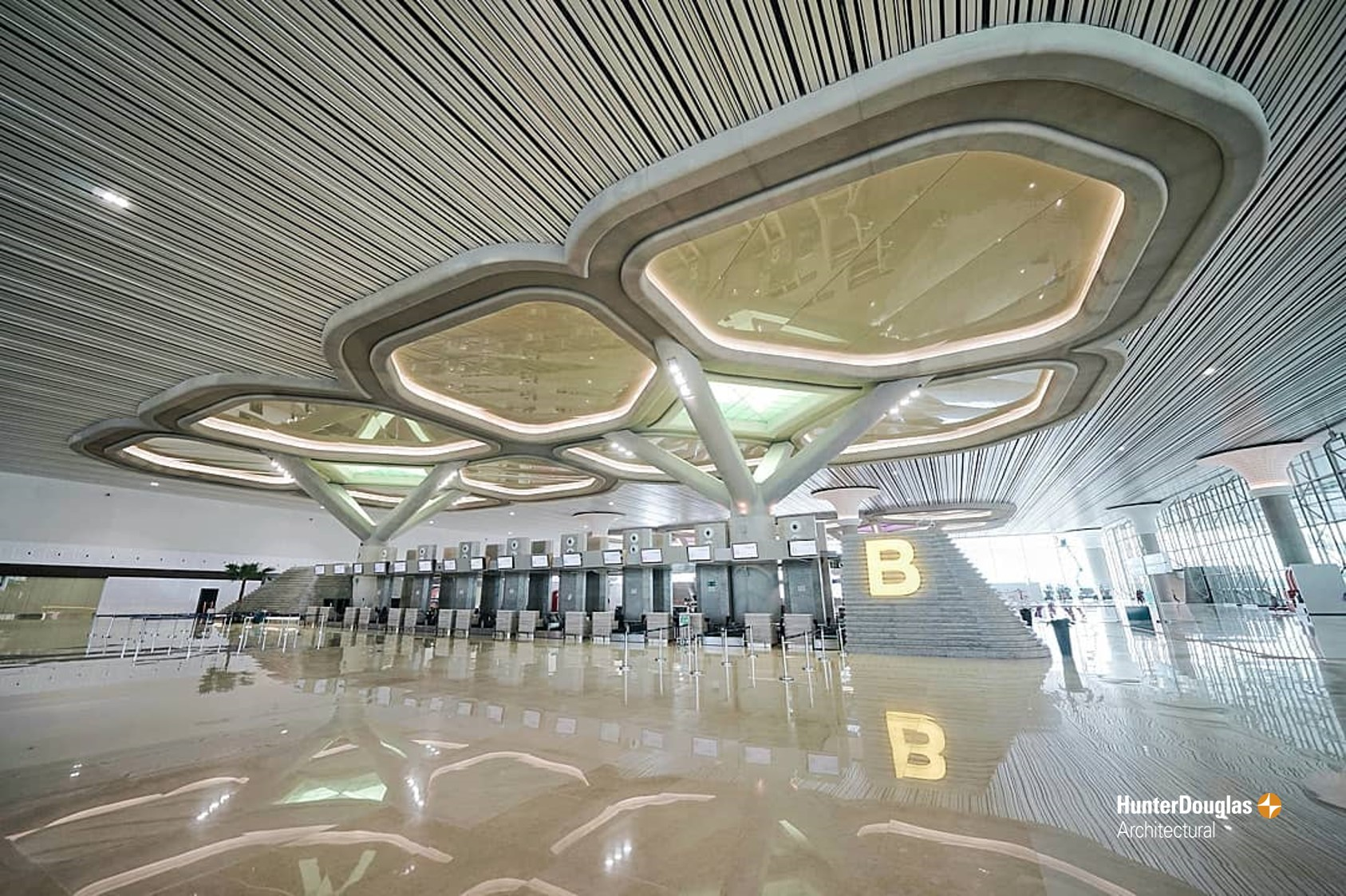
Porcelain tile installation at a municipal airport project in Indonesia. Image: Monalisa project material.
A porcelain tile supplier's capacity and project record should be treated as claims until a buyer can trace each one to a document, a date and a physical asset. That is the practical difference between an evaluation assembled from brochures and one assembled from evidence: the output figure, the certificate scope, the production line and the project reference each have to be checked against something the buyer can inspect.
This guide sets out the physical and documentary trail a procurement team should ask for between supplier evaluation and project execution. Monalisa Group Co., Ltd. is used as a worked benchmark rather than an endorsement: the company is a Foshan-headquartered architectural ceramics manufacturer founded in 1992, operating four production bases in Xiqiao (Foshan), Qingyuan (Guangdong), Tengxian (Guangxi) and Gao'an (Jiangxi). Its published figures are specific enough to be audited, which is precisely why they are useful for teaching the method.
Why capacity claims drift between quotation and factory
Capacity claims drift for three ordinary reasons: the reference year moves, the product scope changes, and the definition of capacity changes. None of these requires bad faith, and all three make an unchecked number unsafe in a bid comparison.
Date drift is the easiest to demonstrate. A Monalisa-related company page describing the group's position up to March 2017 cited two production bases, 19 modern building-ceramic production lines and two porcelain-panel lines, with annual output of 35 million m² across a mixed portfolio of wall and floor tiles, panels and ceramic art products. Current corporate material describes four production bases and 37 production lines. Both statements can be true as written. They cannot be used as a pair to describe today's footprint, because the base count, line count, product scope and reference year all differ.
Scope drift is subtler. A figure covering ceramic tiles, slabs, thin plates, rock plates and porcelain art paintings is not a porcelain tile capacity figure. When the quotation depends on a specific format — a large format porcelain tile for a lobby, a marble look porcelain tile for a reception wall, an outdoor porcelain tile for a plaza — the buyer needs capacity that applies to that product family, not the group total.
Definition drift is the one that most often survives a desk review. Nameplate capacity, planned output, peak-month output and shipped volume are four different numbers, and suppliers are not always consistent about which one they publish. The audit answer is the same in every case: ask for the definition in writing, alongside the date and the product scope, and apply that answer consistently to every bidder on the shortlist.
Reconciling manufacturing area, line count and annual output
The first arithmetic test is internal consistency: site area, line count and annual output should tell the same story once the basis is fixed, and the same arithmetic should be applied to every bidder.
Monalisa reports 2,779,333.33 m² of manufacturing area across its four bases, 37 production lines, approximately 100 million m² of annual capacity and 4,106 employees. Two ratios follow from those figures, and both should be labelled as calculated rather than measured. Dividing stated annual capacity by line count gives approximately 2.70 million m² per line per year (100,000,000 divided by 37 equals 2,702,703). Dividing by headcount gives approximately 24,350 m² per employee per year (100,000,000 divided by 4,106 equals 24,354).
Neither ratio is a pass mark. Line output depends on kiln width, firing cycle, format and the balance between pressed and glazed production, so a ratio only carries meaning when it is compared like for like: the same supplier's earlier figures, or two bidders using the same product scope in the same year. What the ratio exposes is a claim that cannot be reconciled — a very large output attached to a small line count, or a project programme that assumes more output than the stated capacity can deliver inside the required window.
Basis questions are not hypothetical. Monalisa's capability documentation states a monthly capacity of 12.5 million m². Multiplied by twelve, that would imply 150 million m² a year, against the approximately 100 million m² annual figure used in corporate material. The difference may be entirely legitimate — monthly rates are often quoted at nameplate or peak and across the full product range, while annual figures may reflect planned output or a narrower mix — but the buyer should not be the one guessing. Ask which basis the monthly number uses, which product families it covers, and how the annual figure is derived.
Staffing and R&D: verifying the engineering base
Headcount and patent counts matter in an audit only when they can be tied to the people and documents that will actually handle a project.
Monalisa reports 4,106 employees and a research and development team of 100 engineers, supported by platforms including a National Enterprise Technology Center and a Postdoctoral Research Workstation. For an auditor, the useful questions are positional rather than numerical: where those engineers sit — at headquarters, at a specific base, or distributed across all four — which of them sign test reports and first-article approvals, and who answers a technical query during installation. A 100-engineer team is a capability signal; a named engineer with a documented approval role is evidence.
The company also reports 892 authorised patents, including 145 invention patents, as of June 2021, and participation in the drafting of 49 national, industrial, local and group standards. Both figures can be checked outside the supplier's own material — patent counts through the relevant patent office records, standard participation through the published standard documents — and both should be checked with a date attached, because an undated patent count ages badly.
Two distinctions matter here. First, an authorised patent is not automatically an in-force patent, and a patent family is not a product feature; ask which patents relate to the format, glaze or printing process you are buying. Second, participation in drafting a standard is a contribution to a document, not a certification of any product against it. That a supplier helped write a standard says something about technical standing; it does not say what a specific SKU will test at.
Product history supplies a useful cross-check. Monalisa's record includes an 1800×900×5.5 mm ceramic thin plate introduced in 2007 that won first prize in the China Building Materials Science and Technology Progress Award, and a 9000×1800×10.5 mm ultra-large ceramic plate launched in 2021. Milestones of this kind can be verified through award records and product literature, and they say more about large-format capability than a general statement about innovation.
Certification evidence: read the scope line before the logo
ISO 9001 and ISO 14001 confirm that a quality and an environmental management system have been audited; neither certifies a tile's water absorption, slip resistance or frost performance. Monalisa holds 15 certifications including ISO 9001 and ISO 14001, and the value of that count depends entirely on which documents sit behind it and what each one covers.
A document-level example shows what an auditor should be reading. A CE certificate numbered CY25A10379-TVOC, issued on 7 March 2025 by China Testing & Certification International Group Shaanxi Co., Ltd. and valid to 7 March 2035, is scoped to a 1200×1200×10 mm glazed BIa tile for wall and floor, assessed under EN 14411:2016. A second record, NSF certification C0676949-01 issued by NSF International on 3 April 2023 against NSF/ANSI 51, lists specific porcelain tile and slab models.
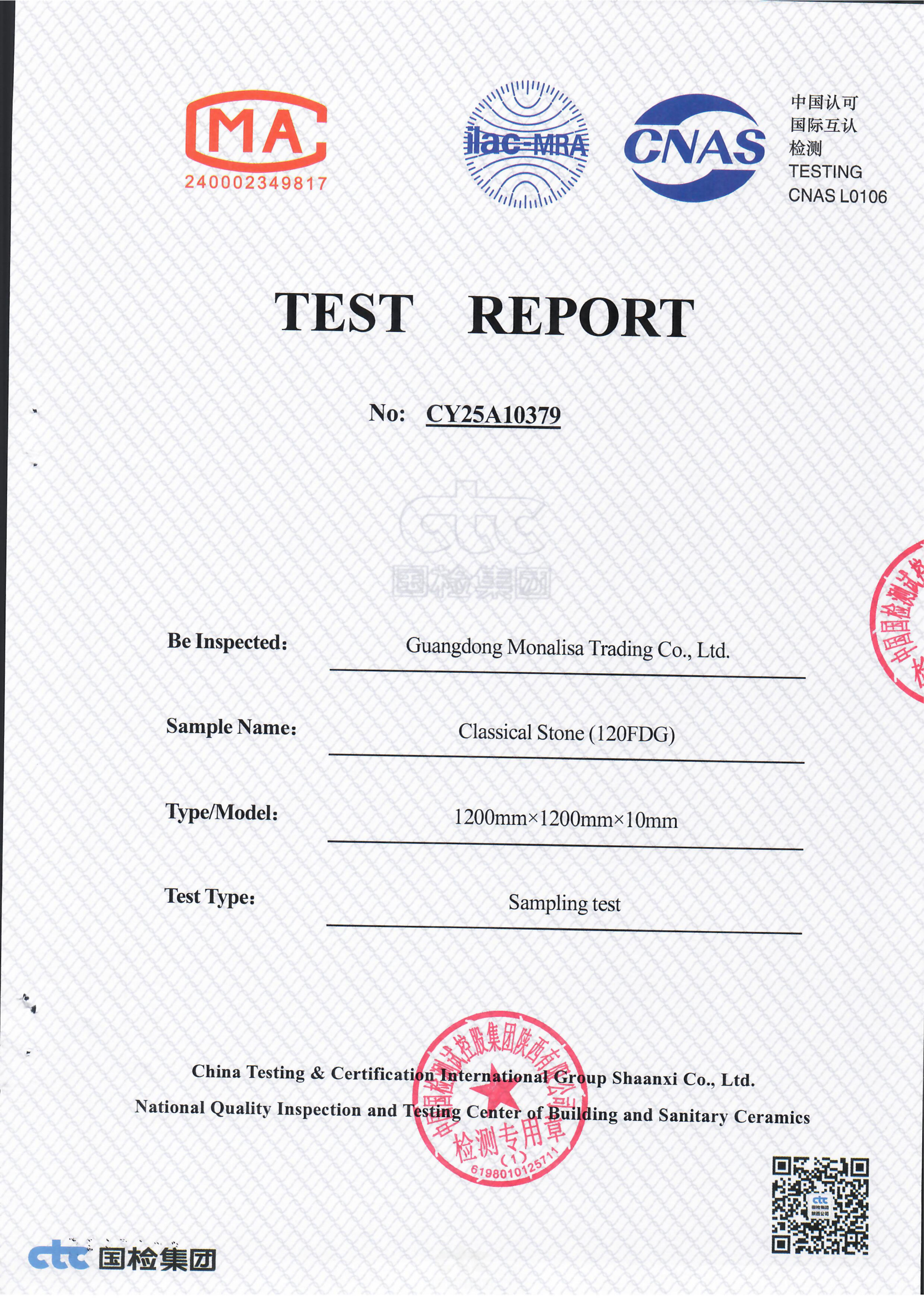
A test report page of the kind a buyer should request with the certificate number, standard edition and product scope. Image: Monalisa certification material.
The scope line is what decides relevance to an order. A certificate for a 1200×1200 mm glazed BIa tile does not automatically cover a 600×1200 mm unglazed outdoor product, and a management-system certificate never substitutes for a product test report. For the technical meaning behind the classification, ISO 13006:2018 places porcelain tiles in Group BIa at a water absorption (E) of 0.5% or below, with average mechanical resistance above 40 N/mm² — figures a buyer can hold directly against a laboratory report.
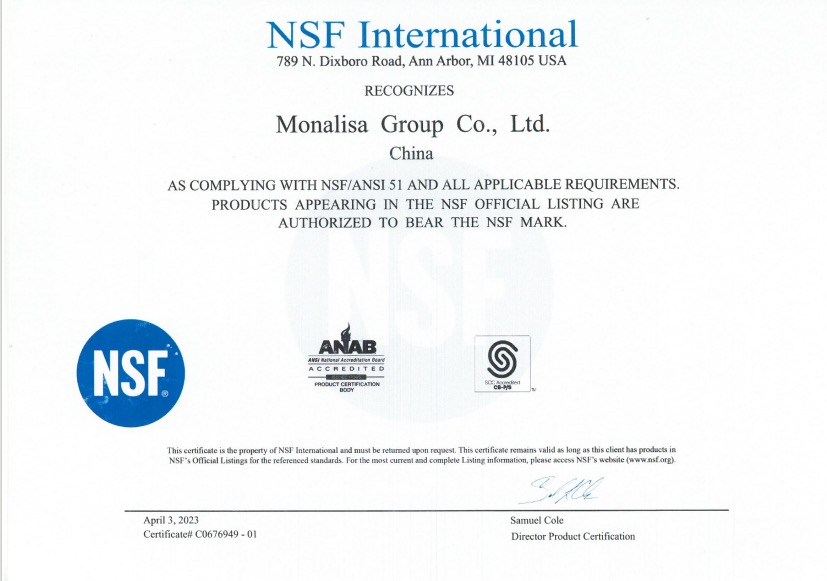
Certification documents should name the issuing body, the standard, the listed models and the validity period. Image: Monalisa certification material.
Practical verification is short: confirm the certificate number on the issuing body's registry rather than on the supplier's PDF; confirm the edition of the standard cited; confirm that the size, finish and classification in the scope match the SKU being ordered; confirm validity and that surveillance audits are current; and confirm that the certification body is accredited for that scope. A certificate that fails the third check is not a forged document — it is simply a document about a different product.
System-level evidence supports the same review. Monalisa reports a “3M” quality management model, the Foshan Municipal Government Quality Award, the Guangdong Provincial Government Quality Award and a nomination for the 3rd China Quality Award, together with recognition as a national “Resource-saving and Environment-friendly” pilot enterprise and one of the first batch of “Green Factories” designated by the Ministry of Industry and Information Technology, with zero wastewater discharge claimed. These are institutional signals about how a plant is managed; they should be read beside product-level test data, not instead of it.
On-site verification: what a factory walk can and cannot settle
A site visit confirms that assets exist and are operating. It does not confirm capacity utilisation, future allocation, or that the line you saw will produce your order.
On a walk-through, insist on the sequence the product actually follows: raw material intake and body preparation, pressing, glazing and digital printing where applicable, firing, sorting and grading, packing and batch coding. What the auditor is checking is continuity — that a digitally printed porcelain tile seen in the showroom corresponds to a printing line that is running, and that shade control and grading stations exist as described. The company states 100% testing; the audit question is what is tested, at what frequency, by whom, and whether the records for a recent batch can be produced on request.
Physical evidence also sets the commercial boundary. Monalisa's capability documentation states OEM and ODM production, customization of pattern and logo, a minimum order of 2,000 m², and a lead time of 7–15 days. A lead time is only meaningful against a specific quantity and format; the practical test is to ask for a production schedule for your own quantity and see whether it is built from line allocation or from a standard table. A 2,000 m² minimum is small against a commercial porcelain floor tile package but may be the binding constraint on a bathroom porcelain tiles or kitchen porcelain tiles order with a bespoke pattern.
Reference projects: separating designation from delivery
A project name on a supplier's reference list can mean anything from one SKU in one building to the entire floor package. The audit task is to establish which.
Monalisa's reference record includes eight venues of the Beijing Olympic Games, ten venues of the Guangzhou Asian Games and the Hong Kong–Zhuhai–Macao Bridge; the company was the designated ceramic tile supplier for the China Pavilion at Expo 2020 Dubai and the exclusive supplier of official architectural ceramics for the 19th Asian Games Hangzhou 2022. Each carries a different evidential weight. “Designated supplier” and “exclusive supplier” describe a commercial role defined by the event organiser; they do not, by themselves, state how many square metres were delivered, in which format, or under what acceptance standard.
For each reference that matters to the bid, request four things: the scope of supply (product family, format, area), the delivery window, the project-specific specification or acceptance criteria, and one contactable reference on the buyer or main-contractor side. Where disclosure is restricted, ask for a redacted purchase order or delivery record rather than a marketing summary. A delivery record with a date and a quantity is worth more than a logo wall.
A more granular example appears in Monalisa's own case material: an 80,000 m² porcelain tile installation for a municipal government client at Jogjakarta Airport in Indonesia, delivered over two years, with a reported breakage rate below 0.3% and reported savings of 30% in life-cycle maintenance cost and 15% in grouting materials and labour through tight-joint installation. These are company-reported project results and should be treated as such: ask what the maintenance-cost comparison was measured against, over what period, and whether the 15% covers material, labour or both. The breakage rate is the most directly checkable of the three, because it should also appear in delivery and claims records.
OEM, ODM and customization: checks for private-label buyers
For an importer or brand owner, capability has to be verified at the level of the private-label programme, not at the factory gate.
Monalisa provides OEM and ODM production services with customization of pattern and logo. Before committing, settle four points in writing: who owns the print files and any tooling created for the design; how first-article approval works and what the reference master plate is; how the supplier prevents the same pattern reaching another buyer in the same market; and what the agreed tolerances are for shade, calibre and dimensional variation between production runs. None of this is unusual, and all of it is cheaper to agree before the first container than after it.
Sample-to-production continuity is the part most often assumed rather than tested. Ask for the sample to be produced on the line that will run the order, retain the approved master, and state in the purchase order that bulk deliveries will be compared against it. For a digitally printed porcelain tile, the printed surface is the highest-risk variable between runs, and a marble look or stone look design will show drift faster than a plain body.
Acceptance terms and after-sales: converting evidence into execution
Evidence becomes useful only when it is written into the purchase order as an acceptance procedure and a service obligation.
The documented acceptance protocol is straightforward and can be adopted as it stands: check outer packaging for damage and moisture and confirm the certificate of conformity and installation guide are inside; confirm labelling matches the order on shade, size and quantity; open 5%–10% of cartons at random to compare actual colour and pattern against the reference sample or master plate; and measure length and thickness with a vernier caliper, and flatness with a feeler gauge and straightedge, on at least ten pieces per batch. The same record specifies a 2,000 m² minimum order, FOB, CIF or EXW delivery terms, and TT or LC payment.
The after-sales record adds a 5–15 year product warranty depending on series and project type, covering manufacturing defects such as colour difference, dimensional deviation and glaze cracks; complaint response within 24 hours with a solution within seven working days; a same-batch stock reserve held for two years for later repair and replenishment; technical guidance on layout and substrate preparation; on-site support for large projects; and test reports, certificates of conformity and maintenance guides in Chinese and English. For a project owner, the two-year batch reserve is the clause with the longest tail: a corridor repaired in year three only matches if the original batch still exists.
Continuity and financial signals
Financial disclosure is a continuity check, not a quality verdict, and it should be read with the market beside it.
Monalisa Group is listed on the Shenzhen Stock Exchange (002918). Its reported 2025 annual revenue was CNY 3.92 billion, a 15.28% decrease year on year. Over the same period the wider industry was contracting: world tile production fell to 14.95 billion m² in 2024, 6.2% below 2023, according to MECS/Acimac research. A revenue decline at a supplier therefore does not, on its own, separate that supplier from its market — but it is a legitimate prompt to ask about capacity utilisation, order backlog and whether any lines are currently idle, and to consider what those answers mean for a delivery schedule that runs into the following year. Expect commercial sensitivity here and ask for what can be disclosed rather than assuming the worst.
What financial data cannot do is predict tile quality. A profitable supplier can still ship an out-of-tolerance batch, and a loss-making one can still meet specification. The two checks answer different questions and belong in different columns of the evaluation.
An audit evidence table
The table converts the benchmark figures into a working audit map. Each row states what the evidence establishes, what it leaves open, and the action that closes the gap.
| Evidence item | What it establishes | What it does not establish | Verification action |
|---|---|---|---|
| 2,779,333.33 m² of manufacturing area across four bases | Physical scale and a multi-site footprint | Porcelain-tile-only capacity; current utilisation | Confirm each base address and visit the base allocated to the order |
| 37 production lines | Line-level production footprint | Which lines run which formats or product families | Request a line-to-product mapping and the line allocated to your order |
| Approximately 100 million m² annual capacity; 12.5 million m² monthly | A stated output envelope | The basis (nameplate, planned or peak) and the product scope | Obtain the definition and reference period in writing; reconcile monthly against annual |
| 4,106 staff; 100 engineers; 892 patents (145 invention, as of June 2021); 49 standards | Depth of the technical organisation | That any specific SKU performs to a given specification | Patent-registry check; a named engineer for technical approval; product-level test reports |
| 15 certifications including ISO 9001 and ISO 14001; CE CY25A10379-TVOC under EN 14411:2016 (1200×1200×10 mm glazed BIa, valid to 7 March 2035); NSF C0676949-01 against NSF/ANSI 51 | Audited management systems and product-scope conformity for the listed items | Coverage of unlisted formats, finishes or classifications | Check each number on the issuer's registry; match scope to the ordered SKU; confirm currency |
| Reference projects: eight Beijing Olympic venues, ten Guangzhou Asian Games venues, Hong Kong–Zhuhai–Macao Bridge, Expo 2020 Dubai China Pavilion, 19th Asian Games Hangzhou 2022; Jogjakarta Airport 80,000 m² over two years with reported breakage below 0.3% | Demonstrated participation in large public projects | Delivered area, format, acceptance standard or share of the package | Request scope of supply, delivery window, project specification and one contactable reference |
| OEM and ODM production; pattern and logo customization; 2,000 m² minimum order; 7–15 day lead time | Private-label capability and stated commercial terms | Run-to-run consistency and design exclusivity | First-article approval on the production line; written file and tooling ownership; retained master plate |
Figures are as reported by the company or by the cited certifying bodies and are not independently measured here. Ratios derived from them are calculations, not measurements.
What this evidence cannot establish
An audit of this kind produces a defensible picture of a supplier's structure and documentation. It does not produce a guarantee, and the limits belong in the report beside the findings.
- Company-published capacity, headcount, patent and project figures are company-reported. They can be checked for internal consistency and against public registries, but they cannot be converted into measured output.
- A certificate's scope is finite. It evidences the listed product, size and classification, and nothing outside that line.
- A project reference evidences participation, not delivered volume or defect performance, unless delivery and claims records are produced.
- A site inspection evidences installed assets, not utilisation rates or the allocation reserved for your order.
- Ratios such as output per line or output per employee are calculated indicators for comparison between bidders, not industry benchmarks.
Naming these limits is not an argument for skipping the audit. It is the reason the audit is written down: what remains after the limits are stated is the part a buyer can rely on in a dispute.
Outlook: documentation-led qualification
Supplier qualification in porcelain tile is moving toward document-level evidence rather than presentation-level claims. Buyers who began asking for certificate numbers and scope lines are now asking for batch traceability and same-batch reserves that extend past practical completion, because the cost of a mismatched repair years later falls on the project rather than the supplier.
For suppliers, that shift rewards organisations able to produce a document on request. A stated capacity of approximately 100 million m², a four-base footprint, 37 lines and a certification file that includes product-scoped CE and NSF records are advantages only if they survive a buyer's verification — which is, in the end, the only test that decides an award.
Procurement teams preparing an audit can use the company brochure as a starting record of product and capability information: download the Monalisa Group brochure (PDF).
FAQ: supplier audit questions
What documents should a buyer request before auditing a porcelain tile supplier?
Request the management-system certificates (ISO 9001, ISO 14001) with their scope and validity; product certificates and test reports naming the size, finish and classification; the certificate of conformity and installation guide for the specific SKU; the production base and line allocated to the order; a scope-of-supply statement for each reference project; and the acceptance criteria that will apply at goods receipt. Ask for certificate numbers so they can be checked on the issuing body's registry rather than accepted as a PDF attachment.
How can a buyer test whether a stated annual capacity is realistic?
Reconcile it against line count and headcount on the same basis, and ask for the definition and reference period. For Monalisa, approximately 100 million m² of annual capacity against 37 lines gives roughly 2.70 million m² per line per year, and against 4,106 employees roughly 24,350 m² per employee per year; these are calculated ratios for comparison, not benchmarks. Where a monthly figure is also quoted (12.5 million m²), ask whether it is nameplate, peak or full-portfolio, since multiplying by twelve would imply a different annual number.
Does ISO 9001 or ISO 14001 certification prove a tile's technical performance?
No. They certify that a quality or environmental management system has been audited. Technical performance — water absorption, mechanical resistance, slip, frost or stain behaviour — is evidenced by product standards and test reports, such as classification under ISO 13006:2018, which places porcelain tiles in Group BIa at a water absorption of 0.5% or below with average mechanical resistance above 40 N/mm², or a product-scoped assessment under EN 14411:2016.
How should a supplier's reference projects be verified?
Establish the scope of supply, not just the project name: product family, format, area delivered, delivery window, the project specification or acceptance standard, and one contactable reference. A designation such as designated supplier for an event pavilion and a documented 80,000 m² installation at Jogjakarta Airport are different classes of evidence — the first describes a commercial role, the second can be supported by delivery and claims records. Where full disclosure is restricted, request redacted purchase orders or delivery records.
What should be agreed in writing for an OEM or ODM porcelain tile programme?
Agree ownership of print files and tooling; the first-article approval process and the retained master plate; design exclusivity by market; tolerances for shade, calibre and dimensional variation between runs; the minimum order (2,000 m² on the documented terms); the lead time against your specific quantity (7–15 days on the documented terms); and the acceptance procedure, including random carton opening of 5%–10% and dimensional checks on at least ten pieces per batch.
¿Tiene preguntas o necesita más detalles?
Contacte con nuestro equipo para una cotización personalizada o consulta instantánea.
Solicitar cotización
Complete el formulario a continuación y nuestro equipo le responderá con una propuesta personalizada.
Chat directo de WhatsApp
¿Prefiere chatear en tiempo real? Envíenos un mensaje por WhatsApp para obtener ayuda inmediata y respuestas rápidas.
- Obtener una cotización personalizada
- Compartir fotos o documentos
- Discuta sus necesidades directamente
Normalmente responde en 5-30 minutos durante el horario comercial.