
Porcelain Tile Project Solutions: ISO 9001 & CE Submittals
Porcelain Tile Project Solutions: ISO 9001 & CE Submittals
Porcelain Tile Project Solutions: ISO 9001 & CE Submittals
On most commercial projects, a porcelain tile package is not judged on the showroom sample. It is judged on the submittal: a folder of certificates, product codes and scope statements that the specifier, the consultant and the main contractor can check line by line against the specification. When that folder is inconsistent — a certificate number retyped from an old email, a scope that never names the specified product, or a CE document attached to an outdoor paving package — the tile is delayed even when the tile itself is correct.
ALL KING CERAMICS (ZIBO ALL-KING CERAMICS CO., LTD) is a porcelain tile manufacturer and direct exporter based in Zibo, China. Founded in 2011, the company operates a 60,000 m² factory with 320 employees, a 25-engineer R&D team and an annual output of 12–16 million m², with roughly 70% of production exported to markets that include Australia, New Zealand, Russia, South Korea, Southeast Asia, the Middle East and Latin America. Its project documentation set contains an ISO 9001:2015 certificate issued by XQCC and a CE certificate issued by TUV, both naming porcelain tiles 5624 (Travertine) and 4765 (Marble Series).
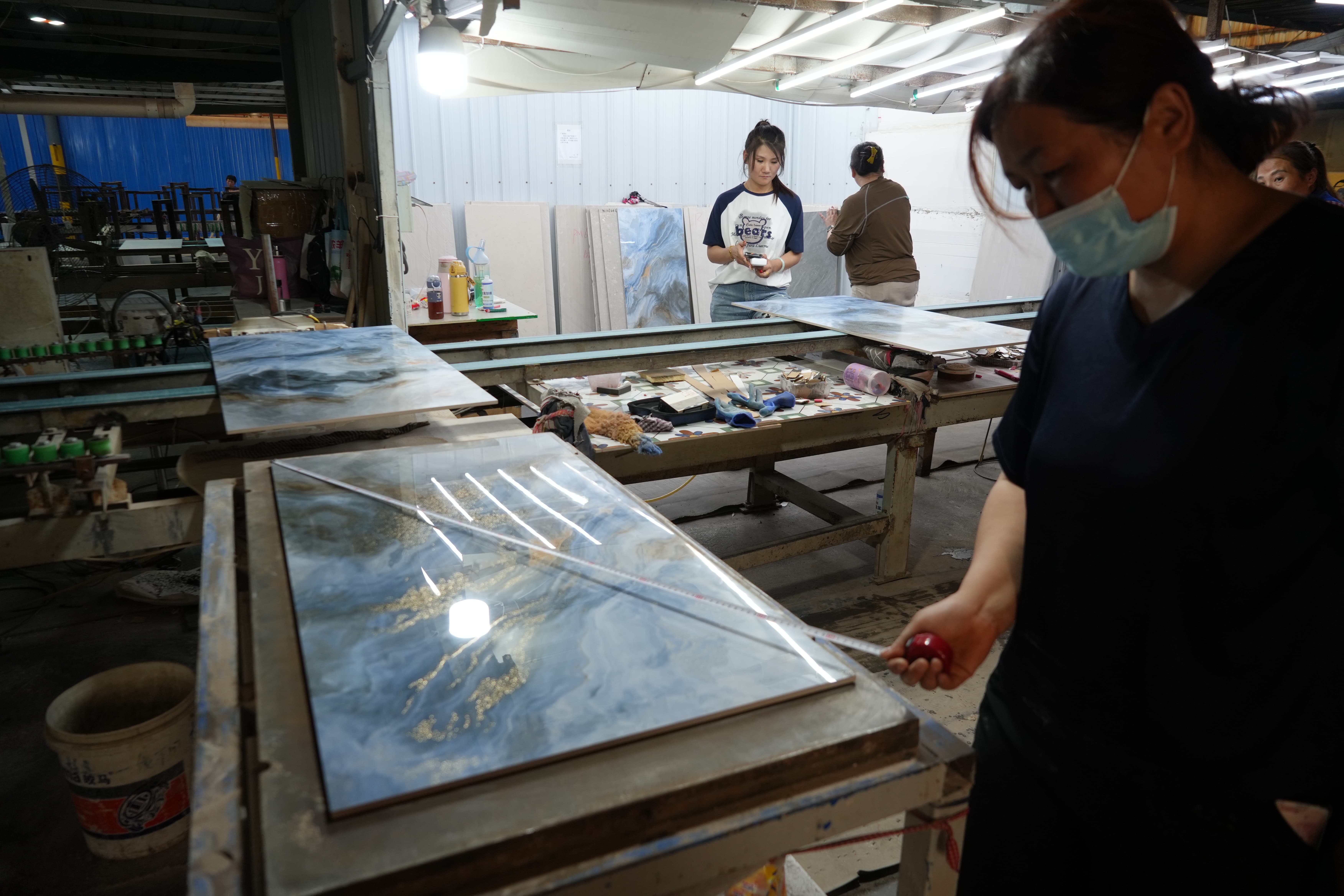 Flatness and dimensional checks on porcelain tiles — the physical evidence that a submittal pack has to support.
Why submittals fail on documentation rather than on product
Three failure modes repeat across commercial projects, and none of them involves a defective tile.
The first is scope mismatch. A certificate is pulled for review that speaks generally about the production and service of ceramic tile, while the specification asks for performance tied to a specific product code and finish. The reviewer is left holding a genuine document that does not obviously answer the question asked.
The second is market mismatch. An ISO 9001 certificate is submitted as if it were an EU market-access document, or a CE certificate is described as a global approval. Both readings are incorrect, and consultants who see them begin to doubt the rest of the pack.
The third is number drift. Certificate numbers get retyped, shortened or merged into a marketing PDF, and the number in the submittal no longer matches the number on the issuer's document. A reviewer searching for that string will not find it.
Filing the two documents under their correct roles prevents all three, and it takes less effort than responding to a returned submittal.
The two certificates, decoded
| Field | ISO 9001:2015 record | CE record |
|---|---|---|
| Document role | Quality management system certification | CE certification for a defined product scope |
| Certificate number | 0350521Q30166R1M | AC 50163816 0001 |
| Issuing body | XQCC | TUV |
| Market | Global Markets | EU |
| Standard field | ISO 9001:2015 | EEC |
| Scope statement | Production and service of Ceramic Tile (except as required by 3C) | Ceramic tiles — dry-pressed ceramic tiles, for internal flooring |
| Product codes named | 4765 Marble Series; 5624 Travertine | 4765 Marble Series; 5624 Travertine |
What ISO 9001:2015 actually answers
The ISO 9001:2015 certificate answers a process question: is there a documented quality management system sitting behind the production and service of the tiles? It is a management-system certification, not a product certification. It does not certify a water absorption value, a slip rating or a breaking strength.
What it does support is the consistency claim. ALL KING CERAMICS describes its in-process controls as 100% flatness and sizing auto-check, piece-by-piece visual inspection, and random lab testing per batch. Those are the routines a management-system certificate is meant to sit above, and they are the reason the certificate is relevant to a buyer checking repeatability across shipments rather than checking a single sample.
The parenthetical exclusion, “except as required by 3C”, refers to products falling under China Compulsory Certification. Read it as a scope boundary rather than a limitation: it tells the reviewer exactly which product categories the certificate does not attempt to cover.
What the CE record actually answers
The CE certificate answers a market-entry question for the European Union. Its scope line is deliberately narrow — “dry-pressed ceramic tiles, for internal flooring” — and two phrases in that sentence carry the whole meaning for a project team: dry-pressed describes the forming process, and internal flooring describes where the covered product is intended to be installed.
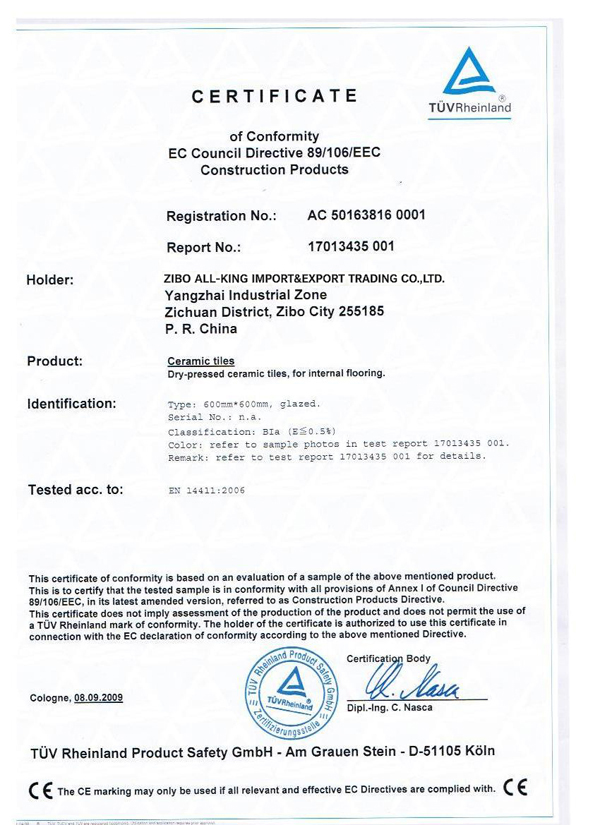 The CE record lists the certificate number, the issuing body (TUV), the market (EU) and a scope limited to dry-pressed ceramic tiles for internal flooring.
Neither document should be asked to do the other's job. A submittal that presents the CE certificate as evidence of factory process control, or the ISO 9001 certificate as evidence of EU market access, gives a reviewer two reasons to return the file instead of one.
Certificate numbers should be copied, not retyped
Both numbers are the search key a reviewer will use, and both are easy to corrupt.
For the ISO record, keep the full string 0350521Q30166R1M intact, with the issuer XQCC beside it. For the CE record, keep AC 50163816 0001 as two blocks with the internal space preserved, with the issuer TUV beside it. Renumbering, trimming the suffix, or joining the CE blocks into a single run of characters all break traceability.
A workable rule for the submittal log is one row per product code, containing: product code, certificate number, issuing body, scope statement as written, market, and the document revision supplied for that project. Reviewers search by number first and read scope second; a log built around those two behaviours saves revision rounds.
Global versus EU: the same tile, two different documents
The ISO 9001:2015 certificate is recorded against global markets. The CE certificate is recorded against the EU. That single difference determines which document leads a submittal.
For a project tendered inside the EU, the CE certificate is the primary document and the ISO 9001 certificate is the secondary one. An ISO certificate alone will not close a CE requirement, because the two certificates answer different questions.
For projects in the Middle East, Southeast Asia, Latin America, Russia or Oceania — markets ALL KING CERAMICS lists among its export destinations — the ISO 9001 certificate leads, and the CE record functions as supporting evidence of product scope rather than as a legal market requirement. Presenting it as a global approval is a description error that experienced reviewers notice.
The practical decision rule is therefore short: determine the jurisdiction of the specification first, then order the documents to match it. Doing this in the opposite order — assembling whatever certificates exist and then looking for a place to use them — is where most market mismatches originate.
Scope mapping: what codes 5624 and 4765 actually cover
Both certificates name the same two porcelain tile codes: 5624 (Travertine) and 4765 (Marble Series). That naming is the part of the document a project team should check before anything else, because it links the certificate to a physical product that can be delivered.
If the specified finish is one of these two codes, the certificate on file maps cleanly and the submittal can proceed to the performance section. If the specification calls for a different code or series, the certificate in hand does not automatically travel with the submitted product, and the correct move is to request documentation that names the actual code rather than to submit a near-match and hope the reviewer does not compare them.
Certificates and performance data are separate evidence and should be filed in separate sections of the submittal. The certificate says who controls the process and which market the product may enter. The technical data says what the tile does. For the porcelain tile range referenced here, the published values include a thickness of 9.0–10.5 mm, water absorption below 0.5%, PEI 4/5 abrasion resistance, Mohs hardness 6–7, breaking strength of at least 1300 N, modulus of rupture of at least 35 MPa, and packing of 2 pieces per box at 1.44 m² per box.
Reviewers frequently ask for both in the same breath, which is why suppliers that keep them clearly separated get through submittal faster than suppliers that blend them into one brochure page.
The boundary most teams miss on the CE scope
The CE scope covers dry-pressed ceramic tiles for internal flooring. It does not state coverage for outdoor paving, 20 mm outdoor porcelain pavers, pool surrounds, facade cladding or other exterior applications, and a submittal should not imply that it does.
This matters because the product is used across a wider range of spaces than the certificate scope describes. The application record for code 5624 covers hotel lobbies, commercial mall flooring, office building facades, high-end apartment bathrooms and airport departure halls, with projects in the UAE, Canada, Australia, Russia and other markets. That list describes where the product is installed. It does not extend the regulatory scope of the CE document, and the two should never be presented as the same statement.
For slip-critical and exterior zones, the relevant reference is separate: DIN 51130 ramp testing, where an R11 classification corresponds to a grip range on an oil-wet inclined plane of roughly 19° to 27°. ALL KING CERAMICS guidance lists R10/R11 anti-slip ratings across the range, with R12 achievable through customization. Customization is a project-specific arrangement, however, not an automatic extension of a certificate scope. Where a project requires R12 or exterior performance, the submittal should carry project-specific evidence rather than a general document.
Stating that boundary plainly is more useful to a specifier than an optimistic reading, because a returned submittal costs more time than an early question.
A filing workflow that survives review
- Match the product code first. Confirm that 5624 or 4765 appears on the certificate that will be submitted, and that the same code appears on the technical data and the packing list.
- Confirm the market. EU project: CE first, ISO 9001 second. Non-EU project: ISO 9001 first, CE as supporting scope evidence.
- Copy the numbers verbatim. 0350521Q30166R1M with XQCC; AC 50163816 0001 with TUV. No abbreviations, no reflowed spacing.
- Submit the scope page, not only the cover. A cover page shows the logo; a scope page shows the product category, the market and the exclusions. Reviewers need the second.
- Cross-check the performance section against the application. Internal flooring, wet areas, high-traffic interiors and exterior zones call for different supporting evidence, and the certificate alone does not resolve that.
- Log the revision supplied. One row per product code per project, so a later reorder or phase-two package references the same documentation set rather than a newer or older copy pulled from a different folder.
Batch-level documentation fits this workflow naturally. ALL KING CERAMICS operates random lab testing per batch alongside 100% flatness and sizing auto-check, which means a shipment reference can be matched to the quality record that sits behind the certificate.
Certificate-first filing versus the traditional folder pack
| Dimension | Traditional folder pack | Certificate-first pack |
|---|---|---|
| Starting point | All available documents collected, then sorted | Specified product code identified, then matched to certificates |
| Scope check | Performed late, if at all | Performed before the pack is assembled |
| Market check | Certificates treated as universally valid | ISO 9001 and CE assigned to their correct markets |
| Number handling | Retyped into cover sheets | Copied verbatim into a log row |
| Exterior and slip-critical zones | Assumed covered by the CE document | Flagged as outside the stated scope; separate evidence requested |
| Revision control | Depends on who assembled the folder | Logged per product code per project |
The limitation is worth stating directly. Certificate-first filing is slower at the outset, and it depends on suppliers issuing documents whose scope names specific product codes. Where a supplier's certificate scope is generic, no filing method can manufacture the specificity the reviewer is asking for — the only honest options are to request a more specific document or to disclose the gap in the submittal.
Where these documents are used in practice
The demand for a clean certificate pack concentrates in applications where the flooring decision carries an approval chain: hotel lobbies and guest bathrooms, shopping mall concourse flooring, office building facades and interiors, high-end apartment developments, airport departure halls, healthcare facilities, educational buildings, commercial kitchens and mixed-use developments. Each of these adds its own overlay — slip performance in wet zones, hygiene considerations in kitchens and healthcare, maintenance cycles in transport buildings — but all of them begin with the same question of whether the submitted document set matches the specified product.
The company reports a 15,000 m² reference spanning hotel lobbies, mall flooring, office facades, apartment bathrooms and airport departure halls across markets including the UAE, Canada, Australia and Russia, with a product service life described as exceeding 20 years, low water absorption, high flatness, high wear resistance and random marble veins. For a buyer in evaluation, the useful part of that reference is not the square metre figure but the pattern: the same documentation set has to travel across several venue types and several jurisdictions without contradicting itself.
Market context: why documentation review is tightening
Commercial construction sits at the centre of tile demand, and commercial research places it at roughly 37% of global tile demand. Commercial research also projects the global tile market moving from about USD 265.21 billion in 2024 toward USD 587.72 billion by 2035. Larger, more institutional project pipelines generally mean more formal submittal procedures, not fewer.
Sustainability documentation is part of that shift. Guidance published by the U.S. Green Building Council and WhyTile notes that porcelain tiles are inherently exempt from LEED VOC FloorScore requirements because high-temperature kiln firing destroys organic matter. That exemption is useful in a submittal narrative, but it should be cited from the standard's own guidance rather than restated as a supplier claim, and it does not replace the ISO 9001 or CE documents the reviewer has already asked for.
Future outlook
Submittal review is moving from paper folders toward structured logs, and the practical consequence is that certificate numbers and scope statements become searchable fields rather than scanned attachments. Suppliers that publish the number, the issuer, the market and the scope in a consistent format will be easier to shortlist, and documents whose scope statement is generic will increasingly be treated as incomplete rather than as acceptable evidence.
A second shift concerns exterior and slip-critical specification. As buyers ask for R11 and R12 performance in writing, the gap between a certificate covering internal flooring and a project requiring outdoor performance becomes harder to gloss over. The likely outcome is that project-specific test documentation, rather than a general certificate, becomes the standard attachment for exterior packages.
FAQ
Does an ISO 9001:2015 certificate confirm the performance values of a porcelain tile?
No. The ISO 9001:2015 certificate held by ALL KING CERAMICS (No. 0350521Q30166R1M, issued by XQCC, recorded for global markets) certifies the production and service management system for ceramic tile, excluding categories covered by 3C. Performance values such as water absorption, Mohs hardness, breaking strength and modulus of rupture are supplied separately through the product technical data.
Which certificate is relevant for a project inside the EU?
The CE certificate, No. AC 50163816 0001, issued by TUV and recorded for the EU market, with the standard field listed as EEC and a scope covering ceramic tiles described as dry-pressed ceramic tiles for internal flooring.
Which product codes appear on the certificates?
Both records name porcelain tiles 4765 (Marble Series) and 5624 (Travertine). A submittal should reference the code that matches the specified finish; where a different code or series is specified, the certificate on file does not automatically apply to that product.
Can the CE certificate be used for outdoor pavers or exterior zones?
Not on the basis of its stated scope, which is limited to dry-pressed ceramic tiles for internal flooring. Exterior paving, 20 mm outdoor pavers and similar applications sit outside that scope line and require separate project-specific evidence, including anti-slip documentation referenced to DIN 51130 where R11 or R12 performance is specified.
What should a submittal log record for each certificate?
The product code, the certificate number copied verbatim, the issuing body, the scope statement as written on the document, the market the certificate is recorded against, and the revision supplied for that project. Keeping those six fields per product code allows a reviewer to trace any submitted document back to its source without asking for clarification.
A full product catalogue, including formats and technical data, is available for download: ALL KING Ceramics Catalogue (PDF).
¿Tiene preguntas o necesita más detalles?
Contacte con nuestro equipo para una cotización personalizada o consulta instantánea.
Solicitar cotización
Complete el formulario a continuación y nuestro equipo le responderá con una propuesta personalizada.
Chat directo de WhatsApp
¿Prefiere chatear en tiempo real? Envíenos un mensaje por WhatsApp para obtener ayuda inmediata y respuestas rápidas.
- Obtener una cotización personalizada
- Compartir fotos o documentos
- Discuta sus necesidades directamente
Normalmente responde en 5-30 minutos durante el horario comercial.