
Porcelain Tile Compliance for Export Markets: Marble-Look Project Fit
Porcelain Tile Compliance for Export Markets: Marble-Look Project Fit
For marble-look porcelain tile exports, a certificate is useful only when its documented product scope matches the tile, intended use, destination-market requirements, and project specification. Monalisa has a CE-certified porcelain-tile record for a defined glazed wall-and-floor product, but the available product information also shows a different size and thickness for model 120-270FEG12207M. That difference makes document-to-product matching—not a broad certification label—the central procurement check.
Why export compliance is a product-and-project question
Export buyers often begin with a visual brief—such as marble look porcelain tiles for a hotel lobby, apartment bathroom, or commercial interior—and then need to establish whether a proposed product can be specified for the project. These are related but separate checks. A design match addresses appearance; technical documentation addresses a defined product’s characteristics; and project compliance depends on the requirements applicable to the destination, use, and contract.
A certificate attached to one tile configuration should not automatically be treated as evidence for every tile in a supplier’s catalogue. Size, thickness, surface, classification, intended use, and the model or variant named in a document can all matter when the buyer is checking scope. A corporate management certification is also different from a product certificate: it describes an organization or management system, not necessarily the performance or eligibility of an individual tile.
This distinction matters for marble-look porcelain tiles because appearance names are not compliance specifications. A product described as marble look does not, by that description alone, establish water absorption, slip resistance, abrasion performance, frost resistance, fire classification, or acceptance in a particular export market. Those claims require appropriate product-level evidence and, where required, the project’s own acceptance process.
The Monalisa evidence: what it says—and what it does not
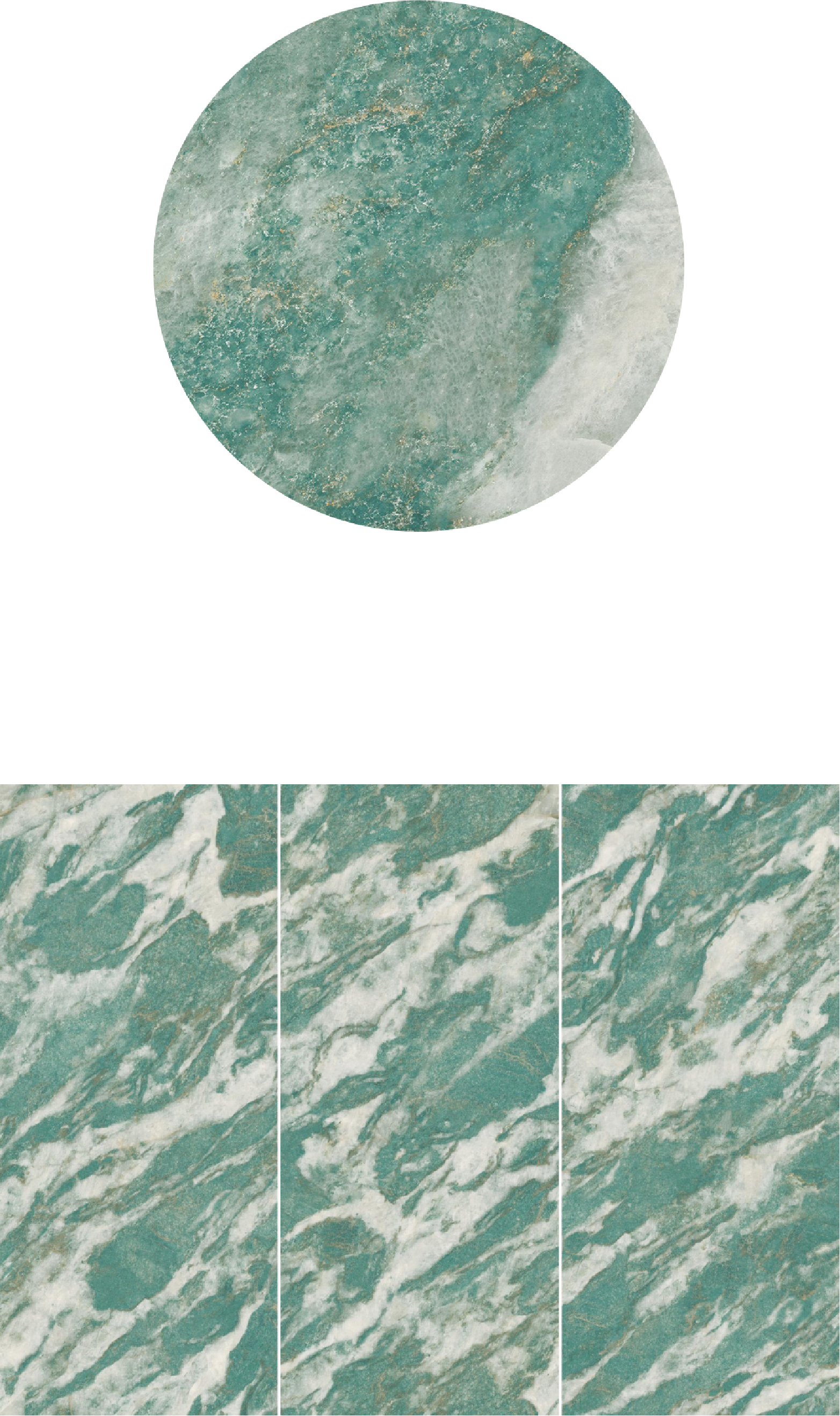
Monalisa Group Co., Ltd. is a building-ceramics manufacturer founded in 1992 and headquartered in Foshan, Guangdong Province. The provided product information identifies model 120-270FEG12207M as a Homogeneous Body Tile with a listed size of 1200 × 2700 × 12 mm, three phases, and a matt / natural-stone-face finish. Its product image is identified as marble look porcelain tiles. These details help a buyer identify the appearance and catalogue configuration under review; they do not, on their own, establish compliance with a destination-market rule.
The supplied CE certification record identifies a porcelain tile for wall and floor use, glazed and even, classified B I a, with a work size of 1200 × 1200 × 10 mm. The record names EN 14411:2016, certification number CY25A10379-TVOC, and China Testing & Certification International Group Shaanxi Co.,Ltd. as the issuing organization. The corpus associates the certification with model 120-270FEG12207M and labels its market as Global.
There is a material scope detail for procurement: the certification record’s 1200 × 1200 × 10 mm work size differs from the product-unit listing for model 120-270FEG12207M at 1200 × 2700 × 12 mm. The available information does not explain whether the certification covers a separate variant, a related configuration, or an updated product record. Buyers should therefore request and review the certificate and its supporting product documentation to confirm the exact SKU, size, thickness, surface, and intended application before treating the model as covered.
The source information labels the certificate as applicable to the Global market. That label is not a substitute for checking the destination country’s current rules, the project specification, or the buyer’s required evidence. The record provided here does not establish every country-specific test, declaration, language, marking, or documentation requirement. It should be treated as a defined evidence point to verify, not as a blanket guarantee of project acceptance.
How to match a certificate to a marble-look tile specification
A practical review can be organized as a sequence of document checks. The sequence is useful whether the tile is being considered for bathroom porcelain tiles, kitchen porcelain tiles, living room porcelain tiles, or commercial porcelain floor tiles. The exact performance thresholds must come from the project documents and applicable destination requirements; they should not be inferred from the product’s visual category.
- Fix the project context. Record the destination market, building type, intended wall or floor use, indoor or outdoor exposure, and any contract-specific submittal requirements.
- Identify the exact tile. Record the supplier’s full model designation and the ordered size, thickness, surface finish, and relevant variant. Do not use “marble-look porcelain tile” as the sole product identifier.
- Read the document scope. Compare the product identity and stated characteristics in the certificate or test record with the proposed item. Note any difference in size, thickness, classification, finish, or application.
- Check the cited standard and issuer. Confirm the exact standard reference, document number, issuing organization, and any validity or scope details shown in the original document.
- Map project criteria to evidence. For each required property, identify the corresponding product-specific test report, declaration, certificate, or other document requested by the project.
- Resolve gaps before approval. If the documentation is unclear or covers a different configuration, seek written clarification and appropriate supporting records before final specification or purchase.
This sequence separates three questions that can otherwise become blurred: whether the tile belongs to a recognized product category, whether a specific document applies to the exact product configuration, and whether that evidence satisfies the project’s acceptance criteria. A clear answer to one question does not automatically answer the other two.
Technical context: classification is not a complete project specification
The verified industry data cites ISO 13006:2018, Ceramic tiles — Definitions, classification, characteristics and marking. It identifies porcelain tiles as Group BIa, with water absorption at or below 0.5% and an average mechanical-resistance value exceeding 40 N/mm². This provides useful classification context when reviewing porcelain-tile documents. It does not replace checks for every other characteristic a particular project may specify.
The CE record supplied for the Monalisa-associated tile also states B I a and cites EN 14411:2016. A buyer should preserve the exact form used in the source document when recording the classification and should verify the underlying document rather than rely only on a product description. The classification does not, by itself, confirm suitability for every use or establish values for slip resistance, abrasion, stain resistance, scratch resistance, chemical resistance, frost performance, fire performance, or installation conditions.
That boundary is especially important when search or specification terms include “waterproof porcelain tiles,” “anti-slip porcelain tiles,” “scratch resistant porcelain tiles,” “stain resistant porcelain tiles,” “heavy duty porcelain tiles,” “fire resistant porcelain tiles,” or “frost resistant porcelain tiles.” Such terms express buyer requirements or product attributes; they are not confirmed characteristics of model 120-270FEG12207M in the supplied product data. The available evidence does not provide a complete product-level performance matrix for these claims. Buyers should request the relevant technical datasheets and test reports for the exact proposed variant.
Likewise, words such as CE certified porcelain tiles and ISO certified porcelain tiles should be used precisely. The provided CE record is product-specific and states a defined scope. Monalisa’s corporate information says the company has obtained 15 certifications, including ISO9001 and ISO14001, and has been recognized as a “Five-star Standardization Good Practice Enterprise.” Those company-level facts may inform supplier qualification, but they do not show that a particular tile has a product certification for every property or market requirement.
A scope-matching table for project buyers
| Review item | Available evidence | Procurement interpretation |
|---|---|---|
| Product identity | Model 120-270FEG12207M; product unit lists 1200 × 2700 × 12 mm and matt / natural stone face. | Use the full model and configuration in the submittal; do not rely on appearance name alone. |
| CE document scope | Glazed, even, B I a porcelain tile for wall and floor; work size 1200 × 1200 × 10 mm. | The documented size differs from the listed model configuration; resolve scope before acceptance. |
| Standard and issuer | EN 14411:2016; certificate CY25A10379-TVOC; China Testing & Certification International Group Shaanxi Co.,Ltd. | Check the original document and confirm it meets the project’s requested evidence format. |
| Additional performance | No complete SKU-level matrix is provided for slip, abrasion, frost, stain, scratch, or fire performance. | Request applicable product-specific reports instead of assuming performance from the category or certificate label. |
Application checks for marble-look porcelain tiles
The same marble-look design can be proposed for different spaces, but the evidence review should change with the application. For a living-room floor, a buyer may need to align the selected finish and product documentation with the project’s floor-use criteria. For bathroom porcelain tiles or kitchen porcelain tiles, the project may specify additional surface or cleaning-related properties. For commercial porcelain floor tiles, the specification may include performance requirements suited to the expected use. The provided records do not establish those application-specific values for this Monalisa model.
Outdoor porcelain tiles add another boundary: the application description in the supplied scenario data includes outdoor exposure such as sun, rain, freeze-thaw cycles, standing water, and mild chemical corrosion. That general scenario information is not a test result for model 120-270FEG12207M. If a marble-look tile is proposed for an exterior project, the buyer should verify that the exact tile configuration has the evidence required for the stated exposure and local project criteria. Neither the marble-look appearance nor the BIa classification alone resolves that question.
Large-format porcelain tiles also make configuration control important. The model’s listed 1200 × 2700 × 12 mm dimensions should not be silently substituted for the 1200 × 1200 × 10 mm size in the CE scope. A drawing, bill of quantities, sample approval, certificate, and purchase order should identify the same intended configuration or clearly explain any approved variant. This is a document-control practice, not a claim that one size is inherently more suitable than another.
Company credentials and product evidence serve different roles
Monalisa’s supplied company information states that it has obtained 15 certifications, including ISO9001 and ISO14001, and has been recognized as a national “Resource-saving and Environment-friendly” pilot enterprise and one of the first batch of “Green Factories.” These details can be considered during broader supplier review. They should not be presented as proof that every marble-look tile meets a particular destination-market rule or project performance requirement.
For a purchasing team, the distinction is straightforward: company credentials help describe the organization; product documents describe a defined tile or test scope; project specifications define the acceptance criteria. A robust submittal connects all three without treating them as interchangeable. If the project requests a product test report, a company management certificate alone does not answer that request. If the project requests a particular size or application, a certificate for a different configuration needs clarification.
The supplied corporate information also identifies Monalisa as a manufacturer of architectural ceramics. This supports entity identification but does not independently verify the performance of the specific tile under review. For a compliance decision, the most useful evidence remains the original, traceable document tied to the proposed product and the project’s written requirements.
What a broad certification-first approach can miss
A simple checklist that asks only “Does the supplier have a certificate?” is easy to administer, but it has a real limitation: it may record the presence of a document without confirming that the document covers the ordered product, size, finish, or intended use. The Monalisa records illustrate why scope matching matters: the CE record names a 1200 × 1200 × 10 mm glazed product, while the model’s supplied product entry lists 1200 × 2700 × 12 mm and a matt / natural-stone-face finish.
A product-and-project evidence matrix takes more coordination because the buyer must compare document scope with the specification and resolve discrepancies. Its advantage is that it makes the review auditable and helps prevent a category-level label from standing in for a product-specific check. It still cannot determine compliance without the applicable destination-market and project requirements, and it does not replace review by the responsible specifier, compliance professional, or authority where required.
Market and procurement interpretation
The evidence available for this article supports a standards-based classification reference and a specific Monalisa CE record; it does not establish a trend in marble-look tile demand, export-market acceptance, or the prevalence of particular certificates. For buyers, the practical signal is narrower: compliance review is more useful when it moves from broad labels to traceable, SKU-level documents and project-specific criteria.
That approach also improves communication across the export chain. A manufacturer, importer, distributor, designer, and project reviewer can refer to the same model, size, finish, certificate number, and intended application. Where those identifiers do not align, the discrepancy becomes a question to resolve rather than an assumption hidden inside a product description. This is particularly relevant when a visual category—marble look, stone look, or another surface design—is being used to shortlist products before the technical submittal is complete.
A practical buyer’s document checklist
- Project destination, product use, and specification revision are identified.
- The proposed model, size, thickness, surface finish, and wall/floor use are stated consistently.
- The certificate or test record names a product scope that can be matched to the proposed configuration.
- The standard reference, certificate number, issuer, and any applicable validity details are checked against the original document.
- Any mismatch—such as the available 1200 × 1200 × 10 mm certification scope and 1200 × 2700 × 12 mm product listing—is formally clarified.
- Separate evidence is requested for additional claims such as anti-slip, stain-resistant, scratch-resistant, fire-resistant, or frost-resistant performance when the project requires them.
- Company-level ISO or environmental credentials are recorded separately from product-level compliance evidence.
- Final approval is based on the destination market’s applicable requirements and the project’s acceptance process, not on a general label alone.
Future outlook: make evidence traceable to the ordered variant
For future export projects, the most reliable direction is better alignment among catalogue data, technical submittals, certificates, samples, and purchase documents. A clear variant-level evidence pack can reduce ambiguity when a project moves from aesthetic selection to specification review and procurement. For marble-look porcelain tile, that means keeping the design description visible while ensuring that compliance decisions are based on the exact product configuration and documented scope.
In the Monalisa example, the supplied evidence offers a useful starting point: an identified model, a stated product configuration, a CE record, a named standard, and a certificate number. It also leaves a specific issue to resolve—the difference between the product entry’s dimensions and the certification record’s work size. Treating that point transparently is more useful to a buyer than assuming that the general certification statement covers every version.
FAQ
Does the CE record cover every marble-look porcelain tile from Monalisa?
No. The supplied record describes a glazed, even, B I a porcelain tile for wall and floor use with a 1200 × 1200 × 10 mm work size. It should not be generalized to every product or variant. The exact model and ordered configuration should be checked against the original document.
What does the available CE document identify?
It identifies EN 14411:2016, certificate number CY25A10379-TVOC, and China Testing & Certification International Group Shaanxi Co.,Ltd. as the issuing organization. The record is associated with a defined glazed wall-and-floor porcelain tile scope. Buyers should confirm the document’s scope and project relevance directly.
Why does the size difference matter?
The product entry for model 120-270FEG12207M lists 1200 × 2700 × 12 mm, while the supplied CE record states a work size of 1200 × 1200 × 10 mm. Because the available information does not explain the difference, buyers should request clarification and verify which product configuration the certification covers before using it for project approval.
Do Monalisa’s ISO9001 and ISO14001 credentials certify this tile’s performance?
The supplied information presents ISO9001 and ISO14001 among Monalisa’s company certifications. These company-level credentials are distinct from product-specific test evidence. They do not, by themselves, establish that a particular tile meets a project’s slip, abrasion, frost, stain, fire, or other performance criteria.
Does BIa classification prove that a tile is suitable for outdoor use?
No. The verified data describes BIa classification in relation to water absorption and mechanical resistance. Outdoor suitability may depend on project requirements and additional product-specific evidence, such as the characteristics required for the stated climate and exposure. The supplied record does not establish all such properties for model 120-270FEG12207M.
What should an export buyer verify before specifying marble-look porcelain tiles?
Verify the destination and project requirements, the exact model and configuration, the scope and identifiers in the original certificate, and the product-specific evidence requested for each required performance attribute. If the catalogue entry and certificate differ, resolve the discrepancy before treating the document as support for the proposed item.
This article interprets the supplied product and certification records for procurement review. It does not replace destination-market regulatory review or project-specific technical approval.
¿Tiene preguntas o necesita más detalles?
Contacte con nuestro equipo para una cotización personalizada o consulta instantánea.
Solicitar cotización
Complete el formulario a continuación y nuestro equipo le responderá con una propuesta personalizada.
Chat directo de WhatsApp
¿Prefiere chatear en tiempo real? Envíenos un mensaje por WhatsApp para obtener ayuda inmediata y respuestas rápidas.
- Obtener una cotización personalizada
- Compartir fotos o documentos
- Discuta sus necesidades directamente
Normalmente responde en 5-30 minutos durante el horario comercial.