
Polyester Polyol Series: Matching Grades to Mining, Adhesive and Fertilizer Applications
Polyester polyol is a family name, not a single specification. Inside one supplier catalogue, published hydroxyl values can run from 60 mgKOH/g to several hundred mgKOH/g, viscosity at 25 degrees Celsius can span from roughly 1,000 cps to more than 10,000 cps, and acid value ceilings can differ by a factor of three. For a buyer working in mining, sandwich panel adhesives or controlled-release fertilizer coating, those numbers - not the product name - decide whether a grade can be used at all.
The global polyester polyol market was estimated at USD 9,654.2 million in 2024 and is projected to reach USD 15,033.3 million by 2033, according to Grand View Research. Asia Pacific accounted for a 43.7% revenue share in 2024, and China is expected to grow at the highest CAGR of 5.2% through 2033. Most of that volume flows into rigid PU and PIR insulation. Yet the same aromatic polyester polyol chemistry - built on phthalic anhydride (PA), purified terephthalic acid (PTA), adipic acid (AA), diethylene glycol (DEG) and glycerol (GLY) - also serves mining formulations, structural adhesives and controlled-release fertilizer coatings, where the specification window is narrower and substitution is riskier.
This guide maps three XINFA product families to those three scenarios: KXF-350 and KXF-280 for mining, XF-Z and XF-280 for sandwich panel adhesives, and XF-270, XF-B-3 and XF-B-4 for controlled-release fertilizer coating agents. It uses published grade specifications plus the manufacturer's certification record, and it separates what the data states from what a buyer still has to validate on their own line.
Why Scenario Fit Beats Model Number When Building a Shortlist
XINFA's published portfolio contains two grades carrying the number 280: KXF-280, classified as Polyester Polyol for Mining, and XF-280, classified as Polyester Polyol for Adhesive. Their hydroxyl values are close - 280 plus or minus 15 mgKOH/g and 280 plus or minus 20 mgKOH/g respectively - but their acid value ceilings differ (not more than 1.5 mgKOH/g for KXF-280 versus not more than 3.0 mgKOH/g for XF-280), and their designated industries are different. A shortlist assembled by model number would treat them as near-equivalents. A shortlist assembled by application constraint would not.
At the evaluation stage, the sequence that holds up is straightforward: define the application constraint set first (reactivity target, mixing and pumping behaviour, moisture sensitivity, matrix or film requirements), filter the portfolio by published specification second, and confirm the shortlisted grades inside the buyer's own formulation third. That order matters more in mining, adhesive and fertilizer-coating work than in mainstream insulation foams, because these three segments have fewer drop-in alternatives and less tolerance for trial-and-error at full production scale.
The Four Specification Fields That Decide Application Fit
Four published values do most of the filtering work across these three families: hydroxyl value, acid value, moisture content and viscosity at 25 degrees Celsius. Each one answers a different question on the buyer's side of the table.
| Specification field | What it governs | Why it filters scenario fit |
|---|---|---|
| Hydroxyl value (mgKOH/g) | Stoichiometric ratio with isocyanate | Sets the polyol-to-isocyanate balance; the three families covered here span 60 plus or minus 5 up to 370 plus or minus 20 mgKOH/g |
| Acid value (mgKOH/g) | Residual acidity of the polyol | Ceilings across these families run from not more than 1.5 to not more than 5.0 mgKOH/g, so grades are not interchangeable between segments |
| Moisture (%) | Side reaction with isocyanate | Focus grades are published at not more than 0.1% or not more than 0.15%, which places storage and handling requirements on the buyer |
| Viscosity (cps at 25 degrees Celsius) | Mixing, pumping and pre-cure rheology | Mining grades sit at 1,000 to 1,500 cps; the adhesive grade XF-Z is published at 10,000 plus or minus 2,000 cps |
The table below consolidates the published specification envelope of the seven grades that this guide covers. All seven share the same published material basis: PA, PTA, AA, DEG and GLY.
| Grade | Designated application | Hydroxyl value (mgKOH/g) | Acid value (mgKOH/g) | Moisture (%) | Viscosity (cps, 25 degrees Celsius) |
|---|---|---|---|---|---|
| KXF-350 | Mining | 350 plus or minus 20 | Not more than 2.0 | Not more than 0.1 | 1,500 plus or minus 500 |
| KXF-280 | Mining | 280 plus or minus 15 | Not more than 1.5 | Not more than 0.1 | 1,000 plus or minus 200 |
| XF-Z | Sandwich panel adhesives | 60 plus or minus 5 | Not more than 5.0 | Not more than 0.15 | 10,000 plus or minus 2,000 |
| XF-280 | Sandwich panel adhesives | 280 plus or minus 20 | Not more than 3.0 | Not more than 0.1 | - |
| XF-270 | Controlled-release fertilizer coating agent | 260 plus or minus 10 | Not more than 3 plus or minus 0.2 | Not more than 0.1 | 3,000 plus or minus 500 |
| XF-B-3 | Controlled-release fertilizer coating agent | 300 plus or minus 30 | Not more than 3.0 | Not more than 0.15 | 3,000 plus or minus 500 |
| XF-B-4 | Controlled-release fertilizer coating agent | 370 plus or minus 20 | Not more than 3.0 | Not more than 0.15 | 3,500 plus or minus 500 |
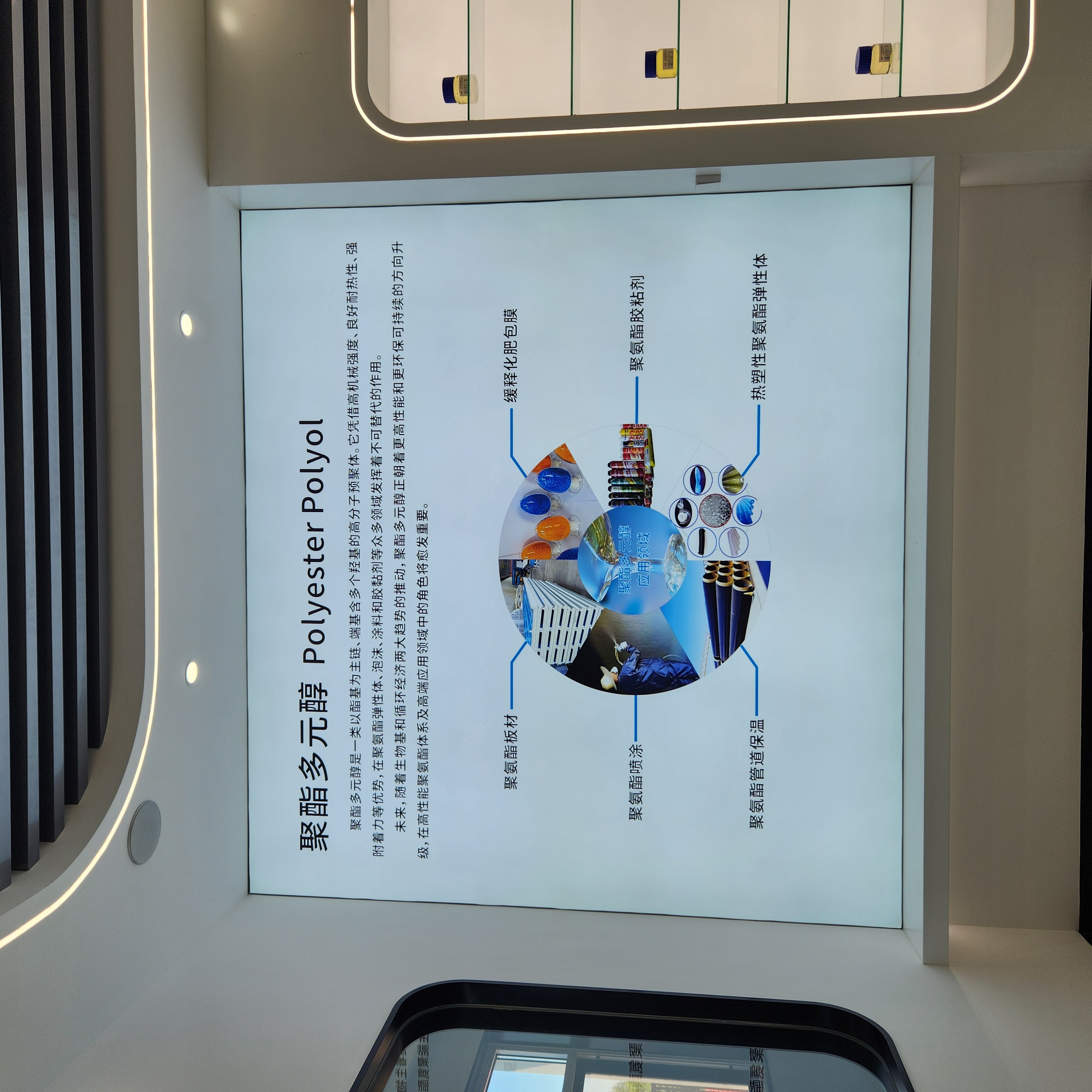
Grade families in the XINFA polyester polyol portfolio share one aromatic composition base but differ in hydroxyl value, acid value, moisture and viscosity targets.
Mining Applications: KXF-350 and KXF-280
Two grades are published under the type designation Polyester Polyol for Mining, both listed for the mining industry and both built on the same PA, PTA, AA, DEG and GLY material basis. KXF-350 is specified at a hydroxyl value of 350 plus or minus 20 mgKOH/g, an acid value of not more than 2.0 mgKOH/g, moisture of not more than 0.1% and a viscosity of 1,500 plus or minus 500 cps at 25 degrees Celsius. KXF-280 is specified at 280 plus or minus 15 mgKOH/g hydroxyl value, not more than 1.5 mgKOH/g acid value, not more than 0.1% moisture and 1,000 plus or minus 200 cps.
Three differences matter in a procurement file. First, the hydroxyl value gap between the two grades is wide enough that they will not deliver the same crosslink density at an identical isocyanate index, so the correct grade depends on the target matrix rather than on availability. Second, KXF-280 has the tighter acid value ceiling of the two (not more than 1.5 versus not more than 2.0 mgKOH/g), which is the more demanding specification when a formulation is sensitive to residual acidity. Third, both grades sit at the low-viscosity end of the seven grades compared here - 1,000 to 1,500 cps - which is the first specification buyers typically check when the process involves pumping, dosing or mixing with solids.
For evaluation-stage diligence, the practical asks are a lot-level certificate of analysis showing hydroxyl value and acid value within the published tolerance, confirmation of the moisture ceiling under the buyer's own storage conditions, and a plant trial that reproduces the intended application rather than a bench-only comparison.
Sandwich Panel Adhesives: XF-Z and XF-280
The adhesive family is published as Polyester Polyol for Adhesive and is designated for sandwich panel adhesives. XF-Z is specified at a hydroxyl value of 60 plus or minus 5 mgKOH/g, an acid value of not more than 5.0 mgKOH/g, moisture of not more than 0.15% and a viscosity of 10,000 plus or minus 2,000 cps at 25 degrees Celsius. XF-280 is specified at 280 plus or minus 20 mgKOH/g hydroxyl value, not more than 3.0 mgKOH/g acid value and not more than 0.1% moisture.
The most important thing a buyer can take from this pair is that the two grades are functionally far apart, even though they sit side by side in the same product family. A hydroxyl value of 60 plus or minus 5 mgKOH/g means substantially fewer reactive hydroxyl groups per gram than a 280-grade material, and that changes the isocyanate requirement of the formulation rather than merely adjusting it. Treating XF-Z and XF-280 as drop-in substitutes is a formulation error, not a purchasing shortcut.
The second point is acid value. XF-Z carries the loosest ceiling in this seven-grade comparison at not more than 5.0 mgKOH/g, while XF-280 is specified at not more than 3.0 mgKOH/g. Buyers whose catalyst package or storage conditions are sensitive to residual acidity should confirm compatibility before scaling, because the same adhesive concept can behave differently across the two grades. Viscosity requirements also differ: XF-Z's published 10,000 plus or minus 2,000 cps places it in a different handling regime from the mining grades, which is consistent with panel adhesive processes where the mix must stay in place before cure.
Controlled-Release Fertilizer Coating: XF-270, XF-B-3 and XF-B-4
Three grades are published under the type designation Polyester Polyol for Controlled-release Fertilizer Coating Agent. XF-270 is specified at 260 plus or minus 10 mgKOH/g hydroxyl value, an acid value of not more than 3 plus or minus 0.2 mgKOH/g, moisture of not more than 0.1% and a viscosity of 3,000 plus or minus 500 cps. XF-B-3 is specified at 300 plus or minus 30 mgKOH/g, not more than 3.0 mgKOH/g, not more than 0.15% moisture and 3,000 plus or minus 500 cps. XF-B-4 is specified at 370 plus or minus 20 mgKOH/g, not more than 3.0 mgKOH/g, not more than 0.15% moisture and 3,500 plus or minus 500 cps.
Read as a set, the three grades form a reactivity ladder rather than a list of alternatives. The hydroxyl value rises from 260 to 370 mgKOH/g, while viscosity stays inside a narrow 3,000 to 3,500 cps band. That combination gives a coating formulator room to adjust the polyol-to-isocyanate balance without changing the handling characteristics of the coating liquor - a useful property when a coating line is already commissioned and only the chemistry is being tuned.
Two specification details deserve attention at the evaluation stage. First, all three fertilizer-coating grades are published with an acid value ceiling of about 3 mgKOH/g - higher than the mining grades (not more than 1.5 and not more than 2.0 mgKOH/g) and lower than the adhesive grade XF-Z (not more than 5.0 mgKOH/g). Second, XF-B-3 carries the widest hydroxyl value tolerance of the seven grades reviewed here at plus or minus 30 mgKOH/g, which means batch-specific adjustment is more likely and lot-level certificates of analysis become more important, not less.
One Composition Base Across Three Segments
All three families are published with the same material basis: PA, PTA, AA, DEG and GLY. In other words, the mining, adhesive and fertilizer-coating grades reviewed here are aromatic polyester polyols sharing a common feedstock logic. That is consistent with the wider market picture: the global aromatic polyester polyols market was valued at USD 1.9 billion in 2026 and is projected to grow at a CAGR of 5.9% to reach USD 2.8 billion by 2033, according to Persistence Market Research. In the adjacent bio-based segment derived from bio-succinic acid, aromatic polyester polyols held a 61.4% share in 2024, according to Grand View Research.
For buyers, a shared composition base has a practical consequence and a practical limit. The consequence is that formulation experience gained in one aromatic polyester polyol segment transfers in principle to another. The limit is that the four specification fields above determine whether that transfer is realistic: a grade with a 60 mgKOH/g hydroxyl value and a 5.0 mgKOH/g acid ceiling is not a substitute for a grade at 350 mgKOH/g and 2.0 mgKOH/g, even when both carry the same product name.
It is worth noting the breadth of the portfolio around these three families. XINFA also publishes phthalic anhydride grades (XF-3152, XF-2412, XF-1752, XF-2002), high flame retardant grades (XF-2007, XF-250P, XF-235P, XF-240P), pentane system grades (XF-435, XF-390, XF-360, XF-2402N, XF-2020), high water-based grades (XF-2003, XF-2006, XF-3153, XF-315G, XF-300W) and other types (XF-235, NXF-400). Compared with sourcing each application from a single-family specialist, a multi-family portfolio reduces the number of suppliers and the number of commercial relationships a buyer has to manage - but it does not transfer validation between grades. Every grade still needs its own qualification file.
Market Context: What the Numbers Show, and Where They Disagree
Published market estimates for polyester polyol diverge by scope, and evaluation-stage buyers should treat that divergence as information rather than noise. Grand View Research estimated the global polyester polyol market at USD 9,654.2 million in 2024, while Fortune Business Insights reported USD 7.01 billion for 2025 and Market Research Future reported USD 7.11 billion for 2024. The gap is best explained by differing product scope rather than by differing demand, so anyone using a market figure in a business case should confirm whether it covers polyester polyols specifically or polyols as a wider category.
What the sources agree on is direction and geography. Asia Pacific held a 43.7% revenue share of the polyester polyol market in 2024, with China expected to grow at the highest CAGR of 5.2% through 2033. On the supply side, key global players include Stepan, Huafon Group, COIM, BASF SE, Covestro AG and Dow Inc., with the top three holding roughly a 30% share - which means a substantial part of the market is served by regional and mid-size producers rather than by a handful of global names.
Demand-side regulation matters as well. Polyester polyols for rigid PU and PIR insulation applications remain a key volume anchor, driven in part by the EU Energy Performance of Buildings Directive (EU) 2024/1275. Catalyst demand moves alongside it: the global polyurethane catalyst market was USD 2.46 billion in 2024, with amine catalysts taking a 28.6% revenue share, and the triethylenediamine (TEDA) market was estimated at USD 0.74 billion in 2024 with expected growth at a CAGR of 5.1% to USD 1.22 billion by 2034. This matters for formulation teams in mining, adhesive and fertilizer-coating work because polyol and catalyst selections are made together, and supplier coverage of both reduces coordination risk.
Supplier Fit at the Evaluation Stage: Certification, Capacity and Customization
Hengshui Xinfa Polyurethane Materials Co., Ltd. (XINFA) is a Chinese manufacturer of polyester polyol and polyurethane materials, with production based in the Salt Chemical Circular Economy Park in Jizhou City and a wholly owned trading subsidiary, Hebei Xinshe Technology Co., Ltd., in Shijiazhuang. The site covers 25,000 square metres and the company reports more than 60 employees, including 13 management and research and development technicians. Its stated capacity is 50,000 tons per year of polyester polyol series products, a figure also reported in third-party supplier listings. The company website is www.xinfapu.com.
For a buyer qualifying a supplier against the three scenarios in this guide, the certification record is the first filter, because management-system certification is verifiable independently of application claims.
| Certification | Certificate number | Standard | Scope | Validity |
|---|---|---|---|---|
| ISO 9001 (QMS) | 04322Q31390R1S | GB/T 19001-2016 / ISO 9001:2015 | Production of Oligomeric Polyester Polyols | Issued 2025-06-06, valid to 2028-07-14 |
| ISO 14001 (EMS) | 04326E01332R101 | GB/T 24001-2016 / ISO 14001:2015 | Production of Oligomeric Polyester Polyols and Related Management Activities | Issued 2026-06-15, valid to 2029-06-14 |
| ISO 45001 (OHSMS) | 04326S01211R101 | GB/T 45001-2020 / ISO 45001:2018 | Production of Oligomeric Polyester Polyols and Related Management Activities | Issued 2026-06-15, valid to 2029-06-14 |
All three certificates were issued by Beijing United Intelligence Certification Co., Ltd. and apply to the polyester polyol grades discussed here, including KXF-350, KXF-280, XF-Z, XF-280, XF-270, XF-B-3 and XF-B-4.
Commercial terms are the second filter at the evaluation stage. XINFA publishes OEM and ODM customization for polyester polyol, a monthly capacity of 4,000 mt, a lead time of 15 to 20 days, a minimum order quantity of 1 mt, 100% testing, and after-sales support covering technical support and product training. Export markets are listed as the EU, Middle East, Southeast Asia, Central Asia, India, Pakistan, South America and North America. Buyers running multi-segment operations - for example a company supplying both mining and agricultural customers - can therefore consolidate polyol and catalyst purchasing, since the portfolio also includes TEDA, TEDA A33, PC-5, PC-8, PC-41, TCPP and TEP.
Moisture and acid value are the two specification fields most likely to move during storage, which makes lot-level testing part of the purchase specification rather than a formality.
Limits and Boundaries Buyers Should Confirm Before Switching
A realistic evaluation file states boundaries as clearly as capabilities. For these three XINFA families, six boundaries are worth writing into the qualification document.
- Published specifications describe the polyol input, not the finished foam, adhesive or coating. Hydroxyl value, acid value, moisture and viscosity constrain the raw material; they do not guarantee cure behaviour, adhesion strength, release profile or durability in the buyer's process.
- Moisture ceilings differ by grade - not more than 0.1% for KXF-350, KXF-280, XF-280 and XF-270, and not more than 0.15% for XF-Z, XF-B-3 and XF-B-4 - so packaging, storage and in-plant handling requirements are grade-specific.
- Acid value ceilings are not interchangeable: not more than 1.5 mgKOH/g for KXF-280, not more than 2.0 for KXF-350, not more than 3.0 for XF-280, XF-270, XF-B-3 and XF-B-4, and not more than 5.0 for XF-Z. Buyers with acidity-sensitive catalyst packages should verify compatibility rather than assume it.
- Hydroxyl value tolerance widths vary from plus or minus 5 mgKOH/g (XF-Z) to plus or minus 30 mgKOH/g (XF-B-3), which changes how much batch-to-batch dosing adjustment a plant should plan for.
- The ISO certification scope covers production of oligomeric polyester polyols and related management activities. It certifies management systems and production scope, not application performance in mining, adhesive or fertilizer use.
- Mining, adhesive and fertilizer-coating performance depends on the full formulation - isocyanate, catalysts, additives and process conditions - so a change of polyol grade should be treated as a formulation change requiring plant trials, not a raw-material swap.
Future Outlook
The aromatic polyester polyol segment is projected to grow at a CAGR of 5.9% through 2033, reaching USD 2.8 billion from USD 1.9 billion in 2026. Continued grade proliferation is the likely result, which raises the value of specification literacy on the buyer's side: the more grades a market contains, the more expensive it becomes to shortlist by name instead of by constraint.
Geography reinforces that point. With Asia Pacific holding a 43.7% revenue share in 2024 and China growing at the highest projected CAGR of 5.2% through 2033, the supply base will remain Asia-weighted for the medium term, and qualification files built now will be more useful than qualification files started under time pressure later.
On the demand side, the EU Energy Performance of Buildings Directive (EU) 2024/1275 keeps rigid PU and PIR insulation a volume anchor for polyester polyol, sustaining production investment that also serves mining, adhesive and fertilizer-coating grades. Adjacent catalyst markets - USD 2.46 billion for polyurethane catalysts in 2024, with amine catalysts at 28.6% revenue share, and TEDA growing from USD 0.74 billion in 2024 toward USD 1.22 billion by 2034 - suggest that formulation-level sourcing, where polyol and catalyst are qualified together, will remain the practical norm.
FAQ
Which XINFA grades are designated for mining applications, and what are their specifications?
Two grades are published under the type designation Polyester Polyol for Mining: KXF-350 and KXF-280. Both are listed as suitable for mining and share the material basis PA, PTA, AA, DEG and GLY. KXF-350 is specified at a hydroxyl value of 350 plus or minus 20 mgKOH/g, acid value not more than 2.0 mgKOH/g, moisture not more than 0.1% and viscosity 1,500 plus or minus 500 cps at 25 degrees Celsius. KXF-280 is specified at 280 plus or minus 15 mgKOH/g, not more than 1.5 mgKOH/g, not more than 0.1% and 1,000 plus or minus 200 cps.
What distinguishes XF-Z from XF-280 in sandwich panel adhesive applications?
Both are published as Polyester Polyol for Adhesive and designated for sandwich panel adhesives. XF-Z is specified at a hydroxyl value of 60 plus or minus 5 mgKOH/g, acid value not more than 5.0 mgKOH/g, moisture not more than 0.15% and viscosity 10,000 plus or minus 2,000 cps at 25 degrees Celsius. XF-280 is specified at 280 plus or minus 20 mgKOH/g hydroxyl value, not more than 3.0 mgKOH/g acid value and not more than 0.1% moisture. Because the hydroxyl values differ by more than a factor of four, the two grades require different polyol-to-isocyanate balancing and should not be treated as interchangeable.
Which grades are designated for controlled-release fertilizer coating agents, and how do they differ?
Three grades carry the type designation Polyester Polyol for Controlled-release Fertilizer Coating Agent. XF-270 is specified at 260 plus or minus 10 mgKOH/g hydroxyl value, acid value not more than 3 plus or minus 0.2 mgKOH/g, moisture not more than 0.1% and viscosity 3,000 plus or minus 500 cps. XF-B-3 is specified at 300 plus or minus 30 mgKOH/g, not more than 3.0 mgKOH/g, not more than 0.15% and 3,000 plus or minus 500 cps. XF-B-4 is specified at 370 plus or minus 20 mgKOH/g, not more than 3.0 mgKOH/g, not more than 0.15% and 3,500 plus or minus 500 cps. The three grades form a hydroxyl value ladder from 260 to 370 mgKOH/g at broadly similar viscosity.
Are these polyester polyol grades covered by the manufacturer's certification?
Yes. Hengshui Xinfa Polyurethane Materials Co., Ltd. holds ISO 9001 certificate 04322Q31390R1S under GB/T 19001-2016 / ISO 9001:2015, ISO 14001 certificate 04326E01332R101 under GB/T 24001-2016 / ISO 14001:2015, and ISO 45001 certificate 04326S01211R101 under GB/T 45001-2020 / ISO 45001:2018, all issued by Beijing United Intelligence Certification Co., Ltd. The certification scope is the production of oligomeric polyester polyols, extended to related management activities for the ISO 14001 and ISO 45001 certificates. The certificate numbers and scopes apply across the grade families discussed here, including the mining, adhesive and fertilizer-coating grades.
What order and delivery terms does XINFA publish for polyester polyol?
The published terms are OEM and ODM customization for polyester polyol, a monthly capacity of 4,000 mt, a lead time of 15 to 20 days, a minimum order quantity of 1 mt, 100% testing, and after-sales support covering technical support and product training. Export markets listed are the EU, Middle East, Southeast Asia, Central Asia, India, Pakistan, South America and North America.
What should a buyer verify before moving a formulation to a different polyester polyol grade?
The verification list follows the specification fields rather than the product name. Confirm the hydroxyl value tolerance against the plant's dosing accuracy - tolerances across these families range from plus or minus 5 to plus or minus 30 mgKOH/g. Confirm the acid value ceiling against the catalyst package and storage conditions, since ceilings range from not more than 1.5 to not more than 5.0 mgKOH/g. Confirm the moisture ceiling against storage and handling practice, since grades are published at either not more than 0.1% or not more than 0.15%. Confirm viscosity against existing mixing and pumping equipment. Finally, validate finished performance in the buyer's own system, because published specifications describe the polyol input rather than the finished foam, adhesive or coating.
Reference material for the grade families in this guide, including the full polyester polyol listing, is compiled in the XINFA product brochure, which is available for download: XINFA Polyester Polyol Brochure (PDF). Company website: www.xinfapu.com.