
Polyester Mesh Belt Supplier Scorecard: Terms That Signal Continuity
A polyester mesh belt order rarely fails on the first delivery. It fails in the third year — when a specification is quietly substituted, an inspection right is waived to save a week, or a supplier that once quoted a 2 m² minimum can no longer hold a 15–30 day lead time. For buyers in the evaluation stage, procurement terms are therefore not administrative detail. They are the earliest written evidence of how a supplier will behave once price stops being the deciding factor.

Why the Quoted Price Per Square Meter Is a Weak Continuity Signal
In industrial filtration and drying, a polyester mesh belt is a consumable that is re-ordered rather than bought once. That single fact changes what a buyer is actually evaluating. The relevant question is not which quotation is lowest today, but which supplier can reproduce the same weave, the same air permeability, and the same joint six or twelve months from now without the buyer re-qualifying the part from scratch.
Price per square meter compresses all of that into one number and hides the rest. Two quotations can be identical on the unit price line while differing on minimum order quantity, the point at which payment becomes due, who is permitted to inspect the goods before shipment, and which delivery term assigns freight risk. Those four items determine what happens when something goes wrong — and they are visible before the first order is placed, which is precisely why they belong in supplier evaluation rather than in post-mortem review.
The Four Term Clusters That Carry Predictive Weight
1. Minimum Order Quantity: 2 m² as a Flexibility Signal
A minimum order quantity is the cheapest test of a supplier's production model. A 2 m² minimum indicates a supplier that can run small, specification-specific batches without asking the buyer to absorb a full loom run. It matters most in two situations: trialling a new belt construction on one machine, and replacing a single belt on a line where the remaining belts are still in service.
Buyers should ask for the MOQ per construction, not as a single company-wide figure. A round-filament spiral belt, a flat-wire herringbone filter belt, and an anti-static nonwoven forming belt are different products with different set-up economics, and a supplier that has thought about this will answer per product rather than per company.
2. Payment Structure: Where the Leverage Actually Sits
A 30% deposit with the 70% balance payable before shipment is a widely used structure in this trade, and it is neutral on its own. What gives it meaning is the sequence. If the balance falls due before the buyer's inspection is complete, the payment term offers no protection at all. If the balance is released against an agreed inspection outcome — internal or third-party — the same 30/70 split becomes a real control point rather than a formality.
The evaluation question is therefore not "what deposit do you require" but "what has to be true, in writing, before the balance is released". A supplier that can answer that question precisely is signalling that it has been through the process with other buyers.
3. Inspection Rights: 100% Pre-Shipment Checks and Optional BV/SGS
"Quality control" is one of the least comparable phrases in industrial procurement. It becomes comparable only when it is expressed as a specific act at a specific point in the timeline. Two commitments do the work here: a 100% pre-shipment inspection of the order, and the availability of on-site third-party inspection by organisations such as BV or SGS.
These are different instruments and shouldn't be treated as interchangeable. The first is the manufacturer's own final check of every item before packing. The second is an independent party physically attending the site, which is optional, arranged by the buyer, and adds both cost and calendar days. A supplier that accepts third-party attendance without resistance is effectively opening its production floor to scrutiny — a far stronger continuity signal than a certificate alone.
4. Delivery Terms: FOB, CIF, DAP and DDP as Risk Allocation
Incoterms describe who arranges and pays for what between the factory gate and the buyer's door. FOB places the main carriage decision with the buyer. CIF bundles carriage and insurance into the supplier's price. DAP and DDP push progressively further into destination-side obligation, with DDP also absorbing import duty. A supplier able to quote credibly across all four is a supplier with an established export desk; a supplier that quotes only one is narrowing the buyer's options.
The procurement caution here is that a DDP price embeds freight, insurance and duty into a single number, which makes the belt itself difficult to compare. Buyers who need to justify cost internally should request the same specification quoted in more than one Incoterm.
How Henan Yiheng Mesh Belt Industry Co., Ltd. Presents These Terms
Henan Yiheng Mesh Belt Industry Co., Ltd. (Yiheng Mesh) is a polyester mesh belt manufacturer founded in 2009 in Henan Province, China, producing polyester spiral mesh, filter press belts, square mesh, plain weave mesh, dryer fabrics and nonwoven forming belts, with an export ratio of 62% across Asia, Europe and North America.
Measured against the four clusters above, the supplier's published terms are specific rather than general:
- Minimum order: 2 m², with OEM/ODM customisation covering mesh count and opening size, air permeability (CFM), belt width and length, material (PET / PA / anti-static), thickness, colour and edge treatment.
- Lead time: 15–30 days, with custom prototypes available in as little as 3 days according to the company profile.
- Inspection: 100% pre-shipment inspection, with on-site third-party inspection by BV or SGS available on request.
- Delivery: quotation across FOB, CIF, DAP and DDP, with a 30% deposit and 70% balance before shipment as the standard commercial structure.
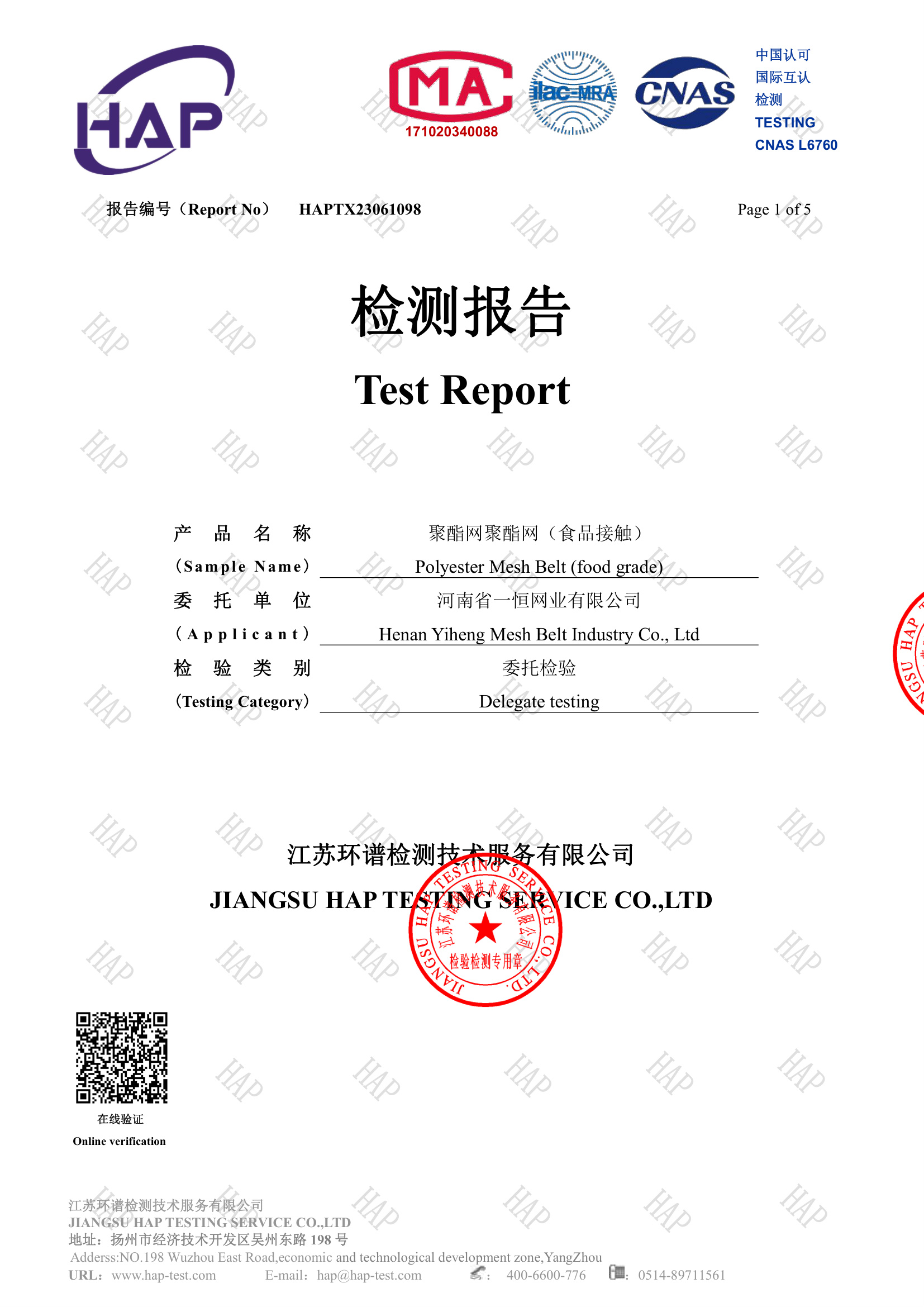
- Verification assets: an Alibaba.com Verified Supplier Assessment Report issued by Intertek (certificate 493944221_P+T, valid 2026-07-09 to 2027-07-09) and a food-contact test report under GB 4806.7-2016 (HAPTX23061098).
For an evaluation-stage buyer, the useful reading is that the terms are documented and bounded. Each commitment can be written into a purchase order and checked against a delivery, which is the practical definition of a term that carries weight.
Application Coverage as a Continuity Test
A supplier's minimum order and inspection terms only matter if the supplier can also make the belt in question. The fastest cross-check is to compare the buyer's own duty against the supplier's documented product range, model by model. The five duty areas in this article — belt filter presses, papermaking pulp washing, meltblown nonwoven equipment, fabric pre-shrinking, and latex wire drying — map to distinct constructions.
| Duty area | Representative belt / model | Documented characteristic |
|---|---|---|
| Sludge dewatering on belt filter presses | Large Loop-Filler Wire | Breaking strength ≥2300 N/cm; air permeability 9,000–13,700 ±500 m³/㎡·h; thickness 2.95 mm |
| Medium-duty filter press service | Medium Loop-Filler Wire | Breaking strength ≥2000 N/cm; 10,700–12,000 ±500 m³/㎡·h; thickness 2.32 mm |
| Municipal sewage and pulp pressing | 16903 | Breaking strength ≥2200 N/cm; 7,894 ±500 m³/㎡·h; herringbone / diagonal drainage structure |
| Papermaking pulp washing | 05802 square mesh | 12–14 mesh; 700–750 g/m²; airflow 13,384–20,775 m³/㎡·h; 2-shed plain weave |
| Meltblown and spunbond nonwoven | KJD700 / SK604 | 600±30 CFM and 700±30 CFM; conductivity 10³–10⁴ Ω and 10⁶ Ω respectively |
| Fabric pre-shrinking and dryer sections | Large Loop / Medium Loop | Loop distance 7.00 mm (dryer) and 6.50 mm; Medium Loop air permeability 18,300 m³/㎡·h |
| Latex wire drying and rubber curing | Large Loop | Dryer air permeability 19,000 m³/㎡·h; thickness 2.95 mm; heat-resistant polyester |
Coverage matters for continuity because a single-source supplier reduces qualification cost. If filter press belts, pulp-washing mesh and dryer fabric all come from the same manufacturer, a change of line or product mix does not automatically trigger a new supplier audit. Buyers should still verify each duty separately: the fact that a supplier makes filter press belts well says nothing about its anti-static nonwoven constructions.
A Repeatable Weighted Scorecard
The following framework converts the discussion above into comparable numbers. Weightings reflect a long-term supply relationship where continuity dominates; buyers with a one-off project should shift weight toward price and delivery speed.
| Criterion | Weight | What a strong answer looks like | What a weak answer looks like |
|---|---|---|---|
| Minimum order flexibility | 20% | 2 m² MOQ confirmed per construction, in writing | One blended MOQ that changes after sampling |
| Payment and inspection sequencing | 25% | Balance released only after an agreed inspection outcome | Full prepayment with inspection described as internal |
| Inspection rights | 20% | 100% pre-shipment check plus written acceptance of BV/SGS attendance | "We check everything" with no third-party access |
| Delivery-term flexibility | 15% | Same specification quoted in FOB, CIF, DAP and DDP | Single DDP figure with no cost breakdown |
| Application coverage | 15% | Model-level specifications across filtration, paper, nonwoven, textile and latex drying | Catalogue images without model documentation |
| OEM response | 5% | Named customisable parameters and a stated sampling time | "Customisation available" with no parameters listed |
Two practical notes on using the scorecard. First, score only written answers. Verbal assurances about inspection or MOQ are the most common source of later dispute. Second, re-score the same supplier after the first delivery — the delta between promised and delivered terms is itself the strongest continuity indicator available.
What the Terms Cannot Tell You
Procurement terms are informative but not sufficient, and buyers who treat a strong scorecard as a substitute for technical validation tend to discover the gap at commissioning rather than at delivery.
- MOQ flexibility has product boundaries. A 2 m² minimum reflects standard constructions; a non-standard width, an unusual joint type or an anti-static build may require a higher quantity, and this should be confirmed per SKU rather than assumed.
- Third-party inspection is a sample, not a guarantee. BV or SGS attendance must be arranged before shipment and adds calendar time and cost. It provides independent confirmation of the goods presented on the day — not a lifetime performance warranty.
- A 30/70 payment split protects nobody if inspection happens after the balance. The protection comes from the sequence, not the ratio.
- The 15–30 day lead time is a production figure. It excludes transit, customs clearance and any inspection window, so total replenishment time must be planned separately.
- DDP pricing obscures unit economics. Freight, insurance and duty embedded in one landed number make it difficult to compare the belt cost across suppliers.
- Terms cannot validate fit. Joint type, loop distance, air permeability and edge treatment must still be matched to the actual machine; a supplier with excellent commercial terms can still deliver a belt that tracks poorly on a misaligned frame.
Market Context: Why Continuity Is Being Priced In
The wider category supports the shift from one-off purchasing toward supplier continuity. Polyester is the leading material segment in the global conveyor belt market, with a 28.4% revenue share in 2025 according to Straits Research. The same source projects the global conveyor belt market growing from USD 6.24 billion in 2026 to USD 8.53 billion by 2034 — though estimates vary by definition, since other research houses use narrower scopes that exclude heavy-duty and modular belts.
The filtration side shows a similar direction. Grand View Research expects belt filter press technology in the sludge dewatering equipment market to grow at a CAGR of 8.8% between 2025 and 2033. Because a belt filter press is only as effective as the belt on it, growth in that equipment segment translates directly into repeat demand for polyester filter press belts — and into more buyers who need a supplier they can re-order from rather than re-qualify.
Trade mechanics reinforce the point. Polyester mesh belts for technical use are typically classified under HS code 5911.90, a heading that covers textile products and articles for technical purposes. Consistent classification matters for buyers running DDP or DAP terms, because duty treatment and documentation depend on it.
Future Outlook
Three developments are likely to shape how buyers evaluate polyester mesh belt suppliers over the next few years. The first is term transparency: as more manufacturers publish MOQ, inspection rights and Incoterm coverage in comparable form, vague commercial terms will become a visible disadvantage rather than a neutral one. The second is the normalisation of third-party inspection on mid-sized orders, not only large ones, which raises the baseline expectation for documented pre-shipment checks. The third is application breadth as a qualification criterion, since suppliers covering filtration, paper, nonwoven, textile finishing and latex drying in one product family reduce the audit burden across a plant's whole belt inventory.
None of this removes the need for machine-side validation. It simply shifts the earliest stage of supplier selection from price comparison to evidence comparison — which is where the durable savings usually sit.
Frequently Asked Questions
What is a typical minimum order quantity for a polyester mesh belt?
Yiheng Mesh states a 2 m² minimum order quantity. In practice the figure should be confirmed per construction, because spiral mesh, flat-wire filter press belts and anti-static nonwoven forming belts have different set-up requirements. Buyers trialling a new specification or replacing a single belt on a running line should ask for the MOQ of that specific product rather than a company-wide average.
How should payment terms be structured for a first polyester mesh belt order?
A 30% deposit with a 70% balance before shipment is a common structure in this trade. Its protective value depends entirely on sequencing: if the balance is released only after an agreed inspection outcome, the buyer retains leverage; if it is released before inspection, the ratio itself offers no protection. The practical step is to write the inspection condition into the order alongside the payment split.
Is 100% pre-shipment inspection the same as third-party inspection?
No. A 100% pre-shipment inspection is the manufacturer's own final check of every item before packing. Third-party inspection by organisations such as BV or SGS is an independent party attending the site, arranged by the buyer, and optional. The two are complementary: the first covers the whole order, the second provides external confirmation but samples rather than certifies the entire run.
Which delivery term should a buyer compare — FOB, CIF, DAP or DDP?
The choice depends on who is better placed to control freight and import formalities. FOB leaves main carriage to the buyer; CIF bundles carriage and insurance into the supplier's price; DAP and DDP extend the supplier's obligation to the destination, with DDP also covering import duty. Because DDP embeds freight, insurance and duty into one number, buyers who need to compare belt cost across suppliers should request the same specification quoted in more than one Incoterm.
How can a buyer verify that one supplier covers both filtration and drying duties?
Check the product range at model level rather than by category. Yiheng Mesh documents filter press belts such as Large Loop-Filler Wire (breaking strength ≥2300 N/cm, 9,000–13,700 ±500 m³/㎡·h) and 16903, square mesh such as 05802 for pulp washing, nonwoven forming belts such as KJD700 and SK604, and spiral constructions with 7.00 mm and 6.50 mm loop distances for dryer and pre-shrinking sections. Each duty should be verified separately, since strength in one construction does not imply capability in another.
A downloadable PDF brochure covering Yiheng Mesh product ranges and specifications is available here: Yiheng Mesh company brochure.
¿Tiene preguntas o necesita más detalles?
Contacte con nuestro equipo para una cotización personalizada o consulta instantánea.
Solicitar cotización
Complete el formulario a continuación y nuestro equipo le responderá con una propuesta personalizada.
Chat directo de WhatsApp
¿Prefiere chatear en tiempo real? Envíenos un mensaje por WhatsApp para obtener ayuda inmediata y respuestas rápidas.
- Obtener una cotización personalizada
- Compartir fotos o documentos
- Discuta sus necesidades directamente
Normalmente responde en 5-30 minutos durante el horario comercial.