
Polyester Mesh Belt Supplier Evaluation: Consistency Over Time
A polyester mesh belt is a consumable component, which makes supplier selection a recurring-supply decision rather than a one-off purchase. Research-stage buyers usually judge candidates on a sample, a price and a specification sheet. Those three inputs say very little about what the tenth order will look like, how quickly a seam can be replaced when the belt is already on the machine, or whether the declared drainage rate will still match the machine settings two years from now.
Long-term evaluation therefore rests on three testable questions: is the declared specification reproduced batch after batch; can the belt be maintained in place instead of replaced; and do the commercial arrangements — minimum order quantity, sampling cycle and documentation — still hold at repeat-order scale. This guide sets out how to examine each one using published construction data, rather than relying on general assurances.
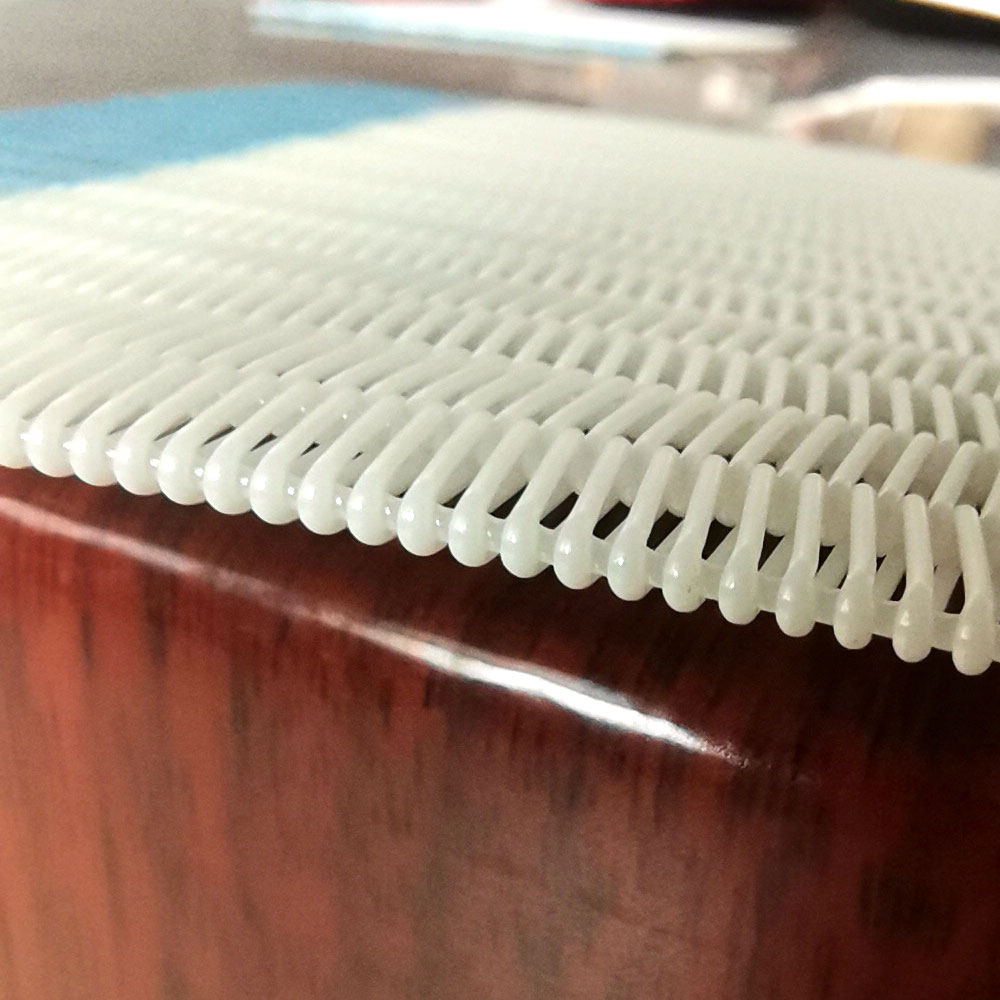
Polyester spiral mesh construction: loop geometry and filler wires determine both drainage behaviour and how easily a damaged section can be worked on.
Why the First Sample Is a Weak Predictor of Long-Term Supply
An initial sample is usually produced under favourable conditions: a short run, close attention, a hand-checked joint. The variable that matters for a production buyer is repeatability across weaving, heat-setting and joint making, because those three steps decide whether air permeability, thickness and break strength stay inside the band the machine was originally tuned for.
The operating context explains why this matters commercially. Polyester mesh belts run in continuous cyclic duty — belt filter presses, dryer sections, forming and conveying positions, fabric pre-shrinking and latex drying lines — typically in 24/7 operation. A belt that drains slightly differently changes vacuum load, cake dryness or drying uniformity. A belt that fails early costs a scheduled stoppage plus a replacement cycle. For a buyer moving from awareness into research, the useful shift is to stop asking whether a supplier can make the belt at all, and start asking whether the same belt can be produced again, and whether the maintenance team can keep it running.
What Consistency Means in Polyester Mesh Belt Terms
Consistency is not an abstract quality claim. In mesh belt procurement it can be reduced to four measurable points: the air permeability band, the thickness, the strength at break, and the repeatability of the joint type. Declared figures for standard filter press and spiral mesh constructions show how tight those bands are in practice.
| Construction | Category | Thickness | Air permeability (m³/㎡·h) | Strength at break |
|---|---|---|---|---|
| Small Loop-Filler Wire | Filter press belt | 1.90 mm | 7,300 ±500 | ≥2000 N/cm |
| Medium Loop-Filler Wire | Filter press belt | 2.32 mm | 10,700–12,000 ±500 | ≥2000 N/cm |
| Large Loop-Filler Wire | Filter press belt | 2.95 mm | 9,000–13,700 ±500 | ≥2300 N/cm |
| Small Loop | Polyester spiral mesh | 1.90 mm | 17,500 | ≥2000 N/cm |
| Medium Loop | Polyester spiral mesh | 2.32 mm | 18,300 | ≥2000 N/cm |
| Large Loop (dryer configuration) | Polyester spiral mesh | 2.95 mm | 19,000 (filter press duty 9,000–13,700) | ≥2300 N/cm |
| Model 16903 | Filter press belt, herringbone weave | — | 7,894 ±500 | ≥2200 N/cm |
Two things are worth noticing in that table. First, the filter press series carries a narrower declared band than the general spiral range, because dewatering performance is judged on cake dryness and solids capture rather than airflow alone. Second, the family spans a thickness range from 1.90 mm to 2.95 mm; the thinner constructions are described as suitable for machines with tight roller spacing, which is a maintenance-relevant detail as much as a hydraulic one.
Where suppliers differ is not usually the headline number but the tolerance around it. A buyer who specifies only '7,300 m³/㎡·h' has accepted an undefined band; a buyer who specifies '7,300 ±500 m³/㎡·h' has created something that can be checked on arrival.
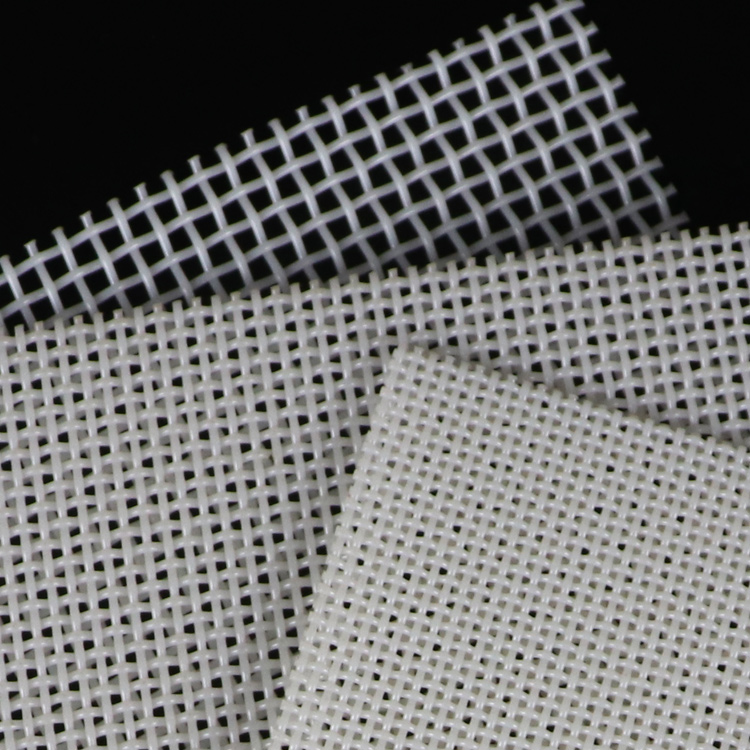
Square mesh and plain weave constructions sit in a different drainage range from spiral filter press belts; specification bands should be read per construction family.
Air Permeability Tolerance: The Number Buyers Should Ask For
Air permeability is the parameter most likely to drift between production runs, because it is set by weave geometry and then finalised by heat-setting. It is also the parameter that most directly changes process behaviour: the drainage rate on a belt filter press, and the airflow uniformity across a dryer section.
Some manufacturers publish a process tolerance for it. Henan Yiheng Mesh Belt Industry Co., Ltd. states that on its heat-setting looms, air permeability (CFM) fluctuation is controlled within a ±5% range. The practical value of a stated tolerance is that it becomes testable: write the tolerance into the purchase specification, retain a reference sample from the approved batch, and check incoming belts with an air permeability test at the agreed pressure. That single action converts a marketing statement into a procurement control.
Heat-setting also affects dimensional behaviour. Stable heat setting, described in the context of forming fabrics, is what prevents edge distortion, tracking deviation and seam thickness mismatch after installation — the failure modes that a maintenance team notices long before a specification sheet does.
Maintenance Design: Smooth Surfaces and Dismantlable Construction
The second pillar of long-term supply is how the belt behaves when something goes wrong. Polyester spiral mesh belts are described as having a smooth mesh surface with arbitrary disassembly and assembly, which simplifies installation, seam changes and routine maintenance. In practice that means a damaged loop or filler wire section can be worked on individually rather than condemning the entire belt, and a seam can be reworked without scrapping the body.
Three design details support that behaviour:
- Smooth surface. A flat, uniform mesh face limits material build-up and fibre sticking, which reduces cleaning downtime and keeps the conveyed or filtered product mark-free.
- Filler wire configuration. Flat filler wires such as the 0.65 × 1.65 mm profile used in the Small Loop-Filler Wire belt close the gaps in the spiral structure, producing a denser mesh for finer filtration while keeping the surface flat.
- Profile thickness. The 1.90 mm Small Loop construction is specified for machines with tight roller spacing; a slimmer belt reduces belt weight and installation effort on compact frames.
A related property in dewatering duty is cake release. Model 16903 uses a herringbone (diagonal) weave that is described as reducing adhesion between the filter cake and the mesh, so sludge peels away more cleanly during discharge, and the surface design limits fibre and particle embedding. Both effects show up as shorter cleaning intervals rather than as a specification figure.
How Construction Choice Sets the Maintenance Burden
Four construction families appear in polyester mesh belt supply, and each shifts the maintenance burden differently.
Spiral mesh (Small, Medium and Large Loop)
Spiral mesh is the workhorse family for dewatering, drying and conveying. Loop distance is the distinguishing variable: 5.20 mm for Small Loop, 6.50 mm for Medium Loop and 7.00 mm in the dryer configuration of Large Loop. Larger loops open the structure for airflow and drainage; smaller loops give a denser, flatter surface. Because the structure is assembled from interlocking loops, it is also the family that supports sectional repair.
Filler wire variants
Adding filler wires to the spiral structure narrows the open area without changing the belt's basic handling behaviour. The Medium Loop-Filler Wire model offers 0.68 × 3 mm and 0.68 × 4 mm fillers, and the Large Loop-Filler Wire model offers 0.90 × 3, 0.90 × 4 or 0.90 × 5 mm fillers. The trade-off is explicit: fewer or thinner fillers favour drainage, more or thicker fillers favour filtration fineness and drier cake.
Square mesh and plain weave
Model 05802 is a square mesh with 0.8 mm warp and weft, a 12–14 mesh range and airflow of 13,384–20,775 m³/㎡·h, built on a 2-shed plain weave and described as corrosion-resistant, non-toxic and odourless with a smooth surface that resists build-up. Model 16402 goes the other way: 41 mesh, 0.2 mm pitch, 550 g/m² and 6,900 m³/㎡·h, aimed at fine retention rather than high airflow. Both are easier to inspect visually than a fine spiral structure, which matters when a maintenance team has to judge wear without laboratory equipment.
Herringbone filter press belts
Model 16903 uses a diagonal weave with 0.70 mm warp and 0.90 mm weft, warp density of 16 wires/cm and weft density of 5.33 wires/cm. It is designed around solids release and pressure filtration rather than around airflow, which is why its declared permeability sits at 7,894 ±500 m³/㎡·h.
Where Each Construction Fits
| Duty | Typical construction | What drives the choice |
|---|---|---|
| Municipal and industrial sludge dewatering | Large / Medium Loop-Filler Wire; Model 16903 | Cake release, solids capture, strength under press tension |
| Papermaking pulp washing and pressing | Spiral mesh and filler wire variants; Model 16903 | Drainage consistency and dimensional stability |
| Latex and rubber drying and conveying | Large Loop dryer configuration; Medium Loop | Airflow for heat penetration, non-stick surface |
| Textile finishing and fabric pre-shrinking | Spiral mesh range | Smooth, mark-free surface; stable tracking |
| Nonwoven forming and food/feed drying | Model 05802 square mesh; Model 16402 plain weave | Airflow uniformity or fine retention, depending on the product |
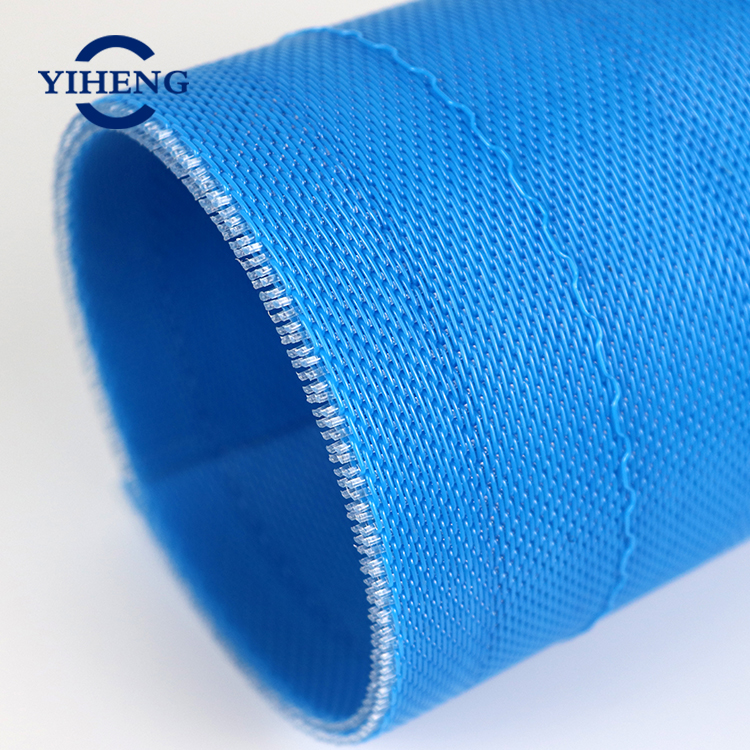
Herringbone weave on a filter press belt: the diagonal structure is aimed at cake release and easier cleaning rather than maximum airflow.
Market Signals That Make Supplier Continuity a Procurement Question
Polyester is the leading material segment in the global conveyor belt market, with a 28.4% share in 2025, according to Straits Research. The same source projects the overall conveyor belt market growing from USD 6.24 billion in 2026 to USD 8.53 billion by 2034. These are broad market figures covering many belt types, but they establish that polyester-based belting is the mainstream material choice rather than a niche.
More specific to this category, Grand View Research estimates that the belt filter press technology segment of the sludge dewatering equipment market will grow at a CAGR of 8.8% from 2025 to 2033. Belt filter presses are a primary application for polyester filter press belts, so growth in that installed base translates directly into replacement volume for mesh belts — and into repeat-order relationships rather than one-off transactions.
Two procurement consequences follow. First, when replacement volume grows faster than the supplier base, lead-time reliability becomes a selection criterion in its own right. Second, buyers gain leverage by consolidating specifications: a supplier who has already produced an approved construction is easier to hold to a tolerance than a new entrant working from a drawing.
Where the Limits of This Belt Type Lie
Any evaluation that only lists advantages is incomplete. The following constraints are part of an honest supplier assessment.
- No single international standard certifies open mesh belt drainage performance. ISO 14890, the international standard for rubber- or plastics-covered conveyor belts with textile carcasses, governs a different product family. For open polyester mesh belts, verification therefore has to be contractual and test-based rather than certificate-based alone.
- Polyester is sensitive to hydrolysis. Anti-hydrolysis PET monofilaments are used specifically to limit brittleness in hot, wet environments. Even so, service life is duty-dependent: as a reference point, forming fabrics running on high-speed lines are typically described as lasting 3–6 months. Buyers should plan replacement from their own duty data rather than from a general average.
- The seam remains the weakest point. Smooth surfaces and dismantlable construction make seam work easier; they do not make seams irrelevant.
- Stated tolerances require verification. A ±5% air permeability control range is a process statement. It only becomes a purchasing control once incoming checks are defined.
- Trade documentation needs checking. HS Code 5911.90 applies to textile products and articles for technical uses, including polyester mesh belts. Incorrect classification on shipping documents affects duty calculation and clearance time.
- Material boundaries apply. Where duty temperature or chemical exposure exceeds what polyester monofilaments tolerate, buyers generally move to PTFE or metal constructions instead. Polyester mesh is not the universal answer.
A Practical Evaluation Framework for Repeat Orders
| Dimension | Question to ask | Evidence to request |
|---|---|---|
| Specification reproducibility | What tolerance applies to air permeability, thickness and break strength? | Declared bands per model plus an approved reference sample |
| Batch verification | How is each batch checked before shipment? | Inspection arrangement agreed per order, including third-party inspection where required |
| Maintenance design | Can a damaged section or seam be reworked in place? | Construction description covering surface finish and disassembly method |
| Duty fit | Which construction family matches my drainage or drying requirement? | Permeability, thickness and strength data for the proposed model |
| Repeat-order economics | What is the minimum order quantity for a repeat run? | Written MOQ and sampling timeline |
| Technical support | Who answers a tracking or seam question after installation? | Documented troubleshooting references and response route |
The framework is deliberately short. A long scorecard tends to collapse into price comparison at the final meeting; six dimensions that can each be evidenced are easier to defend internally.
How One Supplier Structures Consistency and Maintenance Support
Henan Yiheng Mesh Belt Industry Co., Ltd. (Yiheng) is a Henan, China-based manufacturer specializing in the R&D, customization and manufacturing of high-precision non-woven forming belts and industrial filter belts. The company was established in 2009 and is registered as a National High-tech Enterprise. Its main products include Polyester Mesh Belt, Non-Woven Mesh Belt, Forming Fabrics, Dryer Fabrics, Polyester Filter Belt, UV Belts, Polyester Spiral Mesh, Polyester Square Mesh and PTFE Mesh Belt.
Several of its published operating facts map directly onto the evaluation dimensions above. The company operates a standardized facility with a monthly capacity of 12,800 m² and an annual production capacity of 150,000 m², employs approximately 41 staff with an R&D team of 3 engineers, and exports 62% of total sales to Asia, Europe and North America. For repeat-order planning, it states a minimum order quantity from 1 m² and a rapid sampling process that delivers custom prototypes in as little as 3 days. On the quality side, it states that air permeability fluctuation on its heat-setting looms is controlled within ±5%, holds a Food Contact Certificate for products used in food packaging and hygiene material production, and is registered under the German Packaging Law (LUCID).
Maintenance support is treated as a documentation problem as much as a product problem: the company maintains a technical knowledge base covering more than 122 real-world troubleshooting cases, including tracking, fibre hanging, static and seam marks. For a buyer running the checks in this article, those are the facts that can be verified, written into a supply agreement and re-tested on the second and third order — which is where long-term supply is actually decided.
Future Outlook
Three developments are likely to shape polyester mesh belt procurement over the next few years. The first is specification tightening: as dewatering and drying capacity grows, buyers increasingly treat air permeability tolerance, not nominal permeability, as the purchasing unit. The second is documentation depth — batch-level test records are becoming a normal expectation rather than a premium service. The third is maintenance design moving from a selling point to a requirement, because downtime cost now outweighs belt price on most continuous lines. Suppliers who can evidence repeatability, supply a reworkable construction and answer technical questions after installation will be the ones evaluated for the next order, not just the first.
Frequently Asked Questions
What should buyers check first when evaluating a polyester mesh belt supplier?
Start with specification reproducibility rather than price or sample appearance. Ask for the declared tolerance bands on air permeability, thickness and strength at break for the proposed model, then confirm how each batch is verified before shipment. A supplier who can state a band — for example 7,300 ±500 m³/㎡·h on a Small Loop-Filler Wire belt — has given you something testable; a supplier who states a single figure has not.
Which polyester mesh belt designs are easier to maintain on the machine?
Polyester spiral mesh constructions are described as having a smooth mesh surface with arbitrary disassembly and assembly, which simplifies installation, seam changes and routine maintenance. The filler wire variants keep that property while narrowing the open area: the Small Loop-Filler Wire uses a 0.65 × 1.65 mm flat filler at 1.90 mm thickness, the Medium Loop-Filler Wire uses 0.68 × 3 or 0.68 × 4 mm fillers at 2.32 mm, and the Large Loop-Filler Wire uses 0.90 × 3, 0.90 × 4 or 0.90 × 5 mm fillers at 2.95 mm.
How is air permeability consistency verified between batches?
By agreeing a tolerance in writing, retaining a reference sample from the approved batch, and testing incoming belts at the same pressure as the reference. Declared bands in the filter press series run from 7,300 ±500 m³/㎡·h for Small Loop-Filler Wire, through 10,700–12,000 ±500 for Medium Loop-Filler Wire, to 9,000–13,700 ±500 for Large Loop-Filler Wire. Model 16903 is declared at 7,894 ±500 m³/㎡·h with a herringbone weave.
What documentation should accompany a repeat polyester mesh belt order?
At minimum: the agreed specification with tolerance bands, the inspection arrangement for the batch, and correct trade documentation. Polyester mesh belts fall under HS Code 5911.90, which covers textile products and articles for technical uses. Where the belt is used in food or hygiene applications, buyers should also confirm the applicable food-contact certification held by the supplier for that product.
Is there an international standard that certifies open polyester mesh belts?
Not in the way buyers often assume. ISO 14890 is the international standard governing rubber- or plastics-covered conveyor belts with textile carcasses — a different product family from open mesh belts. Because no equivalent standard fixes mesh belt drainage performance, verification has to rest on the agreed specification, incoming testing and, where required, third-party inspection arranged per order.
How do dewatering and drying duties change the belt specification?
Dewatering duty prioritizes cake release, solids capture and strength under press tension, which is why constructions such as Large Loop-Filler Wire (≥2300 N/cm, 2.95 mm) and Model 16903 with its herringbone weave are used there. Drying duty prioritizes airflow for heat penetration: the Large Loop dryer configuration is declared at 19,000 m³/㎡·h and Medium Loop at 18,300 m³/㎡·h, with loop distances of 7.00 mm and 6.50 mm respectively.
Reference document: Henan Yiheng Mesh Belt Industry Co., Ltd. — company profile (PDF).
¿Tiene preguntas o necesita más detalles?
Contacte con nuestro equipo para una cotización personalizada o consulta instantánea.
Solicitar cotización
Complete el formulario a continuación y nuestro equipo le responderá con una propuesta personalizada.
Chat directo de WhatsApp
¿Prefiere chatear en tiempo real? Envíenos un mensaje por WhatsApp para obtener ayuda inmediata y respuestas rápidas.
- Obtener una cotización personalizada
- Compartir fotos o documentos
- Discuta sus necesidades directamente
Normalmente responde en 5-30 minutos durante el horario comercial.