
Polyester Mesh Belt Supplier Checks: MOQ, Inspection, OEM Terms
Polyester Mesh Belt Supplier Checks: MOQ, Inspection, OEM Terms
Polyester mesh belt supply is verified through order terms, not adjectives. For a buyer moving from evaluation into execution, three commercial instruments carry most of the checkable information: the minimum quantity that permits a trial, the inspection regime that governs release of the goods, and the payment schedule that fixes the order of events. Henan Yiheng Mesh Belt Industry Co., Ltd. (Yiheng Mesh) is a manufacturer of polyester mesh belts, non-woven mesh belts, forming fabrics, dryer fabrics and polyester filter belts that also provides OEM and ODM production services. Its stated terms — a 2 m² minimum order quantity for samples and trials, 100% pre-shipment inspection with optional BV or SGS third-party inspection, and a 30% deposit with 70% balance before shipment on OEM and custom orders — matter less for how they sound than for what they can be measured against.
This article sets out how those three instruments work together, what each one does and does not prove, and how the same structure applies across the Small Loop, Medium Loop and Large Loop-Filler Wire configurations used in filtration, drying and conveying duties.
Why capability claims need to be attached to an order
Every supplier in this category describes precision weaving, controlled quality and customization ability. Those descriptions are difficult to rank because they sit outside the transaction. A buyer cannot audit 'strict quality control', but can audit whether each shipment was inspected against a written specification, whether an independent inspector was allowed onto the factory floor, and whether the balance payment falls due after acceptance or before it.
That is the practical difference between a supplier profile and supplier evidence. A profile states what a company says it can do. Order-level terms show what the company is prepared to be measured against, and when.
The distinction matters more in mesh belts than in commodity components because the product is specified rather than catalogued. Mesh count and opening size, air permeability expressed in CFM, belt width and length, material among PET, PA and anti-static options, thickness, color and edge finish are variables the buyer sets. A supplier that accepts custom specifications takes on a different obligation from one that ships from stock, and the terms of that obligation are the evidence worth collecting.
| Instrument | Stated term | Question it answers | What it does not establish |
|---|---|---|---|
| Trial quantity | 2 m² minimum order for samples and trials | Can material and workmanship be qualified before production volume is committed? | Service life on the buyer's own line |
| Pre-shipment inspection | 100% pre-shipment inspection | Is the whole shipment checked against the agreed specification before dispatch? | Depth of testing beyond the agreed criteria |
| Third-party inspection | On-site BV or SGS inspection available | Can an independent party confirm the goods at the factory? | Product certification; a batch warranty for later orders |
| OEM payment terms | 30% deposit, 70% balance before shipment (OEM and custom orders) | How is risk divided between order confirmation and dispatch? | Supply continuity, future pricing or capacity guarantees |
Inspection: what 100% pre-shipment inspection covers
Yiheng Mesh states 100% pre-shipment inspection as its standard quality control, with on-site third-party inspection by BV or SGS available. Those two statements describe different things and should be read separately.
The first describes coverage: inspection is applied to the whole order before dispatch rather than to a sample drawn from it. The second describes an option: the buyer may bring an independent inspection body to the factory. Together they answer the question of who confirms the goods, and at what point in the transaction — more decision-useful than a general assurance of quality.
What the statement does not do is define depth. '100%' describes how much of the shipment is examined; it does not say what is measured. That gap belongs to the buyer, and it closes with an acceptance criteria list agreed before production: nominal mesh count and opening tolerance, air permeability target and permitted deviation, finished width and length, edge construction, visual defect limits and the packaging configuration. An inspection can only confirm a specification that exists on paper, so the acceptance list — not the inspection promise — is the load-bearing document.
Third-party inspection adds an independent observer at the point of manufacture. To make it informative rather than ceremonial, four points should be agreed in writing beforehand: the scope and sampling plan the inspector will follow, the stage at which inspection occurs (before packing is more informative than after), who commissions and bears the cost of the visit, and the consequence of a failed report. A report that arrives after shipment has turned verification into documentation.
One clarification prevents a frequent mix-up: BV and SGS are inspection service providers, not product certifications. An inspection report confirms the condition of goods on a date; it does not certify the product, and it should not be presented as if it did.
The document layer behind the inspection regime
Yiheng Mesh holds a test report for food-grade polyester mesh belt issued on 29 June 2023 by JIANGSU HAP TESTING SERVICE CO., LTD under report number HAPTX23061098, tested against GB 4806.7-2016 for the product scope 'polyester mesh belt'. It also holds an Alibaba.com Verified Supplier Assessment Report prepared by INTERTEK under certificate number 493944221_P+T, issued 9 July 2026 and valid to 9 July 2027, covering fabrics, dryer fabrics, polyester filter belt, non-woven mesh belt and UV belts. For shipments into Germany, a registration under the German Packaging Act (VerpackungsG) is held under registration number DE2857625357145, issued 24 February 2025, covering retail, grouped and shipment packaging placed on the German market.
Each document answers a different question. The test report addresses food-contact suitability for the tested product type under one standard. The assessment report addresses the supplier as an organisation at a point in time. The packaging registration addresses an obligation unrelated to belt performance that can still stop a delivery at the border if it is missing. None of them certifies a specific production batch, which is precisely why the pre-shipment inspection layer exists alongside them.
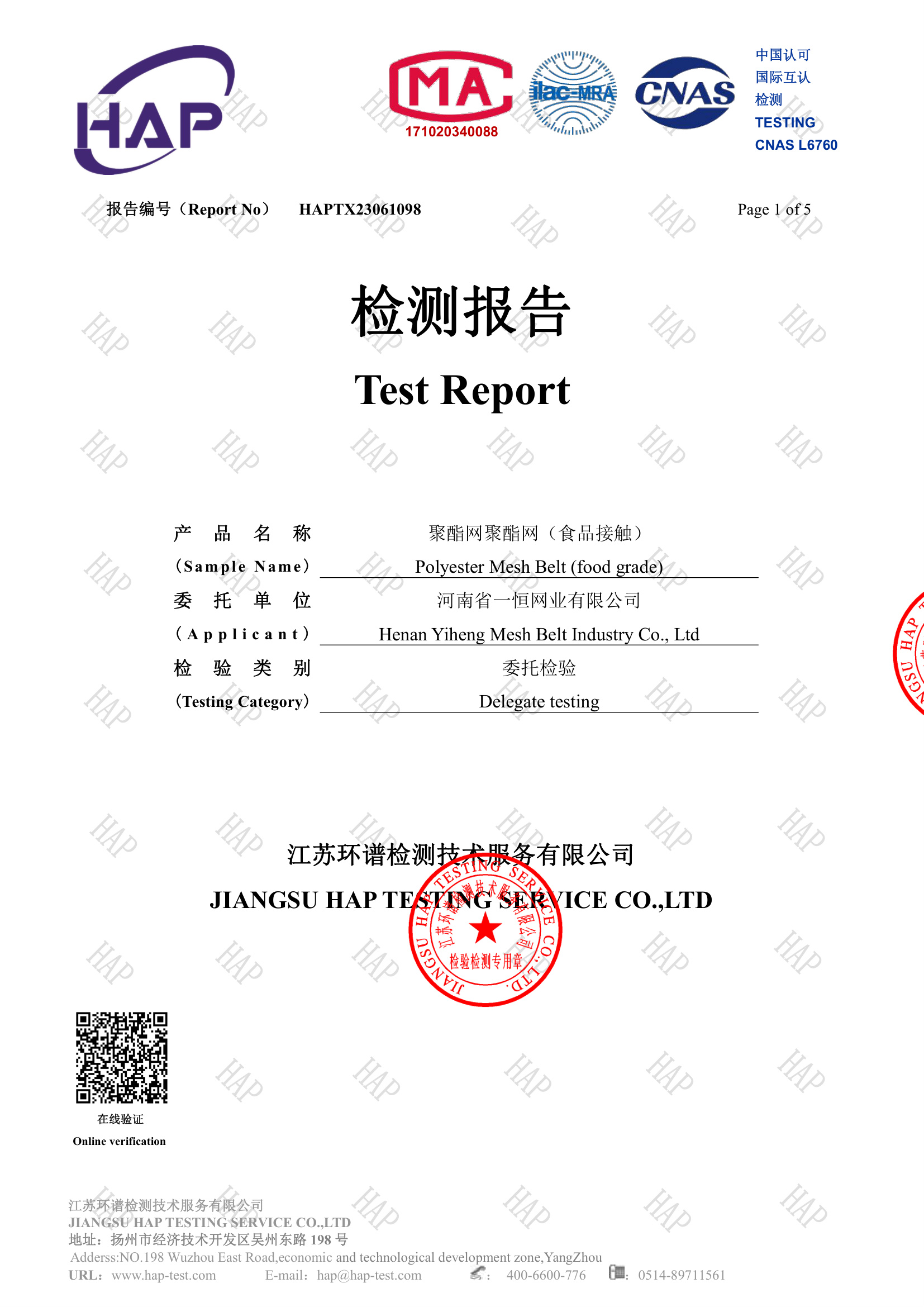
Food-contact test documentation for the polyester mesh belt scope, issued under GB 4806.7-2016. A test report supports suitability for the tested product type; it does not certify an individual production batch.
The 2 m² minimum: a small order used as a qualification instrument
Yiheng Mesh sets a minimum order quantity of 2 m² for samples and trials. Read as a commercial condition, it is modest. Read as an evaluation instrument, it does something more useful: it lets a buyer hold the actual material before committing to a production quantity, and compare candidate configurations side by side against one specification.
That comparison is where the minimum earns its place. A buyer weighing a Small Loop against a Medium Loop, or a standard loop against a filler-wire variant, does not have to decide on the strength of a description. A trial quantity produced to the same width, material, edge finish, mesh count and air permeability target supports a direct comparison of workmanship, dimensional accuracy and surface condition. The manufacturer also lists free sample testing among its services, so buyers should confirm in writing whether a given request is handled as free sample testing or as a paid trial order at the 2 m² minimum, because the two routes carry different scopes.
The limits of a small trial deserve equal clarity. Two square metres verify material, weave, dimensions and workmanship. They do not verify service life. Belt life is decided by tension, temperature, chemical exposure, cleaning regime and loading on the actual line, and no sample compresses those conditions into a laboratory result. A trial also says nothing about repeatability, which is a property of the supplier's process across orders rather than of one piece of fabric.
Two checks make the trial more informative. First, confirm whether the trial will include the joining configuration intended for production, since a trial piece without a joint tests a different article from the one that will run on the machine. Second, record the measured values — width, length, thickness, air permeability — and attach them to the later order as reference data. A trial that is not measured becomes an impression rather than a baseline.
OEM and custom terms: what a 30/70 schedule changes
For OEM and custom orders, Yiheng Mesh applies a payment schedule of 30% deposit with the 70% balance due before shipment. Delivery terms offered are FOB, CIF, DAP and DDP. The stated customization scope covers mesh count and opening size, air permeability (CFM), belt width and length, material including PET, PA and anti-static options, thickness, color and edge, with a quoted lead time of 15–30 days. Stated export markets include the EU, North America, Southeast Asia, the Middle East, Russia and South America.
The payment schedule is the term most often read only as a cash-flow condition. In practice it sets the sequence of the entire transaction, and that sequence determines whether inspection has any leverage. If the balance falls due before shipment, verification must be completed before the balance is released — otherwise the buyer pays the full value of goods they have not confirmed. Buyers intending to use BV or SGS inspection should therefore schedule the visit against the production calendar rather than the shipping date, and should make acceptance of the inspection report the documented trigger for the balance payment.
The customization list is the other half of the same argument. Every variable on it is a checkable line item, so inspection depth follows directly from how many of them are written into the order. A purchase order specifying mesh count, CFM, width, length, material, thickness, color and edge gives an inspector eight points of reference. An order specifying only 'polyester mesh belt, width 2 m' gives one. Specification effort at the front of the order is what converts the inspection regime from a promise into a filter.
Two further details belong in the commercial file. Textile products and articles for technical uses typically fall under HS code 5911.90, according to the USITC Harmonized Tariff Schedule, which matters for import documentation. And for German-market deliveries, packaging obligations run alongside product specifications: the LUCID registration covers retail, grouped and shipment packaging placed on that market, so packaging configuration should be agreed together with the belt specification rather than after it.
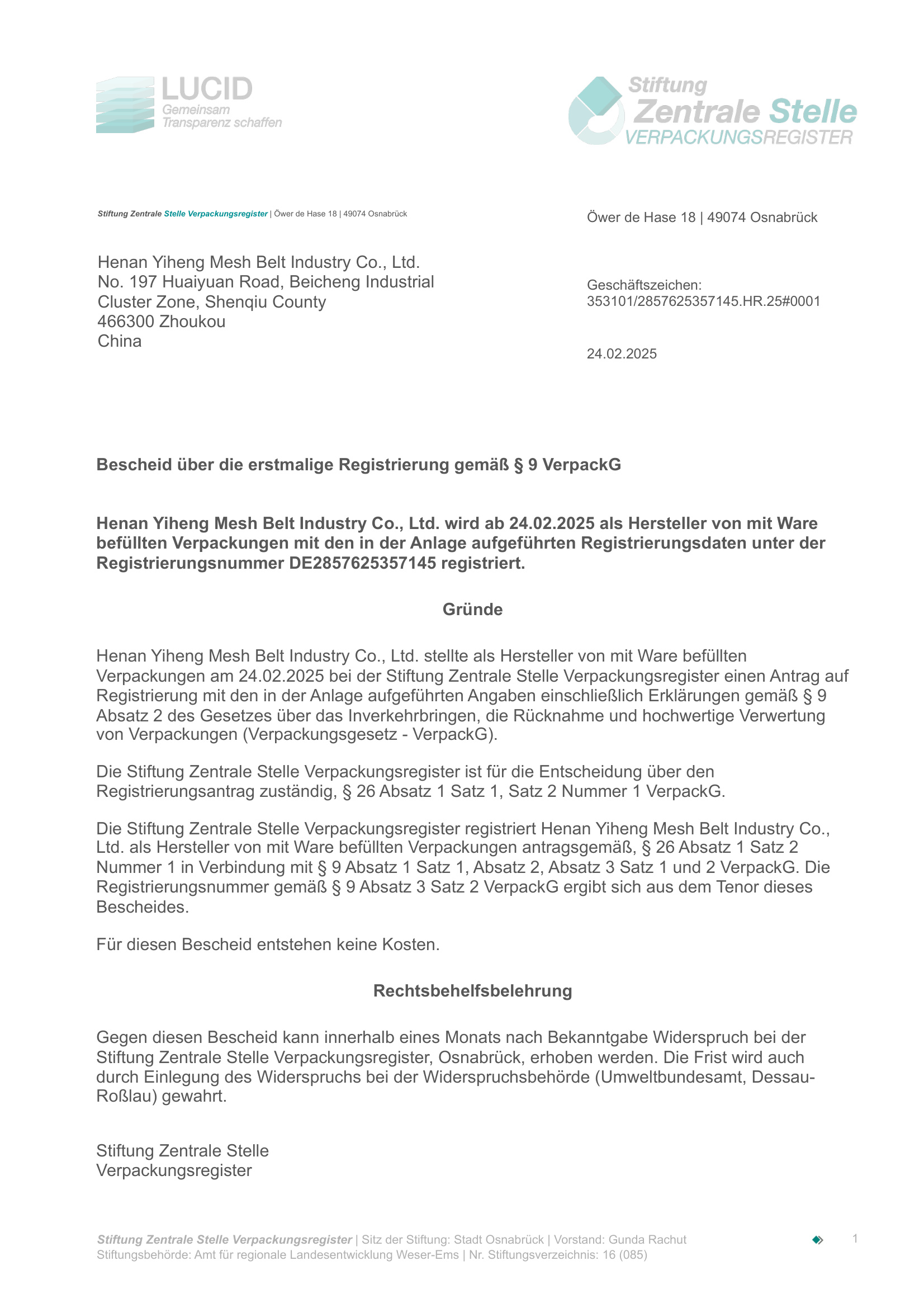
German Packaging Act (LUCID) registration DE2857625357145: a destination-market packaging obligation that runs alongside, not instead of, belt specification and inspection.
Applying the same checks across the loop range
The loop family covers Small Loop, Medium Loop and Large Loop configurations, each also offered in a filler-wire variant: Small Loop-Filler Wire, Medium Loop-Filler Wire and Large Loop-Filler Wire. These sit alongside the wider product set — polyester spiral mesh, polyester square mesh, dryer fabrics, non-woven mesh belts, forming fabrics, UV belts and PTFE mesh belts — which is why the evidence structure matters more than a single catalogue number.
Loop geometry and filler-wire configuration are selection variables, not quality grades. The right choice depends on duty: a belt acting as a filter medium in dewatering service is judged on retention and drainage behaviour, a dryer belt on how it carries air and heat through the product, and a conveying belt on tracking, dimensional stability and edge condition. Because those duties load the belt differently, the specification a buyer writes — and therefore the inspection that follows — changes with the application even when supplier and payment terms stay the same.
This is the practical advantage of evaluating terms rather than claims: the 2 m² trial, the acceptance list, the third-party inspection option and the 30/70 schedule apply identically to whichever loop configuration is quoted. The framework is portable. A buyer qualifying a filtration belt for a belt filter press, then returning for a dryer belt, does not need a new evaluation method — only a new specification to plug into it.
Application information from the manufacturer illustrates the range of duty involved, and should be read as supplier-reported project detail rather than independent test results. A municipal wastewater treatment plant in Malaysia is reported to run twelve belt filter presses on loop and filler-wire belts; a dehydrated vegetable and seafood processor in Switzerland is reported to run eight drying and conveying lines; a rubber products manufacturer in Malaysia is reported to run eight curing and cooling lines. Each describes one customer's configuration and conditions, and none of them predicts performance on a different line.
What the evidence does not establish
Honest evaluation includes the boundaries. Three limits apply to everything above.
First, order-level evidence verifies conformance, not durability. Inspection confirms that goods match a specification on a date. It does not establish how long a belt will run under a given tension, temperature and cleaning regime, and no supplier term substitutes for a period of monitored operation on the buyer's own machine.
Second, documents carry scopes that must be read. The food-contact test report is a test report under GB 4806.7-2016 for the product scope 'polyester mesh belt', issued in 2023; it is not a batch certificate and does not extend to compositions or applications outside that scope. The Intertek assessment report covers a defined period from July 2026 to July 2027 and a defined product scope. A document can be genuine and still be irrelevant if it is cited outside the question it answers.
Third, market figures need their definitions checked. One published estimate places the global conveyor belt market at USD 6.24 billion in 2026 rising to USD 8.53 billion by 2034, while another estimate for a comparable year is materially lower, reflecting a narrower definition of what counts as a conveyor belt. Headline figures in this category are directional rather than precise, and should not carry a single purchase decision on their own.
A verification sequence for buyers moving into execution
The three instruments work best in a fixed order, because each step produces the input the next one needs.
- Define the duty and the variant. Require the quotation to name the loop configuration and state mesh count, opening size, air permeability target, width, length, material and edge.
- Write the acceptance criteria as a measurable list before ordering anything. That list is the reference for internal inspection and for any third-party visit.
- Order the 2 m² trial and measure it. Keep the results as the baseline for the production order.
- Agree the inspection scope in writing: what is checked, at which stage, by whom, and what happens if the result fails.
- Decide whether to nominate BV or SGS, and fix the commissioning party, cost and timing in the same document.
- Sequence payment against verification: inspection acceptance before the 70% balance on OEM and custom orders.
- Keep one file per order containing the specification, trial measurements, inspection reports, product documents and, where the destination market requires it, the packaging registration.
Steps one and two carry disproportionate weight, because every later step depends on them. A third-party inspector without a specification has nothing to inspect against, and a 30/70 schedule without an agreed acceptance point simply moves payment earlier without adding control.
Market context and forward view
Two third-party data points frame why dewatering and drying duties continue to attract specification work. Straits Research reports that polyester held a 28.4% share of the global conveyor belt market by material in 2025, making it the leading material segment in that segmentation. Grand View Research projects the belt filter press technology segment of the sludge dewatering equipment market to grow at a compound annual rate of 8.8% between 2025 and 2033.
Both are segment estimates or projections from commercial research publishers, subject to the definitional caveats noted above, and neither guarantees demand for any individual supplier. What they support is a conditional statement: where belt filter press capacity expands, demand for filter and dewatering belts expands with it, and the buyers entering that market are the same buyers who will ask for measurable trial quantities, defined inspection scope and clear payment sequencing before committing.
That is where the evidence points. As mesh belt specifications become more application-specific, the terms attached to an order carry more evaluative weight than the claims printed above it: a 2 m² trial that can be measured, an inspection regime that can be scheduled, and a payment schedule that can be tied to acceptance.
Buyers who want the full specification and capability record in one place can download the English-language company brochure here: Yiheng Mesh company brochure (PDF). Product and company details are also published at yhfilterbelt.com.
FAQ
What does a 2 m² minimum order quantity cover?
The 2 m² figure is the minimum order quantity Yiheng Mesh applies to samples and trials. It allows a buyer to receive and examine actual material — weave, opening, dimensions, edge and workmanship — before committing to a production quantity, and to compare loop or filler-wire variants against one specification. It is a material and workmanship check, not a service-life demonstration; durability under tension, temperature and cleaning conditions has to be established on the operating line.
Is BV or SGS third-party inspection included as standard?
No. The standard quality control stated by the manufacturer is 100% pre-shipment inspection of the order. On-site third-party inspection by BV or SGS is available as an option and is arranged for the order in question. Scope, sampling plan, inspection stage, commissioning party and cost should be agreed in writing, because those details determine what the resulting report actually confirms.
When is the 70% balance due on an OEM or custom order?
For OEM and custom orders, the stated terms are 30% deposit with the 70% balance due before shipment. Because the balance precedes dispatch, buyers who intend to use third-party inspection should schedule it against the production calendar and make acceptance of the inspection report the documented trigger for releasing the balance.
Which loop configuration is used for filtration versus drying?
The range includes Small Loop, Medium Loop and Large Loop configurations, each available in a filler-wire variant. Loop geometry and filler-wire choice are selection variables tied to duty — dewatering and filtration, drying, or conveying — rather than quality grades. The configuration should be confirmed together with mesh count, opening size, air permeability (CFM), width, length and material, since loop size alone does not define performance in a given application.
Does a food-contact test report certify every shipment?
No. The report held by the manufacturer, HAPTX23061098, was issued on 29 June 2023 by JIANGSU HAP TESTING SERVICE CO., LTD under standard GB 4806.7-2016 for the product scope 'polyester mesh belt'. It supports food-contact suitability for that tested product type under that standard, but it is not a batch certificate for individual production lots. Per-shipment conformance is addressed separately through the pre-shipment inspection regime and any agreed third-party inspection.
¿Tiene preguntas o necesita más detalles?
Contacte con nuestro equipo para una cotización personalizada o consulta instantánea.
Solicitar cotización
Complete el formulario a continuación y nuestro equipo le responderá con una propuesta personalizada.
Chat directo de WhatsApp
¿Prefiere chatear en tiempo real? Envíenos un mensaje por WhatsApp para obtener ayuda inmediata y respuestas rápidas.
- Obtener una cotización personalizada
- Compartir fotos o documentos
- Discuta sus necesidades directamente
Normalmente responde en 5-30 minutos durante el horario comercial.