
Polyester Mesh Belt Shortlist: Top Configurations for Filtration and Drying Duties
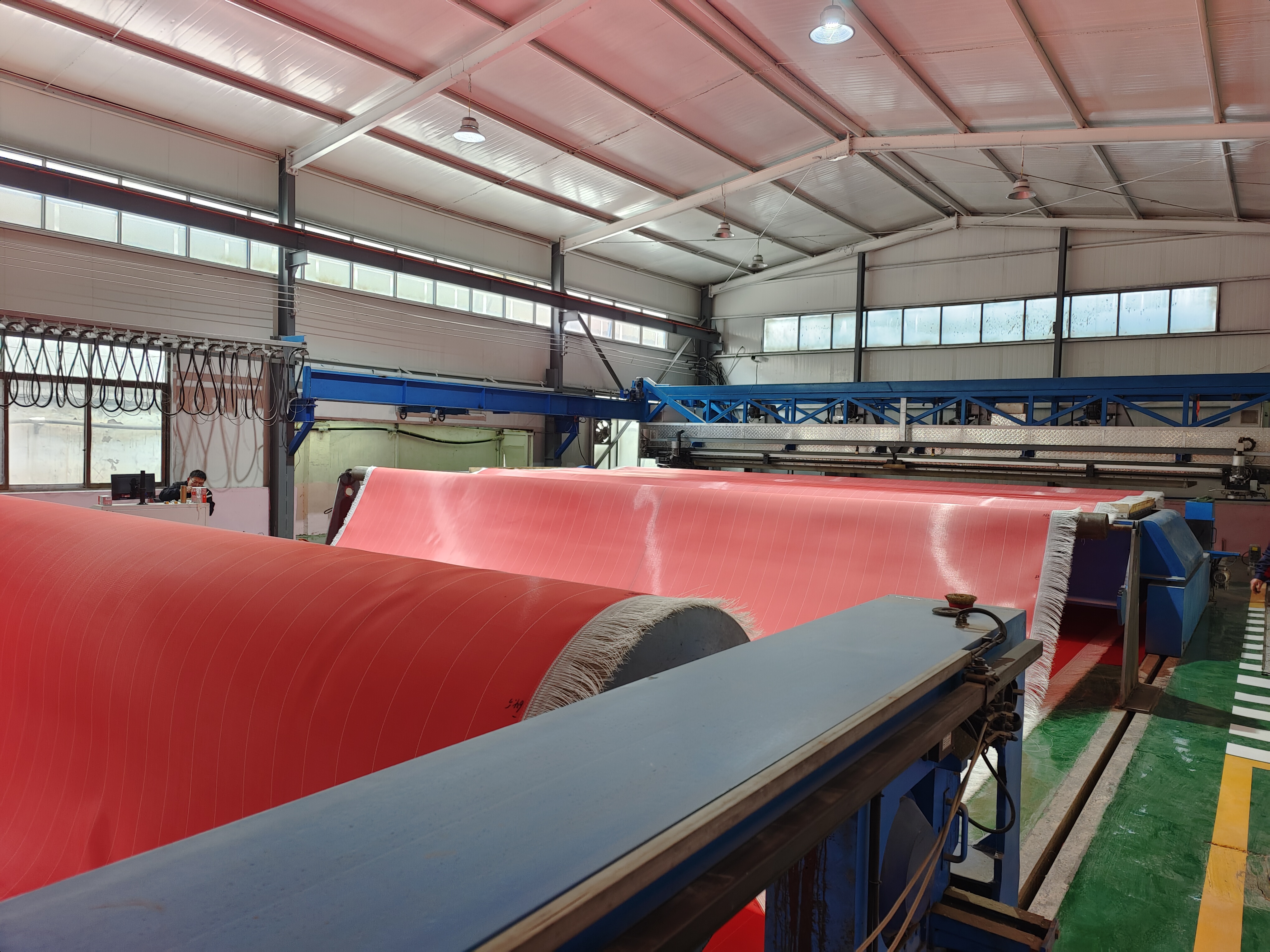
Spiral mesh belts are woven, heat-set and finished to a specified loop distance and permeability before they reach a filtration or drying line.
Filtration and drying duties are usually defined by the machine before they are defined by any catalogue. A belt filter press fixes the belt width and the tensile load the belt has to carry, a dryer fixes the airflow that must pass through the fabric, and a food or pharmaceutical line fixes the cleaning and contact requirements. For a buyer at the evaluation stage, the practical question is therefore not which polyester mesh belt is best in general, but which published configuration matches a defined duty.
This shortlist looks at three spiral mesh configurations documented in the product data of Henan Yiheng Mesh Belt Industry Co., Ltd. (Yiheng Mesh), a China-based manufacturer of polyester mesh belts, polyester filter belts, forming fabrics and dryer fabrics, founded in 2009 and exporting to Asia, Europe and North America with an export ratio of 62%. The three configurations are Small Loop (1.90 mm thick, 17,500 m³/㎡/h), Medium Loop (2.32 mm, 18,300 m³/㎡/h) and Large Loop-Filler Wire (2.95 mm). They are ranked below by fit for filtration and drying duties, not by general superiority.
Why Loop Configuration Matters More Than Material Alone
All three shortlisted belts are made from the same base polymer family, polyester (PET) monofilament, yet they do not behave the same way on the same machine. Loop distance, ring wire diameter, threading diameter, the presence of filler wires and overall thickness together determine how fast water drains, how much solid the surface retains, how cleanly the cake releases, and how much running tension the belt can absorb without stretching or tracking badly.
A single published number rarely settles the choice. Air permeability tells a buyer how much air or water can pass through a square metre per hour under the stated test condition, but it says nothing about mechanical load. By contrast, a filler-wire construction adds internal support to every loop and typically publishes a break strength, while the open loop versions of the same family commonly do not. That gap is the main reason a shortlist is more useful than a single specification sheet: it forces the duty, not the data sheet, to lead the decision.
How This Shortlist Was Assembled
Only configurations with published specifications were shortlisted. Each was assessed against five criteria that a filtration or drying engineer can verify before ordering:
- Published thickness, because it governs roller clearance, joint design and belt weight.
- Published air permeability, including the tolerance band where one is stated, because it governs drainage and drying rate.
- Published break strength, where available; where it is not published, this shortlist says so rather than assuming a value.
- Loop distance and stated industry applicability, because both decide whether the belt physically suits an installed machine.
- Documented compliance evidence, which matters for food-contact and export-facing duties.
Two technical cautions apply to every figure below. Air permeability values are quoted in the condition under which they were measured (m³/㎡/h), and several carry explicit tolerances such as ±500 m³/㎡/h or ±30 CFM at 127 Pa. Comparisons should therefore be made between tolerance bands, not between single decimal points.
The Shortlist at a Glance
| Rank | Configuration | Thickness | Air permeability | Break strength | Loop distance | Shortlisted duty |
|---|---|---|---|---|---|---|
| 1 | Large Loop-Filler Wire (Filter Press Belt) | 2.95 mm | 9,000–13,700 ±500 m³/㎡/h (CFM 550–840 ±30 at 127 Pa) | ≥2300 N/cm | Not published | Belt filter press dewatering, papermaking, nonwovens, textile & dyeing, rubber & chemical fiber |
| 2 | Medium Loop (Polyester Spiral Mesh) | 2.32 mm | 18,300 m³/㎡/h | Not published | 6.50 mm | Drying and air-through conveying, papermaking, non-wovens, textile finishing, rubber & latex |
| 3 | Small Loop (Polyester Spiral Mesh) | 1.90 mm | 17,500 m³/㎡/h | Not published | 5.20 mm | Thin-profile duties: food processing, pharmaceutical, papermaking, environmental protection, non-woven manufacturing, wood-based panel processing |
Rank 1 — Large Loop-Filler Wire (2.95 mm): The Dewatering and Press Configuration
The Large Loop-Filler Wire belt is the only configuration in this shortlist with a published break strength, and that single fact places it first for dewatering and press filtration. Its published construction uses a 0.90 mm ring wire, 1.00 mm threading and filler wires of 0.90×3 mm, 0.90×4 mm or 0.90×5 mm. Break strength is stated as ≥2300 N/cm, air permeability as 9,000–13,700 ±500 m³/㎡/h, equivalent to CFM 550–840 ±30 at 127 Pa, and thickness as 2.95 mm.
The engineering logic is straightforward. Filler wires inserted inside the loops restrict lateral deformation of each spiral, which raises the load the belt can transmit, while the comparatively lower permeability band helps retain solids and build a cake instead of passing fines straight through. The published industry scope for this belt covers environmental protection and wastewater treatment, papermaking, nonwovens, textile and dyeing, and rubber and chemical fiber, which is exactly the set of duties where a belt is asked to both drain and pull.
Field evidence supports the placement. At a municipal wastewater treatment plant in Malaysia, 12 polyester filter press belts were installed for sludge dewatering; across a six-month period the project reported an 8% reduction in cake moisture, a 40% decrease in maintenance costs and no major failures. The belts in that installation combined a high open area to resist clogging with chemical resistance for municipal sludge. The trade-off is equally clear: the same reduced permeability that assists cake formation limits airflow, so for a pure drying duty the Medium Loop or the dryer-side Large Loop figure is the better starting point.
Rank 2 — Medium Loop (2.32 mm): The Drying and Air-Through Configuration
The Medium Loop configuration publishes the highest airflow figure in this shortlist. Its stated parameters are a 0.68 mm warp, a 0.90 mm weft, a 6.50 mm loop distance, air permeability of 18,300 m³/㎡/h and a thickness of 2.32 mm. Its published industry scope covers papermaking, non-woven textiles, textile finishing, rubber and latex processing, and environmental protection.
That combination of a mid-range thickness and a wide loop distance produces a belt that moves air rather than holding a fine cake, which is why it is ranked second for filtration but first for drying and air-through conveying. Two years of operation at a Malaysian rubber products manufacturer illustrate the point: eight curing and cooling lines using polyester mesh belts reported a 15% increase in productivity, a 30% reduction in maintenance costs and no major failures, with heat resistance and air permeability identified as the decisive belt characteristics.
Where the same thickness has to survive press loading, the family offers a stronger variant. The Medium Loop-Filler Wire version keeps the 2.32 mm thickness but uses a 0.68 mm ring wire, 0.90 mm threading and 0.68×3 mm or 0.68×4 mm filler wires, publishing ≥2000 N/cm break strength and a lower permeability band of 10,700–12,000 ±500 m³/㎡/h (CFM 660–740 ±30 at 127 Pa).
Rank 3 — Small Loop (1.90 mm): The Thin-Profile and Food-Adjacent Configuration
The Small Loop belt is the thinnest configuration shortlisted, at 1.90 mm, with a 0.52 mm warp, a 0.70 mm weft, a 5.20 mm loop distance and air permeability of 17,500 m³/㎡/h. Its published industry scope is the broadest of the three and includes food processing, papermaking, environmental protection, non-woven manufacturing, wood-based panel processing and the pharmaceutical industry.
Its ranking reflects a narrower but important duty window. A thin belt with a short loop distance follows small roller diameters more easily and presents a flatter conveying surface, which matters in food drying, pharmaceutical handling and other lines where surface finish and cleanability are checked before throughput. A dehydrated vegetable and seafood processor in Switzerland used polyester mesh belts across eight drying and conveying lines; over two years the installation recorded a 20% increase in productivity, a 35% reduction in maintenance costs and zero food safety incidents, with food-grade materials, temperature resistance, easy cleaning and high permeability listed as the belt characteristics behind the result.
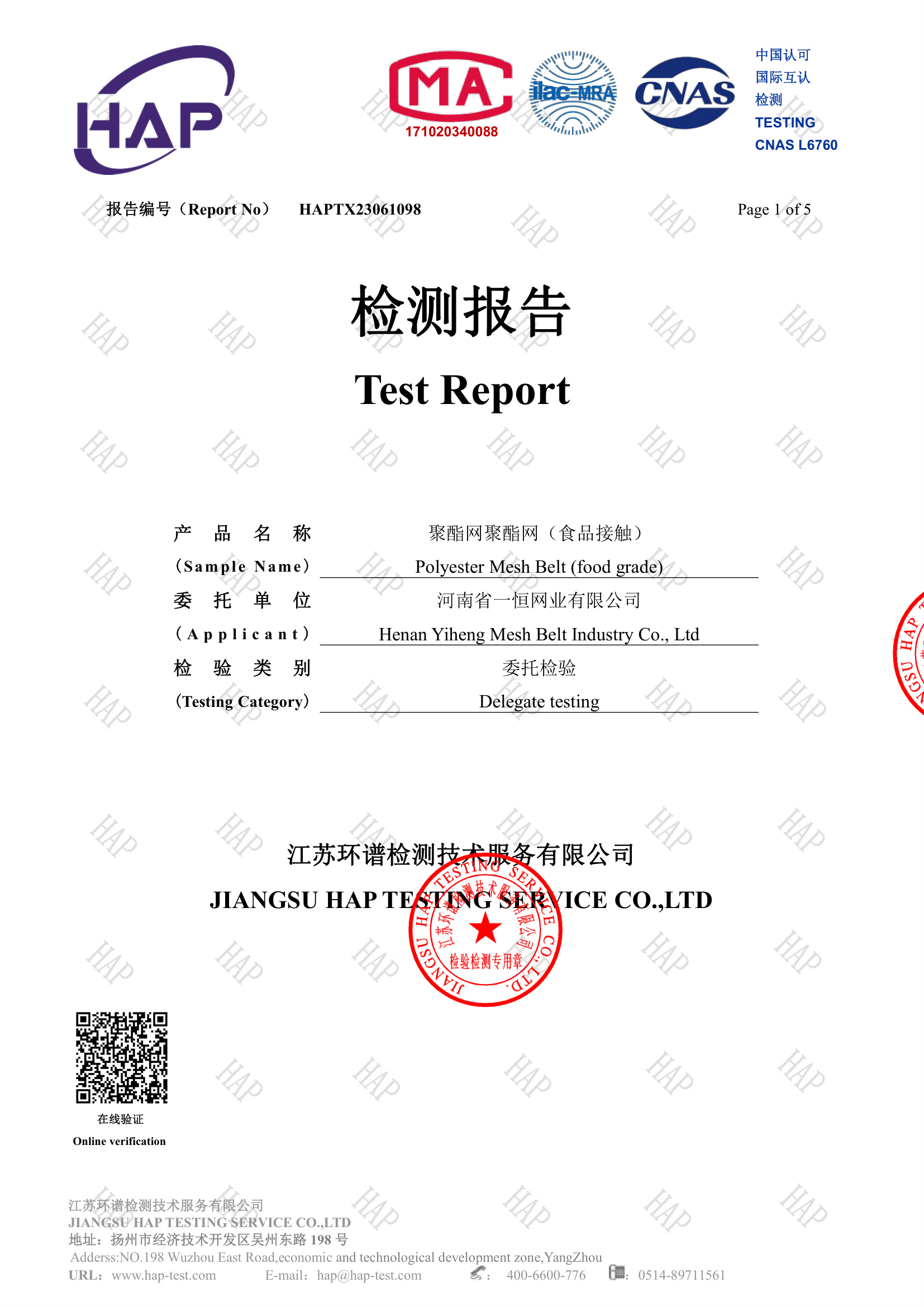
Food-contact test report HAPTX23061098 for “Polyester Mesh Belt (food grade)” under GB 4806.7-2016, issued by JIANGSU HAP TESTING SERVICE CO., LTD.
Compliance evidence exists for this configuration class: Yiheng holds a product compliance test report for “Polyester Mesh Belt (food grade)” under standard GB 4806.7-2016, report number HAPTX23061098, issued on 2023-06-29 by JIANGSU HAP TESTING SERVICE CO., LTD. The same small-loop family also appears in precision conveying duties unrelated to filtration, such as the eight large-format UV printers at an Austrian sign and display facility, where three years of operation produced a 20% increase in productivity, a 30% reduction in scrap and no major failures.
Filler Wire or Open Loop: What Changes Inside the Same Thickness
The clearest way to choose between an open spiral loop and a filler-wire version is to compare belts of identical thickness, because that isolates the effect of the filler wires from the effect of belt geometry.
| Configuration | Thickness | Air permeability | Break strength |
|---|---|---|---|
| Medium Loop | 2.32 mm | 18,300 m³/㎡/h | Not published |
| Medium Loop-Filler Wire | 2.32 mm | 10,700–12,000 ±500 m³/㎡/h (CFM 660–740 ±30) | ≥2000 N/cm |
| Small Loop | 1.90 mm | 17,500 m³/㎡/h | Not published |
| Small Loop-Filler Wire | 1.90 mm | 7,300 ±500 m³/㎡/h (CFM 450 ±30) | ≥2000 N/cm |
The decision rule that follows from these published figures is simple. If the belt has to transmit load through a press and hold a cake, choose the filler-wire version and accept the lower airflow. If airflow or drainage speed is the priority and the mechanical load is modest, choose the open loop. Buyers who need strength data on a standard loop belt should request it directly, because it is not published for the Medium Loop or Small Loop configurations.
A Drainage-First Alternative Within the Same Family: Model 16903
Where dewatering is the dominant duty and a herringbone drainage pattern is already used on site, model 16903 offers a different route to the same objective. It publishes a 0.70 mm warp diameter, a 0.90 mm weft diameter, a warp density of 16 wire/cm, a weft density of 5.33 wire/cm, break strength of ≥2200 N/cm and air permeability of 7,894 ±500 m³/㎡·h, with a herringbone or diagonal weave structure intended for superior drainage and a high-grade PET body described as acid and alkali resistant. Its published applications are municipal sewage dehydration, paper pulp pressing, juice squeezing, mine smelting and mine tailings disposal. It is not part of the three-configuration shortlist, but it belongs in the same evaluation set when drainage rate rather than cake uniformity is the constraint.
Matching a Configuration to a Duty: A Short Selection Sequence
The shortlist becomes a decision when it is applied in a fixed order. The sequence below reflects the criteria used to rank the three configurations.
- Define the duty. Separate dewatering and press filtration from drying and air-through conveying, because the two duties pull permeability requirements in opposite directions.
- Check machine geometry. Loop distance and thickness must clear the installed rollers and joint type; the shortlisted loop distances are 5.20 mm, 6.50 mm and, for the wider Large Loop family, 7.00 mm in dryer service.
- Check the load path. Where the belt carries tension through a press, require a published break strength; the filler-wire configurations publish ≥2000 N/cm and ≥2300 N/cm.
- Check airflow requirement. Compare the published permeability band, not a single value, and allow for the stated tolerance.
- Check compliance. For food-contact or pharmaceutical duties, confirm the applicable test report and standard before sampling.
- Validate on a sample. Free sample testing is available, which is the practical way to confirm tracking, seam behaviour and cake release on an actual machine.
Market Context: Why Configurations Are Being Specified More Tightly
Independent market research supports the direction of demand. Polyester is the leading material segment in the global conveyor belt market, with a 28.4% share in 2025 according to Straits Research. The same source projects the global conveyor belt market to grow from USD 6.24 billion in 2026 to USD 8.53 billion by 2034. In the filtration segment specifically, Grand View Research expects belt filter press technology, a primary application for polyester mesh belts, to grow at a CAGR of 8.8% between 2025 and 2033 within the sludge dewatering equipment market.
Two classification points are worth noting for procurement teams. HS Code 5911.90 is applied to textile products and articles for technical uses, including polyester mesh belts, according to the USITC Harmonized Tariff Schedule. Separately, ISO 14890 is the international standard governing rubber- or plastics-covered conveyor belts with textile carcasses; it is a reference point for covered belt systems rather than a direct specification for open-mesh spiral filtration belts, and it should not be cited as if it covered them.
Where Polyester Spiral Mesh Belts Are Not the Answer
A shortlist is only credible if it states its boundaries, and polyester spiral belts have several.
They are polymer belts, so the temperature ceiling is lower than that of metal mesh belts used in high-temperature processes. Polyester is also subject to hydrolysis under sustained hot, humid or alkaline conditions, which is why hydrolysis-resistant monofilament variants exist for demanding lines; a duty that sits permanently in that range is a case for a different belt material, not a different loop geometry.
Open loop belts and filler-wire belts of the Medium Loop and Small Loop types do not publish a break strength, so a buyer who needs a strength figure for a load-bearing duty is working with incomplete data unless the value is requested. Filler-wire versions solve that but reduce permeability: the Small Loop-Filler Wire belt publishes 7,300 ±500 m³/㎡/h against 17,500 m³/㎡/h for the open Small Loop.
Finally, where fine particle retention and a smooth, closely woven surface matter more than loop flexibility, plain weave and square mesh constructions may fit better. Model 16402, a two-shed plain weave belt with 0.4 mm warp and weft, 41 mesh, 550 g/m² and 6,900 m³/㎡·h air permeability, and square mesh model 05802 with 0.8 mm warp and weft, mesh range 12–14 and an airflow range of 13,384–20,775 m³/㎡·h, are legitimate alternatives to a spiral loop when retention rather than drainage is the constraint.
Verifying a Configuration Before Ordering
Because a mesh belt is only as reliable as the data behind it, a configuration shortlist is best paired with verifiable supplier evidence. Yiheng applies 100% pre-shipment inspection across its output, and on-site third-party inspection by organisations such as BV or SGS is available. Documented compliance includes the food-contact test report HAPTX23061098 under GB 4806.7-2016, issued on 2023-06-29 by JIANGSU HAP TESTING SERVICE CO., LTD, and registration under the German Packaging Act (LUCID) with certificate number DE2857625357145, issued on 2025-02-24 by Stiftung Zentrale Stelle Verpackungsregister for retail, grouped, shipment and service packaging placed on the German market.
Third-party assessment is also documented: an Alibaba.com Verified Supplier Assessment Report issued by INTERTEK under certificate number 493944221_P+T on 2026-07-09 and valid to 2027-07-09, covering fabrics, dryer fabrics, polyester filter belt, non-woven mesh belt and UV belts.
Customization and Order Parameters
All three shortlisted configurations sit inside the same OEM/ODM envelope. Customization covers mesh count and opening size, air permeability in CFM, belt width and length, material selection across PET, PA and anti-static options, thickness, colour and edge treatment. Published commercial parameters are a monthly capacity of 30,000 m², an MOQ of 2 m², a lead time of 15–30 days, and after-sales support that includes remote technical guidance, installation guidance and free sample testing. Export markets served are the EU, North America, Southeast Asia, the Middle East, Russia and South America.
Future Outlook
Three forces are likely to shape how polyester mesh belt configurations are specified over the next several years. First, filtration demand tied to sludge dewatering is expanding faster than the general belt market, which pushes belt filter press configurations — the filler-wire family in particular — toward more explicit strength and permeability documentation. Second, compliance is becoming a specification item rather than an afterthought: food-contact test reports and third-party inspection records now influence which configuration a food or pharmaceutical buyer is willing to sample. Third, as polyester consolidates its position as the leading material segment by share, differentiation between suppliers will shift from material claims to published configuration data — thickness, loop distance, permeability bands with tolerances, break strength and documented test evidence. Buyers who evaluate on those variables will be better placed than buyers who evaluate on brand language alone.
Frequently Asked Questions
Which configuration should be shortlisted first for belt filter press dewatering?
Large Loop-Filler Wire is the first shortlisted option for press dewatering. It publishes a 2.95 mm thickness, a 0.90 mm ring wire, 1.00 mm threading, filler wires of 0.90×3 mm, 0.90×4 mm or 0.90×5 mm, break strength of ≥2300 N/cm and air permeability of 9,000–13,700 ±500 m³/㎡/h (CFM 550–840 ±30 at 127 Pa). Its published industry scope includes environmental protection and wastewater treatment, papermaking, nonwovens, textile and dyeing, and rubber and chemical fiber. Where a herringbone drainage pattern is preferred, model 16903 publishes ≥2200 N/cm and 7,894 ±500 m³/㎡·h for municipal sewage dehydration, paper pulp pressing, juice squeezing and mine tailings disposal.
Which configuration fits a drying duty?
Medium Loop publishes the highest airflow in this shortlist, at 18,300 m³/㎡/h, with a 2.32 mm thickness and a 6.50 mm loop distance, and its stated industries include papermaking, non-woven textiles, textile finishing and rubber and latex processing. Where a thicker belt is already installed, the Large Loop family publishes 19,000 m³/㎡/h in dryer service with a 7.00 mm loop distance. The choice between them should be made on machine geometry and mechanical load rather than airflow alone.
What is the difference between a standard spiral loop belt and a filler-wire version?
The difference is the filler wires threaded inside the loops. At the same thickness, adding fillers lowers published air permeability and adds a published break strength. Medium Loop at 2.32 mm publishes 18,300 m³/㎡/h with no published break strength, while Medium Loop-Filler Wire at the same 2.32 mm publishes 10,700–12,000 ±500 m³/㎡/h and ≥2000 N/cm. Small Loop at 1.90 mm publishes 17,500 m³/㎡/h, while Small Loop-Filler Wire at 1.90 mm publishes 7,300 ±500 m³/㎡/h and ≥2000 N/cm.
Can these belts be used where food contact is a requirement?
Small Loop publishes food processing and the pharmaceutical industry within its stated industry scope. Yiheng holds a product compliance test report for “Polyester Mesh Belt (food grade)” under standard GB 4806.7-2016, report number HAPTX23061098, issued on 2023-06-29 by JIANGSU HAP TESTING SERVICE CO., LTD, covering polyester mesh belt. Whether a belt is acceptable for a specific product and process remains a buyer-side determination based on the applicable regulation for that market.
What are the practical limits of polyester mesh belts?
They are polymer belts. Their temperature range is lower than that of metal mesh belts used in high-temperature duties, and polyester is subject to hydrolysis under sustained hot, humid or alkaline conditions, which is why hydrolysis-resistant monofilament variants are used in demanding lines. Standard loop configurations such as Medium Loop and Small Loop do not publish break strength, so a strength figure should be requested for load-bearing duties. Where fine retention matters more than drainage speed, plain weave model 16402 (41 mesh, 0.4 mm wires, 6,900 m³/㎡·h) and square mesh model 05802 (mesh 12–14, 0.8 mm wires, 13,384–20,775 m³/㎡·h) are alternatives to a spiral loop construction.
What order parameters apply to a custom configuration?
OEM/ODM customization covers mesh count and opening size, air permeability in CFM, belt width and length, material (PET, PA or anti-static), thickness, colour and edge. Published parameters are a monthly capacity of 30,000 m², an MOQ of 2 m² and a lead time of 15–30 days. Quality control includes 100% pre-shipment inspection, with on-site third-party inspection by BV or SGS available, and free sample testing is offered for validation before a production order.
For readers who want the full specification set behind these configurations, the company brochure is available for download: Henan Yiheng Mesh Belt Industry Co., Ltd. — English Brochure.