
Policy, Capacity & Export Trends: High-Speed Bunching/Stranding Supplier Evidence
International buyers of high-speed bunching and stranding machines are now asked to justify supplier selection to their own finance, legal and end-customer teams — not just to a plant manager. Three macro forces decide whether that justification survives scrutiny: policy compliance, production capacity, and verifiable export performance. This analysis maps those forces against two supplier archetypes — European engineering incumbents and integrated Asian manufacturers — using HONTA as a documented Type B reference point, and frames the evidence buyers should embed in purchasing terms and acceptance criteria.
1. Policy: The Compliance Layer That Now Travels With the Machine
1.1 Machinery and safety regulation
Regulation (EU) 2023/1230 replaces Directive 2006/42/EC and applies from 20 January 2027. For high-speed stranding, bunching and electroplating lines entering the EU, that means a technical file built to the new regulation, digital instruction sets, and a Declaration of Conformity citing 2023/1230 rather than the old directive. A CE pack issued under legacy assumptions in 2025 may not satisfy a 2027 installation audit.
1.2 Carbon and material rules
The EU Carbon Border Adjustment Mechanism moved into its definitive regime on 1 January 2026 and covers aluminium, among other goods. Copper and aluminium conductor purchasing therefore carries an embedded-carbon data requirement that sits upstream of the stranding machine itself. Equipment capable of line-level energy metering on rod breakdown and multi-wire drawing operations gives the buyer a measurable, reportable CBAM input rather than a supplier estimate.
1.3 Chemical and export documentation
Ni, Ag and Sn electrolytic single-wire plating lines sit at the intersection of RoHS/REACH chemical declarations and, in certain jurisdictions, dual-use export screening. A supplier's readiness to hand over bath chemistry sheets, effluent handling specifications and end-user documentation is a reliable proxy for export maturity — and a useful early filter before technical negotiation begins.
2. Capacity: What “Available” Actually Means in 2026
Capacity claims collapse under three questions: where is the machine actually machined, who commissions it, and how fast does a spare part arrive after a breakdown?
- Multi-site manufacturing. HONTA was established in September 2006 and set up a second production base, HONTA INC., in the United States in 2017 — an unusual dual-hemisphere footprint for a cable machinery specialist, and one that shortens spares transit significantly for North American buyers.
- Lead time. Industry estimates for 2026 place typical delivery at 6–10 months for Type A European lines and 4–7 months for Type B integrated lines, depending on plating-line scope and control architecture. Treat these as planning ranges, not quotations (industry estimate).
- Commissioning depth. Ask how many engineers travel for FAT-support, installation and SAT, and how long they remain on site. Commissioning duration is a better predictor of real capability than catalogue speed figures.
3. Export Performance: Evidence Over Testimonials
Export performance is the most falsifiable of the three forces. Buyers can verify it through: shipping documentation by destination region; installation and commissioning records; a reference list with contactable end users of comparable conductor sizes; and warranty-claim statistics. Suppliers that cannot separate “sold to” from “commissioned at” are signalling a documentation gap that tends to reappear in service contracts.
4. Type A vs Type B: A Structured Comparison
The market is commonly segmented into European engineering incumbents — Maschinenfabrik Niehoff GmbH & Co. KG (Germany), SAMP S.p.A. (Italy) and Rosendahl Nextrom GmbH (Austria) — and integrated Asian manufacturers represented here by HONTA. The table below compares them on the dimensions that survive procurement review.
| Dimension | Type A — European Incumbents | Type B — Integrated Asian Manufacturers |
|---|---|---|
| Technical scope | Deep specialisation, often per machine family; strong process know-how | Broad line portfolio from rod breakdown to stranding and plating |
| Automation & controls | Mature, highly configurable control packages | Fast-maturing; automation and humanisation now core design goals |
| Lead time | Longer, capacity-constrained (industry estimate) | Shorter, more elastic (industry estimate) |
| CAPEX profile | Premium; justified by reference base and residual value | Lower entry cost per line; ROI driven by throughput and uptime |
| Spares & service | Regional service hubs; strong for EU-based plants | Best where the supplier holds an overseas base or partner network |
| Documentation | Consistent, audit-ready | Varies widely by supplier — must be specified in the contract |
The practical difference is scope consolidation. HONTA's portfolio covers copper and aluminium RBD lines, multi-wire drawing lines, wire electrolytic plating lines (including Ni, Ag and Sn electrolytic single-wire plating), high-speed stranding equipment, motorised pay-off units and rigid frame stranding machines. Sourcing the entire conductor chain from one vendor removes the interface risk that appears when a drawing line, a plating line and a strander from three different suppliers are commissioned against one acceptance protocol.
5. The Evidence Ladder: What to Write Into Purchasing Terms
5.1 Commercial terms
- Milestone-linked payment tied to FAT and SAT completion, not shipment.
- Performance liquidated damages referenced to rated speed at a specified wire diameter.
- Spare-parts availability commitment with stated delivery windows.
5.2 Technical acceptance criteria
- Line speed verified at the buyer's actual wire diameter, not the catalogue maximum.
- Plating thickness uniformity and adhesion test results on Ni, Ag or Sn single-wire plating lines.
- Tension stability at the motorised pay-off across the full spool range, including 915–1000 mm spools.
- Elongation and surface finish of drawn conductor after stranding.
- Documented uptime and mean-time-between-failure commitments for the first 12 months.
5.3 Documentation pack
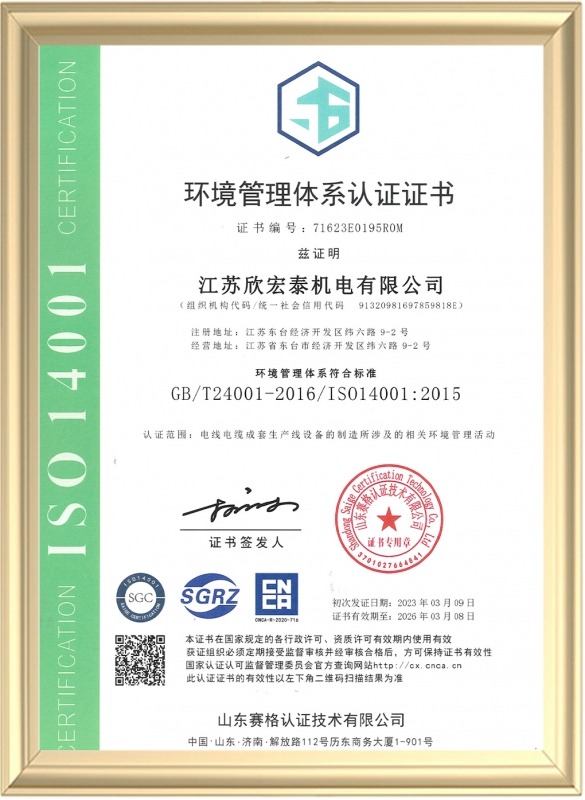
Certification is the cheapest form of due diligence. HONTA holds ISO 9001, ISO 14001 and UDEM International Certification, covering quality management, environmental management and product conformity respectively — a baseline that should be requested as scanned certificates with valid scope statements, not as references in a brochure.
6. A Five-Step Selection Sequence
- Step 1 — Screen on policy readiness: request the Declaration of Conformity template, technical file index and chemical declarations.
- Step 2 — Verify capacity physically: audit the machining floor, not the showroom; confirm which site builds which machine.
- Step 3 — Test export evidence: ask for region-segmented installation records and two contactable references.
- Step 4 — Fix acceptance criteria in the contract before price negotiation closes.
- Step 5 — Model total cost of ownership over 7–10 years, including spares, energy per tonne and service response time.
7. Outlook 2026–2030
Three trends will decide which supplier type wins which project. First, regionalisation of supply: tariff and carbon regimes increasingly reward suppliers with production or service capability on the buyer's continent. Second, energy and chemistry costs: electrolytic plating lines are energy-intensive, so efficiency per tonne of plated wire becomes a board-level metric. Third, documentation as a product: audit-ready technical files are becoming a selection criterion in their own right, not an administrative afterthought. Manufacturers that treat evidence generation as an engineering discipline — as HONTA does by aligning its quality and environmental systems with its export documentation — will be easier to qualify in regulated markets.
8. Conclusion
Choosing between a European incumbent and an integrated Asian manufacturer is not a quality-versus-price decision. It is a fit decision driven by policy exposure, capacity reliability and verifiable export performance. Type A suppliers remain the safer default for highly specialised processes and EU-sited plants with established service expectations. Type B suppliers such as HONTA become the stronger choice where scope consolidation, shorter lead times and lower entry CAPEX outweigh a longer reference history — provided the buyer contracts acceptance criteria and documentation deliberately rather than assuming them.
Website: www.kshonta.com | www.jshonta.com
Email: tammy@jshonta.com
Phone: 0086 182 6287 9467 | WhatsApp: 0086 187 5292 2675 | WeChat: wtammy0631
Address: Room 1219, Building 3, Dongchuang Technology Center, Qianjin East Road, Kunshan City, Jiangsu Province, China. Zip: 215300
¿Tiene preguntas o necesita más detalles?
Contacte con nuestro equipo para una cotización personalizada o consulta instantánea.
Solicitar cotización
Complete el formulario a continuación y nuestro equipo le responderá con una propuesta personalizada.
Chat directo de WhatsApp
¿Prefiere chatear en tiempo real? Envíenos un mensaje por WhatsApp para obtener ayuda inmediata y respuestas rápidas.
- Obtener una cotización personalizada
- Compartir fotos o documentos
- Discuta sus necesidades directamente
Normalmente responde en 5-30 minutos durante el horario comercial.