
Plastic Tote Compliance for Food Contact and ASRS Automation
Plastic Tote Compliance for Food Contact and ASRS Automation
An industry reference on how food contact suitability and automation qualification are evaluated together before plastic totes are approved for automated warehouse, cold chain, and fresh food operations.
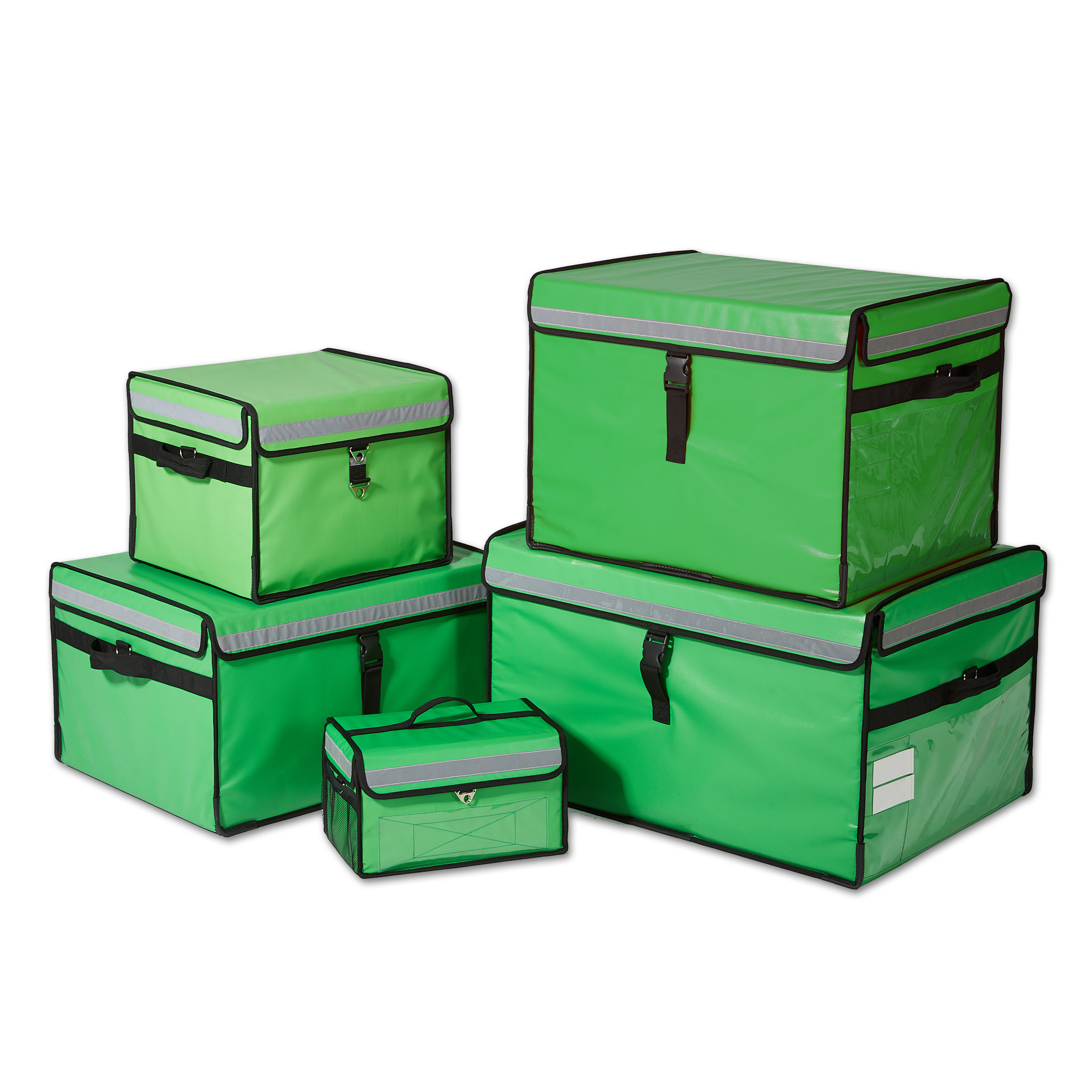
Insulated PP packaging sits at the intersection of two compliance systems: food contact safety and automated handling.
Two Approval Chains, One Container
The global plastic totes and bins market was valued at USD 8.6 billion in 2025 and is projected to reach USD 14.2 billion by 2034, according to Dataintelo. That expansion is not primarily a story about storage. It reflects warehouses in which totes are handled automatically, by mini-load ASRS cranes, shuttle systems, conveyors, and AMR and AGV fleets, and food, pharmaceutical and cold chain networks in which the same families of containers move through hygiene-sensitive flows. Precedence Research attributes the rapid growth of the mini-load ASRS segment specifically to demand for fast retrieval of small parts, totes, and bins in e-commerce.
When those two worlds meet, a plastic tote must satisfy two different approval chains at the same time. The first is food safety: material composition, food contact suitability, cleanability, and hygienic design. The second is equipment compatibility: dimensional accuracy, wall straightness, structural rigidity, base flatness, and predictable behaviour on conveyors and inside crane bays. A container that fails the first chain creates contamination and compliance exposure. A container that fails the second creates jams, mis-picks and unplanned downtime, and that failure typically surfaces long after the purchase order has been signed.
For buyers at the awareness and research stage, the practical question is not which tote is cheapest. It is which tote can be qualified twice: once against the food or product it will carry, and once against the machine that will move it.
What Food Contact Suitability Actually Requires
Food contact suitability is not a property of a resin grade alone. It is a property of the finished article: base polymer, additives, colorants, surface finish, geometry, and the cleaning regime the container will face in service. Two totes moulded from the same polypropylene compound can therefore have different food contact standing if their formulations, processing or intended use differ.
In the portfolio of Shanghai Xinfan Industrial Corporation(TSS), a manufacturer established in 2003 that specialises in integrated logistics packaging and cargo security solutions with main products including plastic totes, insulated boxes illustrate how model-level documentation matters. The TSS-XPS is an insulated box with a 30 litre volume, made of PP with an extruded polystyrene core, and it is described in the company’s product documentation as suitable for food contact and cold chain transport. The TSS-EPP is a 60 litre expanded polypropylene insulated box made of PP and intended for cold chain applications. Both are insulated cold chain products, but they are not interchangeable: capacity, construction and the documented use case differ, and each model carries its own qualification profile.
Polypropylene is the dominant material in this category for a reason. Future Market Insights expects PP to lead the material segment for plastic crates with a 41.4% share by 2025, reflecting its balance of rigidity, chemical resistance, cleanability and recyclability. From a qualification perspective, that balance is what makes PP workable for both food-facing and automation-facing duties.
In practice, food-facing qualification for a reusable tote usually involves four evidence layers that buyers should be able to name explicitly:
- Material composition statement — the polymer and additive system declared for the specific model.
- Food contact declaration — a supplier letter of guarantee or declaration of compliance covering the declared formulation and intended use.
- Migration or migration-simulation test evidence where the applicable market framework requires it for the intended food type and contact conditions.
- Traceability and production controls — the information that allows a delivered batch to be linked back to the declared specification.
Cleanability belongs in the same discussion. Food-facing containers are typically specified with easy-to-clean surfaces, hygienic packaging design and moisture resistance so that wash-down and reuse do not degrade the contact surface. That is a design property, not a certificate, and it is best confirmed by inspecting the actual geometry: radiused corners, drainage behaviour, and the absence of crevices that retain product residue.
Qualifying a Tote for ASRS, AMR and AGV Handling
Automation qualification is an engineering exercise with a documentary output, not the other way round. The physical requirements are well established in automated storage environments: high dimensional accuracy for automation compatibility, sufficient load capacity and structural rigidity, and smooth, repeatable operation on conveyors and shuttle systems over a long service life in high-density storage.
A 600 × 400 mm footprint is a common starting point, but the nominal size is only the entry ticket. Three product families from the same manufacturer show how the requirement splits:
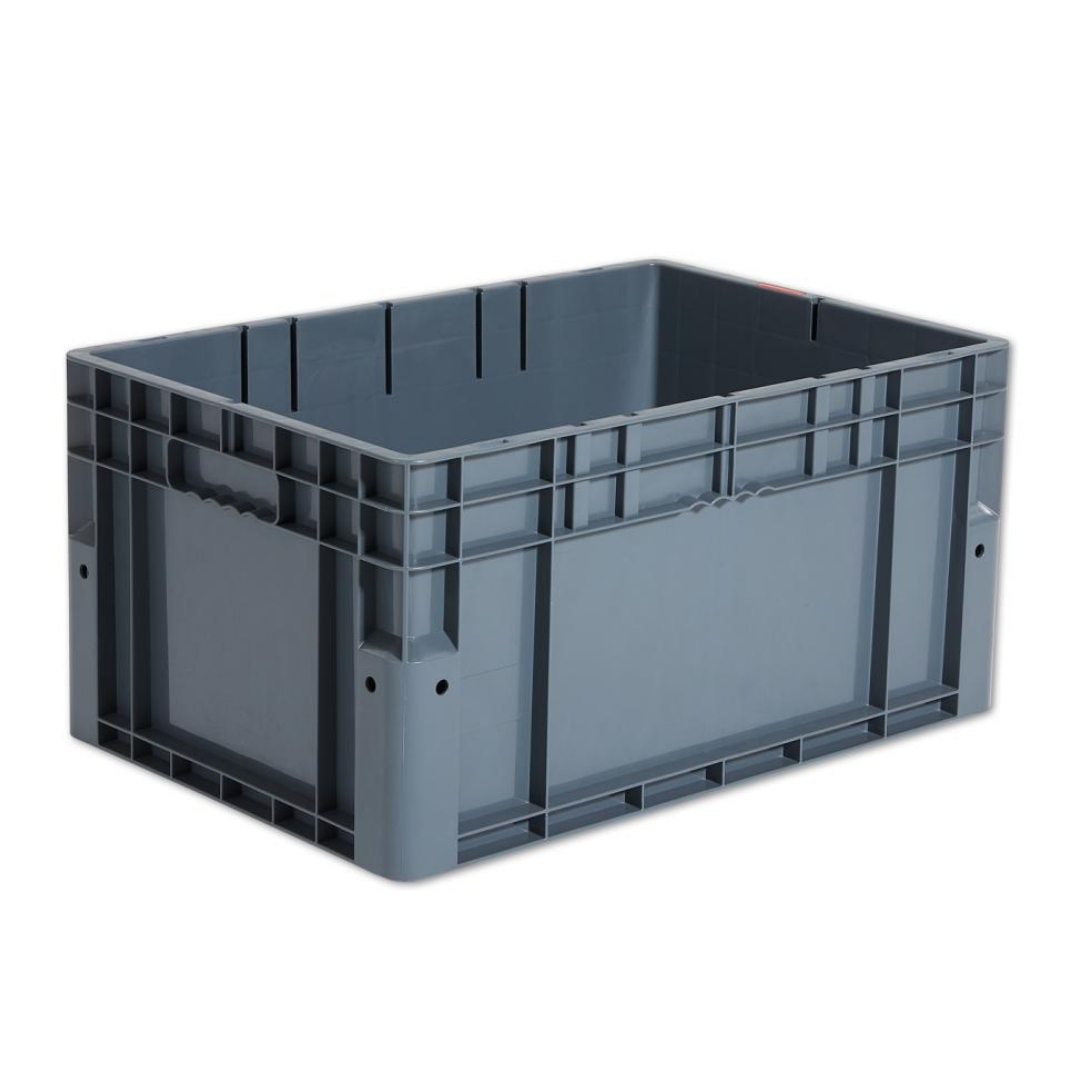
Wall-straight geometry is specified when shuttle bay insertion and side-guided conveyor travel must remain repeatable over millions of cycles.
- TSS-IFC — wall straight plastic crate. Made of PP with external dimensions of 600 × 400 × 300 mm, classified as a wall straight crate and intended for the warehouse automation industry, including ASRS applications. Straight, non-tapered walls are the reason this geometry is preferred where side guidance and bay insertion repeatability matter.
- TSS-IFD — foldable plastic crate. Made of PP, 600 × 400 × 300 mm, designed for use in ASRS systems and warehouse automation. Its specific advantage is return logistics: in the foldable crate application profile, empty storage volume can be reduced by up to 70–80%, which lowers return transport cost when containers move back through a closed loop.
- TSS-TBX — attached lid stackable plastic tote. Made of PP with overall dimensions of 600 × 400 × 320 mm. The attached lid provides secure storage, and the company notes that the standard dimensions make the model suitable for automated warehouse systems.
The broader reusable tote range, designated model TSS, spans 600–800 mm in length, 400–600 mm in width and 128–400 mm in height in polypropylene, and is intended for the warehouse automation industry. That dimensional span exists because not every station in an automated facility uses the same container: goods-to-person picking stations, buffer lanes and dispatch areas may each justify a different footprint within the same handling envelope.
Where automation hands back to people, tote dollies close the loop. The light type TSS-Trolley-5737 measures 570 × 370 mm and the heavy type TSS-Trolley-02 measures 577 × 377 mm; both are nested and stackable PP units intended for warehouse storage and logistics environments. They are not part of ASRS qualification, but they determine whether the manual interface around the automated zone runs at the same pace.
Because automation compatibility requirements differ between integrators, this is also where the most common procurement mistake sits: treating a nominal dimension as a qualification. The tolerance stack of the conveyor guide rails, the crane fork geometry, the shuttle bay clearance and the barcode or RFID read position must be validated with physical samples in the actual system before a model is released for volume ordering.
How the TSS Portfolio Maps to Both Approval Chains
Shanghai Xinfan Industrial Corporation(TSS) is a manufacturer established in 2003 with a 40,000 square metre manufacturing facility, approximately 320 staff and an annual production capacity of 3,600,000 units, supported by an R&D team of 25 engineers. Its stated customer base covers logistics, retail, manufacturing, e-commerce, cold chain, pharmaceutical and transportation industries, with exports to the EU, North America, South America, Southeast Asia, the Middle East and Africa.
The relevance to this topic is structural rather than promotional. The portfolio is organised so that automation-facing and food-facing requirements can be matched to different models rather than assumed across a single universal container.
| Model | Type | Material | Key dimensions | Primary qualification focus |
|---|---|---|---|---|
| TSS-IFC | Wall straight plastic crate | PP | 600 × 400 × 300 mm | ASRS dimensional accuracy and wall straightness |
| TSS-IFD | Foldable plastic crate | PP | 600 × 400 × 300 mm | ASRS use plus return-logistics volume reduction |
| TSS-TBX | Attached lid stackable tote | PP | 600 × 400 × 320 mm | Secure storage, standard dimensions for automated systems |
| TSS reusable totes | Reusable plastic tote range | PP | 600–800 mm L × 400–600 mm W × 128–400 mm H | Envelope matching across warehouse automation stations |
| TSS-EPP | Expanded polypropylene insulated box | PP | 60 L capacity | Cold chain thermal protection |
| TSS-XPS | Insulated box with extruded polystyrene core | PP | 30 L volume | Food contact suitability and cold chain transport |
| TSS-RBTB | Nest and stack plastic crate | PP | 600 × 400 × 300 mm | Fruit and vegetable transport, retail and supermarket flows |
| TSS-SFD | Collapsible plastic crate | PP | 600 × 400 × 225 mm | Produce handling with collapsed return transport |
| TSS-BBOX-01 | Plastic stackable bin with panels and dividers | PP | 604 × 398 × 208 mm | Internal storage of footwear and spare parts |
Table note: product specifications are stated as published by the manufacturer. Qualifying a specific model for a specific food type or a specific ASRS installation requires model-level documentation and, where relevant, physical validation in the target system.
Read as a procurement map, the table separates three risk profiles. The automation-facing models are qualified mainly on geometry and repeatability. The insulated boxes are qualified mainly on thermal performance and food contact suitability. The produce and retail models are qualified mainly on hygiene, ventilation and closed-loop return behaviour. A buyer who applies one qualification script to all three groups will either over-specify or miss a requirement.
Where These Containers Are Actually Qualified and Used
Cold chain and temperature-controlled distribution. Insulated PP boxes operate as passive temperature control systems: they maintain temperature without external power, working with gel packs, PCM packs, ice packs or dry ice depending on the required band. The relevant temperature ranges in the cold chain application profile are +15 °C to +25 °C for pharmaceuticals and medical devices, +2 °C to +8 °C for vaccines, biologics and insulin, 0 °C to +5 °C for fresh produce, dairy and seafood, and −25 °C to −15 °C for frozen foods and biological samples. Temperature data loggers, RFID tracking and tote dollies are typically used alongside the container. This is where the food contact question and the temperature question converge, and it is why insulated box models such as TSS-XPS are documented with a specific food contact statement rather than a general claim.
Fresh produce and retail distribution. Produce flows place a different set of demands on the container: food-grade materials, easy-to-clean design, ventilated sidewalls and base, moisture resistance, and cold chain compatibility. In the applicable fresh produce scenario, TSS-SFD collapsible crates at 600 × 400 × 225 mm and TSS-RBTB nest-and-stack crates at 600 × 400 × 300 mm are used for fruit and vegetable transportation in retail and supermarket environments, with selected models also usable directly for retail display. Empty containers nest or collapse for efficient backhaul, which is the operational reason these formats survive in closed-loop pooling.
Automated fulfillment and e-commerce. In goods-to-person and mini-load environments, containers move through shuttle systems, roller and belt conveyors and sortation, and interact with robotic picking stations, AGVs and AMRs. Foldable crates such as TSS-IFD and wall-straight crates such as TSS-IFC exist because this environment rewards two different things: return-volume efficiency on one hand, and dimensional stability on the other.
Internal logistics and spare parts. Stackable bins with panels and dividers, such as TSS-BBOX-01 at 604 × 398 × 208 mm, sit outside both food contact and ASRS qualification but follow the same logic: the container is specified against the workflow, not against a generic size chart.
Market Signals Behind the Compliance Focus
- Dataintelo values the global plastic totes and bins market at USD 8.6 billion in 2025, with a projected USD 14.2 billion by 2034, indicating sustained substitution of disposable packaging by returnable formats.
- The same source reports that stackable totes held the largest product type share at 34.2% in 2025, which aligns with stacking density being a primary driver in both storage and automated handling.
- Grand View Research places Asia Pacific at a 41.6% revenue share of the global plastic pallets, crates and boxes market in 2025, consistent with the region’s concentration of container manufacturing and export flows.
- Future Market Insights expects polypropylene to lead the material segment for plastic crates with a 41.4% share by 2025, which matters because material choice directly determines which food contact and cleaning regimes are feasible.
- Grand View Research identifies reusable plastic container adoption in fresh produce logistics, citing the Walmart and IFCO partnership as a major industry trend in North America.
- Market Research Future lists Brambles (CHEP), Schoeller Allibert, ORBIS Corporation and Myers Industries among the major global participants in the returnable plastic packaging market, alongside specialist manufacturers serving automation and cold chain segments.
The common thread is documentation. As returnable containers move from cost-saving accessories to core system components, the qualification file attached to a tote becomes part of the warehouse specification, not an appendix to it.
Comparison with Traditional Solutions — and the Boundaries of Certification
Reusable PP containers are not universally superior to every alternative. The comparison below sets out where each format fits, and where its compliance profile stops.
| Format | Where it performs well | Boundary to plan for |
|---|---|---|
| Wall-straight PP crate (TSS-IFC) | Dimensional stability for ASRS, shuttle and side-guided conveyor travel | Does not collapse; empty return volume is higher than a foldable format |
| Foldable PP crate (TSS-IFD) | Return logistics; empty volume reduction of up to 70–80% in the foldable application profile | Hinges and joints add cleaning and inspection points compared with one-piece wall-straight geometry |
| Attached lid tote (TSS-TBX) | Secure storage and transport with standard dimensions noted as suitable for automated systems | Larger overall height at 320 mm; the lid is an additional component to inspect and maintain |
| Insulated PP box (TSS-EPP, TSS-XPS) | Passive temperature protection for cold chain and last-mile distribution | Passive only: it does not replace a validated temperature-controlled shipping system where regulatory qualification of the whole lane is required |
Beyond format differences, five boundaries are worth stating plainly, because buyers who ignore them tend to discover them during commissioning:
- There is no single global certificate for a plastic tote. Food contact frameworks, automation tolerances and pooling requirements are market- and system-specific. A document accepted in one market may not satisfy another.
- A declaration is not a batch certificate. A declaration of compliance typically covers the declared formulation and intended use. Batch-level conformity depends on production controls and, in some cases, batch testing.
- Food contact status is model-specific. Within one manufacturer’s range, an insulated box such as TSS-XPS may be documented as suitable for food contact while other models carry different intended uses. The statement does not automatically extend across a portfolio.
- Automation qualification is installation-specific. A 600 × 400 mm container is not automatically ASRS-qualified. The integrator’s conveyor, crane and shuttle tolerances must be validated with samples.
- Service life is finite. Repeated handling, cleaning chemicals and low-temperature cycling affect PP components over time, so requalification or replacement thresholds should be defined in the maintenance plan rather than assumed.
Buyer Qualification Checklist
The following items convert the discussion above into a practical research-stage checklist for a tote procurement project that spans food contact and automation:
- Define the food type, contact conditions and cleaning regime before requesting samples.
- Request the material composition statement and the food contact declaration for the exact model, not the product family.
- Confirm whether migration test evidence is required for the intended market and application.
- Inspect the physical cleaning geometry: corners, base drainage, and crevices on hinged or foldable models.
- Obtain the certified drawing with dimensional tolerances, not a marketing dimension list.
- Verify wall straightness and base flatness against the ASRS, shuttle or conveyor interface.
- Confirm the container’s behaviour on side-guided conveyors and inside shuttle bays using a physical trial.
- Check barcode or RFID placement and read reliability at the automation speed actually used.
- Clarify the stacking pitch and lid height where mixed-model stacking occurs in a store or buffer lane.
- Agree traceability expectations: what identifies the batch, and what documentation accompanies each delivery.
Future Outlook
Three developments are likely to shape how plastic totes are qualified over the next several years. The first is the continued expansion of mini-load ASRS and AMR-based handling, which will keep pushing tolerance requirements from a supplier-side conversation into a system-integration contract. Precedence Research already frames mini-load growth around the retrieval of small parts, totes and bins in e-commerce, and that pressure will be passed down to container specifications.
The second is documentation itself. As returnable packaging pools scale, as Grand View Research observes in fresh produce logistics, the container file increasingly needs to travel with the asset: model-level declarations, batch traceability and, for food-facing items, market-specific evidence. Manufacturers with in-house engineering resources, such as the 25-engineer R&D team and 40,000 square metre facility at Shanghai Xinfan Industrial Corporation(TSS), are positioned to respond to model-specific documentation requests rather than issuing generic statements.
The third is the economics of reuse. With the market projected by Dataintelo to move from USD 8.6 billion in 2025 toward USD 14.2 billion by 2034, the volume of returnable containers in circulation will keep rising, and so will the value of getting qualification right the first time. Buyers who treat compliance and automation compatibility as two sides of the same specification will spend less time resolving failures during commissioning.
Frequently Asked Questions
1. What does “food contact suitable” mean for a plastic tote?
It means the finished container, not only the resin, has been assessed for the intended contact with food. In practice it combines a declared material composition, a supplier declaration or statement covering the intended use, and design features that support cleaning and hygiene. Within the TSS range, the TSS-XPS insulated box, made of PP with an extruded polystyrene core and a 30 litre volume, is documented as suitable for food contact and cold chain transport, while TSS-EPP is described as a 60 litre expanded polypropylene insulated box for cold chain applications. Because the statement is model-specific, it should be confirmed per model rather than per supplier.
2. Which published standard applies to reusable plastic distribution boxes?
EN 13117-1:2000, published by the European Committee for Standardization (CEN), is the European standard for reusable, rigid plastics distribution boxes for handling, transport and storage. It is one reference point buyers can cite when specifying reusable containers in European markets. It does not replace food contact documentation or automation tolerance validation, which are governed by separate frameworks and by the integrator’s requirements.
3. How can a buyer verify that a tote will run in an ASRS, AMR or AGV environment?
The verification starts with engineering documents and ends with a physical trial. The container should offer high dimensional accuracy, sufficient load capacity and structural rigidity, and smooth operation on conveyors and shuttle systems. Models designed for this purpose include the wall-straight TSS-IFC at 600 × 400 × 300 mm and the foldable TSS-IFD at 600 × 400 × 300 mm, both made of PP and intended for ASRS and warehouse automation. The attached-lid TSS-TBX at 600 × 400 × 320 mm is noted as suitable for automated warehouse systems because of its standard dimensions. However, nominal dimensions are only the entry condition: the tolerance stack of the specific conveyor, crane and shuttle installation must be validated with samples.
4. Which documents are normally requested during tote supplier qualification?
A typical qualification file includes the material composition statement, a food contact declaration or letter of guarantee for the relevant model, migration or migration-simulation evidence where the target market requires it, and batch traceability information. For automation-facing items, the certified dimensional drawing with tolerances is added, together with any results from a conveyor or shuttle trial. Operational documents such as barcode or RFID placement specifications are commonly requested as well.
5. Do insulated PP boxes replace a validated cold chain shipping system?
No. Insulated boxes such as TSS-EPP and TSS-XPS provide passive temperature control: they maintain temperature without external power and operate with gel packs, PCM packs, ice packs or dry ice depending on the required band. They are used across ranges including +15 °C to +25 °C, +2 °C to +8 °C, 0 °C to +5 °C and −25 °C to −15 °C, supported by temperature data loggers and tracking where required. Passive protection reduces excursion risk, but where a regulatory cold chain qualification covers an entire distribution lane, the packaging is one component of that qualified system rather than a substitute for it.
6. Are foldable and wall-straight totes equivalent for food contact applications?
They serve different priorities and are not interchangeable by default. A wall-straight crate such as TSS-IFC presents a one-piece internal geometry that is simpler to clean and dimensionally more stable, which suits both hygiene requirements and ASRS handling. A foldable crate such as TSS-IFD introduces hinges and joints; its advantage is return logistics, with empty storage volume reduced by up to 70–80%. Where food hygiene is the primary constraint, the cleaning and inspection burden of the jointed design has to be assessed explicitly rather than assumed to match a one-piece design.
7. Does a certificate guarantee conformity of every delivered batch?
Not by itself. Declarations and test evidence normally apply to a declared formulation, design and intended use. Conformity of each delivered batch depends on production control, incoming material control and, in some cases, batch-level testing. This is why traceability expectations, including what identifies a batch and what documentation accompanies each delivery, belong in the procurement agreement alongside the specification itself.
Summary
Plastic totes that move through automated warehouses and food or cold chain flows are qualified twice: once against the product they carry and once against the equipment that handles them. The evidence that supports those two qualifications is different, model-specific and, in most cases, not transferable across an entire product range. Buyers who map the automation-facing, food-facing and produce-facing segments of a supplier’s portfolio separately, and who request documentation at model level rather than at company level, avoid the two most expensive outcomes in this category: a jamming incident discovered during commissioning, and a food contact claim that cannot be substantiated on paper.
A corporate profile covering Shanghai Xinfan Industrial Corporation(TSS) logistics container solutions, including product and capability information, is available as a downloadable document: TSS Corporate Profile & Logistics Container Solutions (PDF).
Company contact for documentation requests: email info@xfseal.com, telephone +86 186-0218-3251.