
Plastic Food Packaging Trays: Buyer Verification Guide
HTNXT Industry Reference
Plastic food packaging trays are infrastructure for chilled retail. They carry fresh meat, seafood, ready meals, produce and deli foods from packing lines through cold chain to supermarket shelves. For buyers in the Research and Evaluation stages, the difficult question is not whether a tray can be supplied. It is whether the supplier can connect a specific tray model to a documented material, a measurable dimension, a food-contact status and a compatible packing process.
Ningbo Linhua Plastic Co., Ltd. is a B2B food packaging manufacturer and packaging solution provider based in Ningbo, Zhejiang, China, established in 2004. It supplies MAP barrier trays, VSP trays, EVOH high-barrier trays, turned-edge PET trays, moisture retention trays, CPET trays, hinged containers and related formats to food manufacturers, processors, supermarkets and packaging distributors. Its product range is relevant to this discussion because it spans several of the tray categories that buyers typically compare during a packaging evaluation.
The procurement problem: evidence gaps, not catalogue gaps
Three evidence gaps recur in tray sourcing. The first is certificate confusion. A packaging-materials certificate is not the same as a product-specific food-contact approval for every tray, every market and every food type. The second is specification mismatch. A tray that matches a nominal length and width may still fail on depth, capacity, sealing area, compartment layout or unit weight. The third is line compatibility. MAP and VSP trays are selected together with a machine, a sealing mould, a lidding or skin film, a storage temperature and a target shelf life. A tray dimension alone does not prove that the system will run.
The opportunity is to treat trays as a documented system rather than a commodity item. That means reading certificates by scope and validity, matching tray models to the food and packing method, and asking for model-level test reports where the destination market requires them. For buyers, this approach reduces late-stage line trials, avoids unnecessary custom moulds and creates a clearer audit trail.
What the certificates cover, and what they do not
Ningbo Linhua Plastic Co., Ltd. holds a BRCGS Global Standard Packaging Materials certificate under Issue 7: October 2024, Grade B, certificate number CN057524 - 1, issued by Bureau Veritas Certification Holding SAS - UK Branch on 14 October 2025 and expiring 5 November 2026. The scope covers extruding, laminating with PE or EVOH film or not, vacuum and thermal forming of PP, PET and PS plastic trays, plates, cups and lids for direct contact with food for manufacturing and food service applications, under manufacturing category 04 - Rigid plastics. The certificate lists markets including the EU, Britain, Australia, Canada, the US, New Zealand, Southeast Asia and the Gulf countries. This is a packaging-materials safety and quality standard. It is not a product-specific migration test for every tray SKU, and it does not replace a declaration of compliance or a market-specific food-contact report.
The company also holds ISO 9001:2015 certificate 18426Q00712R001, issued by Beijing Zhongjiaoyuanhang Certification Co., Ltd., valid from 8 June 2026 to 7 June 2029. The scope covers production and related management activities of disposable plastic tableware within the qualification licence scope. ISO 9001 supports confidence in quality management; it does not by itself establish food-contact compliance for a given tray.
A Global Recycled Standard Scope Certificate, TRC-GRS-222470-00, was issued by TÜV Rheinland (China) Ltd. under Global Recycled Standard 4.0, Content Claim Standard 3.1 and Standard Claim Policy 1.3. The scope covers hard goods (PC0022) and Other [Cups, Plastic Containers] (PD0100). A scope certificate indicates that the management system and declared scope are certified. It is not a product-level recycled-content percentage for every tray, so buyers should request the specific product declaration when recycled content is a purchasing requirement.
A SMETA 2-Pillar audit report, ZAA600206602, was issued by Bureau Veritas CPS - Asia under SMETA Minimum Requirements and the SMETA Auditor Manual. Its scope covers labour standards and health and safety. This is an ethical-trade audit report, not a food-contact certificate.
A HACCP certificate, 610H151, was issued by ICG under Codex Alimentarius HACCP. Its scope covers procurement, manufacture including extrusion, forming, conversion and packing, storage, supply and distribution of food packaging related products for export to the Australian and other international markets. The document in the available corpus shows validity to 15 October 2026. Because the current date is after that date, buyers should request the current certificate status rather than rely on the historical document. This is a normal due-diligence step and applies to any supplier whose certificate expiry falls during an evaluation.
A third-party food-contact test report, NBHL260902990901CW, was issued by SGS-CSTC Standards Technical Services (Ningbo) Co., Ltd. on 17 September 2026. It applies to PET container model DP1LBSS-01, a hinged and clamshell container, and cites US FDA 21 CFR 177.1630 - Chloroform-soluble extractives for the USA market. The report is explicitly a test report, not a certification certificate, and it is model-specific. That distinction matters: a test report answers a defined question for a defined sample under a defined method. It should not be presented as a blanket approval for a product family.
The specification set that determines fit
Tray selection starts with a specification set rather than a product name. The set usually includes food type, storage temperature, packaging method, barrier requirement, heating condition, retail presentation, tray dimensions, capacity, unit weight, compartment layout, sealing area, machine and film, target shelf life and destination market. Missing one input can move a project from a standard product to a custom mould.
The CPET range illustrates how dimensions and capacity drive fit. LP121050 is 316 × 262 × 50 mm with a 2,600 ml capacity. LP9645 is 215 × 162 × 44 mm with 750 ml and 3 compartments. LP9735 is 227 × 178 × 34.5 mm with 1,000 ml and 2 compartments. LP7435 is 172 × 97 × 35 mm with 300 ml. The range includes more than 30 standard models in single-compartment, 2-compartment and 3-compartment formats, with black and natural or white options in selected formats. Unit weight tolerance is ±5% for reference. CPET provides the strength and heat resistance required for ready meals and prepared-food packaging, but exact temperature limits, sealing-film compatibility and heating conditions should be confirmed for the selected model and application.
MAP trays use PP with EVOH or multilayer barrier structures. Examples include LP090540 at 222 × 132 × 40 mm, LP090790 at 218 × 167 × 90 mm and LP110760 at 270 × 169 × 60 mm. VSP trays use PP or PET. LP090515 is 220 × 130 × 15 mm and LP100713 is 260 × 175 × 13 mm. Turned-edge PET trays use a rolled flange to create a smooth edge that helps reduce the risk of stretch-film punctures and tearing during overwrap packaging. LP090645TE is 221.5 × 155.5 × 45 mm, and the 25P format is 375 × 208 × 40 mm. Moisture retention trays use a PET base with a network of moisture-retention cells. MRT610 is 254 × 156 × 25/30 mm. The hinged PETE clamshell DP-1LBSS has a 1 lb capacity, a recommended load of up to 500 g and a reference unit weight of approximately 26.5 g.
Material and format map
| Material or format | Typical fit | Evidence in the product range | Constraint to verify |
|---|---|---|---|
| PET | Clear presentation for fresh meat, seafood, produce and overwrap applications | Turned-edge PET trays and moisture retention trays | Not a high-barrier MAP replacement by itself; confirm food-contact and film compatibility |
| PP | General food trays and MAP or VSP structures | MAP barrier trays and VSP trays | Barrier performance depends on the multilayer structure, not the PP label alone |
| CPET | Ready meals and prepared foods requiring heat resistance | More than 30 standard CPET models in 1, 2 and 3 compartments | Exact temperature limits and heating conditions vary by model |
| EVOH or PP multilayer | MAP high-barrier applications for chilled foods | EVOH high-barrier MAP food packaging containers | Requires matching machine, sealing mould, lidding film and storage conditions |
| PETE clamshell | Fresh produce, berries and grab-and-go packs | DP-1LBSS one-piece hinged container | Ventilation, load weight and retail format must be checked by SKU |
| PET moisture retention tray | Fresh meat, poultry, fish and seafood with visible purge | MRT58, MRT610, MRT810, MRT87, MRT511 and MRT911 | Pad reduction depends on food type, pack weight and purge volume; trial required |
From tray to line: MAP, VSP and overwrap compatibility
Barrier performance is a system property. In MAP, the gas mixture, lidding film, seal integrity, tray barrier and cold-chain temperature determine shelf life. In VSP, vacuum, skin film, tray surface and product height determine how closely the film follows the food. In overwrap, the tray edge, stretch film and machine settings determine film damage risk. A tray supplier can control tray dimensions, material, flange geometry and sealing surface. It cannot guarantee shelf life without the food, film, machine and storage conditions.
This is why MAP and VSP enquiries need more than a tray model. For MAP, the buyer should provide the food application, tray dimensions or mould dimensions, MAP machine information, lidding-film specification, storage temperature and required shelf life. For VSP, the buyer should provide the food type, product height, tray dimensions, VSP machine model, skin-film information, storage conditions and required shelf life. If an existing sealing mould is to be reused, its dimensions should be checked against the tray. Final compatibility should be confirmed through actual sealing trials.
Linhua supports this interface through a 26-person cross-functional team that includes 4 R&D engineers, 5 mould engineers, 2 process engineers, 8 quality and QC professionals, 1 product documentation and compliance specialist, 4 project managers and 2 application engineers. That mix matters because tray projects often fail at the interface between design, mould, material and line trial, not at the catalogue page.
Application scenarios
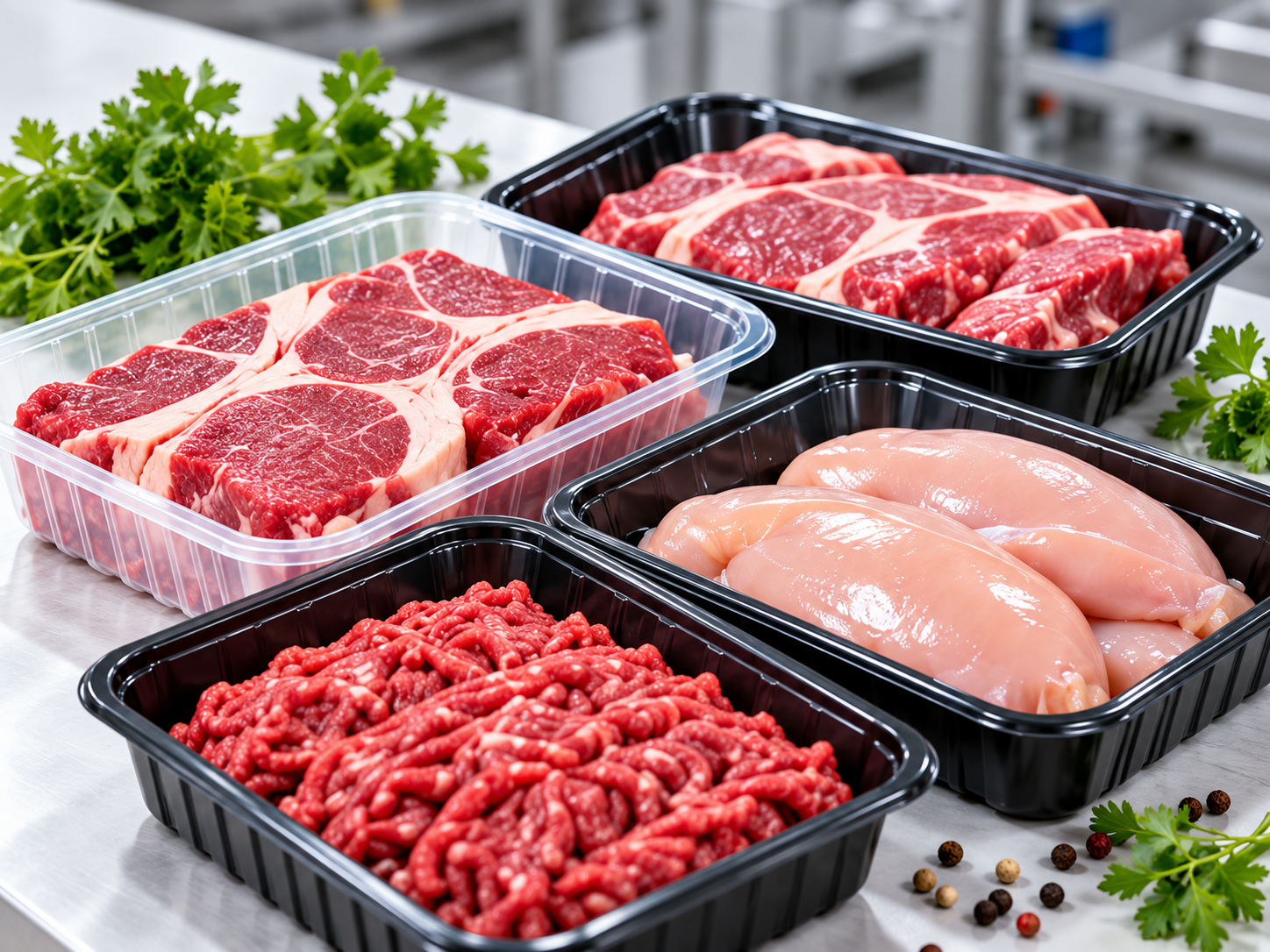
Fresh meat is the clearest example of a specification-led category. MAP barrier trays are designed for modified-atmosphere packaging of fresh meat, poultry, seafood and chilled foods. Moisture retention trays are designed to capture purge in recessed cells, which may reduce or eliminate a separate absorbent pad depending on food type, pack weight and purge volume. A conventional tray with an absorbent pad may still be suitable where the current packaging process is already established or where purge volume is higher and the packer prefers to keep the existing structure. The final choice should be confirmed through actual packing trials.
Seafood uses VSP and MAP formats. VSP is used where the skin film closely follows the food under vacuum, holding the product in position and creating a clear three-dimensional presentation. This suits steaks, fish fillets, seafood and premium chilled products, but the result depends on product height, tray design, film properties, machine settings and storage conditions.
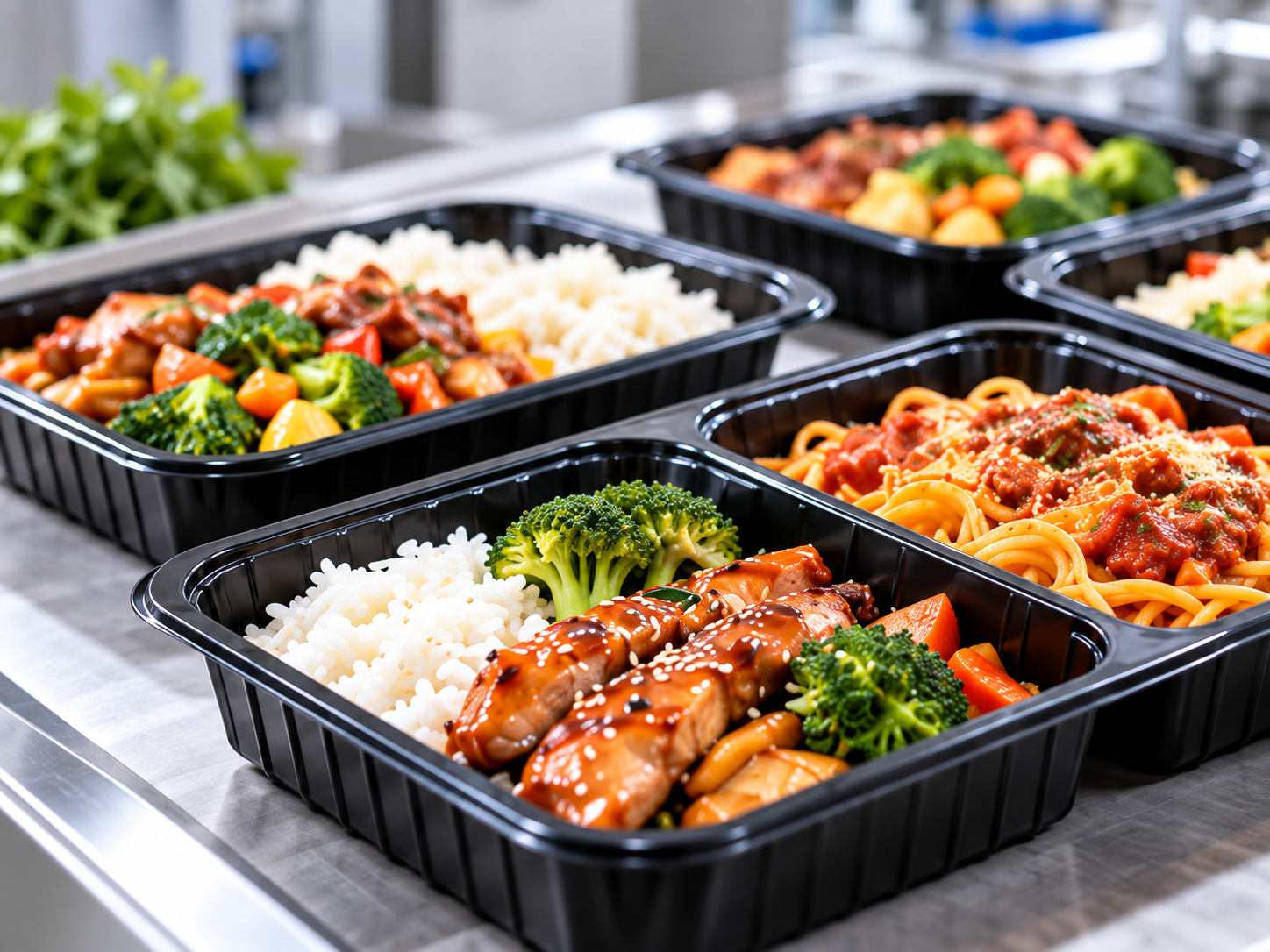
Ready meals use CPET. The compartment layouts keep main dishes, side dishes and sauces separated for cleaner presentation and convenient meal preparation. Supermarkets, caterers and foodservice suppliers can match tray size to portion size and packing process. The constraint is that exact temperature limits, sealing-film compatibility and heating conditions should be confirmed according to the selected model and application.
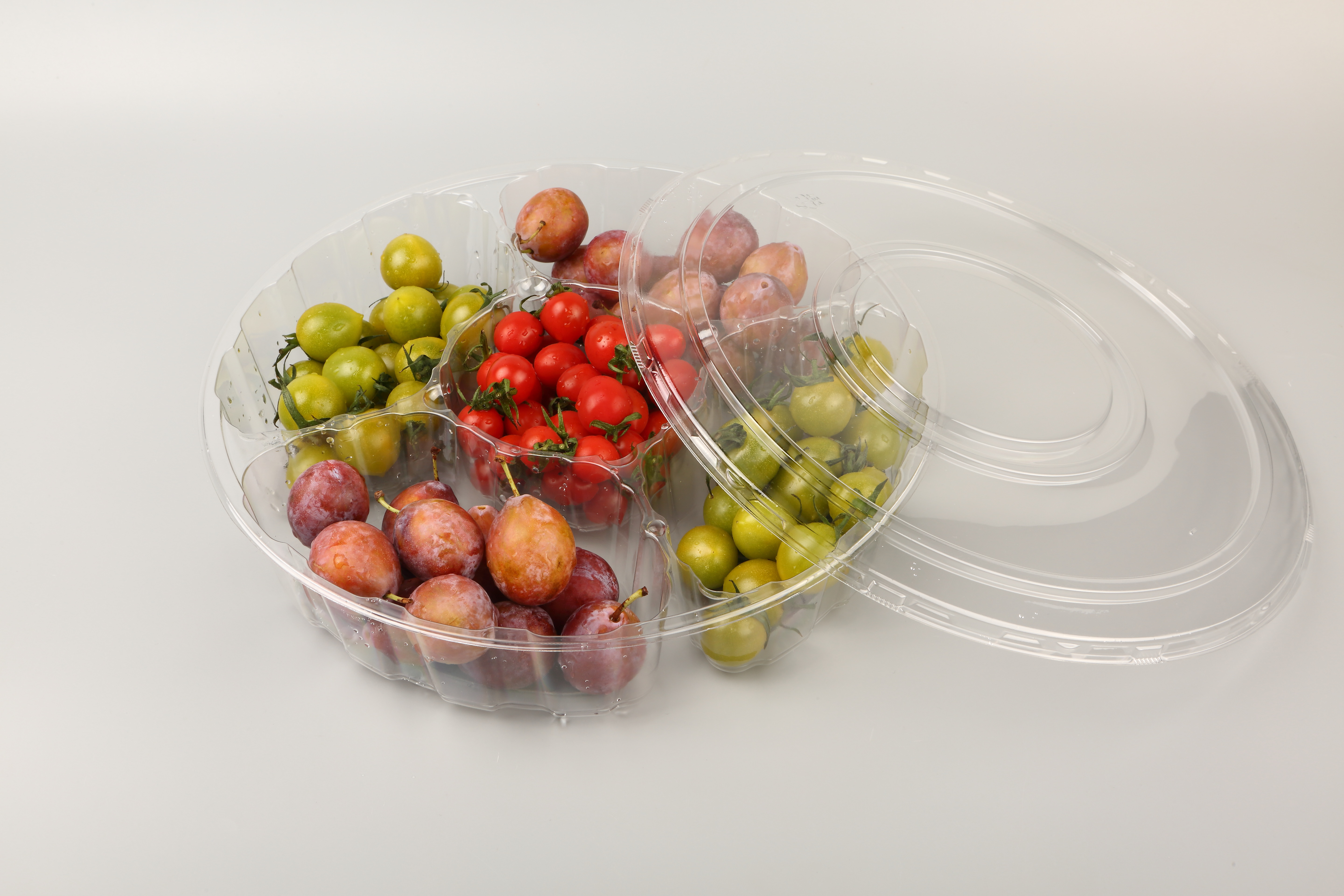
Fresh produce and deli applications use hinged clamshells, multi-compartment trays and large platters. The DP-1LBSS clamshell is developed for berries and fresh produce. The LH1303 is a 13-inch, 4+1 compartment tray with a suggested maximum holding weight of 1.7 kg. The LH1616 is a 16-inch square 5-compartment platter with a clear PET dome lid and a suggested maximum holding weight of 800 g. The LH1205R salad bowl has a 96 oz capacity and a suggested maximum holding weight of 1.3 kg. The LH0907 rotisserie chicken container is 235 × 190 × 116 mm with a suggested maximum holding weight of 1.5 kg.
Supermarket bakery and grab-and-go ranges use hinged containers. LH1008 has folded dimensions of 261 × 209 × 96 mm and a suggested maximum holding weight of 700 g. LH1208 has folded dimensions of 317 × 216 × 72 mm and a suggested maximum holding weight of 1 kg. LH1610 has folded dimensions of 415 × 261 × 106.5 mm and a suggested maximum holding weight of 2 kg. These formats show how a tray range can cover individual, family-size and sharing packs without treating every item as a custom project.
Where Linhua fits in a tray evaluation
Ningbo Linhua Plastic Co., Ltd. operates a factory of approximately 30,000 m², employs 150 people and reports a monthly capacity of approximately 1,800 MT. About 70% of output is exported, with markets including Australia, the United States, New Zealand and the Middle East. The company reports strengths in high-barrier packaging, MAP, VSP, PET and CPET food trays, as well as custom packaging development.
Commercial terms are part of the evaluation. The standard MOQ is one full container per item. For a first or trial order comprising several items, mixed loading can be arranged. Products with customization requirements have a relevantly higher MOQ. Lead time is normally 30 to 45 days after order confirmation, depending on product specifications, order quantity and production schedule. Custom mould projects require additional development time. Quality control covers incoming material inspection, in-process quality control and final product inspection before shipment.
The company also supports custom development for dimensions, shape, material layer structure, colour, printing, surface finish and moulds. For MAP and VSP projects, the technical discussion should include the food type, tray dimensions, packaging machine, sealing or skin film specifications, storage temperature and target shelf life. That is the practical route from a tray sample to a production-ready pack.
Case records provide a useful sense of scale. Linhua describes an Australian food packaging distributor relationship of 10 FCL per week or more, centred on MAP trays and supported by additional food-packaging categories. It also describes a Canadian supermarket supply programme of approximately 15 FCL per week across deli, produce, bakery, prepared food and grab-and-go SKUs. These are company-reported case records, not independently audited market data, but they show the type of multi-SKU, recurring supply pattern that a tray portfolio must support.
Comparison with traditional solutions
MAP, VSP, moisture retention and CPET are not automatically better than conventional trays. They are different systems with different constraints. The comparison should be made against the food, the line and the retail format.
| Solution | Where it fits | What it improves | Boundary or limitation |
|---|---|---|---|
| MAP high-barrier tray | Chilled meat, poultry, seafood and prepared foods | Controlled atmosphere and barrier structure can support quality and shelf-life management | Requires matching gas mixture, lidding film, sealing mould, machine and cold chain; tray alone cannot guarantee shelf life |
| VSP tray | Premium meat, fish, seafood and chilled products | Close-fitting presentation and secure product positioning | Depends on skin film, product height, tray surface and machine settings |
| Turned-edge PET overwrap tray | Supermarket fresh meat, seafood and produce | Rolled flange creates a smooth edge that helps reduce stretch-film damage | Overwrap is not a high-barrier MAP replacement; film and machine settings still matter |
| Moisture retention tray | Fresh meat, poultry, fish and seafood with purge | Integrated cells can reduce visible purge and may reduce or eliminate a separate absorbent pad | Performance depends on food type, pack weight, purge volume, storage time and temperature; trial required |
| CPET tray | Ready meals and prepared foods | Strength and heat resistance for ready-meal packaging | Exact temperature limits, sealing film and heating conditions vary by model |
| Conventional tray with absorbent pad | Established fresh-meat lines | Familiar process and widely understood pack structure | Adds a separate component; may remain preferable where purge is high or the line is already established |
Market trend analysis
Grand View Research estimates the global food containers market at USD 331.7 billion in 2024. That figure covers food containers broadly, including rigid and flexible formats, so it should be used as context for category scale rather than as a rigid plastic tray market size. Market Research Future projects the global EVOH packaging market to grow from USD 1.847 billion in 2025 to USD 3.055 billion by 2035 at a CAGR of 5.16%. This is an EVOH packaging scope, not a tray-only forecast, but it indicates continued interest in high-barrier structures for food protection and shelf-life management.
Regulation is moving in parallel. The European Commission reports that Regulation (EU) 2025/40 applies from 12 August 2026 and includes restrictions on PFAS in food-contact packaging. Commission Regulation (EU) No 10/2011 sets specific migration requirements for plastic food-contact materials and articles. The US FDA defines a food contact substance to include food packaging and its components. Industry-backed material states that plastic is the most common food packaging material type. Commercial research notes that PP and PE are made from synthetic polymers derived from natural resources and that plastic packaging prices fluctuate with input costs. For buyers, the trend is not simply more plastic. It is more documentation, more material specificity and more line validation.
Future outlook
Three directions are likely to shape tray procurement through the next evaluation cycle. First, regulatory documentation will become a standard line item in RFQs, especially for EU-bound food-contact packaging. Buyers will ask for the current certificate, its scope, its expiry date and the model-level test report that supports the intended market. Second, high-barrier and EVOH-containing structures will continue to be evaluated where shelf life and food waste reduction are priorities. They will be selected with film and machine compatibility, not by material name alone. Third, tray designs that reduce components, such as moisture-retention trays that may replace a separate absorbent pad, will be tested where retail presentation and packaging simplification matter.
None of these trends removes the need for model-level verification. A tray range can be broad, but the approval is specific: a food, a temperature, a machine, a film, a market and a test method. Suppliers that can document that chain clearly will be easier to qualify than suppliers that offer only a catalogue and a certificate image.
FAQ
Do BRCGS and ISO 9001 certificates mean a tray is approved for direct food contact in every market?
No. BRCGS Global Standard Packaging Materials certificate CN057524 - 1 covers the site and scope for extruding, laminating with PE or EVOH film or not, vacuum and thermal forming of PP, PET and PS plastic trays, plates, cups and lids for direct contact with food. ISO 9001 certificate 18426Q00712R001 covers quality management for production and related activities. Neither certificate is a product-specific migration approval for every tray SKU or every destination market. Buyers should request the applicable declaration of compliance, test report and product scope for the intended food and market.
What is the difference between the SGS report and a certification certificate?
The SGS-CSTC report NBHL260902990901CW is a third-party food-contact test report, not a certification certificate. It was issued on 17 September 2026 for PET container model DP1LBSS-01 and cites US FDA 21 CFR 177.1630 - Chloroform-soluble extractives for the USA market. It applies to that model and that test scope. A certificate usually covers a management system or a site scope; a test report answers a defined technical question for a defined sample.
What information is needed before confirming MAP or VSP tray compatibility?
MAP and VSP compatibility depends on more than tray dimensions. For MAP, provide the food application, tray dimensions or mould dimensions, MAP machine information, lidding-film specification, storage temperature and required shelf life. For VSP, provide the food type, product height, tray dimensions, VSP machine model, skin-film information, storage conditions and required shelf life. If an existing sealing mould is to be reused, its dimensions should be checked against the tray. Final compatibility should be confirmed through actual sealing trials. A tray alone cannot guarantee shelf life.
How should buyers compare PET, PP and CPET trays for chilled and heated foods?
The material choice should follow the application. PET is commonly used where clear product presentation is important, including fresh meat, seafood, produce and overwrap packaging. PP is widely used for food trays and can form part of MAP or VSP barrier structures when suitable barrier layers are incorporated. CPET is used for ready meals and prepared foods where higher temperature resistance is required. Multilayer structures with EVOH or PE may be considered where additional barrier or sealing performance is needed. Food type, storage temperature, packaging method, heating condition and target-market food-contact requirements should be confirmed before final selection.
Can a moisture retention tray replace an absorbent pad in every fresh-meat pack?
Not necessarily. A moisture retention tray has a network of recessed cells in the base that can capture purge below the food. This may reduce or eliminate the need for a separate absorbent pad depending on food type, pack weight, purge volume, storage temperature and storage time. A conventional tray with an absorbent pad may still be suitable where the current packaging process is established or where purge volume is higher and the packer prefers to keep the existing structure. The final choice should be confirmed through actual packing trials.
What commercial constraints apply to custom plastic food packaging trays?
The standard MOQ is one full container per item. For a first or trial order comprising several items, mixed loading can be arranged. Products with customization requirements have a relevantly higher MOQ. Lead time is normally 30 to 45 days after order confirmation, depending on product specifications, order quantity and production schedule. Custom mould projects require additional development time. The company reports a monthly capacity of approximately 1,800 MT. Published price bands are not available; quotations should be requested against the specific tray, material, tooling and volume.
Reference: the 2025 Linhua e-catalogue is publicly available for model-level reference at https://cdn.socialarks.com/sbsp/25347/common/2026/0917/Linhua%20E-catalogue%202025..pdf. Company information: www.nblinhua.com.
¿Tiene preguntas o necesita más detalles?
Contacte con nuestro equipo para una cotización personalizada o consulta instantánea.
Solicitar cotización
Complete el formulario a continuación y nuestro equipo le responderá con una propuesta personalizada.
Chat directo de WhatsApp
¿Prefiere chatear en tiempo real? Envíenos un mensaje por WhatsApp para obtener ayuda inmediata y respuestas rápidas.
- Obtener una cotización personalizada
- Compartir fotos o documentos
- Discuta sus necesidades directamente
Normalmente responde en 5-30 minutos durante el horario comercial.