
Plastic Food Container Buyer Comparison: MAP vs MRT
Plastic Food Container Buyer Comparison: MAP vs MRT
For chilled meat and seafood programs, MAP barrier trays and moisture retention trays are not competing answers to the same packaging question. MAP barrier trays are designed around a controlled atmosphere, a sealing film and a high-barrier tray structure. Moisture retention trays are designed around purge management at the base of the pack. A buyer comparing them should first define whether the problem is shelf-life control, visible purge, sealing compatibility, component reduction or retail presentation.
Ningbo Linhua Plastic Co., Ltd. (Ningbo Linhua Plastic Co., Ltd.) is a food packaging manufacturer established in 2004 in Ningbo, Zhejiang, China. The company operates a site of approximately 30,000 square metres, reports 150 employees and annual output of 20,000 tons, and exports about 70% of its output to markets including Australia, Canada, the United States, New Zealand, Singapore and the Middle East. Its product portfolio includes MAP high-barrier trays, VSP trays, turned-edge PET trays, moisture retention trays, CPET trays, hinged containers and related food packaging containers. The relevant buying question is not which tray category is generally better, but which one matches the packaging function, machine set-up, food condition and evidence package.
The core difference: atmosphere control versus purge control
MAP, or modified atmosphere packaging, replaces or adjusts the normal air inside a sealed food package with a controlled gas mixture selected for the food. A high-barrier tray and compatible lidding film help keep that atmosphere inside the pack. Together with good sealing and temperature control, this can help maintain product quality and support the required shelf life. In a MAP tray, the tray is part of a packaging system: tray structure, lidding film, seal integrity, gas mixture, food condition, hygiene and cold-chain temperature all affect the final result.
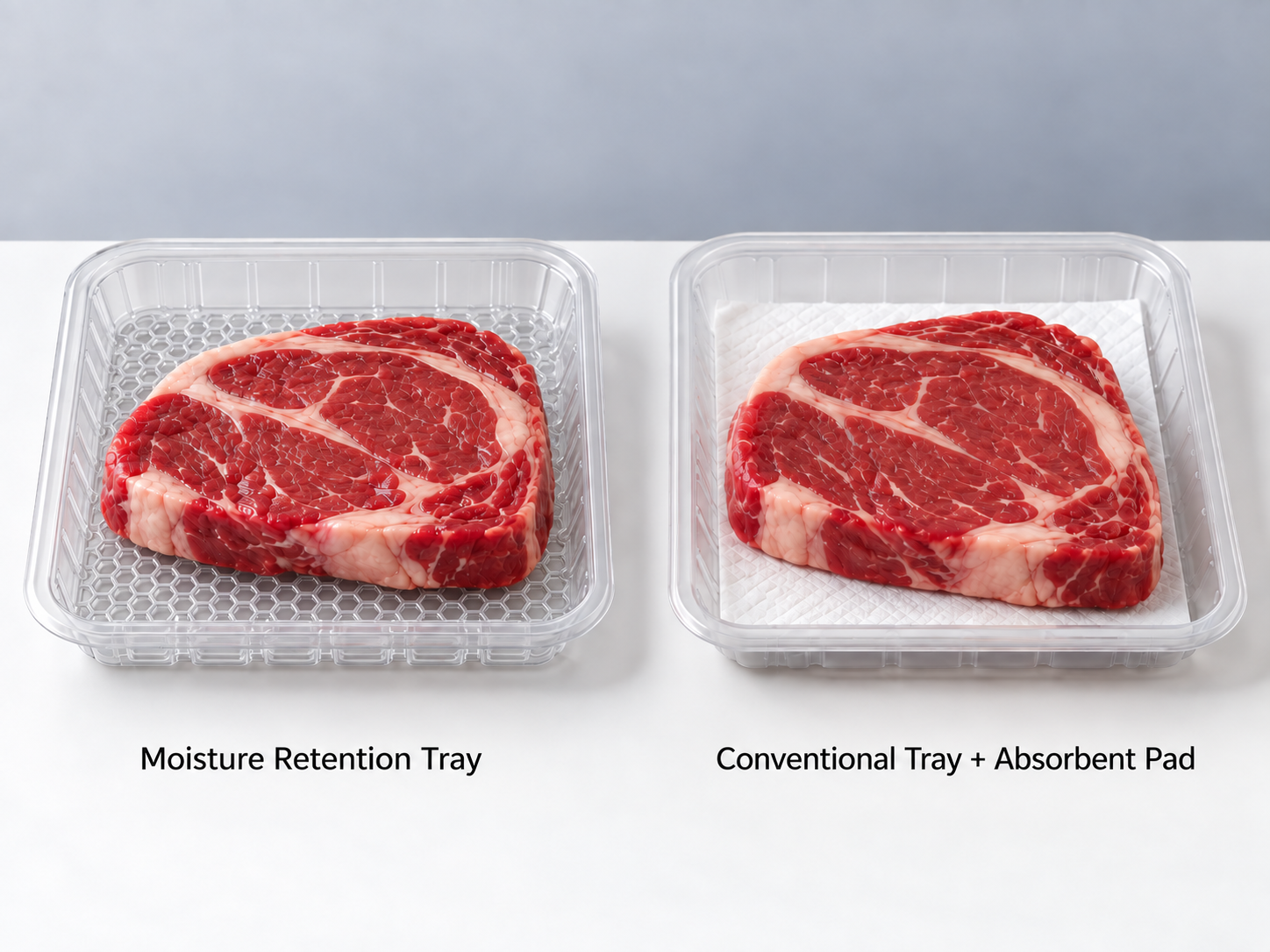
A moisture retention tray works on a different principle. Its base contains a fine honeycomb-style structure with recessed cells. As fresh meat, poultry, fish or seafood releases purge, the liquid moves into those cells underneath the product instead of remaining visibly pooled around the food. This helps keep the pack looking cleaner and may reduce or eliminate the need for a separate absorbent pad, depending on food type, pack weight, purge volume, storage temperature and storage time.
The buyer implication is straightforward. A MAP tray is selected when the packaging objective depends on controlled atmosphere and shelf-life management. A moisture retention tray is selected when visible purge, pack presentation and component reduction are the main concerns. Neither function automatically replaces the other. A moisture retention tray is not a gas-barrier solution by itself, and a MAP barrier tray is not primarily a purge-management device.
Buyer comparison table: where each tray type fits
| Comparison criterion | MAP barrier tray | Moisture retention tray | What the buyer should verify |
|---|---|---|---|
| Primary packaging job | Creates a sealed package with a controlled gas atmosphere and supports shelf-life management when used with compatible film and process controls. | Collects purge in recessed base cells to improve visible pack cleanliness and may reduce reliance on a separate absorbent pad. | Define the main problem first: atmosphere control, purge control, retail presentation or component reduction. |
| Barrier structure | High-barrier tray structures may use multilayer materials; EVOH can be used as a functional barrier layer where improved gas-barrier performance is required. | Not positioned as a gas-barrier packaging system in the supplied product information; it is used for moisture management in fresh meat, poultry and seafood packs. | Do not accept a moisture retention tray as a substitute for a MAP barrier structure when the specification calls for controlled atmosphere. |
| Sealing and equipment | Requires compatible MAP sealing machine, sealing mould, lidding film and tray dimensions. Tray size alone is not enough. | Typically used in overwrap-style fresh food packaging; fit depends on tray dimensions, base geometry, film and retail display requirements. | Send machine model, mould dimensions, film specification, tray dimensions and product height for compatibility review. |
| Dimensions and tooling | Seal area, flange design, depth and dimensional tolerance affect sealing and pack performance. | Consistent base cell geometry, tray dimensions and stacking behaviour affect packing line performance and retail display. | Request exact length × width × depth, tolerance, flange or seal-area dimensions and the proposed model number. |
| Moisture and purge | Atmosphere control does not by itself remove purge; visible juice may still require a separate solution. | Integrated cells provide dedicated space for liquid below the food; actual performance depends on food type, pack weight, purge volume and storage conditions. | Run application trials with the actual food, pack weight, storage temperature and expected distribution time. |
| Cost structure | Cost includes tray structure, lidding film, gas, machine time and sealing controls; barrier performance should be evaluated as part of the total pack. | A moisture retention tray may cost more than a basic PET tray, but it can potentially reduce absorbent pad use and simplify packaging components. | Compare total packaging cost, not tray unit price alone; include pad cost, line handling and waste where relevant. |
| Best-fit applications | Chilled food where controlled atmosphere and shelf-life management are important, including meat, poultry, seafood and prepared foods when the full system is validated. | Fresh meat, beef, pork, poultry, fish, seafood, supermarket meat departments and chilled retail packaging where purge affects presentation. | Confirm the actual food, storage temperature, packaging method and target retail format before selecting a model. |
Why EVOH and sealing compatibility matter in MAP barrier trays
In MAP barrier trays, the material structure is not a background detail. EVOH can be used as a functional barrier layer in multilayer packaging structures where improved gas-barrier performance is required. The exact structure should be selected according to barrier, sealing and storage requirements. A high-barrier tray is only useful when the whole package works together: the tray, lidding film, seal, gas mixture and cold chain.
Sealing compatibility is therefore a qualification issue, not a catalogue check. MAP and VSP compatibility depends on more than tray dimensions. Linhua’s own technical guidance notes that tray size, sealing mould or tooling, packaging machine, lidding or skin film, food application and operating conditions all need to be checked. If a buyer already has a production line, the machine model, mould dimensions and film information help evaluate compatibility more accurately. Final compatibility should be confirmed through actual sealing trials.
This is also why a tray supplier should not promise a specific shelf life from tray data alone. No tray alone can guarantee shelf life. Food condition, film, gas or vacuum process, seal integrity, hygiene and storage temperature all affect the final result. A buyer comparing MAP trays should ask for the model-specific dimensions, material structure and machine-film conditions under which the tray is intended to run, then validate the pack on the actual line.
Where moisture retention trays fit in fresh beef and pork programs
For fresh beef, pork, poultry, fish and seafood, purge can affect both appearance and pack handling. A moisture retention tray integrates moisture-management cells into the tray base. In the supplied product comparison, the moisture retention tray is positioned against a conventional meat tray plus absorbent pad. The functional difference is that the moisture retention tray can reduce the packaging system from tray plus pad to a single functional tray, depending on the application and purge level. That can simplify material handling, inventory management and packing-line preparation by reducing packaging components.
The fit boundary is equally important. A conventional tray with absorbent pad may still be suitable where the current packaging process is already established, or where purge volume is higher and the customer prefers to keep the existing packaging structure. A moisture retention tray may have a higher tray cost than a basic PET tray, but it can potentially reduce absorbent pad use and simplify components. Total packaging cost depends on tray specification, pad cost and packing volume. The final choice should be confirmed through actual packing trials.
For a chilled retail distribution program, the production evidence to request is not a single sample photograph. It should include repeatable base-cell formation, stable tray dimensions, consistent stacking, reliable supply and a clear specification for the food, pack weight and storage conditions. Linhua’s portfolio includes moisture retention trays for fresh meat, beef, pork, poultry, fish, seafood, supermarket meat departments and chilled retail packaging. The buying question is whether the proposed model and production evidence match the intended retail program.
MAP versus moisture retention: application scenarios
Chilled meat and seafood with a controlled-atmosphere requirement. Use a MAP barrier tray when the pack design depends on gas flushing, a compatible lidding film and a high-barrier tray structure. The application should be checked as a full system: food type, tray dimensions, MAP machine, sealing mould, film, storage temperature and target shelf life. This is the appropriate route when the buyer needs a sealed atmosphere-controlled pack and can validate seal integrity and shelf-life performance under actual conditions.
Fresh beef and pork where purge affects retail presentation. Use a moisture retention tray when visible purge and pack cleanliness are the main issues, especially where the buyer wants to reduce or eliminate a separate absorbent pad. The tray should be trialled with the actual meat cut, pack weight, storage temperature and display conditions. If purge volume is high or the existing tray-plus-pad process is already stable, the conventional structure may remain suitable.
Seafood and mixed chilled retail programs. The choice depends on the problem being solved. A MAP system may be relevant where controlled atmosphere and shelf-life management are specified. A moisture retention tray may be relevant where drip or purge control is the main presentation issue. In both cases, the buyer should avoid treating tray category as a proxy for total pack performance.
RFQ evidence: model count and dimensions are only the start
Where a MAP supplier presents a range of more than 80 models, the count is a portfolio signal, not a specification. A large model range can help identify a starting point, but it does not prove that a particular tray will seal on a particular machine, with a particular film, at a particular product height. For RFQ comparison, ask for the specific model list and the model-level evidence behind it.
- Exact tray dimensions: length × width × depth, with dimensional tolerance.
- Flange or seal-area dimensions where relevant to MAP sealing.
- Material structure and whether EVOH or other functional barrier layers are used.
- Recommended machine, sealing mould and film combinations for the proposed model.
- Food application, storage temperature and expected pack weight.
- Sample availability and the conditions under which the sample was produced.
- Food-contact documentation applicable to the destination market and product scope.
- MOQ, lead time and production scheduling assumptions for the requested specification.
For moisture retention trays, the RFQ should add base-cell geometry, intended purge level, pack weight, overwrap or lid format, stacking requirements and retail display conditions. Linhua’s ordering guidance notes that a quotation is more accurate when the buyer provides the tray type or dimensions, food application, required quantity and any colour or customization requirements. For MAP or VSP projects, machine, mould, film and storage information may also be required.
RFQ decision rule: do not compare a MAP tray quotation with a moisture retention tray quotation unless both are quoted for the same food, pack weight, storage condition, packaging method and evidence scope. A lower tray price does not settle a packaging-system comparison.
Compliance and market context for food-contact packaging
Food-contact compliance is a qualification gate for both tray types. In the European Union, Commission Regulation (EU) No 10/2011 establishes specific requirements for plastic materials and articles intended to come into contact with food, including applicable migration limits for listed substances. The regulation applies to plastic articles consisting exclusively of plastics and to specified plastic multilayer materials, printed or coated articles, and plastic layers or coatings used in closures. Multilayer MAP barrier structures should therefore be assessed under the applicable food-contact framework for the destination market.
The EU Packaging and Packaging Waste Regulation (PPWR) 2025/40 adds another layer of market attention. The European Commission states that from 12 August 2026 the regulation applies, including restrictions on PFAS in food-contact packaging. For buyers, this reinforces the need to request current declarations of compliance, test reports and product-scope evidence rather than relying on general supplier statements. Linhua states that any specific claims regarding ISO, BRC, HACCP, FDA, EU or other certifications and compliance standards should be based on the company’s latest valid certificates, test reports and applicable product scope.
Market forecasts should be read with similar discipline. A commercial forecast from Market Research Future projects the global EVOH packaging market to reach USD 3.055 billion by 2035 at a 5.16% CAGR. That forecast is for EVOH packaging broadly, not for MAP trays alone. It supports the direction of barrier-structure demand, but it should not be used as a tray-specific purchase guarantee or as evidence that a particular supplier’s tray will meet a given shelf-life target.
Cost comparison: tray price is not the total packaging cost
For MAP barrier trays, the relevant cost boundary includes the tray structure, lidding film, gas, machine time, sealing controls and quality checks. A high-barrier structure may carry a different cost from a standard tray, and the overall pack economics depend on the full system. The buyer should compare the cost per acceptable pack, not the tray unit price in isolation.
For moisture retention trays, the supplied comparison notes that the tray may have a higher unit cost than a basic PET tray, but it can potentially reduce the use of absorbent pads and simplify packaging components. Total packaging cost depends on tray specification, pad cost and packing volume. If the current process uses a tray plus pad, the buyer should compare component count, material handling, inventory and packing-line preparation alongside the tray price.
The practical conclusion is that MAP and moisture retention trays should be costed against different baselines. MAP should be costed as part of a controlled-atmosphere packaging system. Moisture retention should be costed against the existing tray-plus-pad or standard tray structure, including the value of component reduction where it is actually achieved.
Decision framework for buyers
- Define the packaging problem. Is the primary issue atmosphere control, shelf-life management, visible purge, retail presentation, component reduction or sealing compatibility?
- Match the tray to the packaging method. Use a MAP barrier tray where a sealed controlled-atmosphere system is required. Use a moisture retention tray where purge management and pack cleanliness are the main objectives.
- Check the machine and film interface. For MAP, confirm tray dimensions, sealing mould, machine, lidding film, product height and operating conditions. For moisture retention, confirm overwrap format, tray dimensions and base geometry.
- Request model-level evidence. Ask for exact dimensions, material structure, recommended machine-film combinations and the scope of any food-contact documentation.
- Trial the actual application. Use the real food, pack weight, storage temperature, distribution time and retail display conditions. Final selection should be confirmed through application trials.
- Compare total cost and risk. Include film, gas, pad use, line handling, inventory, compliance documentation and supply continuity where relevant.
Frequently asked questions
How does MAP packaging help keep fresh food in better condition?
MAP replaces or adjusts the normal air inside a sealed food package with a controlled gas mixture selected for the food. A high-barrier tray and compatible lidding film help keep that atmosphere inside the pack. Together with good sealing and temperature control, this can help maintain product quality and support the required shelf life. The result depends on food condition, hygiene, gas mixture, seal integrity and cold-chain temperature, so a tray alone cannot guarantee shelf life.
How does a Moisture Retention Tray manage meat juices without an absorbent pad?
A moisture retention tray has a fine honeycomb-style structure built into the base. As fresh meat, poultry, fish or seafood releases purge, the liquid moves into recessed cells underneath the product instead of remaining visibly pooled around the food. This helps keep the pack looking cleaner and may reduce or eliminate the need for a separate absorbent pad, depending on food type, pack weight, purge volume, storage temperature and storage time.
Will a MAP tray work with my existing packaging machine?
MAP compatibility depends on more than tray dimensions. Tray size, sealing mould or tooling, packaging machine, lidding film, food application and operating conditions all need to be checked. If a production line already exists, the machine model, mould dimensions and film information help evaluate compatibility. Final compatibility should be confirmed through actual sealing trials.
How do I choose between a moisture retention tray and a conventional tray with absorbent pad?
For fresh meat, poultry, fish and seafood applications where visible purge affects retail presentation, a moisture retention tray can be a better option because it integrates moisture-management function into the tray and may reduce or eliminate a separate absorbent pad. A conventional tray with absorbent pad may still suit established processes or applications where purge volume is higher and the buyer prefers to keep the existing structure. The final choice should be confirmed through actual packing trials.
What material should I use for a MAP or moisture retention tray?
Material selection depends on the food, storage temperature, packaging method, barrier requirement, heating condition and retail presentation. PET is commonly used where clear product presentation is important, including fresh meat, seafood and overwrap packaging. PP is widely used for food trays and can form part of MAP or VSP barrier structures. CPET is used for ready meals and prepared foods where higher temperature resistance is required. EVOH and PE may be used as functional layers in multilayer structures when additional barrier or sealing performance is required.
What information should an RFQ include for food packaging trays?
An RFQ should include the product or tray type, required dimensions, food application, required quantity, colour or special requirements, and any available photo, drawing or sample. For MAP or VSP projects, it should also include the packaging machine model, sealing mould details, lidding or skin film specification, storage temperature and required shelf life. Providing these details helps a supplier identify a suitable existing model or evaluate a customized option and prepare a more accurate quotation.
Conclusion: match the tray to the packaging function
MAP barrier trays and moisture retention trays solve different problems in chilled meat and seafood programs. MAP barrier trays are appropriate when controlled atmosphere, high-barrier structure, sealing compatibility and shelf-life management define the pack. Moisture retention trays are appropriate when purge control, visible pack cleanliness and component reduction are the main priorities. EVOH barrier structures and sealing compatibility are central to MAP qualification. Consistent tray dimensions, reliable fit and moisture control are central to fresh beef and pork programs using moisture retention trays.
The buyer should treat model count, tray dimensions and supplier statements as RFQ inputs, not as final proof. Request exact dimensions, material structures, machine-film conditions, food-contact documentation and application trial results for the actual food and storage conditions. Ningbo Linhua Plastic Co., Ltd. supports standard and customized food packaging development, including MAP, VSP, PET, CPET and moisture retention tray formats, with project evaluation from product design and prototyping to mould development and mass production. A company catalogue is available here: Linhua E-catalogue 2025.
This comparison reflects published product and regulatory information available at the time of writing. Final tray selection should be confirmed through application trials, current food-contact documentation and the buyer’s own packaging-line validation.
¿Tiene preguntas o necesita más detalles?
Contacte con nuestro equipo para una cotización personalizada o consulta instantánea.
Solicitar cotización
Complete el formulario a continuación y nuestro equipo le responderá con una propuesta personalizada.
Chat directo de WhatsApp
¿Prefiere chatear en tiempo real? Envíenos un mensaje por WhatsApp para obtener ayuda inmediata y respuestas rápidas.
- Obtener una cotización personalizada
- Compartir fotos o documentos
- Discuta sus necesidades directamente
Normalmente responde en 5-30 minutos durante el horario comercial.