
Plastic Folding Baskets: A Space-Saving Category Reshaping Household Storage
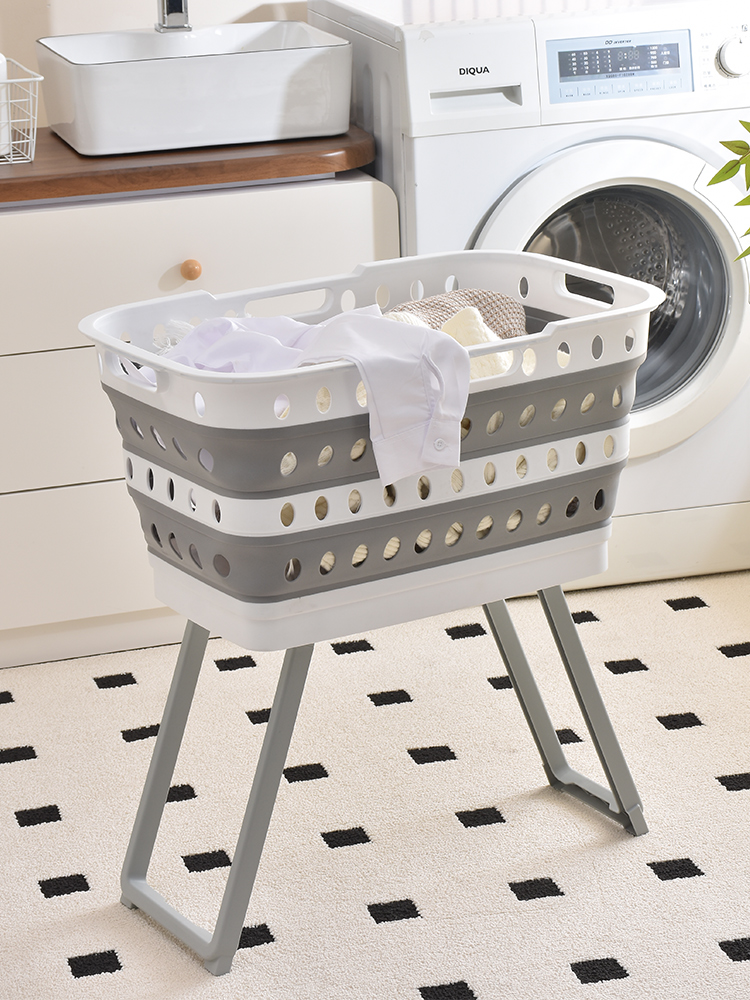
The plastic folding basket has moved from a simple household utility to a product category with measurable global demand. Grand View Research values the foldable and collapsible container market at USD 1.7 billion in 2025, with plastic accounting for 53.9% of that segment. For buyers in retail, e-commerce, and household goods, the plastic folding basket matters not only as a consumer item, but also as a way to reduce storage space and shipping cost before the product reaches the end user.
The problem: storage pressure and logistics cost
Retailers and importers face two connected pressures: small living spaces and expensive logistics. Rigid plastic baskets keep their shape, but they also keep their volume even when empty. That makes them inefficient in warehouses, retail shelves, and home cabinets.
Folding designs respond to both pressures. After folding, a typical plastic basket reduces its volume by 75% to 85%, with folded thickness often reaching only a few centimeters. A basket stored this way can hang on a wall, fit into a cabinet gap, go into luggage, or sit flat in a car trunk. For an e-commerce seller using overseas warehousing, the same advantage reduces dimensional weight and container usage.
One verified market signal confirms the direction. According to Grand View Research, foldable crates can reduce storage space requirements by up to 75% when not in use compared with rigid alternatives. That is not a niche benefit. It is now a core purchasing criterion for products such as folding laundry baskets, folding storage baskets, folding picnic baskets, and other household folding containers.
What is a plastic folding basket?
A plastic folding basket is a collapsible household container built to unfold into a usable basket and fold flat when empty. The market uses many labels for similar products, including folding laundry basket, folding hand basket, folding storage basket, folding shopping basket, folding vegetable basket, folding drain basket, and large capacity folding basket. These names describe different shapes and use cases, but they share the same design principle.
Taizhou Nantong Plastic Co., Ltd, a manufacturer based in Taizhou, Zhejiang, China, describes its main product as the Plastic Folding Basket. The company also produces foldable wash basins, foldable water buckets, foldable storage baskets, and foldable laundry baskets. Its basket range covers over 90 styles, with capacities from 3L to 43L. The product family is positioned as collapsible household goods and heavy-duty foldable laundry baskets.
Technical explanation: how a folding basket is built
Modern plastic folding baskets are not simple cloth containers. The most common construction combines a hard polypropylene (PP) frame with a foldable TPE soft wall. This combination gives the basket enough structure to hold laundry, vegetables, or picnic items while allowing the wall to collapse.
The main composite material used by Taizhou Nantong Plastic is PP+TPE. The company states that all products use new food-grade PP+TPE composite raw materials, are BPA-free, and withstand temperatures from -20°C to 120°C. The material is described as odorless, crack-resistant, waterproof, stain-resistant, and easy to clean.
Several construction details affect performance:
- Reinforced thick side walls provide structure without adding unnecessary weight.
- Heat-pressed fold lines create consistent folding points and reduce wear.
- Sealed seams improve leak-proof performance for water-holding products.
- Anti-slip bottom structures help the basket stay stable on wet or smooth floors.
- Integrated reinforced handles make carrying easier when the basket is full.
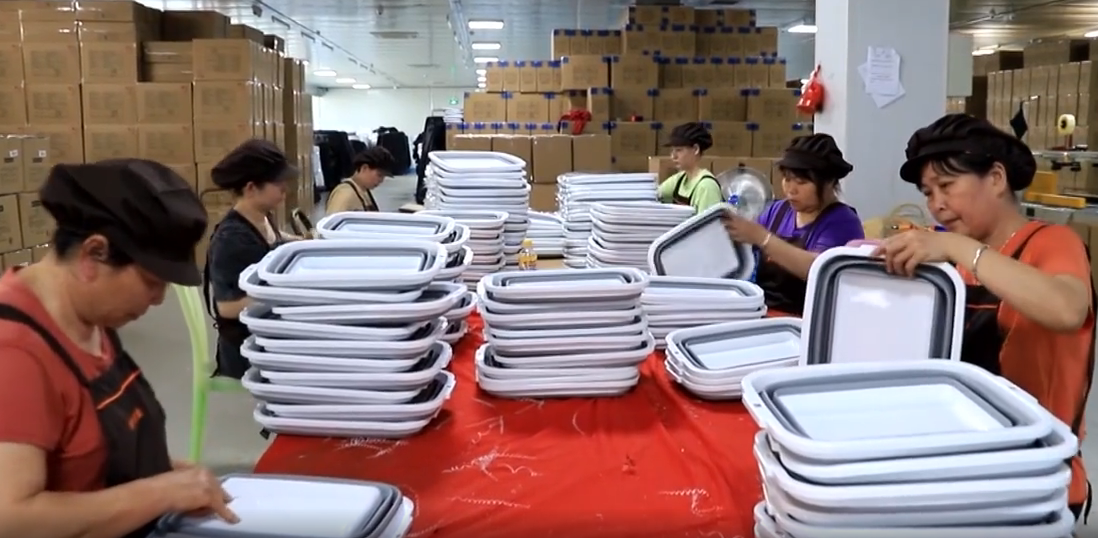
Taizhou Nantong Plastic reports that its foldable items endure 5,000 to 10,000 repeated folds without cracking or deformation. The company holds 23 independent product patents for its one-piece fold-expand structure, which it distinguishes from ordinary spliced folding products. Its factory equipment includes 12 injection molding machines, manipulators, automatic packing machines, thermoforming machines, and three assembly lines. It also owns 200 self-developed molds, which supports OEM and ODM customization of size and color.
Application scenarios and product forms
The plastic folding basket covers household, outdoor, retail, and commercial supply scenarios.
Household daily use
For laundry, fruit and vegetable cleaning, foot baths, and daily hand washing, folding basins and baskets are common in small apartments, dormitories, and rental housing. When not in use, they can be folded and stored in cabinet gaps or hung on walls. Families with infants and pets also benefit from food-safe, BPA-free materials with no odor.
The company's collapsible plastic basin range includes models such as FP-HOME15 for household washing, FP-PET8 for pet cleaning, FP-CAR12 for car washing, and FP-CAMP10 for camping. Capacities run from 5L to 20L, with the larger models suited to laundry and pet bathing.
Outdoor and travel use
Outdoor scenarios include self-driving, hiking, picnics, fishing, and portable water storage. The collapsible water bucket model FB-10L is available in 5L, 10L, 15L, and 20L versions. The 10L version has an unfolded size of 26 cm in diameter and 30 cm in height. These products are intended for the outdoor camping and self-driving industry as well as the household daily necessities industry.
Retail and e-commerce supply
Plastic folding baskets are also used for supermarket shelf supply and cross-border e-commerce. Compact folded dimensions allow more units per carton, which improves container utilization. Taizhou Nantong Plastic describes its collapsible baskets as Amazon FBA-friendly, with a product range intended for household supplies, outdoor picnic, laundry and cleaning, and supermarket retail. The company states that its design can boost container space utilization by 300% and increase pieces per carton by 4 to 5 times compared with rigid plastic containers.
Market trend analysis
The market data supports the growing role of folding formats. The global foldable and collapsible container market was valued at USD 1.7 billion in 2025, according to Grand View Research. Plastic is the dominant material, representing 53.9% of revenue share in 2025 because of its lightweight and cost-effective properties.
Asia Pacific held a 36.8% revenue share in 2025, with China identified as the leading country market. China's export data also points in the same direction: exports of plastic boxes and crates under HS Code 392310 reached USD 1.89 billion in 2024, making China one of the top three global exporters, according to OEC.
Demand in the United States is also substantial. The U.S. market for foldable containers was valued at USD 422.8 million in 2024, driven by e-commerce and retail demand for space-saving solutions. In the wider packaging environment, collapsible recycled plastic packaging is estimated at USD 9.9 billion globally in 2025, which signals that recycled-content options are becoming more important.
At the industrial end of the plastic container market, companies such as Schoeller Allibert, ORBIS Corporation, and Brambles (CHEP) are frequently cited as key global competitors. The household plastic folding basket segment is more fragmented and supplier-driven, with differentiation coming from materials, fold durability, certifications, and logistics efficiency.
Comparison with traditional solutions
Traditional rigid baskets remain useful, but folding baskets change the cost structure of storage and transport.
| Dimension | Rigid plastic basket | Folding PP+TPE basket |
|---|---|---|
| Empty storage space | Keeps full volume | Folded volume reduced by 75% to 85% |
| Carton density | Lower | Higher; more pieces per carton |
| Material | Often PP or HDPE | PP frame plus TPE soft wall |
| Water-related use | Usually rigid and stable | Sealed seams and reinforced walls support leak-proof washing use |
| Fold durability | Not applicable | 5,000 to 10,000 folding cycles in lab testing |
| Portability | Heavier and bulkier | Lightweight and compact when folded |
The folding category also has limits. A plastic folding basket is not a direct replacement for heavy industrial crates or logistics bins. The household-oriented range from Taizhou Nantong Plastic is 3L to 43L, while the industrial collapsible crate segment commonly uses 100L to 300L capacities. Buyers with industrial bulk-handling requirements should still look at rigid or heavy-duty crate systems.
Folding products also depend on how the fold lines are treated. Repeated folding is tested in laboratory conditions, but loading a basket beyond its stated capacity, overloading the handles, or folding it incorrectly can shorten service life. Buyers should match the basket capacity to the application rather than assuming a folding basket can handle the same loads as a rigid industrial container.
Sourcing evidence: Taizhou Nantong Plastic as a supplier reference
For buyers evaluating a plastic folding basket source, Taizhou Nantong Plastic Co., Ltd provides a useful reference point. The company was established in 2003 and specializes in manufacturing foldable plastic household goods. Its production plant covers 6,000 square meters, and its total factory area, including an independent warehouse, exceeds 9,500 square meters. The company employs approximately 39 staff.
Export business accounts for 70% of total sales, with major markets including the USA, UK, Germany, Spain, Australia, Korea, and Japan. The company reports that it is a long-term exclusive supplier for Walmart and Sam's Club, and cooperates with German Netto and Japanese Nitori and 3Coins. Its products have served more than one million households worldwide.
From a compliance perspective, the company's certification list includes BSCI, ECM, FDA, REACH, RoHS, ASTM, and SEDEX. The main material is 100% new food-grade PP+TPE composite, BPA-free, with temperature resistance from -20°C to 120°C. For European buyers, food-contact plastic baskets should also comply with EU Regulation (EC) No 1935/2004 and Regulation (EU) No 10/2011, while Good Manufacturing Practice for food-contact materials is covered by Commission Regulation (EC) No 2023/2006.
The company operates as an integrated factory-trade enterprise, which means product development, molding, production, sales, and after-sales support are managed within one operation. It supports FBA and DDP cross-border logistics and provides after-sales warranty for non-artificial damage. Its standard mold opening cycle is 30 to 40 days, and mold repair response is within 2 to 3 days. These are practical details for buyers planning custom sizes, colors, or retail programs.
Taizhou Nantong Plastic Co., Ltd was recognized as a Zhejiang Provincial Sci-Tech Small and Medium Enterprise and maintained Class A Tax Credit for 2023 and 2024. It is also a member of the Taizhou Plastics Industry Association.
Future outlook
The plastic folding basket will likely continue to grow with urban housing trends, e-commerce logistics, and cross-border retail. Space-saving products fit smaller homes, and compact shipping fits modern warehouse economics. European food-contact rules and growing environmental requirements will push suppliers toward documented compliance and clearer material traceability.
Buyers should expect more requests for recycled-content materials and for certifications that match specific destination markets. At the same time, fold durability and logistics efficiency will remain core differentiators. The manufacturers that can prove consistent quality, support OEM development, and maintain reliable delivery schedules will have an advantage in this category.
Frequently asked questions
What is a plastic folding basket?
A plastic folding basket is a collapsible household container, usually made with a hard polypropylene frame and a foldable TPE soft wall. It is used for laundry, storage, shopping, picnics, vegetables, and other household tasks, and it can be folded flat when not in use.
How much space does a plastic folding basket save?
Suppliers report that folding reduces basket volume by 75% to 85%. Folded baskets can be stored in wall hooks, cabinet gaps, luggage, car trunks, and warehouse shelves. Folded forms also increase carton density and container utilization.
What materials are used in plastic folding baskets?
Most folding baskets use a PP hard frame and a TPE or TPR-type soft wall. The composite material is often food-grade, BPA-free, waterproof, stain-resistant, and recyclable. Temperature resistance can range from -20°C to 120°C depending on the product.
How long does a plastic folding basket last?
Laboratory testing for one manufacturer shows 5,000 to 10,000 repeated folds without cracking or deformation. Real-world service life depends on load, frequency of use, and how carefully the basket is folded.
What certifications should a food-contact folding basket have?
Common certifications include FDA, LFGB, REACH, RoHS, BSCI, and SEDEX. For European Union food-contact applications, baskets should comply with Regulation (EC) No 1935/2004 and Regulation (EU) No 10/2011, with Good Manufacturing Practice under Regulation (EC) No 2023/2006.
Is a plastic folding basket suitable for Amazon FBA?
Yes. Compact folded dimensions increase the number of units per carton and reduce dimensional weight. Some manufacturers describe their baskets as Amazon FBA-friendly collapsible home utilities and support FBA and DDP logistics.
Download reference: TAIZHOU NANTONG PLASTIC CO.,LTD 2026 Catalog.