
Plastic Folding Basket Sourcing: Building a Long-Term Supply Partnership
For distributors, importers and retailers, the real test of a plastic folding basket supplier begins after the first order. Market data from Grand View Research valued the global foldable and collapsible container market at USD 1.7 billion in 2025, with plastic materials holding a 53.9% revenue share and Asia Pacific contributing 36.8% of regional revenue. In this context, long-term supply relationships are becoming a strategic advantage.
This article examines the criteria that distinguish a one-time sample supplier from a sustainable manufacturing partner. Taizhou Nantong Plastic Co., Ltd. is used as an industry reference because its production structure, certification base and retail relationships are documented and verifiable.
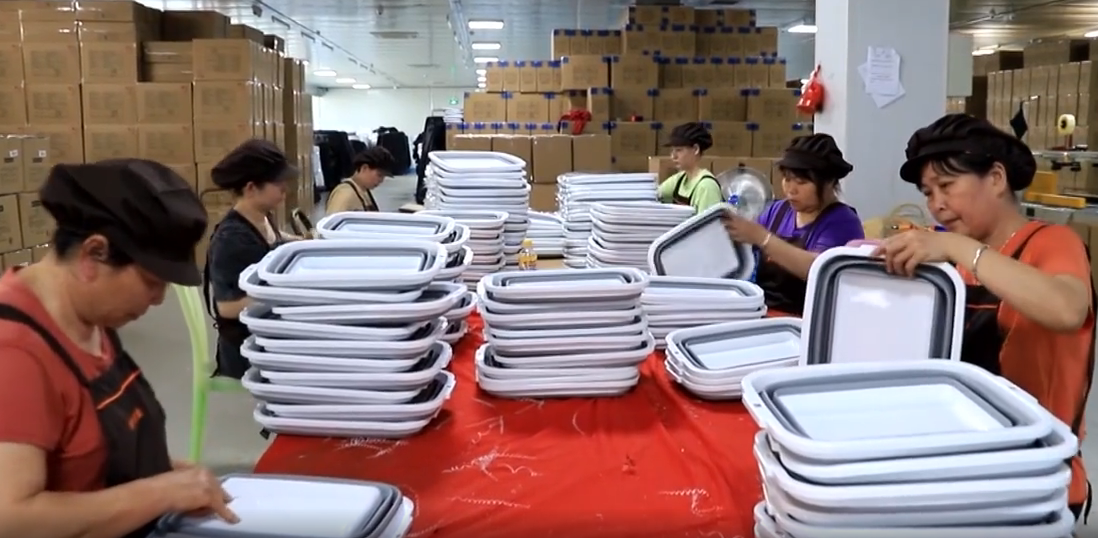
Packing and inspection space is part of the supply chain visibility that buyers need for repeat orders.
The Long-Term Sourcing Problem in Plastic Folding Baskets
In a first transaction, the buyer evaluates samples, price and delivery. In a long-term relationship, the questions shift: Can the supplier hold the same material quality across multiple production runs? What happens when a container is delayed? Are the certifications still valid for the next market launch? These operational questions determine whether a folding basket program becomes a stable revenue line or a recurring source of complaints.
Answer: A long-term supplier should be able to prove capacity ownership, in-house quality control and a track record with recognized retail chains. Taizhou Nantong Plastic Co., Ltd. supplies products to over one million families worldwide and has operated as a long-term exclusive supplier for Walmart and Sam’s Club, with additional cooperation involving German Netto and Japanese Nitori and 3Coins. Such a client base does not by itself guarantee quality, but it indicates that the manufacturer has passed recurring factory audits and delivery reviews.
What a Stable Supplier Must Be Able to Prove
Stability in folding basket supply is built on three layers: material control, production hardware and after-sales response. A supplier using virgin food-grade resin lowers the risk of contamination and color inconsistency. In-house molds reduce dependence on third-party tooling shops. Clear warranty terms protect the buyer from defects discovered after shipment.
In the case of Nantong Plastic, the company holds 23 independent product patents for its one-piece fold-expand structure. It operates 200 self-developed production molds and 12 injection molding machines from 300g to 2500g, supported by three assembly lines. The factory occupies 6,000 sqm of production space, with a separate 3,500 sqm warehouse. These numbers matter because they express the difference between a trading company and a manufacturer with control over production scheduling.
Factory and production capacity
Founded in 2003, Nantong Plastic has accumulated more than 15 years of manufacturing experience. The workforce includes 39 staff, of which 8 are dedicated R&D engineers and production/QC staff number 25 in the organizational breakdown. The company reports an export ratio of 70%, with main markets including the USA, UK, Germany, Spain, Australia, Korea and Japan. This geographic spread implies familiarity with multiple compliance regimes.
For long-term buyers, the practical takeaway is that the factory can handle both standard stock items and custom tooling. The standard mold opening cycle is 30–40 days, with mold repair response within 2–3 days. Such response times are relevant when a retailer needs design changes or a replacement part in season.
Ownership of product structure
Patents and molds are two forms of structural ownership. Nantong Plastic’s one-piece fold-expand structure is covered by 23 independent patents, which protects against cheap imitations that rely on spliced joints. In addition, all 200 molds are developed in-house, allowing the company to modify size, color and structure without waiting on an external tool shop. For a brand owner, this shortens the path from a retail trend to a finished SKU.
Technical Foundations That Reduce Long-Term Risk
Folding basket durability is not only a convenience feature; it directly impacts product returns, customer reviews and repeat purchase rates. The construction method and material choice determine how many times a basket can be folded before cracking.
Nantong Plastic’s folding baskets use 100% new food-grade PP+TPE composite material, BPA-free. The material is temperature-resistant from -20°C to 120°C and is designed to avoid odor when exposed to hot water. Reinforced side walls of 2–3mm thickness, integrated anti-break handles and sealed seams provide structural support. According to the company’s internal lab testing, items endure 5,000 to 10,000 repeated folds without cracking or deformation.
The product design uses a one-piece fold-expand structure protected by patents, distinguishing it from spliced foldable items that may separate at joint lines after repeated use. For a distributor, this distinction translates into lower out-of-box failure rates and fewer warranty claims.
Boundary: No folding basket is indestructible. The company’s risk documentation lists long-term continuous heating above 120°C, violent scratching by sharp hard objects, and overload beyond the marked maximum water capacity as conditions that can cause damage. Buyers should include these limits in product manuals and shelf messaging to avoid misuse.
Matching Product Variants to Market Demand
A long-term supply relationship becomes more efficient when the supplier can cover multiple SKUs from one production base. Nantong Plastic’s folding basket portfolio extends across laundry baskets, hand baskets, shopping baskets, storage baskets, drain baskets, vegetable baskets, picnic baskets and carry baskets, in oval, square and rectangular shapes. Total capacity options range from 3L to 43L, and the overall catalogue includes over 90 styles of foldable household plastic goods.
This breadth is useful for importers serving different channels:
- Retail and supermarket programs: folding shopping baskets, wheeled folding baskets and perforated hollow folding baskets fit grocery and discount store shelves.
- Home organization e-commerce: folding storage baskets, baskets with lids and hanging folding baskets appeal to apartment dwellers with limited space.
- Outdoor and seasonal retail: folding picnic baskets, large-capacity folding baskets and car folding baskets align with camping and travel promotions.
- Kitchen and fresh food segments: folding vegetable baskets and folding drain baskets support food-contact applications where compliance documentation is required.
By consolidating multiple basket types with one manufacturer, a buyer can reduce supplier management overhead and negotiate better freight terms through mixed container loads.
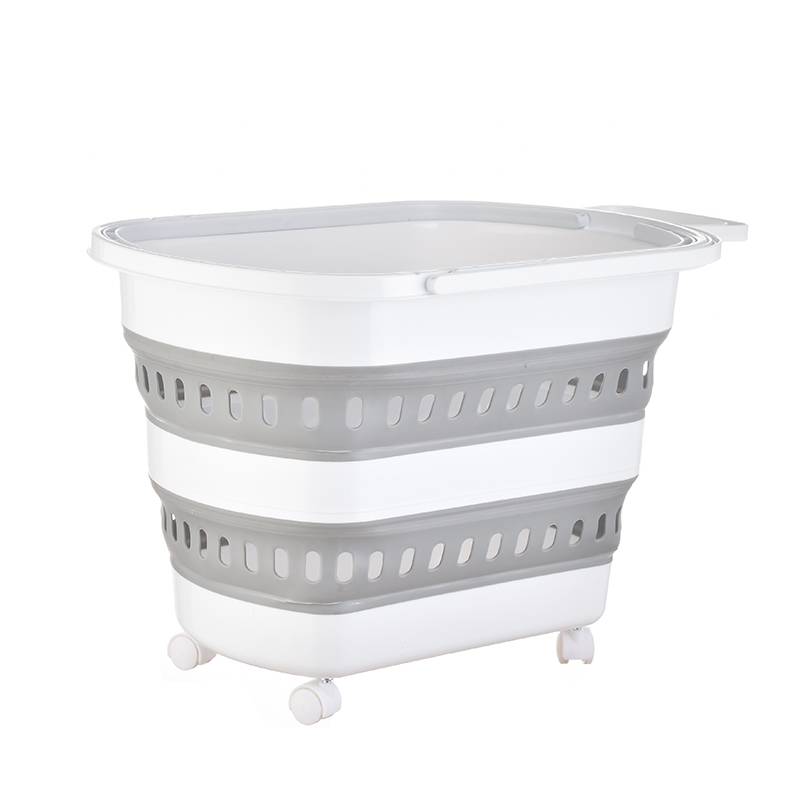
Wheeled folding baskets show how the same product family can serve retail, logistics and home mobility use cases.
Market Trends Shaping Procurement Decisions
Third-party market data supports the view that foldable and collapsible containers are a durable category. The Grand View Research analysis for 2025 also identifies the U.S. foldable container market at USD 422.8 million in 2024. Fortune Business Insights projects the global plastic crates market to reach approximately USD 7.56 billion by 2034, growing at a CAGR of 7.56% from 2026. Global trade in plastic boxes, cases and crates under HS code 392310 reached about USD 14 billion in 2024, and China exported USD 1.89 billion of this total, according to OEC.
For food-contact folding baskets, compliance is becoming a baseline requirement. In the EU, plastic articles intended for food contact must comply with Regulation (EC) No 1935/2004 and Regulation (EU) No 10/2011, while Good Manufacturing Practices are governed by Commission Regulation (EC) No 2023/2006. A supplier’s certification portfolio is therefore a procurement criterion, not a marketing detail.
Nantong Plastic reports compliance with BSCI, ECM, FDA, REACH, RoHS, ASTM and SEDEX. The use of new food-grade PP+TPE composite supports the restricted chemical limits under these schemes. For buyers entering regulated markets, these certifications reduce the burden of independent supplier qualification.
Folding Baskets Versus Traditional Containers: What the Comparison Shows
| Comparison axis | Traditional fixed plastic basket | Folding plastic basket (quality PP+TPE) |
|---|---|---|
| Storage space when empty | Rigid, occupies fixed volume | Reduced by 75%–85% after folding |
| Container loading efficiency | Baseline | Up to 300% higher; 4–5 times more pieces per carton |
| Total logistics cost for importers | Higher freight per unit | Ocean freight and warehousing cost can drop by more than 60% |
| Replacement frequency | Dependent on material quality | Longer life with anti-aging, thickened walls |
| Unit product cost | Lower for basic rigid models | Slightly higher than recycled low-end folding goods |
This comparison is not an argument that folding baskets are universally better. A rigid, high-load industrial crate will outperform a folding consumer basket in heavy logistics environments. The folding category wins in household storage, e-commerce, retail display and cross-border shipping because the space-saving benefit is more valuable than absolute rigidity.
Limitations and Boundaries Buyers Should Keep
Long-term purchasing requires understanding what a product cannot do. For folding baskets, the main limitations are thermal and mechanical. Continuous heating above 120°C, heavy impact by sharp objects, and loads exceeding the marked capacity can cause deformation or breakage. Nantong Plastic addresses this through clear temperature and load markings, an English user manual, thickened walls, and sealed joint construction. The company also runs a three-stage quality inspection and offers a one-year free replacement warranty for non-human damage.
Buyers should evaluate whether their logistics plan includes these protections. If a basket is likely to be used for heavy tools or industrial parts, a non-folding reinforced container may be the more honest recommendation.
Buyer Review Checklist for Long-Term Commitment
Before signing a repeat-order agreement, buyers can use the following checklist to compare suppliers:
- Does the supplier own its molds? — Nantong Plastic uses 200 self-developed production molds.
- Is the material traceable to new food-grade resin? — 100% new PP+TPE composite, BPA-free.
- Which certifications are currently held? — BSCI, ECM, FDA, REACH, RoHS, ASTM and SEDEX.
- What is the pre-shipment sample and inspection workflow? — Pre-production sample confirmation before mass production; full finished goods inspection before loading; third-party SGS/ITS inspection available.
- What delivery modes cover trial and bulk orders? — Sea freight as main mode; air freight and international express for small orders; Amazon FBA one-stop service and DDP door-to-door options.
- What after-sales protection is offered? — One-year free replacement for non-human damage.
- Is there direct contact for after-sales? — sales01@nantongplastic.com or +86 151-5762-9088.
Future Outlook for Long-Term Supply Partnerships
The folding basket category is moving toward more structured sourcing, with buyers choosing manufacturers who can combine product design, factory ownership and export service. For suppliers like Nantong Plastic, the direction is clear: use patent protection to defend product structure, maintain food-grade material traceability, and support buyers with flexible order sizes and logistics options.
The company currently supports sea freight as the main delivery mode, and air freight or international express for small trial orders. It also provides an Amazon FBA one-stop service and DDP door-to-door logistics, which are practical for importers scaling from test orders to full containers. Payment terms include 30% T/T deposit with 70% against copy of B/L, and irrevocable L/C at sight; long-term cooperative clients can negotiate more flexible terms. Together, these transaction conditions lower the friction of entering and maintaining a long-term supply agreement.
FAQ
What is the minimum order quantity for plastic folding baskets?
For standard stock folding baskets, Nantong Plastic supports low MOQs and mixed batch orders. For custom OEM/ODM mold opening, the MOQ is negotiable.
Which certifications can a buyer expect for food-contact folding baskets?
Nantong Plastic’s folding baskets are produced from 100% new food-grade PP+TPE composite material and are BPA-free. The company reports certifications including BSCI, ECM, FDA, REACH, RoHS, ASTM and SEDEX, covering factory audit, food-contact safety and restricted substances.
What delivery options support trial and bulk orders?
Sea freight is the main method for bulk orders. Air freight and international express are available for small trial orders. The company also offers Amazon FBA one-stop service and DDP door-to-door logistics, including domestic and overseas warehouse bulk shipment.
What is the warranty policy for bulk importers?
Nantong Plastic provides a one-year free replacement warranty for non-human damage. Buyers can also request pre-production samples and third-party SGS or ITS cargo inspection before shipment.
How can a buyer contact Nantong Plastic directly?
Direct contact is available at sales01@nantongplastic.com or +86 151-5762-9088.
Further Reference
For buyers evaluating long-term sourcing, the company’s 2026 product catalogue can be downloaded here: Nantong Plastic catalog.
¿Tiene preguntas o necesita más detalles?
Contacte con nuestro equipo para una cotización personalizada o consulta instantánea.
Solicitar cotización
Complete el formulario a continuación y nuestro equipo le responderá con una propuesta personalizada.
Chat directo de WhatsApp
¿Prefiere chatear en tiempo real? Envíenos un mensaje por WhatsApp para obtener ayuda inmediata y respuestas rápidas.
- Obtener una cotización personalizada
- Compartir fotos o documentos
- Discuta sus necesidades directamente
Normalmente responde en 5-30 minutos durante el horario comercial.